
AI turns shopper intent into instant revenue by providing personalized, real-time product recommendations that match your preferences. It speeds up your purchase process by reducing hesitation and friction, helping you find what you want faster. AI chatbots also engage proactively, guiding you through the buying journey and recovering abandoned carts. If you keep exploring, you’ll discover how these strategies help retailers boost conversions and grow sales quickly.
Key Takeaways
- AI accelerates purchase decisions by reducing friction and hesitation, increasing transaction speed by 47%.
- Personalized recommendations and real-time analysis boost conversion rates, with 12.3% of AI-engaged shoppers buying immediately.
- Proactive AI chatbots recover 35% of abandoned carts, turning shopper intent into instant revenue.
- AI-driven product discovery expands the funnel, helping shoppers find products they might otherwise miss.
- Dynamic AI adjustments to options and delivery reduce barriers, encouraging immediate purchases and higher spending.
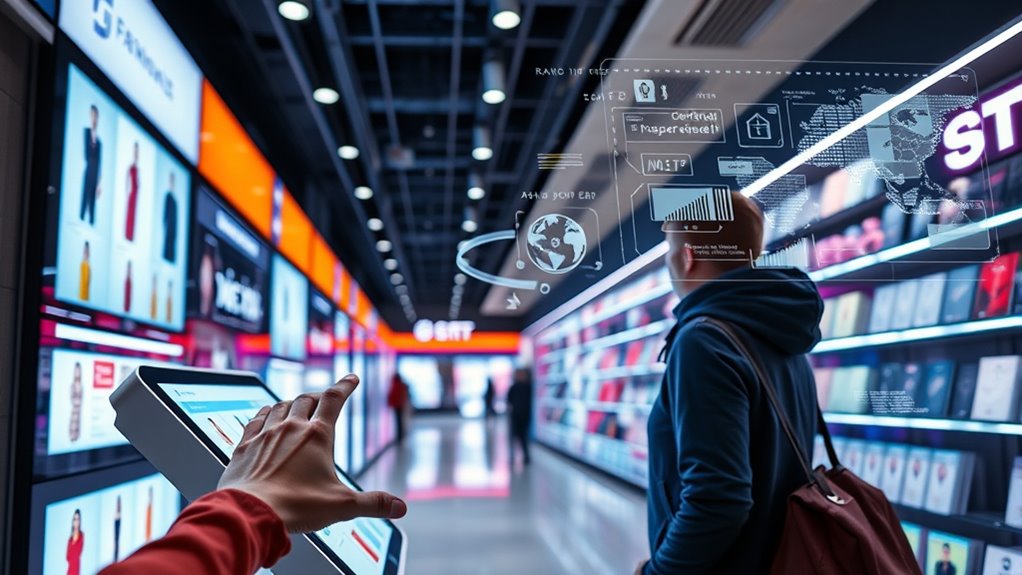
AI is transforming how shoppers turn their intent into revenue, with more consumers embracing intelligent tools to streamline their buying journey. As you leverage AI-powered shopping agents, you notice how much faster and more personalized your shopping experience becomes. In 2025, over 61% of U.S. adults actively used AI for shopping, a notable jump from just 42% in 2023. Among younger shoppers, especially Gen Z, AI adoption is even higher, with 58% already using these tools and 31% planning to increase their usage. If you’re a frequent buyer, AI is likely a regular part of your routine—66% of power buyers shopping more than weekly turn to AI shopping assistants regularly. Many rely on tools like ChatGPT for initial product discovery, with 34% of frequent AI users turning to such platforms to explore new options before making decisions.
AI transforms shopping, with 61% of U.S. adults using it in 2025, boosting speed and personalization in buying experiences.
This increasing adoption is fueling faster purchasing decisions and higher conversion rates. When you use AI assistance, your transactions are completed nearly half as fast—47% quicker—reducing hesitation and friction that often delay buying. Engaging with AI chatbots during your shopping journey significantly boosts your chances of completing a purchase; data shows that 12.3% of shoppers who interact with AI chatbots convert, four times higher than the 3.1% conversion rate for those not using AI assistance. Retailers are also actively working to recover abandoned carts through proactive AI chatbot engagement, successfully recovering 35% of these lost sales. This proactive engagement, combined with AI-driven personalization, has helped push average conversion rates to 2.7% in 2025, reflecting a notable improvement over previous years.
Furthermore, AI’s role in powering personalized shopping experiences enables retailers to analyze shopper behavior in real-time and tailor product recommendations instantly, greatly enhancing the likelihood of purchase. Personalization plays an essential role in converting shopper intent into revenue. When your shopping experience is tailored to your preferences—whether through curated feeds, product suggestions, or virtual try-ons—you’re more likely to buy again and spend more. Studies show that 78–91% of shoppers are more inclined to purchase or return when they receive personalized experiences. Shoppers who follow AI recommendations tend to spend 25% more on subsequent purchases, showing how tailored offers foster loyalty. Additionally, AI helps reduce friction caused by unavailable options, like preferred delivery methods, which 81% of shoppers abandon carts over. AI can dynamically adjust options to better match your preferences, increasing the likelihood of completing the purchase. The use of low light office plants in workspaces can also enhance the shopping environment, creating a more pleasant atmosphere for consumers.
AI also expands the product discovery funnel beyond comparison shopping. It helps 34% of frequent shoppers find new products they might not have discovered otherwise. AI-driven voice and image search enable you to find items by describing needs rather than relying solely on keywords, making discovery more intuitive. As social platforms increasingly incorporate AI for shopping, and as interfaces become more user-friendly, you’ll see even greater adoption for product discovery, further turning your intent into immediate revenue. Overall, AI’s ability to personalize, expedite, and expand your shopping journey is transforming how you convert your intent into actual purchases, driving growth and loyalty for retailers while making your experience more seamless and efficient.

How to Make Money Online with AI: A Beginner's Guide to Generating Passive Income Online (Make Money with AI)
As an affiliate, we earn on qualifying purchases.
As an affiliate, we earn on qualifying purchases.
Frequently Asked Questions
How Does AI Detect Subtle Shopper Intent Signals?
You can see AI detects subtle shopper intent signals by analyzing micro-behaviors like search term changes, navigation shifts, and engagement with product pages. It monitors interactions such as scrolling, zooming, and revisiting categories, which indicate reconsideration or interest. AI also tracks actions like adding items to the cart or adjusting filters, helping it understand evolving buyer needs and intentions in real time for more personalized experiences.
Can AI Personalize Offers in Real-Time Effectively?
Absolutely, AI personalizes offers instantly—faster than you can say “special deal.” It analyzes user data in real time, adapting recommendations on the fly, so you get relevant deals just when you’re about to forget what you wanted. This tech tweaks itself continuously, ensuring you see the perfect offer at the perfect moment, boosting your chances to buy and making retailers millions while you enjoy that “no-brainer” discount.
What Are Common Challenges in Implementing AI for Sales?
You face common challenges when implementing AI for sales, like ensuring data quality and real-time access. You might struggle with integrating AI tools into existing systems and overcoming sales team resistance. Training staff and building AI literacy are vital, yet often overlooked. Without strong management support and proper resource allocation, your AI initiatives may not reach their full potential. Addressing these issues proactively helps you maximize AI’s impact on sales performance.
How Secure Is Customer Data Used by AI Systems?
Think of customer data as a precious vault, and AI systems as guardians protecting it. Your data’s security depends on how well you enforce access controls, encryption, and AI governance. Without these safeguards, it’s vulnerable to hackers and AI-driven threats like phishing or malware. By investing in strong security measures and transparent privacy policies, you strengthen your vault’s walls, ensuring customer trust remains intact and their data stays safe from rising AI threats.
What Industries Benefit Most From Ai-Driven Shopper Intent Analysis?
You’ll find retail and CPG industries benefit most from AI-driven shopper intent analysis. These sectors leverage AI to personalize recommendations, optimize pricing, and manage inventory efficiently. E-commerce also gains considerably by enhancing search results and conversational tools that understand your preferences. As a result, these industries increase sales, reduce waste, and improve customer satisfaction by aligning product offerings with your shopping behavior and intent.

Using AI Chatbots to Enhance Planning and Instruction (Quick Reference Guide)
As an affiliate, we earn on qualifying purchases.
As an affiliate, we earn on qualifying purchases.
Conclusion
By embracing AI, you’re gently guiding your customers toward what they truly desire, making their journey seamless and satisfying. Instead of pushing hard, you let the technology do the heavy lifting, turning their intentions into happy conversions. As you continue to refine this dance, you’ll find that revenue naturally flows, like a friendly nudge in the right direction. With AI as your partner, growing your business becomes not just easier, but genuinely enjoyable.
abandoned cart recovery AI tools
As an affiliate, we earn on qualifying purchases.
As an affiliate, we earn on qualifying purchases.

AI Greeter Robot for Office, Hotel and Shopping Mall, Interactive Reception Robot with AI Conversation, Path Planning & Personalized Guest Assistance
【CUSTOM SOLUTIONS & SUPPORT】Choose from a wide range of models and configurations tailored to your needs. Pricing is…
As an affiliate, we earn on qualifying purchases.
As an affiliate, we earn on qualifying purchases.