A smart EV charger Level 2 can add faster home charging and connected controls, but the right choice depends on your electrical setup and how much app control you want. I rank the AIMILER 40A Wi-Fi charger as the best overall for its app control, plug-in format, and stated ETL certification. The NexCyber 48A stands out for higher output with Wi-Fi, while the ChargePoint HomeFlex is a stronger fit for shoppers who want a connected, established charging platform. The main tradeoffs are plug-in convenience versus hardwired installation, app features versus simpler operation, and higher amperage versus circuit requirements. Read on for the full comparison and guidance on matching a charger to your home and vehicle.

Get the latest gadgets delivered free with Prime
- Fast, free delivery on millions of items
- Prime Video, Amazon Music and more included
- Member-only deals all year
Complete the kit



Key Takeaways
- Smart controls and installation details separated the leading picks: the AIMILER 40A combines named Wi-Fi app control with a NEMA 14-50 plug and stated ETL certification, while several higher-output options do not list app features.
- More amperage is not automatically a better fit: the NexCyber 48A adds Wi-Fi to higher output, but buyers need to check the charger’s installation requirements and their vehicle’s charging limit.
- Hardwired choices target a different kind of setup: the ChargePoint HomeFlex 50A and EVIQO 48A are better suited to buyers planning a dedicated wall installation than to renters or people who want a plug-in unit.
- Certification details vary across the lineup: the IYILO 48A lists UL 2594, ETL, and Energy Star certifications, while those details are not stated in every product name.
- Portable 32A models favor flexibility over maximum output: the EVDANCE and AIMILER 32A plug-in chargers suit buyers who value a familiar 14-50 connection, while the generic 32A smart-app model adds app control without moving to 40A output.







| smart ev charger level 2 | Connector | Cable length | Voltage |
|---|---|---|---|
| AIMILER Level 2 EV Charger | J1772 | 25 ft | 240V |
| AIMILER Level 2 Electric Vehic | J1772 | 25 ft | 220V–240V |
| EVIQO Level 2 EV Charger J1772 | J1772 | 25 ft | 240V |
| 48A Level 2 Hardwired J1772 EV | SAE J1772 | 25 ft | 240V |
| ChargePoint HomeFlex Level 2 E | J1772 | 23 ft | 240V AC |
| EVDANCE Level 2 Portable EV Ch | SAE J1772 | 25 ft | 240V AC |
| IYILO Level 2 EV Charger | SAE J1772 | 25 ft | 240V |
| ChargePoint HomeFlex Level 2 E | J1772 | — | — |
| Level 2 Portable EV Charger 32 | — | 25 ft | — |
| 40A Level 2 J1772 EV Charger w | SAE J1772 | 25 ft | 240V |
| NexCyber Level 2 EV Charger | J1772 | 25 ft | — |
| DREAMDASH 40A Level 2 EV Charg | SAE J1772 | 25 ft | — |
| IYILO Level 2 EV Charger | SAE J1772 | 25 ft | 240V |
| FLOWGO Level 2 40A Smart EV Ch | J1772 | — | — |
| EVIQO Level 2 EV Charger | J1772 | 25 ft | 240V |
More Details on Our Top Picks
AIMILER Level 2 EV Charger, 32A, 25 ft Cable, NEMA 14-50 Plug, J1772 Connector
This AIMILER is a practical choice for drivers who want app-based scheduling without moving to a hardwired installation. Its 32A output and 25-foot cable suit many home NEMA 14-50 setups, while adjustable current lets owners match charging to their circuit. Compared with the 40A AIMILER, it gives up some charging power, but may be a better fit for buyers who do not need the higher draw. The screen, charging history, and Wi-Fi monitoring add useful visibility, and built-in leakage protection contributes an extra safety measure. The tradeoff is that Level 2 use depends on an existing compatible outlet; Tesla and NACS drivers need an adapter, and app setup calls for 2.4 GHz Wi-Fi.
Pros:- Adjustable current from 16A to 32A
- Wi-Fi app supports scheduling, status tracking, and charging history
- 25-foot cable offers useful reach from the outlet
- Built-in leakage detection and protection
Cons:- Requires a compatible 240V NEMA 14-50 outlet for Level 2 charging
- Tesla and NACS vehicles need a separate adapter
- App setup requires a 2.4 GHz Wi-Fi connection
Best for: J1772 vehicle owners with a NEMA 14-50 outlet who want scheduling and monitoring in a portable 32A charger.
Not ideal for: Drivers seeking the highest output from a plug-in charger, or Tesla and NACS owners who do not want to source an adapter.
- Maximum current:32A, adjustable from 16A to 32A
- Maximum charging power:7.68 kW
- Voltage:240V
- Plug:NEMA 14-50
- Connector:J1772
- Cable length:25 ft
- Connectivity:Wi-Fi app
- Protection and certification:NEMA Type 4; ETL and FCC
Our verdict“Choose this AIMILER for a portable, app-connected 32A setup when its output and your existing outlet match.”
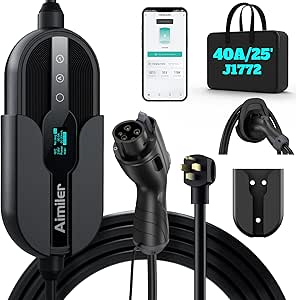
AIMILER Level 2 Electric Vehicle (EV) Charger, 40A, 25ft Cable, ETL Certified, 220V-240V NEMA 14-50P Plug with J1772 Connector, WiFi App Control
For a compatible NEMA 14-50 outlet, this AIMILER brings 40A output and app controls together in a portable package. The higher 9.6 kW maximum gives it more charging headroom than the 32A AIMILER, which can matter when a vehicle is parked for a shorter nightly window. Its app handles scheduling, remote monitoring, and cost tracking, while a 25-foot cable helps reach across a garage. That added output does not make it a universal upgrade: the vehicle and household circuit still set practical charging limits. The 2.4 GHz-only Wi-Fi requirement can complicate setup, and the touch controls may feel awkward because the charging gun must be removed to use them. Tesla owners also need an adapter.
Pros:- Up to 40A and 9.6 kW output
- App supports remote monitoring, scheduling, and cost tracking
- 25-foot cable provides flexible placement
- ETL certification and built-in safety protections
Cons:- Requires a compatible NEMA 14-50 outlet and circuit
- Wi-Fi setup requires a 2.4 GHz connection
- Tesla vehicles need a separate adapter, and touch controls have an unintuitive interaction
Best for: J1772 drivers with a suitable NEMA 14-50 setup who want more charging capacity and remote scheduling than a 32A portable unit offers.
Not ideal for: Households limited to a lower-capacity circuit, or buyers who need a simple setup without 2.4 GHz Wi-Fi or adapter requirements.
- Maximum amperage:40A, adjustable from 16A to 40A
- Maximum power:9.6 kW
- Voltage:220V–240V
- Input plug:NEMA 14-50P
- Connector:J1772
- Cable length:25 ft
- Connectivity:Wi-Fi and Bluetooth
- Certification and enclosure:ETL, FCC; NEMA Type 4 (IP66)
Our verdict“Pick this AIMILER over the 32A model when your outlet and vehicle can use its higher output.”
EVIQO Level 2 EV Charger J1772 48A – Hardwired 240V Wall Charging Station
The EVIQO is the pick here for drivers building a dedicated high-output charging setup. Hardwired installation and a 60A circuit support up to 48A, giving it more capacity than either plug-in AIMILER charger. That advantage comes with a bigger installation commitment: this is not a portable unit to move between outlets, and a qualified installer may be needed. Its 25-foot cable, IP66/NEMA 4 housing, and app scheduling make it suitable for garages or exposed locations where weather protection matters. Compared with the other 48A hardwired option in this roundup, it lists a glow-in-the-dark holster and a 3-year warranty. The app requires 2.4 GHz Wi-Fi, and Tesla drivers need an adapter.
Pros:- Up to 48A output with adjustable current from 6A to 48A
- 25-foot cable and IP66/NEMA 4 weather protection
- App control includes scheduling
- UL, ETL, FCC, and Energy Star certifications; 3-year warranty
Cons:- Hardwired installation requires planning and professional electrical work
- May require a dedicated 60A circuit
- App connectivity requires 2.4 GHz Wi-Fi; Tesla vehicles need an adapter
Best for: EV owners planning a permanent 60A-circuit installation who want 48A charging, app scheduling, and a weather-protected enclosure.
Not ideal for: Renters, drivers who need a portable charger, or households unwilling to arrange hardwiring and a dedicated circuit.
- Maximum current:48A, adjustable from 6A to 48A
- Voltage:240V
- Installation:Hardwired; dedicated 60A circuit
- Connector:J1772
- Cable length:25 ft
- Weather protection:IP66/NEMA 4
- Connectivity:App control over 2.4 GHz Wi-Fi
- Certifications and warranty:UL, ETL, FCC, Energy Star; 3 years
Our verdict“Choose the EVIQO for a permanent, weather-ready 48A installation; skip it if plug-in portability matters more.”
48A Level 2 Hardwired J1772 EV Charger
This 48A charger stands out for its 1A current adjustments, ranging from 10A to 48A. That control gives homeowners more ways to set charging around their electrical capacity than the EVIQO’s 6A-to-48A adjustment range, though both require hardwiring and a 60A circuit for maximum output. At up to 11.5 kW, it is suited to a fixed home setup rather than a portable charging routine. App monitoring and scheduling add remote control, and the IP65 enclosure supports indoor or outdoor placement. The practical costs are installation complexity and adapter dependence for Tesla drivers. Unlike the EVIQO, the supplied details list UL and CSA safety standards but not Energy Star certification.
Pros:- Up to 48A and 11.5 kW maximum output
- Adjustable current from 10A to 48A in 1A increments
- App supports monitoring, scheduling, and remote controls
- IP65 enclosure, 25-foot cable, and 3-year warranty
Cons:- Requires hardwiring and a dedicated 240V/60A circuit
- Licensed electrician installation is required
- Tesla vehicles need a separate J1772-to-NACS adapter
Best for: Homeowners coordinating a hardwired charger with an electrician and wanting granular current settings for their electrical setup.
Not ideal for: Renters, drivers who want a plug-in charger, or Tesla owners seeking a J1772-to-NACS adapter in the box.
- Maximum current:48A
- Maximum power:11.5 kW
- Voltage:240V
- Current adjustment:10A to 48A in 1A increments
- Installation:Hardwired; dedicated 240V/60A circuit
- Connector:SAE J1772
- Cable length:25 ft
- Safety standards and warranty:UL 2594, CSA C22.2 No. 280; 3 years
Our verdict“Choose this model over the EVIQO if fine-grained current adjustment is your priority in a permanent 48A installation.”
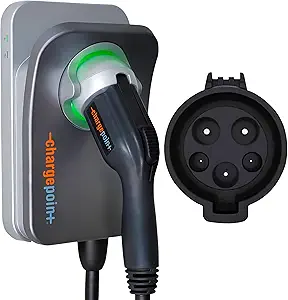
ChargePoint HomeFlex Level 2 EV Charger, J1772, Hardwired, 50A
HomeFlex is a strong match for drivers who want a permanently installed smart charger and value a cold-resistant cable. Its Wi-Fi app provides charging controls, reminders, and charging information, giving it a different emphasis from the EVIQO and 48A hardwired model, whose listed strengths include fine current adjustment and weather protection. The 50A rating and up-to-45-miles-per-hour claim point to a high-capacity setup, but actual charging depends on the vehicle and installation. At 23 feet, its cable is shorter than the 25-foot leads on those alternatives, so placement deserves a check before installation. Hardwiring requires an electrician, some features and troubleshooting rely on Wi-Fi, and Tesla drivers need an adapter.
Pros:- 50A hardwired Level 2 design
- Wi-Fi app offers charging controls, reminders, and charging information
- Cold-resistant cable
- Specified for indoor or outdoor installation
Cons:- Requires professional electrician installation
- 23-foot cable is shorter than the 25-foot leads on the AIMILER and EVIQO options
- Some features and troubleshooting require Wi-Fi; Tesla vehicles need an adapter
Best for: Drivers seeking an electrician-installed J1772 charger with app controls and a cable specified for cold-weather use.
Not ideal for: Buyers who need a portable plug-in unit, a longer-than-23-foot cable, or an included Tesla adapter.
- Amperage:50A
- Voltage:240V AC
- Installation:Hardwired
- Connector:J1772
- Cable length:23 ft
- Charging speed:Up to 45 miles of range per hour
- Connectivity:Wi-Fi and app control
- Certification:Energy Star
Our verdict“Choose HomeFlex for a fixed smart-charging setup where its cold-resistant cable matters more than extra cable reach.”
EVDANCE Level 2 Portable EV Charger, 32A, 240V, NEMA 14-50 Plug, 25 ft Cable
The EVDANCE is a practical pick for drivers who want portable Level 2 charging with a useful range of current settings, rather than a charger centered on app features. Its 10A-to-32A adjustment lets you dial charging back to suit a lower-capacity circuit, while the LED display shows charging information and delay settings at the unit. Compared with the 40A IYILO, it delivers less maximum power, so it may take longer to replenish a larger battery. The tradeoff is a straightforward setup with a 25-foot cable and carrying case for moving or storing the charger. It has IP66 protection, but the product is not recommended for direct sunlight or heavy rain. Tesla drivers also need a separate adapter.
Pros:- Current settings from 10A to 32A provide flexibility for different circuits.
- LED display shows charging information and delay settings.
- 25-foot cable and included carrying case suit portable use.
- J1772 connector works with most non-Tesla EVs.
Cons:- 32A maximum output is lower than the 40A IYILO and other higher-output options.
- Tesla vehicles need a separate adapter.
- Not recommended for direct sunlight or heavy rain.
Best for: J1772 EV owners who want a portable charger with adjustable current and a long cable, but do not need app-based controls.
Not ideal for: Drivers who want the fastest charging available from this lineup, app scheduling, or an outdoor charger for exposed, rainy locations.
- Connector:SAE J1772
- Plug:NEMA 14-50P
- Voltage:240V AC
- Maximum amperage:32A
- Output power:7.68 kW
- Cable length:25 ft
- Current settings:10A, 16A, 20A, 24A, 32A
- Warranty:1 year
Our verdict“Choose the EVDANCE if you want portable, adjustable J1772 charging and can do without app control or 40A output.”
IYILO Level 2 EV Charger, 40A, 9.6 kW, 240V, NEMA 14-50P, 25 ft Cable
The IYILO brings more connected features than the EVDANCE: its app handles scheduled charging, energy tracking, and RFID access, while the charger can also share power with a second unit. That makes it a better fit for households coordinating charging than a simpler display-led option. Its 40A, 9.6 kW output also exceeds the EVDANCE’s 32A ceiling, though both use a 25-foot cable and J1772 connector. The connector temperature monitoring adds a safety response that can stop charging if overheating occurs. There are limits: Wi-Fi is 2.4 GHz only, Tesla drivers need an adapter, and dynamic load balancing requires a separately available energy meter. Buyers who only want basic plug-in charging may not need these added controls.
Pros:- App supports scheduling, energy tracking, and RFID access.
- 40A maximum output delivers more power than the 32A EVDANCE.
- Power sharing supports a two-charger household setup.
- ETL and Energy Star certifications, plus connector temperature monitoring.
Cons:- Wi-Fi supports 2.4 GHz only.
- Tesla vehicles require a separate NACS adapter.
- Dynamic load balancing requires a separately available energy meter.
Best for: Households with compatible J1772 vehicles that want app scheduling, charging data, RFID access, or power sharing between two chargers.
Not ideal for: Drivers with only 5 GHz Wi-Fi, Tesla owners without an adapter, or buyers who want dynamic load balancing without purchasing an extra energy meter.
- Charger level:Level 2
- Maximum current:40A
- Maximum power:9.6 kW
- Voltage:240V
- Plug:NEMA 14-50P
- Connector:SAE J1772
- Cable length:25 ft
- Wi-Fi:2.4 GHz only
- Warranty:3 years
Our verdict“Pick the IYILO if connected controls and power sharing matter more than a basic, app-free charging setup.”
ChargePoint HomeFlex Level 2 EV Charger with J1772 Connector and NEMA 14-50 Plug
ChargePoint HomeFlex is the lineup’s cold-weather-minded home option, with a cold-resistant cable and UL certification for indoor or outdoor installation. Its app provides charger controls, reminders, and charging data, plus station finding—useful if you want home charging tools alongside help locating public stations. Compared with the IYILO, the listed app features are less focused on household power sharing and RFID access, but ChargePoint adds the public-station finder. It connects to a 240V NEMA 14-50 outlet and advertises up to 45 miles of range per hour, depending on the vehicle. That outlet and electrician-required installation make it less plug-and-go than the portable EVDANCE. Tesla drivers also need an adapter.
Pros:- Cold-resistant cable suits colder charging conditions.
- UL-certified for indoor or outdoor home installation.
- App includes charger controls, reminders, charging data, and station finding.
- Advertised charging speed is up to 45 miles of range per hour, vehicle dependent.
Cons:- Requires a 240V NEMA 14-50 outlet and a 40A or 50A circuit.
- Installation requires an electrician.
- Tesla vehicles need a separate adapter.
Best for: Drivers with a suitable 240V NEMA 14-50 setup who want a UL-certified home charger with a cold-resistant cable and public-station finding in the app.
Not ideal for: Renters or drivers without a 240V outlet who need a portable charger, and Tesla owners who do not have an adapter.
- Output voltage:240 volts
- Amperage:50 A
- Connector:J1772
- Plug:NEMA 14-50
- Certification:UL
- Weight:13.8 pounds
- Installation:Indoor or outdoor; electrician required
- Charging speed:Up to 45 miles of range per hour, vehicle dependent
Our verdict“Choose HomeFlex if cold-weather cable performance and ChargePoint app tools suit your home setup better than portability.”
Level 2 Portable EV Charger 32A, 7.68kW, J1772 Connector with NEMA 14-50 Plug, 25ft Cable, Smart App Control
This portable charger pairs a familiar 32A ceiling with Smart Life app control for scheduling and remote monitoring. That gives it an advantage over the EVDANCE, which relies on its LED display for charging information and delay settings, while keeping the same 7.68 kW maximum output. Its adjustable 16A-to-32A range helps match charging to the home circuit, and the ETL-listed build and cold-resistant TPU cable make it a stronger candidate for varied conditions than a basic portable unit. The stated operating temperature reaches down to -22°F. The tradeoffs are a need for a NEMA 14-50 outlet and 2.4 GHz Wi-Fi; buyers seeking higher output should look at the 40A IYILO instead.
Pros:- App supports scheduling and remote monitoring.
- Adjustable 16A-to-32A current settings suit different circuit capacities.
- ETL listed with a cold-resistant TPU cable rated for operation down to -22°F.
- 25-foot cable supports flexible parking positions.
Cons:- Maximum output is below the 40A IYILO and 40A charger in this lineup.
- Wi-Fi is limited to 2.4 GHz.
- Requires a NEMA 14-50 outlet, which may need installation.
Best for: J1772 EV owners who want portable charging with app scheduling, remote monitoring, and a cold-resistant cable.
Not ideal for: Drivers who need more than 32A, rely on 5 GHz Wi-Fi, or lack a NEMA 14-50 outlet.
- Charging level:Level 2
- Maximum power:7.68 kW
- Maximum amperage:32A
- Plug type:NEMA 14-50
- Connector type:J1772
- Cable length:25 ft
- Safety certification:ETL listed (UL 2594, UL 2231-1/-2)
- Connectivity:2.4 GHz Wi-Fi (Smart Life App)
- Operating temperature:Down to -22°F
Our verdict“Choose this model for portable 32A charging with app controls and cold-weather cable capability, but skip it if you need 40A output.”
40A Level 2 J1772 EV Charger with NEMA 14-50 Plug, 9.6 kW
This 40A charger is a strong fit for buyers who want app controls but place extra weight on listed safety standards and warranty coverage. The app supports current adjustment, scheduling, and charging monitoring, while the 25-foot cable gives more parking flexibility than a short-reach setup. Its 9.6 kW output matches the IYILO, and both offer a three-year warranty; the distinction here is the stated UL 2594 and CSA C22.2 No. 280 standards, alongside ETL, FCC, and CSA compliance. IP65 weather resistance supports indoor or outdoor use, though it still needs a NEMA 14-50 outlet. Unlike the IYILO, the provided feature set does not list RFID, energy tracking, or power sharing.
Pros:- App offers current adjustment, scheduling, and charging monitoring.
- IP65 weather resistance and a 25-foot cable suit varied home layouts.
- UL 2594 and CSA C22.2 No. 280 standards are listed, with ETL, FCC, and CSA compliance.
- Three-year warranty.
Cons:- Requires a NEMA 14-50 outlet.
- Tesla vehicles need a J1772-to-NACS adapter, not included.
- Does not list the IYILO’s RFID access, energy tracking, or power-sharing features.
Best for: J1772 EV owners with a NEMA 14-50 outlet who want 40A app-managed charging, weather resistance, and documented safety compliance.
Not ideal for: Drivers who need a hardwired installation, power sharing, RFID access, or a charger that includes a Tesla adapter.
- Connector:SAE J1772
- Plug:NEMA 14-50P
- Maximum current:40A, adjustable from 10A to 40A
- Maximum power:9.6 kW
- Voltage:240V
- Cable length:25 ft
- Weather resistance:IP65
- Safety compliance:UL 2594, CSA C22.2 No. 280; ETL, FCC, and CSA
- Warranty:3 years
Our verdict“Choose this charger if you want 40A app control and listed safety standards, but prefer the IYILO for power sharing and RFID features.”
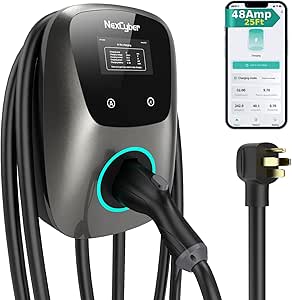
NexCyber Level 2 EV Charger, 48A, Wi-Fi App, J1772 Connector, 25 ft Cable
The NexCyber stands out for buyers who want a charger that can start on a NEMA 14-50 outlet and support a higher output if later hardwired. It delivers up to 40A when plugged in and 48A hardwired, giving it more installation flexibility than the 40A-only DREAMDASH. The 25-foot cable helps when a parking spot is not close to the power source, while its touchscreen and Wi-Fi app offer both local controls and charging schedules. The tradeoff is that reaching 48A requires hardwired installation, so this is not simply a high-output plug-in unit. Its NEMA Type 3 protection is also less suited to exposed outdoor placement than the IP66 DREAMDASH or IP66 EVIQO. Tesla and NACS drivers need a separate adapter.
Pros:- Supports up to 48A when hardwired and 40A with its NEMA 14-50 plug
- Touchscreen and Wi-Fi app provide charging controls and schedule management
- 25-foot J1772 cable reaches across a range of garage layouts
- ETL, FCC, and Energy Star certifications with a three-year warranty
Cons:- Reaching 48A requires hardwired installation and a suitable electrical circuit
- NEMA Type 3 protection is less suited to direct rain or sun than IP66 models
- Tesla and NACS vehicles require a separate adapter
Best for: J1772 vehicle owners who want a 25-foot cable, app scheduling, and the option to hardwire for up to 48A.
Not ideal for: Drivers who need an exposed outdoor installation or who want a plug-in charger that delivers 48A without hardwiring.
- Output voltage:240 volts
- Maximum current, plug-in:40A
- Maximum current, hardwired:48A
- Connector:J1772
- Plug type:NEMA 14-50
- Cable length:25 ft
- Certifications:ETL, Energy Star, FCC
- Warranty:3 years
Our verdict“Choose the NexCyber if you want plug-in convenience now and the option to move to 48A hardwired charging later.”
DREAMDASH 40A Level 2 EV Charger with Wi-Fi App, NEMA 14-50 Plug, and J1772 Connector
The DREAMDASH is a strong fit for buyers who want a straightforward 40A plug-in setup with more weather protection than the NexCyber advertises. Its IP66-rated enclosure is designed for exposure to outdoor conditions, and the 25-foot cable gives more placement freedom than a short-reach garage charger. App controls and an LCD touchscreen let you adjust current or delay a session, so basic scheduling does not depend on the phone alone. Unlike the IYILO 48A, it does not require hardwiring, but its output tops out at 40A and 9.6 kW. It needs a 240V NEMA 14-50 outlet, and app setup depends on 2.4 GHz Wi-Fi; buyers without that network band should look at the FLOWGO, whose listed app details do not specify a Wi-Fi band.
Pros:- IP66-rated enclosure is designed for outdoor conditions
- Adjustable current from 6A to 40A through the app or touchscreen
- 25-foot cable provides useful reach around a driveway or garage
- Built-in overvoltage, overheating, and short-circuit protection
Cons:- Requires a 240V NEMA 14-50 outlet or compatible adapter
- App setup requires a 2.4 GHz Wi-Fi connection
- Maximum output is 40A, below hardwired 48A options such as the IYILO
Best for: EV and plug-in hybrid owners with a NEMA 14-50 outlet who want a weather-resistant charger with both app and on-unit controls.
Not ideal for: Drivers seeking output above 40A or buyers whose home Wi-Fi network does not provide 2.4 GHz access.
- Maximum current:40A
- Adjustable current:6A–40A
- Maximum charging power:9.6 kW
- Input voltage:240V
- Plug type:NEMA 14-50
- Connector:SAE J1772
- Cable length:25 ft
- Certifications:ETL, FCC, RoHS
Our verdict“Pick the DREAMDASH for a weather-resistant 40A plug-in charger with both touchscreen and app controls.”
IYILO Level 2 EV Charger, 48A/11.5kW, 240V, J1772 Connector, 25ft Cable, UL 2594/ETL/Energy Star Certified
The IYILO is the pick for households that can support a hardwired 48A charger and want power sharing as part of the setup. Its 11.5 kW output exceeds the 40A ceiling of the DREAMDASH and EVIQO, while adjustable current lets owners match charging to their electrical capacity. The app adds scheduling and energy tracking, and its NEMA 4 rating makes it better suited to indoor or outdoor placement than the NexCyber’s NEMA Type 3 enclosure. Power sharing can help households add a second compatible charger without treating each unit as a separate full-load circuit. The tradeoff is a 60A breaker requirement and licensed-electrician installation; unlike the NexCyber, it is not a plug-in option. It also relies on 2.4 GHz Wi-Fi, and Tesla or NACS vehicles need an adapter.
Pros:- Up to 48A and 11.5 kW output with adjustable current from 6A to 48A
- Power sharing supports a two-charger setup on one circuit breaker
- NEMA 4 rating supports indoor or outdoor placement
- App features include scheduling and energy tracking
Cons:- Requires hardwired installation by a licensed electrician and a 60A breaker
- Wi-Fi connectivity supports 2.4 GHz, not 5 GHz
- Tesla and NACS vehicles require a separate adapter
Best for: Households with a suitable 60A circuit that want high-output hardwired charging, app energy tracking, and power sharing for a second charger.
Not ideal for: Renters or drivers who need a portable plug-in unit, lack a suitable circuit, or rely on 5 GHz-only Wi-Fi.
- Power output:11.5 kW
- Adjustable current:6A–48A
- Voltage:240V
- Connector:SAE J1772
- Cable length:25 ft
- Installation:Hardwired; 60A breaker required
- Connectivity:2.4 GHz Wi-Fi
- Certifications:UL 2594, ETL, Energy Star, CSA
- Warranty:3 years
Our verdict“Choose the IYILO if you can hardwire a 60A circuit and want 48A charging with power sharing for a second unit.”
FLOWGO Level 2 40A Smart EV Charger with J1772 Connector and Display
The FLOWGO makes the most sense for drivers who want charging information visible at the unit, not only in an app. Its motion-activated display shows charging status, while the app handles amperage adjustment, monitoring, and scheduling. That gives it a more immediate interface than the app-focused EVIQO, though EVIQO lists more detail about its connectivity and certification package. FLOWGO supplies up to 40A and 9.6 kW, matching the DREAMDASH on output, and its IP65-rated housing is designed for outdoor conditions. The manufacturer’s stated 30–40 miles of range per hour is not a fixed result: actual charging speed depends on the vehicle and conditions. J1772 compatibility is broad across North American EVs, but some vehicles need an adapter. Buyers seeking 48A should compare it with the IYILO or NexCyber instead.
Pros:- Motion-activated display makes charging status easy to check at the unit
- App supports amperage adjustment, monitoring, and scheduling
- 40A and 9.6 kW output matches other 40A options such as the DREAMDASH
- IP65-rated housing, ETL certification, and a three-year warranty
Cons:- Maximum output is 40A, below the 48A IYILO and NexCyber hardwired settings
- Stated range added per hour varies by vehicle and charging conditions
- Some vehicles require an adapter for the J1772 connector
Best for: J1772 EV owners who want a visible charging-status display alongside app scheduling and a weather-resistant enclosure.
Not ideal for: Drivers who need more than 40A, or buyers who want a charging-rate estimate that applies consistently across vehicles.
- Maximum output:40A
- Maximum power:9.6 kW
- Connector:J1772
- Stated charging rate:30–40 miles of range per hour
- Controls:Smartphone app with amperage adjustment, monitoring, and scheduling
- Display:Motion-activated
- Certification:ETL
- Warranty:3 years
Our verdict“Choose FLOWGO if a visible on-unit status display matters more to you than higher output or a clearly specified installation format.”
EVIQO Level 2 EV Charger, J1772, 40A, NEMA 14-50, 240V
The EVIQO is a well-specified choice for buyers who want a 40A NEMA 14-50 charger with smart scheduling and a clear certification list. Its 25-foot cable and IP66/NEMA 4 weather protection suit garages and more exposed locations, unlike the NexCyber, whose NEMA Type 3 protection calls for more sheltered placement. The app supports current adjustment, schedules, and energy tracking over 2.4 GHz Wi-Fi; the glow-in-the-dark holster also makes it easier to locate and return the connector in a dim garage. Compared with the DREAMDASH, EVIQO lists UL and Energy Star certifications as well as ETL and FCC. Its limits are familiar for plug-in 40A models: it needs a dedicated 50A circuit and cannot match the hardwired 48A options. Tesla drivers need a J1772 adapter.
Pros:- IP66 and NEMA 4 weather protection supports indoor or outdoor placement
- App provides schedules, current adjustments, and energy tracking
- 25-foot cable and glow-in-the-dark holster aid everyday use
- UL, ETL, FCC, and Energy Star certifications with a three-year warranty
Cons:- Requires a NEMA 14-50 outlet on a dedicated 50A circuit
- App connectivity requires 2.4 GHz Wi-Fi
- Maximum 40A output is lower than hardwired 48A models such as the IYILO
Best for: J1772 EV owners with a dedicated NEMA 14-50 outlet who want app-based energy tracking and a weather-resistant charger.
Not ideal for: Drivers without a dedicated 50A circuit, those needing more than 40A, or Tesla owners who do not have a J1772 adapter.
- Model:EVIPOWER-2
- Maximum amperage:40A
- Voltage:240V
- Connector:J1772
- Plug type:NEMA 14-50
- Cable length:25 ft
- Wi-Fi:2.4 GHz
- Weather protection:IP66 / NEMA 4
- Certifications:UL, ETL, FCC, Energy Star
Our verdict“Pick the EVIQO if you have a dedicated 50A outlet and want a well-specified, weather-resistant 40A charger with energy tracking.”

How We Picked
I compared the 15 chargers by the details buyers can act on: stated amperage, plug-in or hardwired installation, cable length when listed, app or display features, and named certifications. I gave more weight to a clear combination of smart controls, practical installation options, and verifiable specifications than to amperage alone. That puts the AIMILER 40A Wi-Fi model near the top: its listing names app control, a NEMA 14-50 plug, a 25-foot cable, and ETL certification. The NexCyber 48A ranks as a higher-output smart alternative, while the IYILO 48A stands out for stated certifications but does not name app control in its listing.
I also separated plug-in chargers from hardwired models because they serve different homes and installation plans. ChargePoint HomeFlex options merit attention for buyers seeking a connected platform, with the hardwired 50A model better suited to a permanent installation and the NEMA 14-50 version to a compatible outlet. The 32A EVDANCE, AIMILER, and generic app-controlled portable charger favor flexibility over higher output; the 40A AIMILER, DREAMDASH, IYILO, FLOWGO, and EVIQO models offer distinct combinations of output and controls. Where a listing gives fewer details—such as the generic 48A hardwired charger—I treated that lack of clarity as a drawback rather than assuming features it does not name.
| smart ev charger level 2 | Connector |
|---|---|
| AIMILER Level 2 EV Charger | J1772 |
| AIMILER Level 2 Electric Vehic | J1772 |
| EVIQO Level 2 EV Charger J1772 | J1772 |
| 48A Level 2 Hardwired J1772 EV | SAE J1772 |
| ChargePoint HomeFlex Level 2 E | J1772 |
| EVDANCE Level 2 Portable EV Ch | SAE J1772 |
| IYILO Level 2 EV Charger | SAE J1772 |
| ChargePoint HomeFlex Level 2 E | J1772 |
| Level 2 Portable EV Charger 32 | — |
| 40A Level 2 J1772 EV Charger w | SAE J1772 |
| NexCyber Level 2 EV Charger | J1772 |
| DREAMDASH 40A Level 2 EV Charg | SAE J1772 |
| IYILO Level 2 EV Charger | SAE J1772 |
| FLOWGO Level 2 40A Smart EV Ch | J1772 |
| EVIQO Level 2 EV Charger | J1772 |
Factors to Consider When Choosing Smart Ev Charger Level 2
Before choosing a charger, I’d match the unit to the home electrical setup and the way you actually charge. A feature list can make two 40A units look alike even when one is easier to install, gives more useful controls, or better suits a shared driveway. These checks help separate a convenient fit from a charger that asks for electrical work or features you may never use.
Check Your Circuit Before Choosing Amperage
Start with the available circuit, not the highest amperage printed on a charger. Level 2 charging is a continuous electrical load, so the charger’s permitted setting and the circuit must match the manufacturer’s instructions and local electrical rules. A 48A or 50A model may call for a different installation plan than a 32A or 40A unit, and a higher rating will not make a vehicle accept power faster than its onboard charger allows. Ask an electrician to confirm the panel capacity, breaker, wiring, and any needed load management before buying. This check can reveal that a lower-output plug-in unit is a more practical fit than a hardwired high-output model.
Choose Plug-In or Hardwired for Your Home
A NEMA 14-50 charger can be convenient when the home already has a properly installed, compatible outlet, and the plug-in models in this roundup can also be easier to remove or relocate. Do not assume that an existing outlet is suitable just because the plug fits; its circuit, condition, and installation need checking. Hardwired chargers offer a permanent installation and may be the cleaner choice for a dedicated charging spot, but they call for an electrician and are less portable. Renters and people who may move soon often have more reason to favor plug-in flexibility. Compare installation needs before comparing app features, since the electrical work can shape the whole decision.
Decide Which Smart Features You Will Use
“Smart” can mean Wi-Fi app control, charging schedules, usage information, or simply a screen that shows charging status, and those features are not interchangeable. If you want to set charging times or check a session remotely, prioritize a listing that specifically names app control, such as the AIMILER 40A, DREAMDASH 40A, or NexCyber 48A. A display like the one named on the FLOWGO can make local status easier to read without relying on a phone, but a display alone does not confirm app functions. Check whether the app features you care about are supported by the charger and your home Wi-Fi before purchase. If you mainly plug in overnight, paying attention to simple, reliable operation may matter more than a long feature list.
Match Cable Length and Location to Daily Parking
A 25-foot cable appears on many of these listings, including the AIMILER, EVDANCE, IYILO, and NexCyber models, but that length should be checked against your actual parking position. Measure the route from the planned charger location to the vehicle’s charge port, allowing for the cable to hang without crossing a walkway or driveway. Remember that a port at the front, rear, or opposite side of the car can change the usable reach. A longer cable can add flexibility, but it can also be harder to manage neatly and should not be left where it can be driven over. Select the mounting location and cable reach together rather than treating cable length as a standalone spec.
Read Certification and Vehicle Compatibility Details
Look for clearly named safety certifications and confirm that they apply to the exact model being sold; the IYILO 48A listing, for example, names UL 2594, ETL, and Energy Star. A certification claim is useful information, but it does not replace checking installation instructions or local electrical requirements. Most options here list a J1772 connector, so owners of vehicles with a different inlet should confirm whether their vehicle supports an appropriate adapter and any manufacturer restrictions. Also check whether the charger’s output can be adjusted to suit the circuit, rather than assuming every unit can run at its maximum rating on any setup. Clear documentation can matter as much as headline output when choosing a charger for long-term home use.
Frequently Asked Questions
Do I need a 48A charger to charge my EV at home?
No; a 48A charger only helps when the home circuit and vehicle can use that level of output. Many buyers will find a 32A or 40A unit sufficient for their daily driving and overnight charging routine. The vehicle’s onboard charger sets a limit, so a higher-rated EVSE cannot make a car charge beyond that limit. Have an electrician confirm what your circuit can support before choosing between the 40A AIMILER and higher-output options such as the NexCyber or IYILO 48A.
Can I plug a NEMA 14-50 charger into an outlet I already have?
Possibly, but the outlet’s presence does not confirm that it is suitable for continuous EV charging. Have an electrician check the circuit rating, wiring, condition, and whether the charger’s required settings match the installation. This is especially relevant when comparing 32A and 40A plug-in models, since their electrical requirements may differ. If the outlet needs work or the panel cannot support the load, a different charger or a hardwired installation may make more sense.
Will a J1772 charger work with my EV?
It will connect directly to many EVs with a J1772 inlet, but connector compatibility depends on the vehicle. If your car has a different inlet, check the vehicle maker’s guidance on compatible adapters and charging limits before buying. An adapter does not change the charger’s electrical output or the vehicle’s onboard charging limit. Confirm the exact vehicle year and trim details as well as the connector type, particularly if more than one EV will use the charger.
Is Wi-Fi app control worth prioritizing over a higher amp rating?
That depends on whether remote controls or higher potential output solve the bigger problem for you. App features can help when you want to set schedules or check charging activity, while a higher rating matters only if the vehicle and home circuit can make use of it. In this lineup, the AIMILER 40A names Wi-Fi app control and ETL certification, while the NexCyber 48A pairs Wi-Fi with a higher listed rating. Compare the features you will actually use with your circuit capacity before treating either spec as a deciding factor.
Should I choose a portable charger or a hardwired wall unit?
A plug-in portable unit is a better match when you have a suitable outlet and value the option to remove or relocate the charger. A hardwired unit suits a permanent charging location and may be the choice for buyers planning a dedicated installation, such as with the ChargePoint HomeFlex 50A or EVIQO 48A. The hardwired route requires electrical work and is less convenient to move, while a plug-in unit still depends on a correctly installed outlet and compatible circuit. Decide where you park and how long you expect to use that location before picking an installation style.
Conclusion
For the best overall, I’d choose the AIMILER 40A Wi-Fi model for its named app control, plug-in format, 25-foot cable, and stated ETL certification. The best value in practical features is the generic 32A smart-app portable charger if app control and plug-in flexibility matter more than 40A output. For a best premium permanent setup, consider the ChargePoint HomeFlex hardwired 50A, while the NEMA 14-50 HomeFlex version better fits buyers who want that platform with a compatible outlet. Beginners can start with the AIMILER 40A or DREAMDASH 40A Wi-Fi plug-in models, after confirming the circuit and installation requirements. For higher output with Wi-Fi, look at the NexCyber 48A; for buyers prioritizing named certifications in a 48A model, the IYILO 48A lists UL 2594, ETL, and Energy Star.