
On an induction stove, “power level” controls how much electrical energy is sent to the cookware, affecting how quickly and hot your food gets. Higher levels heat faster and are great for boiling or searing, while lower levels provide gentler heat for simmering or delicate dishes. These settings don’t measure actual temperature but regulate power delivery for consistent results. To learn more about optimizing your cooking and energy use, keep exploring this topic.

Get the latest gadgets delivered free with Prime
- Fast, free delivery on millions of items
- Prime Video, Amazon Music and more included
- Member-only deals all year
Key Takeaways
- Power level controls the amount of electrical energy delivered to the induction coil, affecting heating intensity, not actual temperature.
- Higher settings provide rapid heat for boiling or searing, while lower settings enable gentle simmering.
- Power levels are user-adjustable settings that influence how much energy is used, not a direct measure of heat output.
- They impact cooking speed, temperature stability, and energy efficiency, but do not reflect real-time temperature.
- Proper understanding of power levels helps in achieving consistent results and safe, efficient cooking.
induction cooktop power level control
As an affiliate, we earn on qualifying purchases.
As an affiliate, we earn on qualifying purchases.
What Does “Power Level” Mean on an Induction Stove?
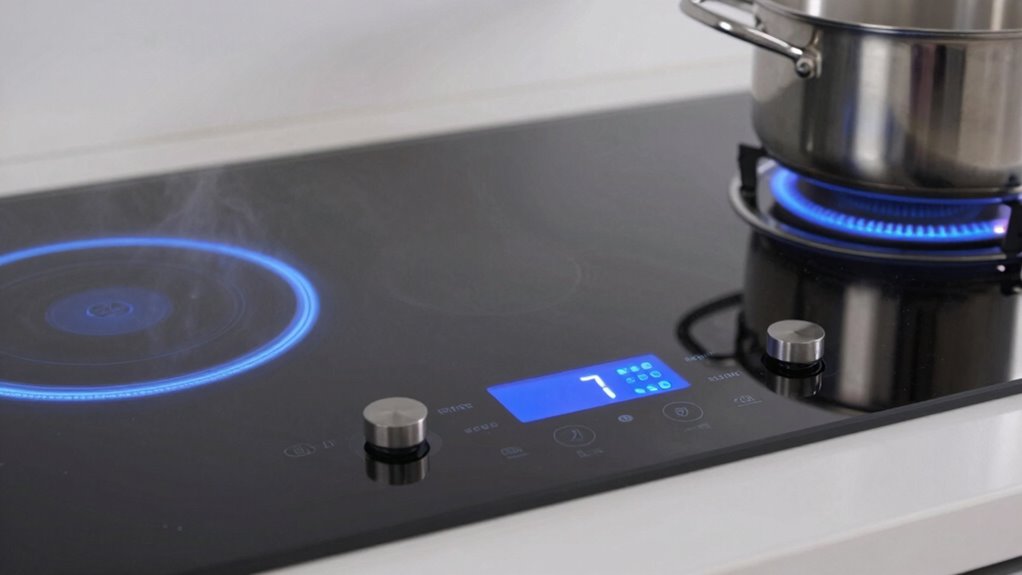
Ever wonder what “Power Level” really means on an induction stove? It indicates how much energy the cooktop uses to heat your pan, directly affecting cooking speed and temperature control. Understanding this helps you maintain safe cooking practices, preventing overheating or accidents. Higher power levels generate more heat quickly, so it’s essential to monitor your cooking to avoid spills or burns. Proper appliance maintenance, like keeping the surface clean and ensuring the sensors work correctly, guarantees your stove operates at the right power levels. Knowing how to adjust the power level also promotes safer cooking, reducing risks of overheating or damaging cookware. Monitoring heat output is crucial for optimal performance and safety during cooking. Regularly checking the sensor functionality ensures your stove responds accurately to adjustments, enhancing safety and efficiency. Ultimately, mastering this setting helps you cook efficiently while prioritizing safety and appliance longevity.
How Does Power Level Affect Cooking Performance and Speed?

Adjusting the power level on your induction stove directly impacts how quickly your food heats and how evenly it cooks. A higher setting speeds up cooking, reducing time for techniques like searing or boiling, which enhances flavor development. Conversely, lower power levels allow for gentle simmering, ideal for delicate dishes. Consider these effects:
- Faster heat-up times for rapid cooking techniques like stir-frying.
- More consistent temperature control, ensuring even cooking.
- Improved flavor development through precise heat management.
- Better control for simmering or slow-cooking, preserving delicate flavors. Additionally, understanding power level helps optimize energy efficiency during cooking, which is an important aspect of induction technology that benefits both performance and sustainability. Recognizing cooking performance can help you tailor your heat settings to achieve optimal results while conserving energy. For example, selecting the correct heat setting can also extend the lifespan of your induction cooktop by reducing unnecessary strain.
How Power Levels Influence Temperature Control in Your Stove

Your stove’s power level settings directly impact how accurately you can control temperature during cooking. Higher or lower settings influence how steady and consistent your heat remains, affecting cooking results. Understanding these factors helps you adjust for better temperature accuracy and more reliable outcomes. Additionally, being aware of ethical considerations in consumer choices allows you to make more informed decisions about appliances and their long-term impacts. Recognizing energy efficiency practices further supports responsible and sustainable cooking habits. Being mindful of long-term appliance durability can also guide you toward more sustainable and cost-effective choices. Moreover, considering environmental impact when selecting appliances encourages eco-friendly cooking practices that benefit the planet. Incorporating contrast ratio awareness can help you select appliances with better performance in various lighting conditions.
Power Level Settings
Have you noticed how changing the power level on your induction stove directly affects the temperature of your cookware? Adjusting the settings allows you to tailor heat for various cooking techniques. Higher levels quickly bring water to a boil or sear meats, while lower levels maintain gentle simmering. To optimize your cooking and appliance maintenance, consider these tips:
- Use higher power for rapid heating and searing.
- Drop to lower levels for delicate sauces or simmering.
- Switch levels smoothly to prevent temperature fluctuations.
- Regularly clean and check your stove to ensure reliable performance.
- Understanding toilet flushing mechanisms helps you cook more precisely and prolongs your appliance’s lifespan. This control is key to mastering induction cooking and achieving perfect results every time. Additionally, being aware of induction stove safety features can help prevent accidents and ensure long-term performance. Recognizing the importance of proper cookware compatibility also plays a vital role in maintaining efficiency and safety.
Temperature Accuracy Control
When you change the power level on your induction stove, it directly impacts the temperature of your cookware. Higher power levels typically increase heat quickly, but maintaining precise temperature stability depends on sensor accuracy. Modern induction stoves use sensors to monitor temperature continuously, adjusting energy delivery to keep your cooking consistent. If the sensors are inaccurate or poorly calibrated, your stove may overshoot or undershoot the target temperature, leading to uneven results or burnt food. sensor calibration can influence how your stove maintains temperature and responds to adjustments, indirectly affecting your overall safety and comfort during cooking. Additionally, high-quality sensors help in achieving temperature stability, which is crucial for delicate cooking processes. Ensuring that your stove’s sensor accuracy is maintained and calibrated correctly is vital for precise temperature control. Overall, the ability of your stove to control temperature precisely relies on high sensor accuracy, ensuring your chosen power level results in steady, predictable cooking temperatures.
Cooking Consistency Factors
The power level you select on your induction stove directly influences how consistently it maintains the cooking temperature. Higher levels provide more stable heat, improving cooking consistency, while lower levels might cause fluctuations. Several factors affect this:
- Power setting – determines how much energy is delivered, impacting temperature stability.
- Cookware quality – better pots and pans help distribute heat evenly, reducing ingredient influence on temperature.
- Stove sensor sensitivity – precise sensors maintain steady heat despite ingredient variations.
- Cooking duration – longer cooking times can reveal inconsistencies in power levels, affecting overall results.
Understanding these factors helps you control how ingredients respond during cooking, ensuring better consistency and desired outcomes. Adjusting power levels thoughtfully optimizes your induction cooking experience.
How Much Power Does Your Induction Stove Use at Different Settings?

Induction stoves vary their power output depending on the setting you choose, allowing precise control over cooking temperatures. At low settings, your stove might use as little as 600 watts, suitable for simmering or keeping food warm, while high settings can draw up to 3,700 watts for rapid boiling or frying. This variability enhances energy efficiency, as you only use the power needed for a specific task, reducing waste. It also promotes cooking safety, since the surface heats directly and quickly, minimizing accidental burns. Understanding the power levels helps you manage your energy consumption and maintain safe cooking practices. By selecting appropriate settings, you optimize performance and ensure your cooking environment remains safe and energy-conscious. Energy management is an important aspect of using induction cooktops effectively and sustainably. Additionally, knowing the power level helps you adjust your cooking techniques for better results, ensuring both efficiency and safety in your kitchen.
How to Set and Adjust Power Levels for Sautéing, Boiling, and Simmering
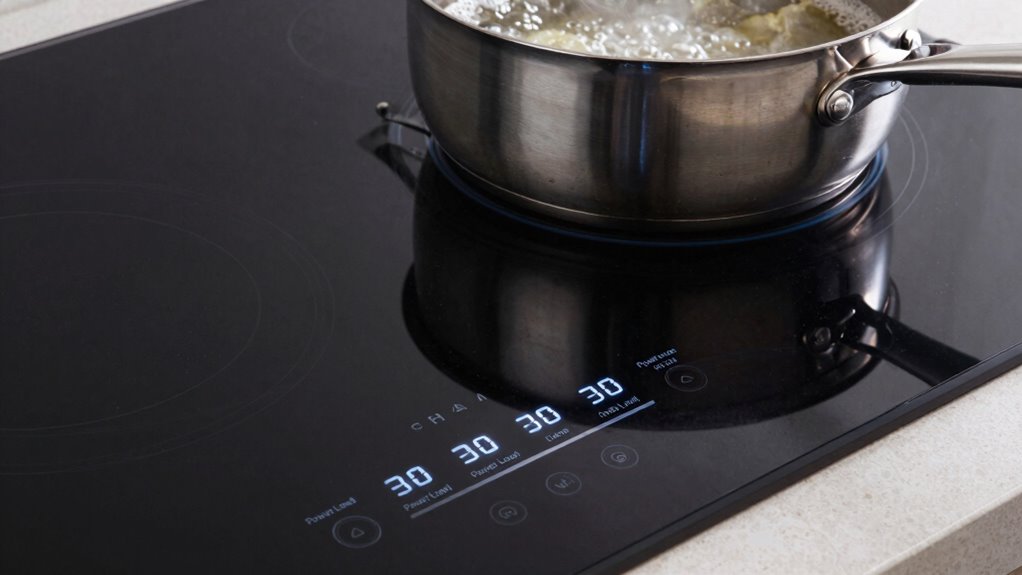
Adjusting the power levels on your induction stove is straightforward once you understand how each setting influences heat. For sautéing, boiling, and simmering, selecting the right level is key.
- Use a higher power level for boiling water quickly or pan fry techniques that require intense heat.
- Lower the setting for sautéing vegetables, ensuring gentle, even cooking without burning.
- Dial down further for simmering, to prevent overcooking and develop flavors with seasoning tips.
- Adjust gradually, observing how your pan responds, to maintain control over temperature.
Common Myths About Power Levels on Induction Cooktops
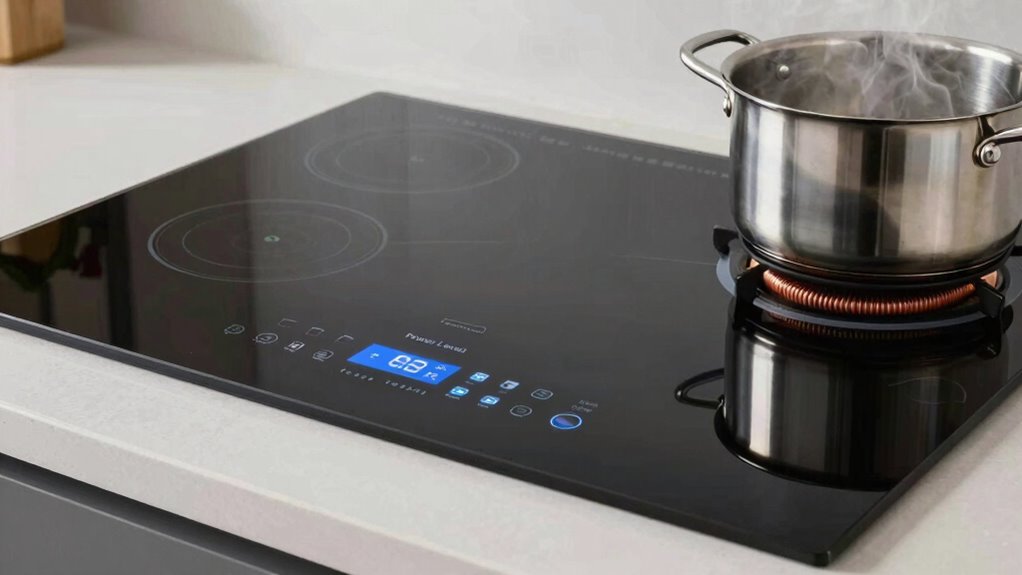
Many people believe that the power level setting on your induction cooktop directly indicates how much heat it produces, but that’s a common misconception. Power levels are not actual measurements of heat output; instead, they are just settings that control the cooktop’s power delivery. Understanding this helps you cook more accurately without being misled by the numbers on the control panel.
Power Levels Are Not Power
It’s common to assume that higher power levels on an induction cooktop mean more actual energy being delivered to your cookware, but that’s not quite true. Power levels are more about the cooktop’s cooking terminology than real power output. Understanding this helps improve your kitchen ergonomics by choosing settings that suit your cooking needs. Here’s what you should know:
- Higher power levels often mean faster heat adjustments, not more energy.
- They control the duration and frequency of the magnetic field, not necessarily heat output.
- Power level settings are designed for user convenience, not precise wattage.
- This distinction helps you better manage heat, making your cooking more efficient without confusion.
Misconceptions About Heat Output
A common misconception is that higher power levels on your induction cooktop automatically mean more heat is being produced. In reality, heat output doesn’t always scale directly with the power setting. Many assume that setting to “high” results in the most heat, but induction cooktops are designed for precise control and energy efficiency. This means that at higher levels, the cooktop may use less energy to maintain a consistent heat, especially when the cookware reaches the desired temperature. The heat output can also vary depending on cookware material and size, which influences how efficiently energy is transferred. Understanding this helps you better manage your cooking process, ensuring you’re not overestimating the amount of heat being generated based solely on the power level.
Settings Don’t Reflect Actual Heat
Despite what the power level settings on your induction cooktop suggest, they don’t always correspond to the actual heat produced. This can affect your cooking safety and appliance maintenance. Here’s what you should know:
- Power levels are approximate, not precise, so don’t rely solely on them for exact cooking temperatures.
- Variations in cookware material and size influence real heat output, regardless of the setting.
- Ambient conditions and cookware placement can cause fluctuations in heat, even at the same setting.
- Always monitor your food closely to prevent overcooking or uneven heating, ensuring safe use and prolonging your appliance’s lifespan.
Understanding this helps you cook safely and maintain your induction cooktop more effectively.
How to Choose the Right Power Level for Different Recipes

Choosing the right power level on your induction cooktop is essential for achieving the best results in your recipes. Different cooking techniques require specific power settings to control heat effectively. For simmering or gentle melting, use a low or medium-low setting to prevent burning and allow flavors to develop slowly. When searing or boiling, opt for high power to quickly reach the desired temperature. Adjusting the power level may also involve recipe modifications, like increasing cook time for lower settings or adding liquids to prevent sticking. Pay attention to how your ingredients respond, and don’t hesitate to fine-tune the power level during cooking. Mastering this balance helps you produce perfectly cooked dishes, ensuring your recipes turn out just right every time.
Troubleshooting When Power Levels Don’t Match Your Expectations
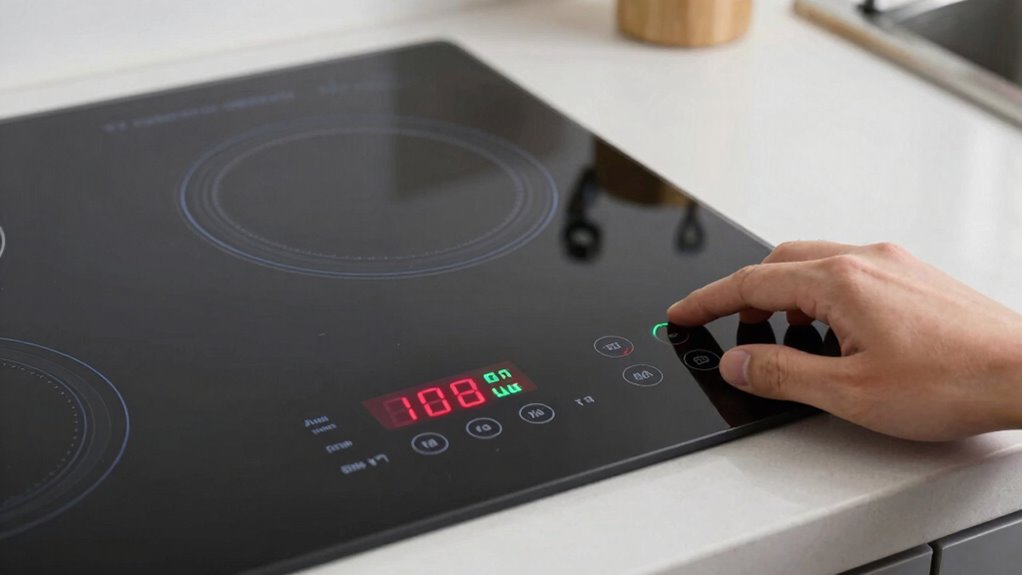
When your induction cooktop isn’t delivering the expected power, start by checking the settings to make certain they’re correct. Next, familiarize yourself with the power level scale to see if your expectations match the actual output. Finally, verify that your appliance is compatible with your cookware and electrical supply to prevent any mismatched performance.
Check Power Settings
Have you noticed that your induction cooktop isn’t reaching the expected power levels? First, double-check that you’ve set the correct power level on your control panel. Second, verify your cookware is compatible; induction safety depends on proper cookware contact. Third, confirm that your cookware is centered on the hob, as misalignment can reduce power transfer. Fourth, consult your user manual to verify that your settings match the recommended guidelines for your specific model. Sometimes, a simple reset or turning the cooktop off and on again can fix the issue. Remember, proper power settings are vital for induction safety and peak performance. If problems persist, consider testing with different cookware or contacting customer support to make sure your device functions correctly.
Understand Power Level Scale
Understanding the power level scale on your induction cooktop is essential for troubleshooting when the heat doesn’t match your expectations. Many power level myths exist, leading to confusion about how these settings relate to actual cooking temperature. Unlike traditional stoves, induction cooktops use a numerical scale, often from 1 to 10 or 1 to 20, but these numbers don’t directly translate to specific heat levels. Instead, higher numbers generally indicate more power, not necessarily hotter temperatures in a linear way. Knowing this helps you set the right level for your recipe without expecting exact temperature control. If your dishes aren’t cooking as planned, understanding the scale allows you to adjust more effectively, ensuring consistent results and dispelling misconceptions about what each power level truly means.
Inspect Appliance Compatibility
If your induction cooktop isn’t delivering the expected heat at certain power levels, verifying appliance compatibility is a crucial step. Start by checking the appliance features: ensure your cookware has a flat bottom and is compatible with induction. Next, consider the warranty considerations—some brands specify compatible models or cookware types, affecting performance. Then, test your cookware on different power settings to see if it responds consistently. Finally, consult your cooktop’s user manual or manufacturer’s website for approved cookware lists. If issues persist, it may be necessary to replace incompatible items or contact customer support. Confirming appliance compatibility helps your cooktop perform efficiently and avoids voiding your warranty. Proper matching of cookware and device features guarantees accurate power level response and reliable operation.
How Power Level Settings Differ Among Brands and Models

Did you know that power level settings can vary considerably between induction cooktop brands and models? These brand variations mean that a “high” setting on one model might not be as powerful on another. Manufacturers design their controls differently, so your preferred level of heat may require some adjustment when switching brands. Some brands offer more granular control, allowing you to fine-tune heat precisely, while others use broader steps. Your user preferences also influence how you interpret these settings—whether you want quick boiling or gentle simmering. It’s essential to understand that the numeric or descriptive levels aren’t standardized, so always refer to your specific appliance’s manual. This awareness helps you better manage heat and achieve consistent cooking results across different induction cooktops.
Tips to Use Power Levels Effectively and Save Energy
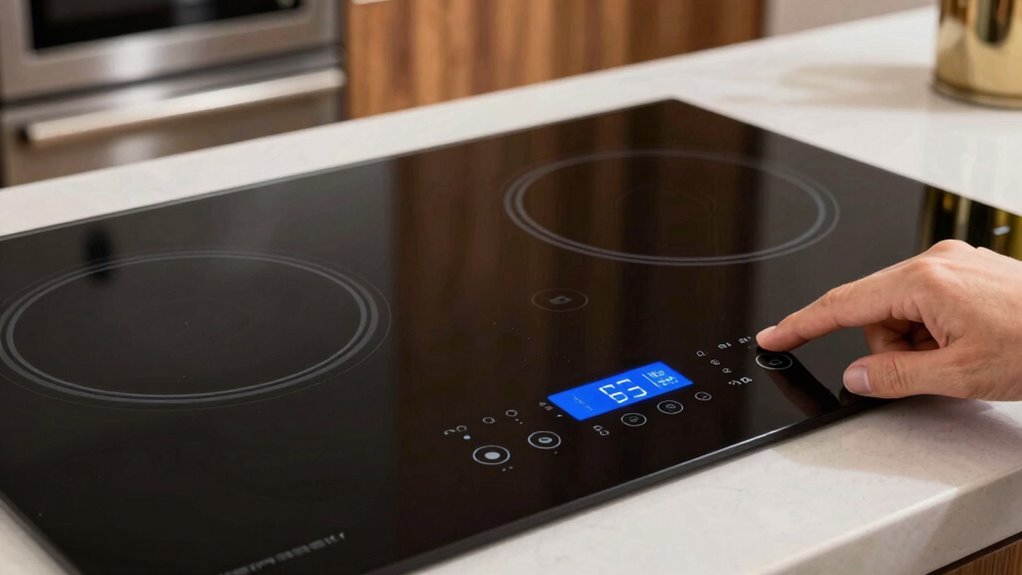
Ever wonder how to make the most of your induction cooktop’s power levels while saving energy? Here are some tips to improve energy efficiency and ensure user safety:
- Use lower power levels for simmering or keeping food warm to conserve energy.
- Increase power only when boiling or cooking quickly, avoiding unnecessary energy use.
- Match the cookware size to the power level—larger pots may need higher settings, but avoid overuse.
- Always stay attentive to the display and prevent overheating, which enhances user safety and prolongs your appliance’s lifespan.
Frequently Asked Questions
Can I Customize Power Levels Beyond the Preset Options?
Yes, you can customize power levels beyond preset options using power level customization, giving you more precise control over cooking. Many induction cooktops allow you to manually adjust the power levels, offering better user control to suit your specific needs. This feature lets you fine-tune heat settings, ensuring superior cooking results. Check your appliance’s manual to see if it supports advanced user control for customizing power levels beyond the standard presets.
Do Power Levels Impact Energy Efficiency on Induction Cooktops?
Yes, power levels impact energy efficiency on induction cooktops. When you select a lower power level, you reduce energy consumption, making your cooking more efficient. Precise temperature control at different power levels helps you avoid wasting energy by overheating or undercooking. By using the appropriate power level for your task, you optimize energy use and maintain better control over your cooking process, saving you both energy and money.
Are There Safety Concerns Related to High Power Levels?
A warning to keep in mind: “Better safe than sorry.” High power levels on your induction cooktop can pose safety concerns, especially related to fire hazards and electrical safety. While modern units have built-in protections, using excessively high settings improperly can increase risks. Always follow manufacturer guidelines, verify proper cookware, and avoid leaving the cooktop unattended at high power to prevent accidents and maintain safety.
How Do Ambient Conditions Affect Power Level Performance?
Ambient conditions, like air circulation and ambient temperature, directly impact your induction cooker’s power level performance. Poor air circulation can cause overheating, leading the system to automatically lower power to stay safe, while high ambient temperatures may reduce efficiency by making it harder to maintain the desired heat. To guarantee ideal performance, keep the area well-ventilated and avoid placing the cooktop in overly hot environments.
Is There a Standard Scale for Power Levels Across Different Brands?
You might find it tricky to compare power levels across brands because, unfortunately, there’s no universal scale for power level standards. Each brand often uses its own system, leading to variability that can cause confusion. While some brands aim for consistency, others prioritize unique features. So, when shopping, check the specific power level descriptions and performance tests to get a clearer idea of what each appliance offers, rather than relying solely on numbers.
Conclusion
Understanding what “power level” really means helps you cook smarter and more efficiently. It’s tempting to think higher always means faster, but the truth is, matching the right power level to your recipe guarantees better results and energy savings. Think of it like tuning an instrument — the right setting open the door to perfect harmony in your cooking. When you master this, you’ll see that controlling power levels isn’t just about speed, but about creating delicious, consistent dishes every time.
Halloween Picks
halloween
As an affiliate, we earn on qualifying purchases.