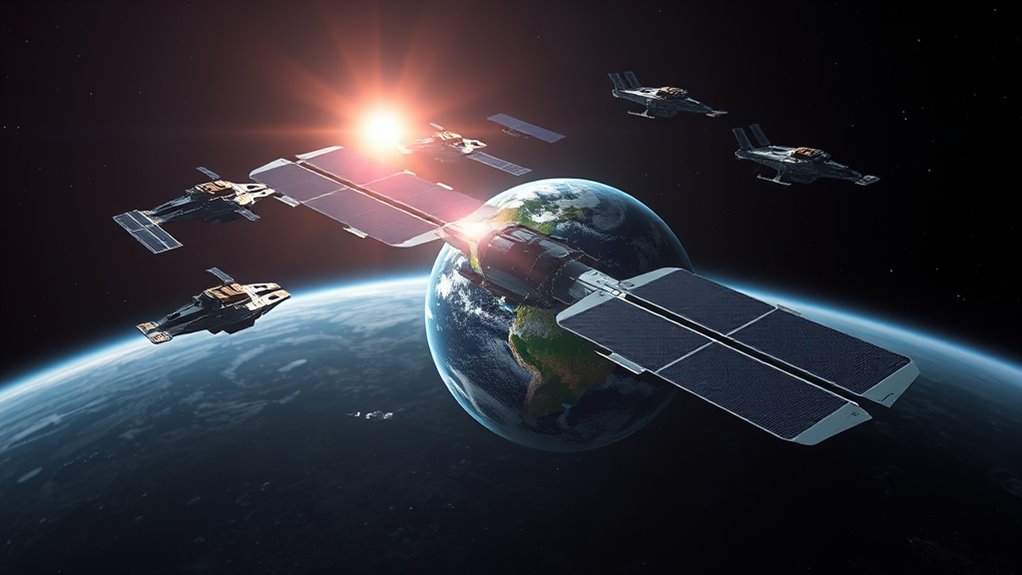

By 2025, the space race ramps up with mega-constellations like SpaceX’s Starlink aiming for tens of thousands of satellites to improve worldwide connectivity. Exploration missions push further with lunar infrastructure, Mars research, and the use of advanced robotics and AI for in-space assembly. Breakthrough propulsion systems, such as nuclear thermal and electric propulsion, accelerate deep-space travel. Innovations in microgravity manufacturing enable new materials and parts. Exploring these developments will reveal how humanity’s access to space continues to transform at an unprecedented pace.
Key Takeaways
- Advancements in mega-constellations like Starlink aim for global connectivity with thousands of LEO satellites by 2025.
- Increased focus on sustainable space practices to mitigate debris, collisions, and ensure long-term satellite network viability.
- Expanding lunar and deep-space exploration with Artemis missions, international collaborations, and in-space manufacturing innovations.
- Deployment of nuclear propulsion (NTP and NEP) and orbital refueling to enable faster, more efficient interplanetary travel.
- Integration of AI, robotics, and microgravity manufacturing to revolutionize exploration, satellite operations, and space infrastructure development.

STARLINK Standard Kit AX 4 X Tri Band Wi-Fi System – High-Speed, Low-Latency V4 Internet Band AC Wi-Fi Router and Satellite Dish System – High-Speed Portable Internet – White
Starlink provides reliable high-speed, low-latency, internet wherever you live
As an affiliate, we earn on qualifying purchases.
As an affiliate, we earn on qualifying purchases.
The Rise of Mega-Constellations and Next-Generation Satellite Networks
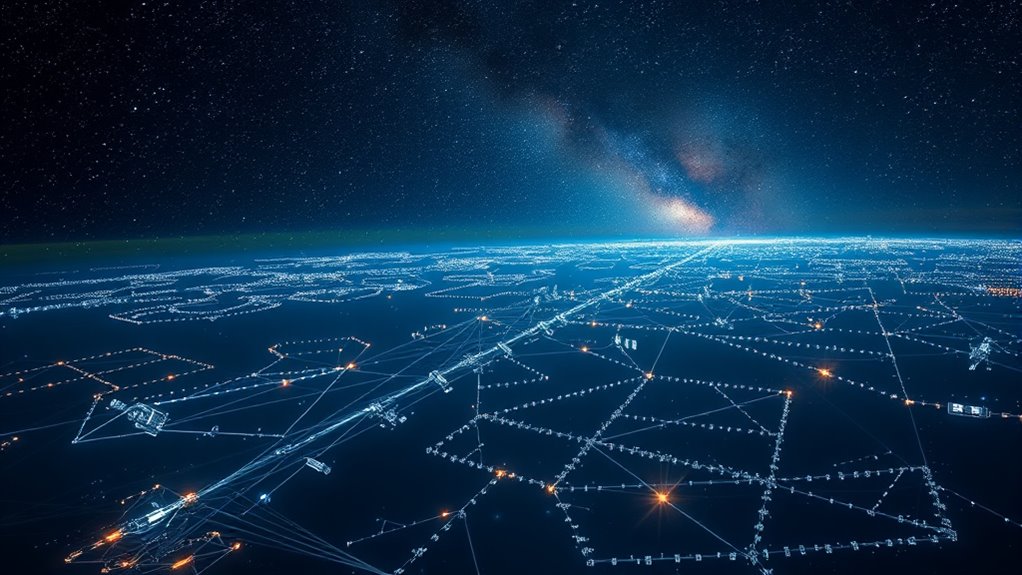
The rise of mega-constellations marks a transformative shift in satellite networks, driven by the goal of providing global internet coverage. You’ll see thousands of satellites, like SpaceX’s Starlink aiming for 42,000, deployed in low Earth orbit (LEO) at altitudes between 340 km and over 1,500 km. These satellites operate across various frequencies—V, Ka, Ku, L, and S bands—though bands like Ka experience significant signal loss, complicating communication. With so many satellites, spectrum management becomes critical to prevent interference, requiring international coordination. The proliferation of these satellites has increased the risk of space debris and collision, highlighting the need for sustainable practices. Mega-constellations aim to connect remote regions, offering low-cost, low-latency, high-bandwidth internet. However, they also pose challenges like space debris, collision risks, and orbital congestion, demanding sustainable practices and global cooperation for long-term success.

NASA Future Explorers – Canadarm Robot Arm Mobility System. Build & Learn STEM Education & Interactive Space Exploration for Kids. with Hydraulic Power & 4 Axis of Movement!
IGNITE SPACE EXPLORATION PASSION: Dive into the world of space engineering with the Canadarm Robot Arm Mobility System,…
As an affiliate, we earn on qualifying purchases.
As an affiliate, we earn on qualifying purchases.
Advances in Space Exploration Missions and Robotic Technologies
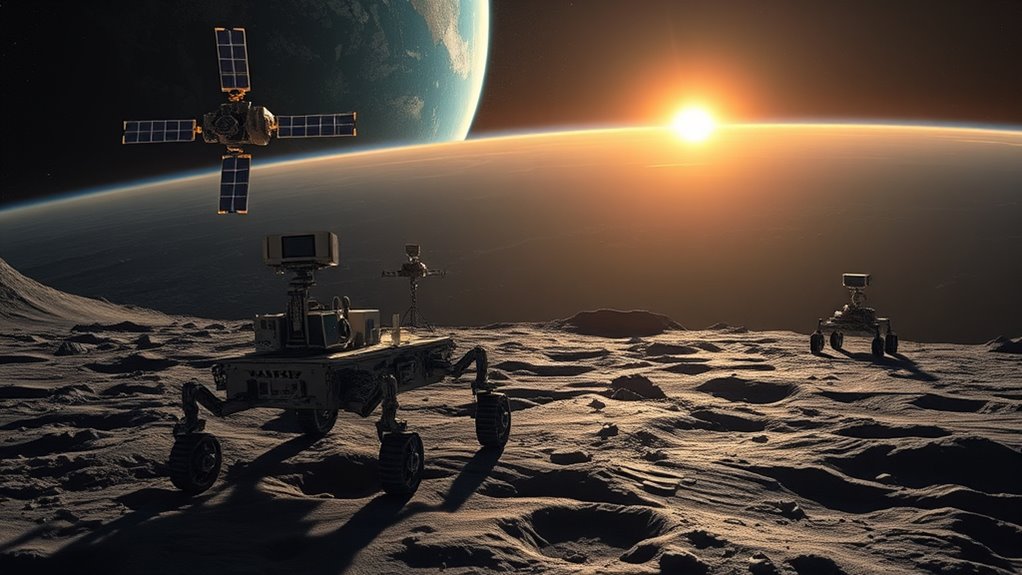
Recent advances in space exploration missions and robotic technologies are revolutionizing how you study and navigate the cosmos. NASA’s twin Escapade spacecraft now explore Mars’ magnetic field, helping you understand the planet’s climate and geology. The ongoing Mars missions are providing unprecedented data on the planet’s atmospheric dynamics. China’s Tianwen missions expand your reach to asteroids and other celestial bodies, with sample return efforts bringing new insights. Spectro-photometers analyze the universe’s history, while robots explore asteroid surfaces, orbitals, and even assist in deflection efforts. Advanced robotics enable in-space assembly, autonomous decision-making, and maintenance tasks, extending mission lifespans. AI integration enhances robot intelligence, allowing for smarter operations. These innovations facilitate long-duration deep space exploration and foster international collaboration, sharing expertise and establishing standards. Together, these developments are shaping a future where robotic systems play a crucial role in uncovering cosmic secrets, supported by intercultural collaboration that accelerates technological progress across nations. Additionally, the use of space-based communication networks ensures reliable data transmission over vast distances, enabling more complex and autonomous mission operations. Moreover, advancements in communication technology are critical for maintaining real-time control and data flow between Earth and distant spacecraft, further enhancing mission capabilities. The integration of remote sensing technologies also allows for more precise environmental monitoring of celestial bodies, aiding scientific discovery and mission planning.
microgravity manufacturing equipment
As an affiliate, we earn on qualifying purchases.
As an affiliate, we earn on qualifying purchases.
Human Lunar Missions and Moon-Based Innovations
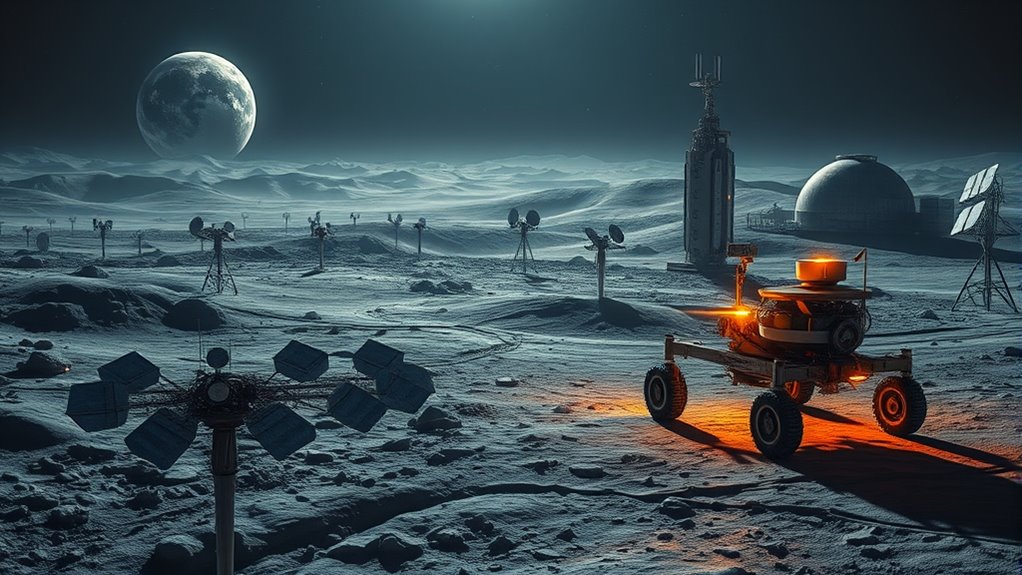
Ever wondered how humanity is preparing to return to the Moon? The Artemis program aims to establish a sustainable human presence by 2025, with Artemis II scheduled for February 2026. After the successful launch of Artemis I in November 2022, international partners like ESA, JAXA, and CSA are helping develop lunar infrastructure. Multiple lunar missions launched in early 2025, including Firefly Aerospace’s Blue Ghost and ispace’s Hakuto-R Mission 2. The goal is to build a lunar base that supports future Mars missions, focusing on surface operations, advanced propulsion, power management, and robust communication systems. Commercial efforts, like Intuitive Machines’ IM-2 mission to the South Pole, are expanding exploration and technological innovation. These collaborations and innovations are driving us toward a new era of lunar exploration, with the long-term vision of scientific discovery, international cooperation, and human presence beyond Earth. Developing lunar infrastructure is essential for sustaining long-term human activity on the Moon and beyond, especially as advancements in sound design techniques can enhance the communication systems used in these missions. Additionally, integrating advanced propulsion systems can significantly reduce travel time and increase mission efficiency, facilitating more ambitious exploration goals. Ongoing research into life support systems is critical for ensuring crew safety during extended lunar stays, and improvements in projector technology can aid in training and mission simulations.

Integrated System Modeling for Nuclear Thermal Propulsion (NTP)
As an affiliate, we earn on qualifying purchases.
As an affiliate, we earn on qualifying purchases.
Breakthroughs in Space Propulsion and Power Systems
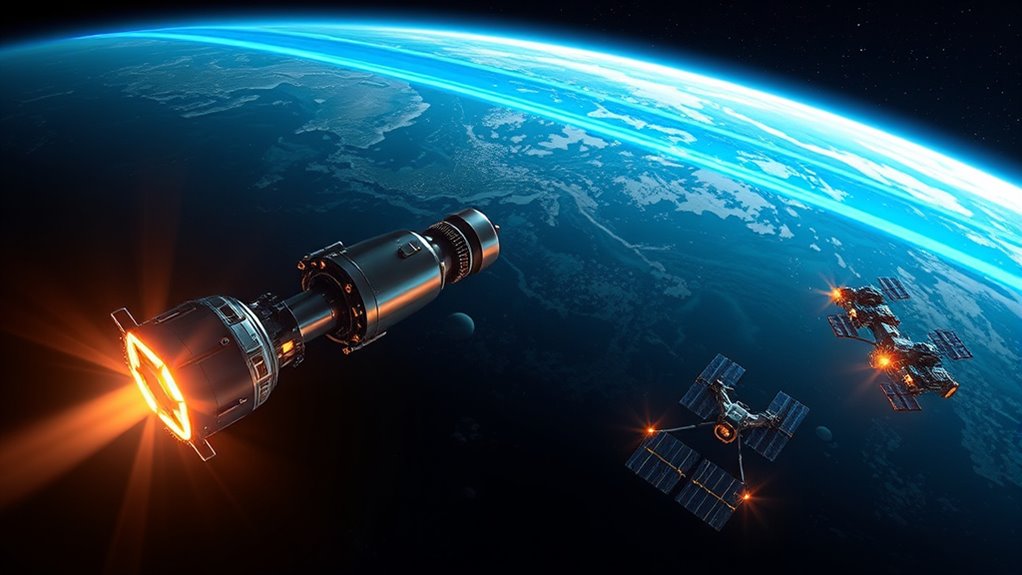
Advancements in space propulsion and power systems are rapidly transforming how missions are planned and executed beyond Earth. Nuclear Thermal Propulsion (NTP) now offers high-efficiency thrust, enabling faster transit times and shorter crew exposure to radiation. Its increased speed grants greater mission flexibility, supporting higher payloads and wider launch windows. NTP technology has seen recent successful testing, bringing it closer to operational deployment. Collaborative programs, like Lockheed Martin’s NTP development, demonstrate reactor-based propulsion and heat transfer innovations that manage extreme temperatures. Nuclear Electric Propulsion (NEP) integrates fission reactors for deep-space missions, powering ion thrusters and providing sustained energy for high-tech instruments. Modular designs allow scalable outputs for diverse missions. In-space propellant transfer, such as orbital refueling tests, reduces fuel loads, extends spacecraft life, and boosts payload capacity. In-space propellant transfer is a key enabler for longer and more complex missions, opening new horizons for exploration. The development of space-based power systems is also essential for supporting sustained human presence beyond Earth, ensuring reliable energy supply for habitats and equipment. Additionally, understanding and applying creative practice principles can enhance innovative solutions in spacecraft design and mission planning. Incorporating vertical storage solutions and other organization strategies can optimize spacecraft and habitat design, making them more efficient. These breakthroughs are accelerating space exploration capabilities and paving the way for ambitious interplanetary endeavors.
Manufacturing and Material Science in Microgravity
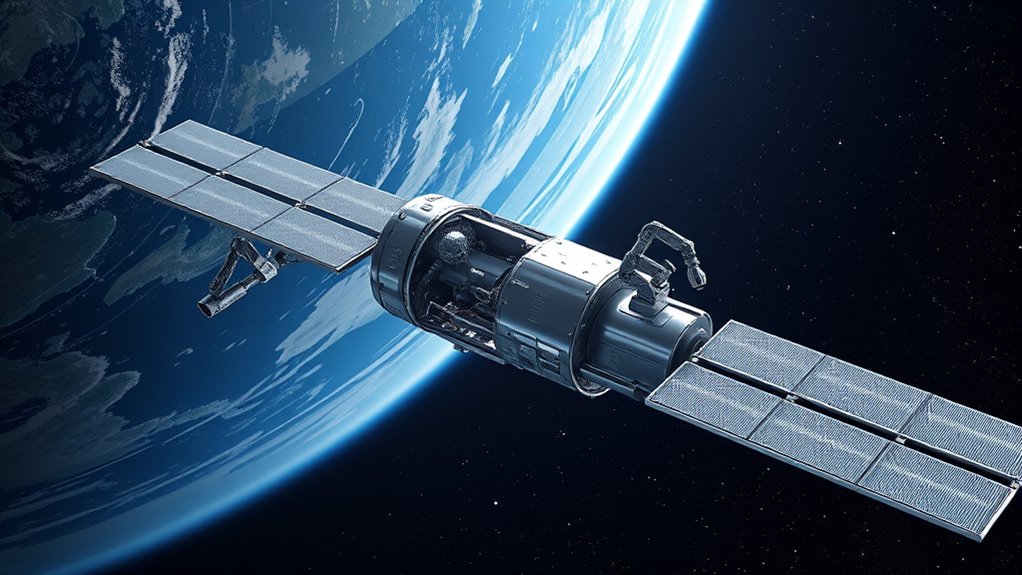
Microgravity fundamentally transforms manufacturing and material science by eliminating gravity-driven effects that hinder traditional processes. Without buoyancy and sedimentation, you can perform pure phase separation studies essential for developing advanced alloys. Microgravity reduces surface tension effects, allowing for more precise control over material interfaces and bonding processes. Reduced convection currents enable precise control of crystal growth, improving semiconductors’ efficiency. Surface tension dominance prevents void formation during bonding, resulting in stronger materials. Directional solidification becomes more accurate, enhancing turbine blade metallurgical properties. You can also explore miscibility gap alloys, ideal for self-lubricating bearings and electrical components. Additionally, thermal management becomes more effective in space, supporting delicate manufacturing processes. Additive manufacturing benefits from uniform microstructures in metal 3D printing, while multi-material printing achieves stable melt pools. Powder-based processes exhibit less segregation, producing high-performance composites. In-space fabrication allows on-demand parts production, reducing launch costs and enabling rapid mission adaptations.
Enhancing Earth Monitoring, Connectivity, and Data Sharing
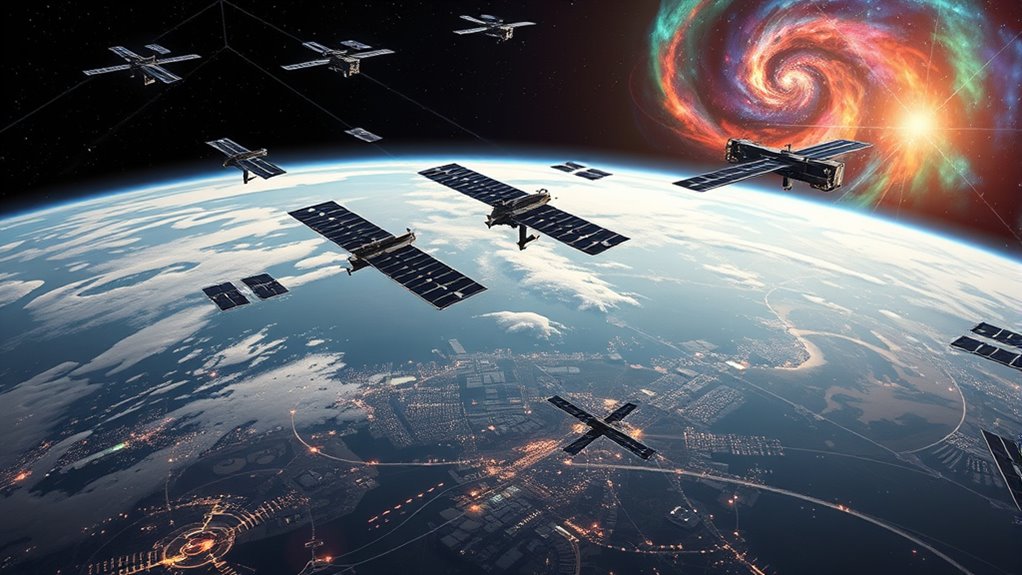
Recent developments in satellite technology are markedly enhancing Earth monitoring, connectivity, and data sharing capabilities. The NISAR satellite, launching in March 2025, uses dual-frequency radar for global land and ice monitoring every 12 days, enabling precise tracking of ice displacement, ground shifts, and soil moisture even through cloud cover. It also detects millimeter-scale land deformation for early earthquake and landslide warnings and penetrates dense forests for biodiversity mapping. Regular maintenance of satellite instruments ensures sustained accuracy and longevity of these systems. Proper calibration and maintenance routines are vital for maintaining data integrity over time. Additionally, advancements in automation facilitate faster data analysis, allowing for more timely responses to environmental changes. Implementing preventive maintenance practices helps identify potential issues before they impact system performance, thereby reducing downtime and ensuring continuous operation. Consistent system upkeep helps prevent data discrepancies and extends the operational lifespan of satellite components. Next-generation satellites offer high-resolution imaging for real-time urban and agricultural oversight, while multi-spectral sensors improve disaster response. Global constellations ensure persistent ecosystem monitoring, and shared frequency bands optimize data flow. Open-access policies and international collaborations facilitate rapid data sharing, empowering researchers, policymakers, and citizens alike to address climate change, natural hazards, and environmental conservation more effectively.
Frequently Asked Questions
How Will Space Debris Management Evolve With Increasing Satellite Deployments?
You’ll see space debris management evolve with more satellite deployments by adopting advanced AI and data analytics to track and predict debris movement better.
Active debris removal missions and innovative satellite designs with deorbiting systems will become standard.
Stricter regulations and global cooperation will uphold responsible disposal practices, reducing new debris.
Commercial ventures will drive innovation, leading to sustainable space practices that ensure safety and longevity for future space activities.
What Are the Long-Term Sustainability Plans for Lunar and Deep Space Habitats?
Oh, sure, because building lunar and deep space habitats is just a walk on the moon, right? Long-term plans include using local resources like water and regolith, recycling air and water, and expanding habitats with modular designs.
You’ll see international teams teaming up, making habitats self-sufficient, and testing tech for Mars.
Basically, you’re creating space homes that are sustainable, adaptable, and ready for a future where humans might just live off-world.
How Secure Are Quantum Communication Networks Against Potential Cyber Threats?
You’re wondering how secure quantum communication networks are against cyber threats. These networks are highly secure because they use quantum principles like entanglement and teleportation, making interception detectable.
Quantum Key Distribution ensures safe key sharing, and quantum-safe cryptography protects against future quantum attacks.
While environmental factors can pose challenges, ongoing development and implementation mean you’ll benefit from advanced, resilient security that considerably reduces cyber threat risks.
What Ethical Considerations Arise From Space Manufacturing and Resource Utilization?
You should consider the ethical implications of space manufacturing and resource utilization. This involves ensuring environmental impacts are minimized, resources are used sustainably, and access is fair among nations and businesses.
You need to prioritize transparency, accountability, and international cooperation. Additionally, it’s essential to develop regulations that prevent monopolies, protect space environments, and promote societal benefits.
All of this should be done while handling technological risks responsibly and involving diverse stakeholders in decision-making.
How Will Space-Based Solar Power Impact Earth’s Energy Infrastructure?
You might wonder how space-based solar power will change Earth’s energy infrastructure. It offers a continuous, clean energy source that could supplement or replace fossil fuels, reducing environmental harm.
While initial costs and technological challenges are high, advancements could make it more affordable and efficient.
This system could provide reliable energy regardless of weather or day-night cycles, transforming how you access sustainable power and supporting global energy needs.
Conclusion
As you watch the night sky, imagine the vast network of satellites forming a glowing web overhead, connecting every corner of the Earth. With new propulsion systems fueling lunar missions and innovative materials shaping future explorers, the universe feels closer than ever. It’s as if space itself is unfolding, revealing endless possibilities. You’re at the edge of a new era—where discovery and innovation are aligning, lighting the way to a future that’s truly out of this world.