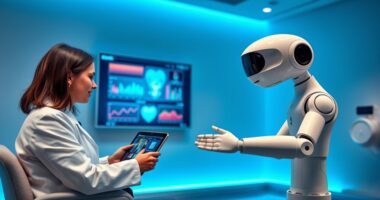
Automated economies are developing as machines and AI systems begin handling transactions and operations independently across sectors like manufacturing, finance, and logistics. These systems rely on robotics, AI, and machine learning to boost efficiency, reduce costs, and speed up decision-making. As automation transforms markets and labor roles, it creates new opportunities and challenges for economies worldwide. To understand how these changes could impact you and the global landscape, keep exploring deeper insights into this evolving trend.

Get the latest gadgets delivered free — and shop member deals
- Fast, free delivery on millions of items
- Access to Prime Big Deal Days deals on October 6–7
- Prime Video, Amazon Music and more included
Key Takeaways
- Fully automated economies leverage AI and robotics to perform transactions and operational tasks independently across various sectors.
- Autonomous systems enable faster decision-making and reduced costs, transforming traditional supply chains and industry structures.
- AI-driven financial transactions, such as stock trading, exemplify machines transacting without human intervention.
- Automation improves efficiency and responsiveness, leading to increased competitiveness in the global economy.
- The rise of autonomous economic systems challenges existing labor markets and requires new skills for human workers.

Have you ever wondered how machines and AI are transforming the way economies operate? Today, we’re witnessing the rise of automated economies—systems where machines and AI handle transactions and operational tasks independently. These economies rely heavily on robotics, AI, and machine learning to reduce human labor, streamline processes, and boost productivity. In a fully automated economy, physical robots and AI software perform most work-related activities, from manufacturing to digital transactions like stock trading and financial operations. This shift means faster decision-making, lower costs, and increased efficiency across sectors.
Automation is more than just a trend; it’s a powerful technological force classified as a general-purpose technology (GPT). Similar to the steam engine, electricity, or the internet, AI-driven automation has the potential to cause large-scale economic transformations. Initially, productivity gains may seem slow as industries adapt, but over time, automation sparks rapid growth, as organizations become more efficient and resource use improves. You can expect to see gross domestic product (GDP) rise as labor productivity increases and companies respond quicker to market demands. Businesses gain a competitive edge by lowering operational expenses and enhancing their responsiveness, giving them an advantage over less automated competitors.
However, this shift has profound implications for the labor market. Automation could replace up to a quarter of full-time jobs globally by 2030, especially in sectors like accommodation, food services, manufacturing, agriculture, transportation, and retail—where automation risks reach up to 73%. Jobs requiring routine physical or administrative tasks are most vulnerable. Even sectors traditionally considered less automation-prone, such as healthcare, education, and professional services, are feeling AI’s influence, encroaching on legal, accounting, and real estate roles. As automation advances, workers need to adapt by developing skills in oversight, maintenance, and managing complex tasks, shifting the nature of employment and skill demands.
Emerging and developing economies face even higher automation risks, with job automation probabilities between 55% and 85% in countries like China, India, Ethiopia, and Uzbekistan. Historically, these nations relied on manufacturing growth to catch up economically, but automation threatens to slow this progress or cause ‘premature de-industrialization,’ where manufacturing moves closer to advanced economies with automated production. Weaker social safety nets and declining consumer demand worsen the social disruptions caused by automation in these regions. To navigate this new landscape, emerging economies will need innovative growth models that balance technological advancement with employment sustainability, ensuring they don’t fall behind in the age of autonomous economies. Additionally, automation in supply chains and logistics can significantly reduce costs and improve delivery times, further transforming economic structures.
AI-powered robotic process automation tools
As an affiliate, we earn on qualifying purchases.
As an affiliate, we earn on qualifying purchases.
Frequently Asked Questions
How Do Automated Economies Impact Global Employment Rates?
Automated economies impact global employment rates by displacing millions of jobs, especially in AI-sensitive sectors like customer service and administrative roles. You’ll see some employment decline but also new opportunities emerge in tech and infrastructure. While overall employment may grow, many workers will need to switch careers or develop new skills. This shift creates uneven effects across countries and industries, so staying adaptable becomes essential for maintaining employment stability.
What Are the Main Technological Challenges in Developing Autonomous Markets?
Imagine trying to build a puzzle where each piece is from a different box—that’s what developing autonomous markets feels like. You face technological challenges like improving sensor reliability in bad weather, ensuring real-time data processing, and cybersecurity threats. You also need seamless integration with existing infrastructure. Addressing diverse data laws and gaining public trust add layers of complexity, making it a demanding but essential pursuit for future economies.
How Is Consumer Protection Maintained in Automated Trading Systems?
You’re protected in automated trading systems through strict regulations, like requiring broker registration and transparency measures. These rules ensure algorithms are tested and monitored regularly, preventing manipulative or rogue activities. Risk controls, such as order limits and safeguards, help avoid errors. Exchanges also enforce measures to detect anomalies before trades happen, safeguarding your interests. Continuous oversight and compliance reporting further bolster confidence that your trades are secure and honest.
What Legal Frameworks Govern Machine-Led Economic Transactions?
You might think machines have it all figured out, but legal rules still guide their transactions. Currently, specialized legislation is needed to recognize DAOs as legal entities, allowing them to own assets and sign contracts. Regulatory frameworks, like FCA rules, ensure compliance with financial laws, while contract enforcement adapts to smart contracts. Without clear laws, these automated transactions could turn chaotic, risking liability issues and stifling innovation.
Could Automated Economies Lead to Increased Economic Inequality?
Yes, automated economies can increase inequality. You might notice that automation favors high-skilled workers and wealthy elites, widening income gaps. Low-skilled workers often face displacement, struggling to find new roles. As technology boosts productivity mainly for the already privileged, your economic disparity could grow. To prevent this, you should support policies that invest in education, retraining, and fair regulation, ensuring everyone benefits from automation’s advances.
Conclusion
Imagine walking into a bustling marketplace run entirely by machines, where every transaction happens seamlessly without human intervention. Just like ants working together to build an empire, automated economies are now orchestrating complex trades independently. With over $10 trillion in digital assets already moving through these systems, it’s clear you’re witnessing the dawn of a new financial era—one where machines don’t just assist, but lead the way. The future’s here, and it’s operating on autopilot.
Fall Picks
fall essentials
As an affiliate, we earn on qualifying purchases.