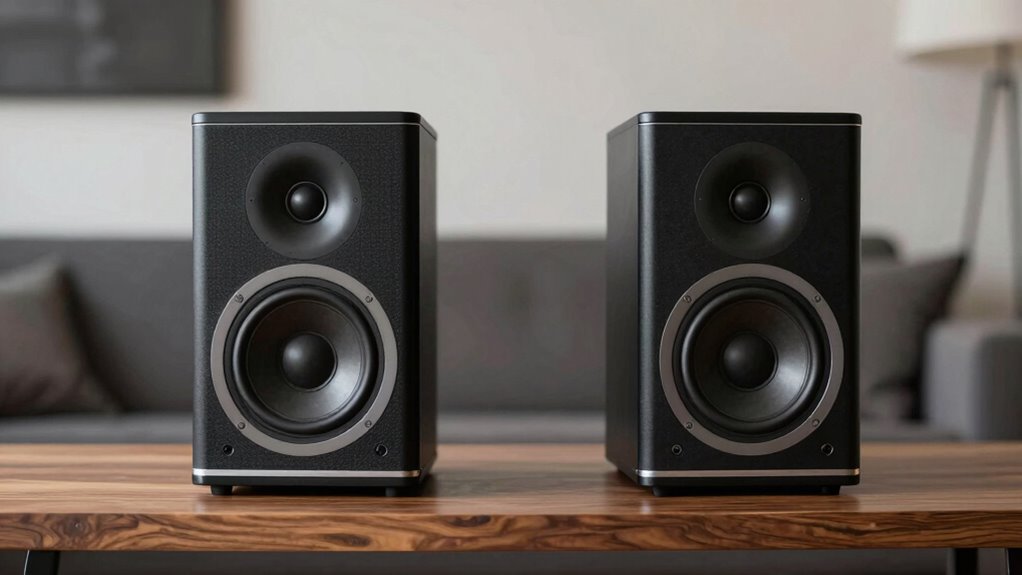

For high-end bookshelf speakers, I rank the KEF Q1 Meta as the best overall choice for its advanced Uni-Q driver design and audiophile focus. The ELAC Debut 3.0 DB63 is a strong alternative for listeners who want a capable passive pair, while the Klipsch RP-600M favors lively, high-output playback. The main tradeoffs are passive speakers’ need for an amplifier, powered models’ simpler setup, and how each speaker’s sound suits your room and listening habits. Not every option here has the same high-end ambitions: the Polk T15 and Edifier R1280T are better matched to simpler starter systems. Read on for the full comparison and help choosing the right fit.

Get the latest gadgets delivered free with Prime
- Fast, free delivery on millions of items
- Prime Video, Amazon Music and more included
- Member-only deals all year
Complete the kit



Key Takeaways
- KEF Q1 Meta leads for refinement: Its Uni-Q driver array makes it the most design-focused passive pick, though it still needs a suitable amplifier.
- ELAC DB63 is the balanced alternative: Its 6.5-inch woofer and broad stated frequency response make it a versatile choice without the KEF’s premium positioning.
- Klipsch RP-600M favors impact: Its lively, high-sensitivity approach suits listeners who want dynamic playback more than a restrained presentation.
- Powered speakers simplify the system: The Klipsch R-40PM and Edifier R1280T include amplification, but they serve different ambitions and listening setups.
- Several models are starter-oriented: The Sony SS-CS5M2, Klipsch R-51M, and Polk T15 offer accessible routes into passive audio, but they are not the most ambitious choices in this group.
| Klipsch RP-600M Reference Premiere Bookshelf Speakers – Pair (Ebony) |  | Best for Dynamic Listening | Tweeter: 1-inch titanium LTS vented tweeter with hybrid Tractrix horn | Woofer: 6.5-inch spun-copper Cerametallic | Bass reflex port: Rear-firing Tractrix port | VIEW ON AMAZON | See Our Full Breakdown |
| Polk Audio T15 100 Watt Home Theater Bookshelf Speakers, Black (1 Pair) |  | Best for Entry-Level Surround Expansion | Speaker type: Passive bookshelf speakers | Power handling: 100 watts | Tweeter: 0.75-inch | VIEW ON AMAZON | See Our Full Breakdown |
| Sony SS-CS5M2 3-Way 3-Driver Hi-Res Compact Bookshelf Speakers (Pair) |  | Best Compact Pick | Configuration: 3-way, 3-driver bookshelf speaker pair | Woofer: 5.12-inch | Tweeters: High-precision tweeter and super tweeter | VIEW ON AMAZON | See Our Full Breakdown |
| Edifier R1280T Powered Bookshelf Speakers -2.0 Near Field Studio Monitor |  | Best Powered Desktop Pick | Speaker type: Powered 2.0 stereo pair | Tweeter: 13 mm silk dome | Driver: 4-inch full-range unit | VIEW ON AMAZON | See Our Full Breakdown |
| ELAC Debut 3.0 DB63-WN Bookshelf Speakers, Walnut (Pair) – 1” Aluminum Dome Tweeter & 6.5” Aramid Fiber Woofer – 2-Way Bass Reflex – 42Hz to 38KHz Response |  | Best Overall | Configuration: 2-way bass-reflex bookshelf speaker pair | Tweeter: 1-inch aluminum dome | Woofer: 6.5-inch woven aramid fiber | VIEW ON AMAZON | See Our Full Breakdown |
| Klipsch Reference R-40PM Powered Bookshelf Speakers |  | Best Powered All-in-One | Speaker type: Powered bookshelf | Horn design: 90° × 90° Tractrix horn | Tweeter: 1-inch Linear Travel Suspension | VIEW ON AMAZON | See Our Full Breakdown |
| Klipsch R-51M Bookshelf Speakers – Black |  | Best Compact Passive Klipsch | Speaker type: Passive bookshelf | Tweeter: 1-inch aluminum LTS | Woofer: Dual 5.25-inch spun-copper IMG | VIEW ON AMAZON | See Our Full Breakdown |
| KEF Q1 Meta Bookshelf Speakers (Pair, Walnut) |  | Best for Even, Detailed Stereo Imaging | Speaker type: Passive 2-way bookshelf speaker; sold as a pair | Driver array: 12th-generation Uni-Q | Tweeter: 25 mm aluminum dome | VIEW ON AMAZON | See Our Full Breakdown |
| high end bookshelf speakers under 1000 | Tweeter | Woofer | Speaker type |
|---|---|---|---|
| Klipsch RP-600M Reference Prem | 1-inch titanium LTS vented tweeter with hybrid Tractrix horn | 6.5-inch spun-copper Cerametallic | — |
| Polk Audio T15 100 Watt Home T | 0.75-inch | — | Passive bookshelf speakers |
| Sony SS-CS5M2 3-Way 3-Driver H | — | 5.12-inch | — |
| Edifier R1280T Powered Bookshe | 13 mm silk dome | — | Powered 2.0 stereo pair |
| ELAC Debut 3.0 DB63-WN Bookshe | 1-inch aluminum dome | 6.5-inch woven aramid fiber | — |
| Klipsch Reference R-40PM Power | 1-inch Linear Travel Suspension | 4-inch spun-copper thermoformed crystalline polymer | Powered bookshelf |
| Klipsch R-51M Bookshelf Speake | 1-inch aluminum LTS | Dual 5.25-inch spun-copper IMG | Passive bookshelf |
| KEF Q1 Meta Bookshelf Speakers | 25 mm aluminum dome | — | Passive 2-way bookshelf speaker; sold as a pair |
More Details on Our Top Picks
Klipsch RP-600M Reference Premiere Bookshelf Speakers – Pair (Ebony)
I rank the RP-600M for listeners who want a lively, detailed presentation and stronger bass potential than compact models can offer. Its Tractrix horn and 6.5-inch woofer give it a different approach from the ELAC Debut 3.0 DB63: Klipsch prioritizes an immediate, energetic sound, while the ELAC emphasizes wide dispersion and a braced cabinet. Dual binding posts also give system builders bi-wire or bi-amp flexibility. The tradeoff is placement: the rear-firing port needs breathing room, so these are less convenient against a wall than the wall-mountable Polk T15. They are passive speakers, too, and need an amplifier or receiver; buyers seeking a self-contained wireless setup should look elsewhere. I’d choose these for a dedicated stereo or theater system where lively detail matters more than flexible placement.
Pros:- Horn-loaded titanium tweeter is designed to deliver crisp, detailed high frequencies.
- 6.5-inch spun-copper woofer offers more bass capability than the smaller Polk T15 and Sony SS-CS5M2 drivers.
- Dual binding posts support bi-wire or bi-amp configurations.
- Removable magnetic grille allows a clean look or exposed drivers.
Cons:- Rear-firing port makes close-to-wall placement less straightforward.
- Passive design requires a separate amplifier or receiver.
- No built-in Bluetooth or wireless connectivity.
Best for: Listeners building a receiver-based stereo or home theater system who want crisp highs, a larger woofer, and an energetic presentation.
Not ideal for: Buyers placing speakers close to a wall or looking for built-in amplification and wireless playback.
- Tweeter:1-inch titanium LTS vented tweeter with hybrid Tractrix horn
- Woofer:6.5-inch spun-copper Cerametallic
- Bass reflex port:Rear-firing Tractrix port
- Binding posts:Dual posts for bi-wire or bi-amp setups
- Grille:Removable magnetic
- Finish:Ebony
- Configuration:Passive bookshelf speaker pair
Our verdict“Choose the RP-600M if you want a lively, detailed passive speaker and can give its rear port room to breathe.”
Polk Audio T15 100 Watt Home Theater Bookshelf Speakers, Black (1 Pair)
The Polk T15 is the practical pick for someone starting a receiver-based theater setup, not the one I’d choose for the most refined two-channel system in this group. Its wall-mountable cabinet and clear-vocal focus make it easy to use as front or rear channels, and Polk’s broader speaker lineup gives buyers a path to expand a surround system. Compared with the Klipsch RP-600M, the T15 has a smaller 5.25-inch driver and a simpler feature set; it gives up the Klipsch’s larger woofer and horn tweeter for more flexible mounting and an easier role in a basic system. Bass can be limited beside larger bookshelf speakers, so it may need subwoofer support for impactful movie effects. I’d pick it for approachable system building, but skip it if sound refinement is the main goal.
Pros:- Wall-mountable design gives theater builders more placement options.
- 5.25-inch Dynamic Balance driver and tweeter are suited to clear vocal reproduction.
- Can serve as front, left-right, or rear speakers in a receiver-based system.
- Can be expanded with additional Polk speakers for a surround setup.
Cons:- Passive speakers require an external AV receiver or amplifier.
- Bass response is limited compared with larger bookshelf speakers.
- Less suited to buyers prioritizing high-end stereo detail over basic system flexibility.
Best for: First-time home theater builders who need wall-mountable front or rear speakers and plan to add matching Polk components.
Not ideal for: Stereo listeners seeking the greater bass capability and more detailed presentation of larger models such as the Klipsch RP-600M.
- Speaker type:Passive bookshelf speakers
- Power handling:100 watts
- Tweeter:0.75-inch
- Driver:5.25-inch Dynamic Balance
- Mounting:Wall-mountable
- Color:Black
Our verdict“Choose the T15 for a straightforward, expandable surround setup, not for the most ambitious stereo system in this roundup.”
Sony SS-CS5M2 3-Way 3-Driver Hi-Res Compact Bookshelf Speakers (Pair)
I’d give the Sony SS-CS5M2 the compact-system role: its 5.12-inch woofer and bass-reflex enclosure suit rooms where a larger speaker like the Klipsch RP-600M would be harder to accommodate. The three-way driver layout, including a high-precision tweeter and super tweeter, is intended to spread high frequencies broadly, which can help when listeners are not seated directly in front of the pair. Sony lists a 53 Hz–50 kHz response, but the small woofer still limits how much deep, weighty bass I’d expect compared with the Klipsch or ELAC DB63. These are passive speakers, so they need an amplifier or compatible receiver; the stated Sony receiver compatibility doesn’t make them self-powered. I’d choose them for a compact listening space, but add a subwoofer if full-range impact is a priority.
Pros:- Compact cabinet is easier to place than the Klipsch RP-600M.
- Three-way design combines a woofer, high-precision tweeter, and super tweeter.
- Bass-reflex enclosure is designed to support low-frequency output.
- Wide listed frequency response suits buyers interested in extended high-frequency reproduction.
Cons:- 5.12-inch woofer limits deep bass compared with larger bookshelf models.
- Passive design requires a separate amplifier or receiver.
- May need a subwoofer for substantial low-frequency impact.
Best for: Apartment dwellers and desk or small-room listeners who want a compact passive pair with broad high-frequency dispersion.
Not ideal for: Buyers who want room-filling low bass without a subwoofer or a powered speaker that connects directly to devices.
- Configuration:3-way, 3-driver bookshelf speaker pair
- Woofer:5.12-inch
- Tweeters:High-precision tweeter and super tweeter
- Frequency response:53 Hz–50 kHz
- Enclosure:Bass reflex
- Cone material:Reinforced cellular cone
- Compatibility:Sony AV receivers
Our verdict“Choose the Sony for a smaller room where compact size and broad dispersion matter more than deep bass.”
Edifier R1280T Powered Bookshelf Speakers -2.0 Near Field Studio Monitor
The Edifier R1280T is the simplest route to a working stereo setup here: its built-in amplification means you don’t need the separate receiver required by the passive ELAC Debut 3.0 DB63 or Klipsch RP-600M. Two simultaneous AUX inputs let you connect two analog sources without swapping cables, while the remote and side-mounted bass and treble controls make everyday adjustments convenient. The 4-inch driver and 13 mm silk-dome tweeter are better suited to near-field listening than filling a large room with deep bass. Compared with the other passive picks, the Edifier gives up the option to pair with a separate amplifier and lacks stated Bluetooth or digital inputs. I’d choose it for a desk or compact living space where easy setup matters more than upgrade flexibility or larger-speaker scale.
Pros:- Built-in amplification avoids the separate receiver needed by the passive speakers in this roundup.
- Two AUX inputs allow two connected sources without cable swapping.
- Remote control and side-panel bass and treble knobs provide convenient adjustments.
- Wood-effect vinyl finish and MDF construction suit home or desk setups.
Cons:- 4-inch driver is limited for deep bass and large-room playback.
- No Bluetooth or digital input is listed.
- Built-in amplification offers less flexibility for future amplifier upgrades than a passive pair.
Best for: Desktop listeners and small-room users who want powered stereo speakers with simple analog connections and no separate receiver.
Not ideal for: Buyers planning a high-output home theater, seeking deep bass from the speakers alone, or wanting Bluetooth or digital inputs.
- Speaker type:Powered 2.0 stereo pair
- Tweeter:13 mm silk dome
- Driver:4-inch full-range unit
- Inputs:Two AUX inputs
- Controls:Remote control; side-panel volume, bass, and treble controls
- Cabinet:MDF with wood-effect vinyl finish
Our verdict“Choose the R1280T for convenient near-field listening when powered simplicity matters more than system expansion.”
ELAC Debut 3.0 DB63-WN Bookshelf Speakers, Walnut (Pair) – 1” Aluminum Dome Tweeter & 6.5” Aramid Fiber Woofer – 2-Way Bass Reflex – 42Hz to 38KHz Response
I rank the ELAC Debut 3.0 DB63 as the most balanced fit for a serious passive stereo system in this group. Its 6.5-inch aramid-fiber woofer, aluminum-dome tweeter, and listed 42 Hz–38 kHz response give it a broad specification base, while the waveguide is designed for wider dispersion and internal bracing helps control cabinet vibration. Compared with the Klipsch RP-600M, the ELAC’s stated strengths lean toward controlled cabinet behavior and broad dispersion rather than a horn-led presentation; the Klipsch may suit listeners who prefer a more immediate, energetic character. The ELAC still needs an amplifier or receiver, unlike the powered Edifier R1280T, and its larger driver does not remove the need for a subwoofer when very deep bass is wanted. I’d choose it as the strongest all-round passive option for a dedicated system.
Pros:- 6.5-inch aramid-fiber woofer is designed for stiffness and extended low-frequency response.
- Aluminum-dome tweeter and waveguide are intended to deliver clear highs across a wider listening area.
- Internal bracing helps reduce unwanted cabinet vibration.
- Magnetic grilles and walnut finish offer a clean, furniture-friendly appearance.
Cons:- Passive design requires a separate amplifier or receiver, unlike the powered Edifier R1280T.
- No built-in wireless connectivity is listed.
- Buyers seeking very deep bass may still want a subwoofer.
Best for: Stereo listeners seeking a well-equipped passive pair with a larger woofer, wide-dispersion design, and cabinet bracing.
Not ideal for: Buyers who need built-in amplification, wireless playback, or the easiest possible setup without a receiver.
- Configuration:2-way bass-reflex bookshelf speaker pair
- Tweeter:1-inch aluminum dome
- Woofer:6.5-inch woven aramid fiber
- Frequency response:42 Hz–38 kHz
- Enclosure:Bass reflex with internal bracing
- Waveguide:Designed for wider dispersion
- Grille:Magnetically attached
- Finish:Walnut
Our verdict“Choose the ELAC DB63 for a balanced passive stereo system where driver design and cabinet control take priority over plug-and-play convenience.”
Klipsch Reference R-40PM Powered Bookshelf Speakers
The Klipsch Reference R-40PM is the simplest route here to a music or TV setup without a separate receiver: Bluetooth, phono, digital, and analog inputs are built in. Its 90° × 90° Tractrix horn and LTS tweeter aim for clear, controlled treble, while the powered design cuts down on extra components and setup choices. Compared with the passive Klipsch R-51M, it trades larger woofers for built-in amplification and broader source connections. The Edifier R1280T is another powered alternative, but the R-40PM adds phono and digital inputs for more varied systems. Its 4-inch woofer limits deep bass, so listeners wanting weight in larger rooms may need a subwoofer. I’d choose it for convenience over maximum low-frequency output.
Pros:- Built-in amplification avoids a separate receiver
- Bluetooth, phono, digital, and analog inputs accommodate varied sources
- Tractrix horn and LTS tweeter are designed for controlled, detailed high frequencies
Cons:- The 4-inch woofers may not deliver satisfying deep bass without a subwoofer
- Powered design is less suitable for buyers who want to select their own amplifier
Best for: Listeners building a compact stereo or TV setup who want Bluetooth, turntable, and digital-source connections without buying a separate receiver.
Not ideal for: Buyers who want strong deep bass from the speakers alone, or who already own an amplifier they want to use.
- Speaker type:Powered bookshelf
- Horn design:90° × 90° Tractrix horn
- Tweeter:1-inch Linear Travel Suspension
- Woofer:4-inch spun-copper thermoformed crystalline polymer
- Connectivity:Bluetooth, phono with ground screw, digital and analog inputs
- Amplification:Powered; no external AV receiver required
Our verdict“Choose the R-40PM for a versatile, low-clutter system; pick the passive R-51M instead if larger woofers and an external amplifier suit your setup better.”
Klipsch R-51M Bookshelf Speakers – Black
The passive Klipsch R-51M suits listeners who want a compact pair with a lively, horn-led presentation and already have an amplifier or receiver. Its dual 5.25-inch spun-copper IMG woofers give it more mid-bass capability on paper than the R-40PM’s 4-inch woofers, though they do not promise room-filling sub-bass. The square Tractrix horns and aluminum LTS tweeters emphasize clear high frequencies, while the cabinet’s modest footprint makes shelf or stand placement easier than larger designs such as the Klipsch RP-600M. Placement is less forgiving near a wall: the rear-firing port needs breathing room, and a subwoofer may still be needed in a large room. I’d favor it over the powered R-40PM when an existing system matters more than built-in source connections.
Pros:- Compact 13.3 × 7 × 8.5-inch cabinets fit shelves and stands
- Dual 5.25-inch woofers offer more mid-bass potential than the R-40PM’s 4-inch drivers
- Aluminum LTS tweeters and Tractrix horns are designed for clear high-frequency detail
- Rear bass-reflex port supports low-frequency output
Cons:- Requires a separate amplifier or receiver
- Rear-firing port can make close-to-wall placement less suitable
- May need a subwoofer for deep bass or larger rooms
Best for: Listeners with a stereo amplifier or AV receiver seeking compact passive speakers for a small or medium room, with clear treble and punchy mid-bass.
Not ideal for: Buyers without an amplifier, listeners who need deep bass without a subwoofer, or anyone who must place speakers close to a wall.
- Speaker type:Passive bookshelf
- Tweeter:1-inch aluminum LTS
- Woofer:Dual 5.25-inch spun-copper IMG
- Horn type:Square Tractrix horns
- Port:Rear-firing bass-reflex
- Dimensions:13.3 × 7 × 8.5 inches
Our verdict“Pick the R-51M if you have an amplifier and want a compact, dynamic passive Klipsch pair, but plan for careful placement and possibly a subwoofer.”
KEF Q1 Meta Bookshelf Speakers (Pair, Walnut)
The KEF Q1 Meta is the most explicitly imaging-focused pick in this group: its 12th-generation Uni-Q array places the tweeter at the center of the midbass driver, helping sound reach listeners across a wider seating area. Metamaterial Absorption Technology is designed to reduce unwanted rear output from the tweeter, while the stated bass reach gives this compact pair credible low-end extension for its size. Unlike the powered Klipsch R-40PM, the Q1 Meta needs an amplifier, and it offers no built-in Bluetooth or phono input. It is also a different proposition from the more compact Klipsch R-51M: the KEF prioritizes even stereo presentation and provides port bungs for shelf or near-wall use. The tradeoff is system cost and setup complexity, plus limited deep-bass authority compared with a subwoofer-equipped system.
Pros:- Uni-Q driver array is designed to spread stereo sound evenly across seating positions
- Metamaterial technology targets unwanted rear sound from the tweeter
- Port bungs allow response adjustment for shelf or near-wall placement
- Can serve in a stereo setup or as front and surround speakers in a KEF Q Series system
Cons:- Passive design requires a separate amplifier or AV receiver
- No built-in Bluetooth, phono, or other powered-speaker source connections
- Compact cabinet and stated bass extension cannot replace a subwoofer for deep low-frequency output
Best for: Stereo listeners building a carefully matched system who value consistent imaging across several seats and can provide a suitable amplifier.
Not ideal for: Buyers seeking powered, plug-and-play speakers with wireless or turntable inputs, or listeners who expect deep bass without a subwoofer.
- Speaker type:Passive 2-way bookshelf speaker; sold as a pair
- Driver array:12th-generation Uni-Q
- Tweeter:25 mm aluminum dome
- Midbass driver:5.25-inch cone
- Sound technology:Metamaterial Absorption Technology
- Bass response:47 Hz at -6 dB; stated in-room bass to 42 Hz
- Amplifier compatibility:10–150 W
- Dimensions:10.9 × 7.1 × 11.9 inches
- Finish:Walnut
Our verdict“Choose the Q1 Meta for a passive stereo system where wide, consistent imaging matters more than built-in amplification or one-box convenience.”

How We Picked
I compared the eight models by the factors that shape ownership: speaker design, driver configuration, stated frequency range where provided, amplification needs, connection simplicity, and likely fit for different rooms and listening habits. I gave more weight to models that pair an ambitious acoustic design with flexibility for a serious stereo setup, while accounting for whether buyers must add an amplifier or can connect a source directly.
That logic puts the KEF Q1 Meta first for its audiophile-oriented Uni-Q design, followed by the ELAC DB63 as a more broadly practical passive option and the Klipsch RP-600M for listeners drawn to energetic output. Powered options rank according to how well they simplify setup without overpromising on system flexibility. The Polk T15 and Edifier R1280T sit lower because their simpler, entry-level roles are less aligned with the high-end brief, even though they can suit modest systems well.
| high end bookshelf speakers under 1000 | Speaker type |
|---|---|
| Klipsch RP-600M Reference Prem | — |
| Polk Audio T15 100 Watt Home T | Passive bookshelf speakers |
| Sony SS-CS5M2 3-Way 3-Driver H | — |
| Edifier R1280T Powered Bookshe | Powered 2.0 stereo pair |
| ELAC Debut 3.0 DB63-WN Bookshe | — |
| Klipsch Reference R-40PM Power | Powered bookshelf |
| Klipsch R-51M Bookshelf Speake | Passive bookshelf |
| KEF Q1 Meta Bookshelf Speakers | Passive 2-way bookshelf speaker; sold as a pair |
Factors to Consider When Choosing High End Bookshelf Speakers Under 1000
The biggest choice is not just which speaker sounds appealing on paper; it is which one fits the system you already own and the way you listen. I would settle the power, placement, and connectivity questions before comparing smaller differences between models.
Passive or Powered: Choose Your System First
Passive speakers need an amplifier or receiver, so account for that component, its connections, and the space it takes up. They can make sense if you already own suitable equipment or want to change parts of your system over time. Powered speakers include amplification and can reduce setup complexity, but they tie you more closely to the speaker’s built-in electronics. A common mistake is comparing a powered pair with passive speakers as if both are complete systems. Decide whether you value a simpler setup or more freedom to select and upgrade separate components.
Match Output and Sound Character to Your Room
A speaker that sounds lively in a large room may feel too forward in a small, reflective space. Room size, listening distance, furnishings, and nearby walls all shape the result, so product descriptions cannot predict sound in your home perfectly. Higher sensitivity can help a speaker play loudly with less amplifier power, but it does not by itself mean better sound. Avoid choosing solely by maximum output or an advertised frequency range. If possible, buy from a seller with a clear return policy so you can judge the speaker in your own room.
Plan Placement Before You Buy
Bookshelf speakers still need stable stands or a solid surface, and their position can affect bass and stereo imaging. Placing a rear-ported speaker close to a wall may change the bass balance, while placing both speakers too close together can narrow the stereo image. Measure the available width, height, and depth, including room for cables and any rear-facing ports. Do not assume a speaker labeled compact will work well crammed into a cabinet. A careful placement plan can matter more than moving up a model tier.
Treat Specifications as Clues, Not a Scorecard
Frequency-response figures, driver materials, and tweeter layouts describe different parts of a speaker’s design, but they do not tell the whole listening story. A wider stated range does not automatically mean more convincing bass or smoother treble. Use specifications to identify meaningful differences, then weigh them against reviews, room fit, and your preferred music. Also check whether published response figures include tolerances, since numbers without measurement context can be hard to compare. The Uni-Q design, for example, sets the KEF apart structurally, but that alone cannot decide whether its presentation suits you.
Spend on the Limitation You Actually Have
Paying more makes the most sense when it addresses a specific shortcoming, such as wanting more detailed stereo listening or a more capable foundation for a system you plan to keep. If your main goal is background music at a desk, extra speaker refinement may bring less benefit than good placement or a suitable source. Do not stretch for passive speakers without accounting for amplification and stands. Likewise, a powered model may be the better choice if the alternative is buying components you do not need. Prioritize the upgrade that solves your real setup problem rather than the feature list that sounds most impressive.
Frequently Asked Questions
Do I need an amplifier for every speaker in this roundup?
No. The KEF Q1 Meta, ELAC DB63, Klipsch RP-600M, Klipsch R-51M, Sony SS-CS5M2, and Polk T15 are passive speakers and need an amplifier or receiver. The Klipsch R-40PM and Edifier R1280T are powered, so they have built-in amplification. Check that your source has a connection the powered model accepts before ordering. If you already own a receiver, a passive pair may fit your system more neatly.
Which of these speakers makes the most sense for a small room?
For a small room or desk, the Edifier R1280T is a straightforward powered option, while the Klipsch R-40PM offers a more system-focused powered alternative. Room size alone does not decide fit: listening distance, wall placement, and how loudly you play music also matter. Larger passive models can still work in smaller spaces if positioned carefully, but may need more attention to bass and placement. Measure your available surface and leave room for cables before choosing.
Can I connect passive bookshelf speakers directly to a television?
Passive speakers such as the ELAC DB63 or KEF Q1 Meta cannot connect directly to most televisions; they need an amplifier or receiver between the TV and speakers. A powered model may connect directly only if the TV and speaker share a compatible output and input. Check the exact connection types on both devices, such as optical, analog, or HDMI through an external component. Do not assume a speaker’s included amplification also means it has every input your television requires. If your TV is the main source, connection compatibility should guide the shortlist.
Is the KEF Q1 Meta a better choice than the ELAC DB63 for every listener?
No. I rank the KEF Q1 Meta as the most audiophile-focused pick, while the ELAC DB63 is a strong alternative for a flexible passive stereo system. The KEF’s Uni-Q design may appeal to listeners who value its particular driver approach, but personal preference, room acoustics, and amplifier pairing still matter. The ELAC’s 6.5-inch woofer and stated frequency range make it a persuasive option for buyers who want a capable all-rounder. If possible, compare both with familiar music and confirm the return terms before deciding.
Are the Polk T15 and Edifier R1280T genuinely high-end options?
They are the least aligned with a strict high-end goal in this group, but they may still fit specific needs. The Edifier R1280T prioritizes a simple powered setup for near-field or casual listening, while the Polk T15 is a basic passive entry point for a home-theater system. Neither should be mistaken for the most ambitious stereo choice here. If your priority is refinement and a system you can build around, look more closely at the KEF, ELAC, or Klipsch RP-600M. If convenience and a modest setup matter more, the simpler options can make sense.
Conclusion
For the best overall and best premium choice, I recommend the KEF Q1 Meta, especially for listeners building a serious passive stereo system. The ELAC Debut 3.0 DB63 is my best value-style pick for a balanced passive setup, while the Klipsch RP-600M suits buyers who prefer lively, high-output playback. For beginners who want to avoid a separate amplifier, the Klipsch R-40PM is the most fitting starting point; the Edifier R1280T is better for simple desktop listening. Choose the Sony SS-CS5M2 or Klipsch R-51M for a more entry-level passive route, and the Polk T15 for basic home-theater use. Match the speaker to your amplifier, room, and listening priorities before choosing a model.