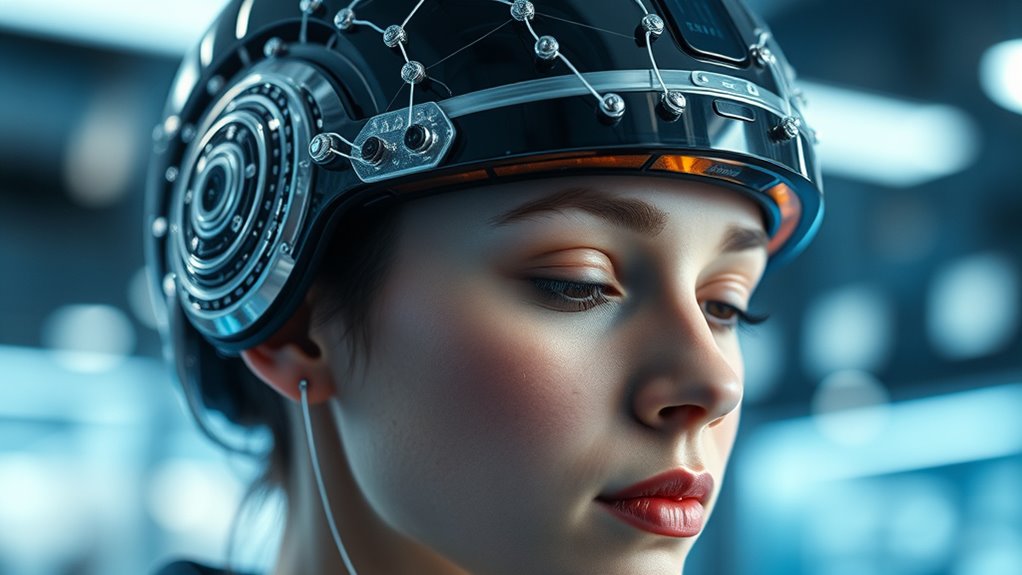

Brain-computer interfaces (BCIs) allow you to connect directly with devices by interpreting your brain signals and even sending information back into your mind. While reading neural activity enables new ways to control prosthetics or communication tools, writing thoughts raises ethical questions about mental privacy and autonomy. Concerns about manipulation and misuse of neural data mean safeguards are essential. If you keep exploring, you’ll discover how these technologies balance innovation with crucial considerations for your mental integrity.
Key Takeaways
- BCIs decode neural signals to interpret thoughts and intentions for communication and control of external devices.
- Neural decoding algorithms continuously improve accuracy in translating brain activity into digital commands.
- Writing thoughts involves neural stimulation, raising ethical concerns about mental privacy and autonomy.
- Risks include hacking, data misuse, and manipulation of mental states, necessitating strict safeguards and regulations.
- Ethical considerations focus on protecting mental privacy, consent, and ensuring responsible development of BCI technology.

Brain-Computer Interfaces (BCIs) are groundbreaking technologies that enable direct communication between your brain and external devices. They work by interpreting neural signals through neural decoding, a process that translates your brain’s electrical activity into commands your devices can understand. As you imagine moving a cursor or thinking a specific word, your brain emits electrical signals that BCIs can capture and decode. This technology opens up incredible possibilities, from restoring mobility for those with paralysis to controlling prosthetic limbs seamlessly. However, it also raises significant ethical implications that you should be aware of. Since BCIs can access your thoughts and intentions directly, questions about privacy, consent, and mental autonomy become critical. Who owns the decoded neural data? How do you guarantee your thoughts aren’t accessed or manipulated without your permission? These are complex issues that researchers and ethicists are actively debating.
When it comes to neural decoding, the process involves sophisticated algorithms that interpret patterns in brain activity. For example, if you think about moving your hand, the BCI’s algorithms recognize the specific neural signatures associated with that action. By continuously refining these decoding techniques, BCIs are becoming more accurate and responsive, enabling more natural interactions. Yet, the technology isn’t perfect, and decoding errors can occur, which underscores the need for strict safeguards and transparent data handling practices. The ethical implications extend beyond privacy concerns. There’s also the potential for misuse or unintended consequences, such as hacking into neural data or manipulating thoughts. Guaranteeing your mental integrity remains intact is crucial as this technology advances.
Furthermore, the idea of writing thoughts—not just reading them—introduces a new layer of ethical complexity. If BCIs can stimulate or induce specific neural patterns, there’s a risk of controlling or altering your mental state. This raises questions about free will and mental sovereignty. It’s essential that regulatory frameworks keep pace with technological developments to protect individuals like you from exploitation or coercion. As BCIs evolve, the balance between innovation and ethical responsibility becomes more critical. You must be aware of these concerns, advocating for strict standards to guard your rights and privacy. In essence, neural decoding is at the core of BCI functionality, transforming thoughts into digital signals. But with this power comes the obligation to address the ethical implications, ensuring that your mental privacy and autonomy are preserved as you explore the vast potential of brain-computer communication. Additionally, protecting biodiversity in the development and deployment of these technologies is important to ensure a sustainable and ethically responsible future.
Neurable Explained for Beginners: A Practical Guide to How Brain-Computer Interfaces Are Revolutionizing Gaming, Healthcare, and Accessibility
As an affiliate, we earn on qualifying purchases.
As an affiliate, we earn on qualifying purchases.
Frequently Asked Questions
How Secure Are Brain-Computer Interfaces Against Hacking?
Brain-computer interfaces are still developing, so their security isn’t foolproof. You face hacking vulnerabilities, especially if neural encryption isn’t strong enough. Hackers could potentially access or manipulate your neural data, risking privacy breaches. To stay safe, it’s vital that developers improve encryption standards and regularly update security protocols. While progress is promising, you should remain cautious about the potential risks and stay informed about the latest security measures.
Can BCIS Be Used for Memory Enhancement?
Yes, BCIs can be used for memory enhancement and cognitive augmentation. You can leverage this technology to improve your ability to recall information, sharpen focus, and boost learning efficiency. By directly stimulating specific brain regions, BCIs aim to strengthen memory pathways and optimize cognitive functions. This innovative approach holds promise for both everyday use and therapeutic applications, helping you open your brain’s full potential and enhance mental performance.
What Are the Ethical Concerns Surrounding Thought Privacy?
Thought privacy raises serious ethical implications, especially when BCI technology could access your innermost thoughts without consent. You might enjoy the convenience, but you also risk losing control over sensitive mental data. It’s vital to contemplate how data is protected and who has access. Protecting your thought privacy ensures that technological advances don’t compromise personal autonomy, keeping ethical concerns at the forefront as this technology evolves.
How Long Does It Take to Develop a New BCI Device?
Developing a new BCI device typically takes several years, often around 3 to 7 years, depending on the research complexity. You’ll need to navigate a lengthy device development timeline, which involves extensive research, iterative testing, and regulatory approval. The research complexity can lengthen this process, especially if you’re working on innovative or highly sophisticated technology. Patience and thorough planning are essential to bring a reliable BCI device to market.
Are There Any Risks of Long-Term Brain Damage From BCIS?
You might worry about long-term brain damage from BCIs, but current evidence suggests minimal risk if neural tissue isn’t harmed during implantation. For example, a case study shows no significant neural tissue deterioration after five years. However, device durability matters; prolonged use could cause inflammation or tissue scarring. While risks are low, ongoing research ensures safety, and proper device maintenance minimizes potential harm over time.

Human-Machine Interface Technology Advancements and Applications (Materials, Devices, and Circuits)
As an affiliate, we earn on qualifying purchases.
As an affiliate, we earn on qualifying purchases.
Conclusion
Brain-computer interfaces are transforming how you interact with technology, allowing thoughts to be read and written directly. Did you know over 150,000 people have already benefited from these devices worldwide? As research advances, you’ll find even more innovative applications emerging, making communication and control more seamless than ever. The future holds incredible potential—brace yourself for a world where your mind truly connects with machines in ways you never imagined.
Neurable Explained for Beginners: A Practical Guide to How Brain-Computer Interfaces Are Revolutionizing Gaming, Healthcare, and Accessibility
As an affiliate, we earn on qualifying purchases.
As an affiliate, we earn on qualifying purchases.

Clarity – 40Hz Sound Player by Gamma – Memory Sound Therapy – Memory & Brain Improvement Device – Brain Stimulator Device
40Hz Gamma Waves for Memory – Emits precisely tuned 40Hz gamma frequency tones. Research suggests this frequency can…
As an affiliate, we earn on qualifying purchases.
As an affiliate, we earn on qualifying purchases.