
If your current income is high and you want immediate tax savings, a Traditional IRA might suit you best since it offers a tax deduction now. But if you expect your income or tax rate to increase later, a Roth IRA could be better, providing tax-free withdrawals in retirement. Think about your future earnings and tax outlook before choosing. Keep exploring to find out how these options can fit into your long-term plan.

Get the latest gadgets delivered free — and shop member deals
- Fast, free delivery on millions of items
- Access to Prime Big Deal Days deals on October 6–7
- Prime Video, Amazon Music and more included
Key Takeaways
- Consider current income: high income favors traditional IRA for upfront tax deductions; lower income may benefit Roth for tax-free growth.
- Think about future tax rates: expect higher taxes later? Roth provides tax-free retirement income; if lower, traditional may be better.
- Evaluate immediate vs. future tax benefits: traditional IRA offers immediate deduction; Roth offers tax-free withdrawals.
- Assess long-term plans: Roth suits those wanting predictable tax-free income; traditional suits those seeking current tax relief.
- Stay aware of potential tax law changes to optimize long-term retirement strategies.
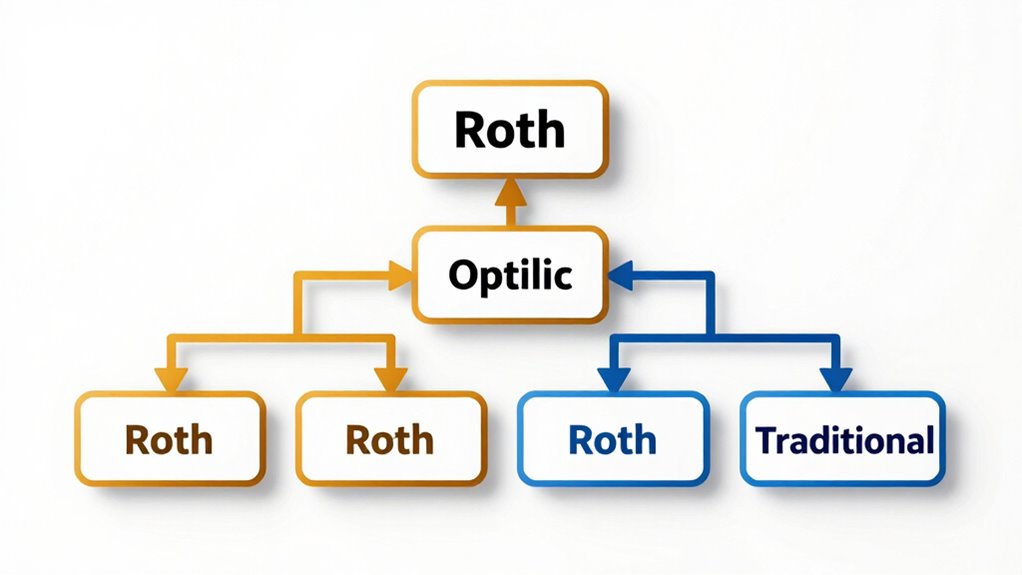
Are you unsure whether a Roth or traditional IRA is the right choice for your retirement savings? Making this decision can seem complicated, but understanding the key differences helps clarify your options. The choice mainly hinges on how you want to handle your retirement income and the tax implications involved. With a traditional IRA, you get an immediate tax benefit because your contributions are often tax-deductible. This means you lower your taxable income right now, which can be appealing if you expect your income to decrease in retirement. However, when you start withdrawing funds during retirement, those distributions are taxed as ordinary income, increasing your tax bill at that time. If your goal is to reduce your taxable income now and pay taxes later, a traditional IRA might be the better fit.
On the other hand, a Roth IRA offers no immediate tax deduction, but your contributions grow tax-free. When you retire and begin withdrawing, those distributions are generally free from federal taxes, providing a significant advantage if you anticipate being in the same or higher tax brackets in retirement. This setup is particularly appealing if you expect your income—and, consequently, your taxes—to be higher later, or if you prefer the certainty of tax-free income during retirement. The trade-off is that you don’t get the current-year tax break, so you might want to weigh your current income level and future expectations before choosing. Understanding the tax implications of each option can help you make a more informed decision. Additionally, considering the future tax landscape can influence which IRA type aligns best with your long-term financial goals. Being aware of tax laws and how they may change over time can also play a crucial role in your decision-making process. Being aware of potential tax law changes can help you plan more effectively for retirement.
As an affiliate, we earn on qualifying purchases.
Frequently Asked Questions
Can I Switch From a Traditional to a Roth IRA Later?
Yes, you can switch from a traditional to a Roth IRA later through a process called a Roth conversion. This move allows you to access different investment options, but keep in mind that you’ll need to pay taxes on the converted amount. Be aware of contribution limits, which still apply to the Roth account after the switch. Planning ahead helps you maximize benefits without exceeding limits or incurring penalties.
Which Is Better for Early Retirement Planning?
For early retirement planning, a Roth IRA often offers better benefits because of its tax implications—your withdrawals are tax-free, which boosts your savings. Investment strategies with a Roth allow you to grow your money tax-free, giving you more flexibility and potentially greater growth. However, if you expect to be in a lower tax bracket later, a traditional IRA might be advantageous. Consider your current and future tax situation to choose the best option.
How Do Income Limits Affect Roth IRA Eligibility?
You can’t contribute to a Roth IRA if your income exceeds certain limits, which vary annually. In 2023, singles earning over $153,000 lose eligibility entirely, and phase-out begins at $138,000. Income limits affect eligibility because they influence tax benefits and contribution limits. Tax implications of Roth accounts are attractive—they grow tax-free, making them ideal for those with higher earnings who want to maximize their retirement savings without worrying about future taxes.
Are Roth IRAS Suitable for High-Income Earners?
Roth IRAs aren’t usually suitable for high-income earners because of income limits, but if you qualify, they offer great benefits for retirement income and tax implications. You pay taxes upfront, so your withdrawals in retirement are tax-free, which can be advantageous if you expect higher future tax rates. However, if your income exceeds limits, traditional IRAs or other retirement accounts might be better options for maximizing your savings.
What Are the Penalties for Early Withdrawals?
If you withdraw early from a Roth IRA, you’ll face a 10% penalty and potential tax implications on earnings. However, there are penalty exceptions, like using funds for a first-time home purchase or qualified education expenses. You should always consider these penalty exceptions and tax implications before making early withdrawals, as they can considerably impact your savings. Planning carefully helps you avoid unnecessary costs and keeps your retirement goals on track.
Conclusion
So, now that you’ve seen the epic battle between Roth and Traditional IRAs, it’s clear your choice could shape your financial future for decades to come. Imagine retiring in absolute freedom, living your dream life, all because you made one simple decision today. Don’t let this moment slip away—pick the right account now, and watch your savings explode into an unstoppable force of wealth! Your future self will thank you forever.
Fall Picks
fall essentials
As an affiliate, we earn on qualifying purchases.