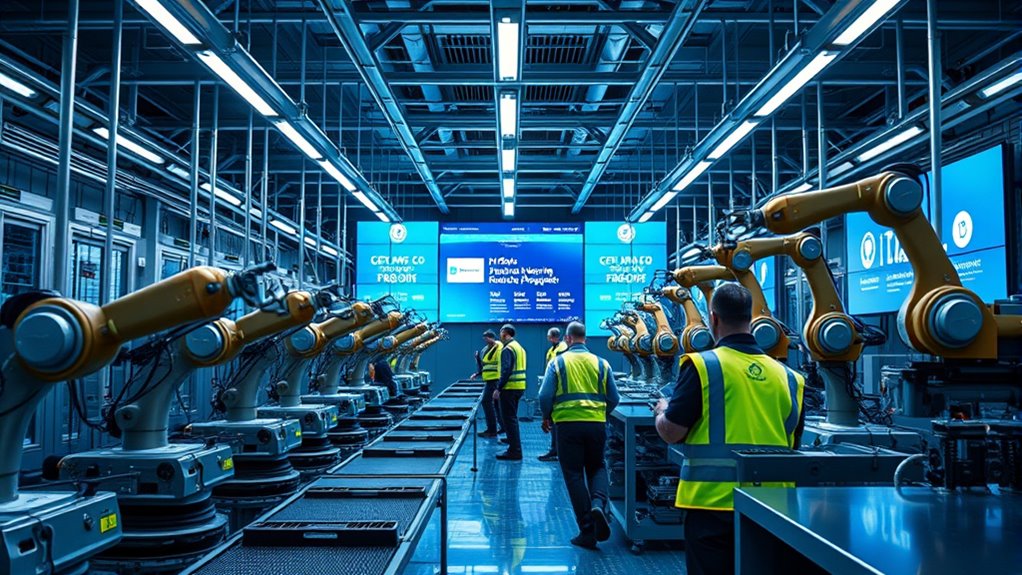

As automation increases, you’ll notice profits shifting from individual workers to platforms and automated systems. Companies automate tasks like marketing, sales, and payment processing, which boosts efficiency and cuts costs. This means more revenue flows to platform owners and automated channels, often at the expense of workers’ jobs and wages. If you want to understand how this trend impacts your work and future, explore the details below.
Key Takeaways
- Automation shifts profits from individual workers to platforms and automated systems, reducing reliance on human labor.
- Automated marketing and sales processes generate higher ROI and more revenue than manual efforts.
- Cost savings from automation decrease expenses and increase profit margins for companies.
- Automation diminishes job security, with many routine roles replaced or threatened by AI and robots.
- Profits increasingly flow to platform owners and automated channels, marginalizing traditional workforce contributions.

Automation is transforming how businesses operate, shifting profits and redefining roles across industries. As you adopt more advanced tools, you’ll notice a clear trend: profits increasingly flow from individual workers toward platforms and automated systems. This shift isn’t just about efficiency; it’s reshaping the entire economic landscape. For example, automating sales and marketing processes, such as email campaigns and data management, delivers quick returns. Most companies see positive ROI within a year, with some witnessing results in less than a month. Automated emails, especially welcome and cart abandonment flows, outperform manual efforts profoundly—converting nearly 50% of clicks compared to 5% for non-automated campaigns. This means the bulk of revenue generated online comes from automation-driven channels, reducing reliance on direct human engagement. Automation adoption is now widespread, with about 50% of companies utilizing marketing automation, making it a marketing baseline. Moreover, the principle of comparative advantage highlights how businesses can achieve greater efficiency through automation. Automation also cuts costs dramatically. In finance, payment processing automation saves hundreds of staff-hours annually, while invoice automation slashes processing expenses by over 60%. Businesses using robotic process automation (RPA) report receiving three times their investment over three years, highlighting how automation shifts profit margins away from labor-intensive activities. These tools cost a fraction of what human workers do, especially offshore or onshore, making it more economical to rely on algorithms than personnel for repetitive tasks. As a result, companies experience fewer errors, better quality control, and higher customer satisfaction—all of which boost profits. More than half of organizations report improved operational costs and customer experiences thanks to automation. However, these gains come with a cost: job displacement. AI and automation threaten up to 92 million jobs globally by 2030, although they could also create 78 million new roles. Still, nearly half of US workers worry about losing their jobs to AI within the next decade. Many routine tasks, like rekeying data or processing invoices, are now automated, reducing the need for human intervention. This shift means some workers’ wages and job security are at risk, while platform-based systems and automated processes capture a larger share of profits. High earners and certain sectors will likely benefit more, as automation enables companies to operate with fewer employees and lower costs. The bottom line is clear: as automation continues to advance, the traditional distribution of profits favors platforms and systems that streamline operations—leaving individual workers to face a future where their roles are diminished, and profits are concentrated in digital and automated channels.

No B.S. Guide to Successful Marketing Automation: The Ultimate No Holds Barred Guide to Using Technology, Automation, and Artificial Intelligence in Marketing
As an affiliate, we earn on qualifying purchases.
As an affiliate, we earn on qualifying purchases.
Frequently Asked Questions
How Will Automation Impact Overall Employment Levels Long-Term?
Automation will likely lead to a mixed long-term impact on employment. You’ll see job displacement in routine roles like clerical work and manufacturing, but new opportunities will emerge in tech, healthcare, and AI oversight. While overall employment might grow, certain sectors and worker groups will face challenges, especially without reskilling. You’ll need to adapt by learning new skills to stay relevant in a shifting job market shaped by automation.
What Industries Are Most Affected by Profit Shifts Due to Automation?
You’ll notice that industries like manufacturing, retail, and hospitality are most affected by profit shifts due to automation. In manufacturing, robots and AI handle tasks once done by workers, boosting platform owners’ profits. Retail and hospitality use automation for customer service, check-ins, and inventory, shifting earnings to platform operators. These sectors benefit financially from automation, often at the expense of traditional jobs and local businesses, as profits move to platform owners and tech providers.
Are There Policies to Protect Displaced Workers From Automation?
Imagine a ship steering stormy seas, with automation threatening to toss displaced workers overboard. Policies now act as lifeboats, offering some protection. You’re protected by laws requiring transparency, anti-discrimination safeguards, and worker rights to challenge automated decisions. While these measures don’t fully prevent displacement, they ensure you’re informed and have avenues for recourse, helping you stay afloat amid rapid technological change.
How Do Platform Companies Leverage Automation to Increase Profits?
Platform companies leverage automation to boost profits by streamlining operations, reducing costs, and enhancing scalability. You’ll see them implement RPA to cut manual tasks, automate customer interactions, and optimize supply chains using AI-driven analytics. This allows you to serve more customers efficiently, increase revenue, and improve margins, all while minimizing labor expenses. Automation also enables personalized marketing and data-driven decision-making, helping you stay competitive and maximize profitability in a rapidly evolving digital landscape.
What Skills Will Be Most Valuable in an Automated Economy?
In an automated economy, your adaptability and human skills become your greatest assets. You’ll find that analytical thinking, creativity, leadership, and a hunger for lifelong learning are highly valued. Developing technological literacy, like programming and data visualization, boosts your relevance. Staying flexible and resilient helps you navigate rapid changes. Embrace these skills, and you’ll not only survive but thrive, turning technological shifts into opportunities for growth and influence.

Instrument and Automation Engineers' Handbook: Process Measurement and Analysis, Fifth Edition – Two Volume Set
As an affiliate, we earn on qualifying purchases.
As an affiliate, we earn on qualifying purchases.
Conclusion
As automation continues its relentless march, you can feel the landscape shifting beneath your feet like an unstoppable tidal wave. Profits are pouring into platform owners’ pockets while workers are left in the shadows, barely clinging to scraps. The future’s clear: as machines take over, the chasm between the few who profit and the many who struggle widens into an abyss so vast, it could swallow the very fabric of our society. Buckle up—change isn’t just coming; it’s already here.
Robotic Process Automation: Guide To Building Software Robots, Automate Repetitive Tasks & Become An RPA Consultant
As an affiliate, we earn on qualifying purchases.
As an affiliate, we earn on qualifying purchases.

Email Marketing Rules: Checklists, Frameworks, and 150 Best Practices for Business Success
As an affiliate, we earn on qualifying purchases.
As an affiliate, we earn on qualifying purchases.