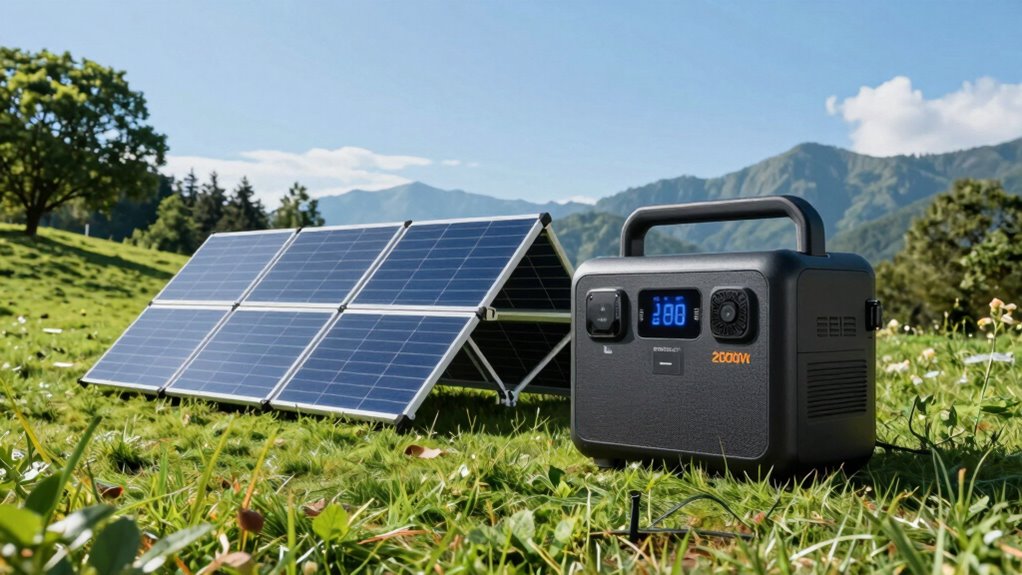
For most buyers seeking a 2000W solar generator kit, my best overall pick is the BLUETTI Elite 200 V2 bundle, which pairs a 2073.6Wh power station with two 200W panels. The Jackery Explorer 2000 v2 kit is another strong choice for buyers who want a similarly sized station with two panels, while the Jackery HomePower 3000 suits those who need more storage capacity. The main tradeoff is that inverter output, battery capacity, and included solar panels answer different needs: a 2000W rating does not tell you how long a unit can run an appliance or how quickly it can recharge. I compare all 13 options by power, storage, solar kit, and practical fit so you can choose a setup for home backup, travel, or off-grid use.

Get the latest gadgets delivered free with Prime
- Fast, free delivery on millions of items
- Prime Video, Amazon Music and more included
- Member-only deals all year
Complete the kit


Key Takeaways
- The BLUETTI Elite 200 V2 bundle has the clearest all-around match for this roundup’s 2000W search intent: it combines a 2073.6Wh battery with two 200W solar panels.
- Two 200W panels recur in the stronger full-kit options, including the BLUETTI Elite 200 V2 and Jackery Explorer 2000 v2; panel count matters because a power station alone does not provide solar recharging.
- Capacity varies as much as output. The OUPES Mega 1 kits list 1024Wh, while the Jackery HomePower 3000 and 3600 Plus offer a different fit for buyers prioritizing larger storage.
- A product labeled for a 2000W inverter is not automatically a 2000Wh battery system. The wind-and-solar kit lists a 2000W inverter alongside a 1000W generator description, so buyers should verify continuous output and energy capacity separately.
- Several bundles prioritize portability or a smaller setup over long runtimes. The 576Wh station and 1000Wh-class options can suit lighter loads, but they are not direct substitutes for higher-capacity home-backup systems.


| solar generator kit 2000w | Battery capacity | AC output |
|---|---|---|
| ABOK Ark2000 1536Wh Power Stat | — | 2000W pure sine wave |
| BLUETTI Elite 200 V2 Solar Gen | — | — |
| 1000W Wind and Solar Generator | — | — |
| OUPES Mega 1 Solar Generator w | 1024Wh, expandable to 5120Wh | 2000W pure sine wave |
| Jackery Solar Generator 1000 V | 1070Wh | 1500W |
| OUPES Mega 1 Solar Generator w | 1024Wh | 2000W |
| Jackery HomePower 3000 Portabl | — | 3600W |
| AUECOOR 880W Solar Panel and W | — | — |
| Jackery Explorer 2000 v2 Porta | 2042Wh | 2200W |
| OUPES Mega 1 Lite Solar Genera | 1024Wh | — |
| Portable Power Station 2000W P | 576Wh | — |
| Jackery HomePower 3600 Plus Po | 3,584Wh | 3,600W |
| EBL 1000W Portable Power Stati | 999Wh | — |
More Details on Our Top Picks
ABOK Ark2000 1536Wh Power Station with Asp200 200W Solar Panel
The ABOK Ark2000 makes sense for buyers who want a 2000W inverter and a useful starter panel without locking themselves into the included battery capacity. Its 1536Wh LiFePO4 battery is larger than the OUPES Mega 1’s 1024Wh pack, and ABOK offers expansion to 3072Wh or 4608Wh with separately sold batteries. That gives it a clearer growth path for longer outages or RV use, though the add-on cost and separate battery purchase are part of the plan. The included 200W foldable panel is a stronger solar starting point than OUPES’s 100W panel, but the station can accept up to 1200W of solar, so one panel will not approach its maximum input. Eight ports support several devices at once; note that the station and panel may arrive in separate shipments.
Pros:- Includes a foldable 200W solar panel
- 1536Wh LiFePO4 battery can expand to 4608Wh with add-on batteries
- Eight output ports support multiple devices
- Rated for 4000+ battery cycles
Cons:- Expansion batteries are sold separately
- Station and solar panel may arrive in separate packages
- The included 200W panel is well below the 1200W maximum solar input
Best for: RV travelers and household backup buyers who want a 2000W station with room to expand capacity later.
Not ideal for: Buyers who need a complete high-capacity system immediately or want the panel and station guaranteed to arrive together.
- Power station capacity:1536Wh
- AC output:2000W pure sine wave
- Included solar panel:200W Asp200 foldable panel
- Maximum solar input:1200W
- Outputs:8: 3 AC, 2 USB-A, 2 USB-C, 1 12V car port
- Battery chemistry:LiFePO4
- Battery cycle life:4000+ cycles
- Expandable capacity:3072Wh or 4608Wh with separately sold batteries
Our verdict“Choose the ABOK if you want a 2000W kit that can grow beyond its included 1536Wh capacity and can accept a modest initial solar harvest.”
BLUETTI Elite 200 V2 Solar Generator with Two 200W Solar Panels, 2073.6Wh
For buyers prioritizing appliance headroom, the BLUETTI Elite 200 V2 has the strongest continuous AC rating in this group: 2600W from a 2073.6Wh battery. That gives it more room for demanding loads than the ABOK Ark2000’s 2000W output, while its two included 200W panels provide a 400W solar array out of the box. The tradeoff is that its stated 2.4-hour solar charge time assumes 1000W of panels, not the included pair; the supplied array will not match that pace. Its over-6000-cycle LiFePO4 battery is a standout longevity figure, and charging can also use AC or an alternator. Choose this kit for higher output and a larger starter array, not for minimal charging gear or the lightest setup.
Pros:- 2600W continuous AC output exceeds the 2000W rating of the ABOK Ark2000
- Includes two 200W solar panels
- 2073.6Wh capacity and support for up to nine devices
- LiFePO4 battery rated for over 6000 cycles
Cons:- Panels and power station ship separately
- The 2.4-hour solar charging claim requires 1000W of panels
- Fast alternator charging requires a separate BLUETTI Charger 2
Best for: Campers, RV owners, and backup-power buyers running multiple appliances who want more than 2000W of continuous AC output.
Not ideal for: Buyers who need the advertised fastest solar charging with only the panels in the box or who want a lower-output, simpler kit.
- Capacity:2073.6Wh
- Continuous AC output:2600W
- Power lifting mode:3900W
- Included solar panels:2 × 200W
- Battery chemistry:LiFePO4
- Battery cycle life:Over 6000 cycles
- Maximum simultaneous devices:9
- Solar charging time:2.4 hours with 1000W of panels
- AC and DC charging:0–80% in 50 minutes
Our verdict“Pick the Elite 200 V2 if appliance headroom and a larger included solar array matter more than matching its fastest charging claims with the box contents.”
1000W Wind and Solar Generator Kit with 2000W Inverter, 400W Wind Turbine, and Flexible Solar Panels
This kit differs from the battery-based ABOK and BLUETTI systems: it is a 12V or 24V wind-and-solar generation setup with a 2000W inverter, controllers, cables, turbine, and flexible panels. That makes it more suited to a buyer assembling an off-grid system for a boat, vehicle, or fixed site than someone seeking a ready-to-use portable power station with stored capacity. The six flexible panels can bend to a 30-degree arc, which may help on curved mounting surfaces, while the 400W turbine adds a generation source the other kits do not offer. But the supplied information is less settled: panel wattage is listed as 100W in the title and 120W in the package contents, and no battery capacity is specified. Compared with the BLUETTI kit, this asks for more system planning and leaves key performance details unclear.
Pros:- Combines a 400W wind turbine with flexible solar panels
- Panels can bend to a 30-degree arc for curved or uneven mounting
- Includes wind and solar charge controllers and connector cables
- Supports 12V or 24V system configurations
Cons:- Panel wattage conflicts between the title and package contents
- No battery capacity or complete performance details are provided
- Requires system-level planning rather than offering a ready-to-use battery station
Best for: Off-grid builders fitting a 12V or 24V vehicle, boat, or site who want both wind and solar generation components.
Not ideal for: Buyers seeking a self-contained power station with a specified battery capacity, straightforward setup, or clear verified panel wattage.
- Inverter power:2000W
- Wind turbine power:400W
- Wind turbine blades:6
- Starting wind speed:2.5 m/s
- Solar panels:6 flexible monocrystalline panels; wattage listed as 100W in the title and 120W in package contents
- Maximum panel bend:30-degree arc
- System voltage:12V or 24V
- Solar charge controller:50A
- Included cables:One pair of 5m connector cables: 2.5m red and 2.5m black
Our verdict“Choose this kit for a custom wind-and-solar installation, but skip it if you need a self-contained 2000W power station with clearly specified storage.”
OUPES Mega 1 Solar Generator with 100W Solar Panel, 1024Wh LiFePO4 Battery
The OUPES Mega 1 is a 2000W-output station in a lighter, lower-capacity package than the ABOK Ark2000. Its 1024Wh battery means less stored energy before recharging, but its 27.8-pound weight and UPS mode make it a practical choice for portable backup where quick handoff matters. The included 100W panel is smaller than the ABOK’s 200W panel, and well below OUPES’s own 800W solar-input ceiling, so meaningful solar replenishment may call for more panels. Its stated AC recharge time—0–80% in 36 minutes—is the standout if wall charging is available. With 13 ports, app control, and expansion to 5120Wh, it offers flexibility, but reaching that capacity requires extra batteries. This is a different priority from the BLUETTI Elite 200 V2, which starts with more capacity and two panels.
Pros:- 2000W pure sine wave output with 4500W surge capacity
- AC charging reaches 80% in a stated 36 minutes
- 13 ports, app control, and UPS mode with under-20ms transfer time
- Capacity can expand to 5120Wh with additional batteries
Cons:- 1024Wh capacity is lower than the ABOK Ark2000 and BLUETTI Elite 200 V2
- Included 100W panel is far below the 800W maximum solar input
- Expanded capacity requires separately purchased batteries
Best for: Users who need a portable 2000W station for short outages or travel and value fast wall charging, UPS operation, and port variety.
Not ideal for: Buyers who need long runtimes from the included battery or expect a 100W panel to make full use of the 800W solar input.
- Battery capacity:1024Wh, expandable to 5120Wh
- Battery type:LiFePO4
- AC output:2000W pure sine wave
- Surge output:4500W
- Included solar panel:100W
- Maximum solar input:800W
- Ports:13 total: 4 AC, 2 USB-C, 4 USB-A, 2 DC5521, 1 car socket
- AC recharge time:0–80% in 36 minutes
- Weight:27.8 lbs
Our verdict“Choose the Mega 1 when portability and fast AC recharge outweigh the need for a large included battery or solar array.”
Jackery Solar Generator 1000 V2 with 200W Solar Panel
At 23.8 pounds with a foldable handle, the Jackery Solar Generator 1000 V2 is the easiest of these battery-based kits to carry, but it is not a true 2000W-output option: its AC rating is 1500W. That distinction matters if the roundup’s 2000W target means running a load near that level; the ABOK Ark2000 and OUPES Mega 1 can supply 2000W continuously, while this Jackery cannot. In return, it pairs a 1070Wh LFP battery with a 200W panel and a compact port selection suited to trip essentials. App controls include a quiet overnight mode, and emergency charging can reach a full charge in one hour when enabled. That fast-charge mode is conditional, not the ordinary charging expectation, and the panel and station ship separately.
Pros:- Lightest listed battery-based station in this group at 23.8 lbs
- Includes a 200W solar panel with a 1070Wh LFP battery
- 100W USB-C PD and app charging controls, including quiet overnight mode
- Battery is rated to retain over 70% capacity after 4000 charge cycles
Cons:- 1500W AC output falls short of the 2000W target and the ABOK and OUPES ratings
- One-hour full charging requires emergency mode in the app
- Solar panel and power station ship separately
Best for: Campers and travelers who prioritize a lighter, easy-to-carry kit for devices and moderate appliances below its 1500W AC limit.
Not ideal for: Buyers who need 2000W continuous AC output, a larger device-port selection, or a full charge without enabling emergency mode.
- Battery capacity:1070Wh
- Battery type:LFP
- AC output:1500W
- Surge peak:3000W
- Weight:23.8 lbs
- Included solar panel:200W
- Ports:3 AC, 2 USB-C, 1 USB-A, 1 DC car port
- USB-C charging:100W PD
- Battery lifespan:Over 70% capacity after 4000 charge cycles
Our verdict“Pick the Jackery for lighter trips and moderate loads, but choose the ABOK or OUPES if you specifically need 2000W continuous output.”
OUPES Mega 1 Solar Generator with 240W Solar Panel, 1024Wh LiFePO4 Battery
The OUPES Mega 1 pairs a full 2000W AC output with a 240W panel and a 1024Wh LiFePO4 battery, making it a balanced pick for buyers who want portable backup and a path to more storage. Its capacity is far below the Jackery HomePower 3000, but the OUPES weighs 27.8 pounds and can expand to 5120Wh with an optional B2 battery. That upgrade route suits changing needs without starting with a larger power station. Simultaneous AC and solar charging adds flexibility when sunlight alone is too slow, while app monitoring and a 20ms UPS switch help with everyday backup. The tradeoff is that the included panel is modest for a 1024Wh battery, and expansion requires a separate battery. I’d choose it for portability and modular growth, not maximum capacity out of the box.
Pros:- 2000W AC output in a 27.8-pound power station
- Includes a 240W monocrystalline solar panel
- LiFePO4 battery rated for 3500+ cycles
- Expandable to 5120Wh with an optional B2 battery
Cons:- The 240W panel may take 5–8 hours to recharge, depending on sunlight
- Reaching the expanded capacity requires buying a separate B2 battery
Best for: Campers and outage-prepared households who want a 2000W portable station with included solar and the option to add storage later
Not ideal for: Buyers who need several days of household backup immediately or want fast solar recovery from the included panel
- Battery capacity:1024Wh
- Battery chemistry:LiFePO4
- AC output:2000W
- Included solar panel:240W monocrystalline
- Solar recharge time:5–8 hours, depending on sunlight
- Expandable capacity:Up to 5120Wh with optional B2 battery
- UPS switch time:20ms
- Weight:27.8 lbs
Our verdict“Choose the OUPES Mega 1 if you want a portable 2000W kit that can grow beyond its included 1024Wh capacity.”
Jackery HomePower 3000 Portable Power Station with Two 200W Solar Panels
For buyers who put stored energy ahead of portability, the Jackery HomePower 3000 brings 3072Wh of capacity and 3600W AC output—substantially more reserve and headroom than the 1024Wh OUPES Mega 1. That makes it better suited to keeping several household essentials running through a longer outage, and its TT-30 RV port also broadens its use beyond the home. A 20ms UPS and multiple charging methods add practical flexibility; AC charging is listed at 2.2 hours, with hybrid AC and DC charging at 1.7 hours. The two 200W panels help provide solar input, though the stated solar time is up to nine hours to reach 80%. The station and panels may ship separately, so this is less convenient as a single ready-to-go package than the Jackery Explorer 2000 v2 kit.
Pros:- 3072Wh capacity and 3600W AC output suit heavier backup loads
- UPS transfer time of 20ms supports essential devices
- Includes two 200W solar panels and supports several charging methods
- LiFePO4 battery rated for 4000 cycles to 70% capacity
Cons:- Solar charging takes up to nine hours to reach 80% with the included panels
- Power station and solar panels may ship separately
Best for: Households or RV owners who need substantial stored power, high AC output, and a broad mix of charging and connection options
Not ideal for: Campers prioritizing a lighter carry or buyers who need the station and panels to arrive together as one shipment
- Capacity:3072Wh
- AC output:3600W
- Surge output:7200W
- Included solar panels:2 × 200W
- Battery type:LiFePO4
- Battery cycle life:4000 cycles to 70% capacity
- AC recharge time:2.2 hours
- Ports:AC, USB-C, USB-A, DC, TT-30 RV
Our verdict“Pick the HomePower 3000 when long backup duration and high output matter more than compact size or a simpler solar recharge plan.”
AUECOOR 880W Solar Panel and Wind Turbine Hybrid System Kit
The AUECOOR hybrid kit differs from portable power stations in this lineup: it is a build-out for a fixed off-grid site, combining rigid panels, a wind turbine, batteries, controller, and 2000W inverter. That integrated generation approach can suit a cabin or outbuilding where wind and sun are both available, while a portable option such as the Jackery Explorer 2000 v2 is easier to move and arrives with its energy storage in one power station. AUECOOR’s four rigid panels have pre-drilled mounting and grounding holes, and the turbine is specified to start at 2.5 m/s wind speed. Still, the 880W maximum solar rating is not the same as 2000W continuous generation, and the supplied battery data gives no watt-hour capacity or runtime. I’d only choose this kit if you can handle installation and can verify the storage and system compatibility before purchase.
Pros:- Combines solar and wind generation in one off-grid kit
- Includes a 2000W inverter, dual MPPT controller, batteries, cables, and mounting brackets
- Rigid panels include pre-drilled mounting and grounding holes
- Five-blade turbine is specified to start at 2.5 m/s
Cons:- Generation depends on suitable sunlight and wind conditions
- Battery capacity in watt-hours and expected runtime are not specified
- Fixed panels and turbine require installation rather than simple portable setup
Best for: Off-grid cabin owners or hands-on buyers planning a mounted solar-and-wind system with a 2000W inverter
Not ideal for: People seeking a portable, ready-to-use 2000W battery station or buyers who need clearly stated watt-hour storage and runtime
- Maximum power:880W
- Solar panels:4 × 120W rigid panels
- Wind generator:400W, 5-blade
- Power inverter:2000W
- Charge controller:Dual MPPT hybrid
- Batteries:2 × 100Ah LiFePO4
- Minimum turbine start wind speed:2.5 m/s
- Panel dimensions:40 × 20 × 5 inches
Our verdict“Choose AUECOOR for a mounted off-grid system with both solar and wind input, not as a portable 2000W generator kit.”
Jackery Explorer 2000 v2 Portable Power Station with Two 200W Solar Panels
The Jackery Explorer 2000 v2 lands between compact 1024Wh choices like the OUPES Mega 1 and larger-capacity stations such as the Jackery HomePower 3000. Its 2042Wh battery and 2200W AC output give it meaningful backup capacity without stepping up to the HomePower’s 3072Wh bulk. The bundle includes two 200W solar panels, with a stated six-hour solar charging time, making it a more substantial solar starting point than the Mega 1’s 240W panel. For grid charging, the supplied figures list 80% in 66 minutes and a 102-minute full charge in Emergency Super Charging mode. Three AC outlets and a 100W USB-C PD port cover common devices, while 20ms UPS switching supports backup use. The main caveats are shipment separation and a possible plug change when connecting Jackery panels; it’s less suited to buyers who need more than 2042Wh stored.
Pros:- 2042Wh capacity paired with 2200W AC output
- Includes two 200W solar panels with a stated six-hour charging time
- AC charging reaches 80% in 66 minutes
- 20ms UPS switching and a 100W USB-C PD port support backup and device charging
Cons:- Power station and solar panels may ship separately
- Connecting Jackery panels may require switching to a straight DC8020 plug
- Lower capacity than the 3072Wh Jackery HomePower 3000
Best for: Campers and homeowners who want a mid-capacity 2000W-class station, included 400W of solar panels, and fast AC recharging
Not ideal for: Households seeking the longer reserve of a 3000Wh-class station or buyers who want a guaranteed single-shipment bundle
- Battery capacity:2042Wh
- AC output:2200W
- AC outlets:3
- USB-C PD output:100W
- Battery type:LiFePO4
- Included solar panels:2 × 200W
- AC charging time:80% in 66 minutes; full charge in 102 minutes with Emergency Super Charging mode
- UPS switching time:20ms
Our verdict“Choose the Explorer 2000 v2 for a balanced 2000W-class bundle with 400W of included solar, provided 2042Wh is enough for your backup needs.”
OUPES Mega 1 Lite Solar Generator with 100W Panel
The OUPES Mega 1 Lite delivers a 1024Wh LiFePO4 battery and 2000W rated AC output in a 26.7-pound package, but its strongest case is fast grid charging rather than solar speed. The listed 46-minute full AC recharge can help when power returns briefly or before a trip. It also has four AC outlets, nine total ports, and two 140W USB-C PD ports, giving it more connection flexibility than the OUPES Mega 1 with 240W panel. Its included 100W foldable panel is the key compromise: solar replenishment will be more limited than with that other OUPES bundle or the Jackery Explorer 2000 v2’s two 200W panels. Both OUPES models offer 1024Wh storage and 2000W output, so I’d favor the Lite for fast AC charging and device ports, not for buyers relying chiefly on the included solar panel.
Pros:- 2000W rated AC output with 4500W surge output
- Listed AC recharge time is 46 minutes from 0% to 100%
- Two 140W USB-C PD ports and nine total ports
- LiFePO4 battery rated for 3500+ cycles to 80% capacity
Cons:- Included 100W panel is modest for a 1024Wh battery
- 26.7-pound weight may be inconvenient for frequent carrying
- No battery expansion capacity is specified in the supplied product data
Best for: Road-trippers and campers who value fast wall charging, strong USB-C output, and a lightweight 2000W-class station
Not ideal for: Solar-first users who want faster replenishment from the included panel or households needing more than 1024Wh of stored energy
- Battery capacity:1024Wh
- Battery chemistry:LiFePO4
- Surge output:4500W
- Included solar panel:100W foldable monocrystalline
- AC recharge time:46 minutes from 0% to 100%
- USB-C ports:2 × 140W PD
- Weight:26.7 lbs
Our verdict“Pick the Mega 1 Lite if fast AC recharge and high-output USB-C ports matter more to you than rapid solar charging.”
Portable Power Station 2000W Peak, 576Wh LiFePO4 Battery Solar Generator
For a 2000W-peak kit that stays easy to carry, this 14.8-pound station trades stored energy for portability. Its 1,000W continuous output can handle listed appliances such as a 700W microwave or 1,000W coffee maker, while the 576Wh battery is better suited to short jobs than long outages. Compared with the EBL 1000W Portable Power Station, it has less capacity but a lighter listed weight and four AC outlets instead of two. The LiFePO₄ chemistry and stated 3,000-plus-cycle life suit repeat use, and 300W solar input gives it a path to off-grid recharging, though panels are sold separately. Its main compromise is clear: high peak output does not make up for modest capacity when running energy-hungry devices for hours.
Pros:- 14.8-pound listed weight makes it easier to carry than the 22-pound EBL 1000W Portable Power Station.
- Four pure sine wave AC outlets support several compatible devices at once.
- LiFePO₄ battery is rated for more than 3,000 cycles to 80% capacity.
- Supports up to 300W solar input and pass-through charging.
Cons:- 576Wh capacity limits runtime compared with higher-capacity options such as the Jackery HomePower 3600 Plus.
- Solar panels and car cables are sold separately.
- The 1,000W continuous rating rules out appliances that need more sustained power.
Best for: Campers, mobile DIY users, and people needing a light backup for short outages who prioritize easy carrying and several AC outlets.
Not ideal for: Buyers planning extended backup or long runtimes for appliances; 576Wh is limited, and solar panels must be purchased separately.
- Battery capacity:576Wh
- Continuous AC output:1,000W
- Peak AC output:2,000W
- Battery chemistry:LiFePO₄
- Weight:14.8 lb
- AC outlets:4 pure sine wave outlets
- Maximum solar input:300W MPPT
- Cycle life:3,000+ cycles to 80% capacity
Our verdict“Choose this station for portable, short-duration power and skip it if your priority is long runtimes between charges.”
Jackery HomePower 3600 Plus Portable Power Station with Two 200W Solar Panels
This is the lineup’s capacity-first choice, with 3,584Wh and 3,600W output—well beyond what a 2,000W-focused buyer needs for basic camping, but useful when backup loads are larger or last longer. Its two included 200W panels make it a more complete solar kit than the Portable Power Station 2000W Peak, 576Wh, which requires a separate panel purchase. The wheeled frame and telescopic handle help manage the larger unit, while AC, solar, gas-generator, and hybrid charging offer more ways to replenish it. Expansion and parallel operation add headroom, although dual voltage requires parallel use, and the station and panels may arrive separately. Compared with the EBL 1000W model, this Jackery is far more capable but also a less compact fit for buyers who only need portable, modest-output power.
Pros:- 3,584Wh capacity and 3,600W output provide substantially more storage and power than the smaller units in this batch.
- Includes two 200W solar panels for a ready-to-use solar setup.
- AC, solar, gas-generator, and hybrid charging provide several recharging routes.
- Wheels and a telescopic handle make the large station easier to move.
Cons:- Station and panels may arrive in separate packages.
- Dual voltage requires parallel use rather than a standalone setup.
- Its size and feature set may be excessive for buyers who need only a compact camping station.
Best for: Households seeking substantial outage storage, buyers who want included solar panels, and users who may expand capacity or pair units for higher output.
Not ideal for: Campers seeking a light, simple 2,000W-peak setup; its larger capacity, wheeled design, and parallel-use requirements are more than many portable-power needs call for.
- Battery capacity:3,584Wh
- AC output:3,600W
- Parallel output:Up to 7,200W
- Expandable capacity:Up to 21kWh per unit or 43kWh with multiple units
- Battery cycle life:6,000 cycles
- Included solar panels:Two 200W panels
- Hybrid charging time:2 hours
- Solar charging time:4 hours
Our verdict“Pick this Jackery for longer home-backup needs and expandable power, not for a lightweight station sized around occasional 2,000W-peak use.”
EBL 1000W Portable Power Station with 200W Solar Panel
The EBL is the straightforward pick for buyers who want a panel included from the start rather than shopping separately. Its 999Wh battery is notably larger than the 576Wh Portable Power Station 2000W Peak, while both list 1,000W running output and 2,000W peak output. That extra stored energy can support longer use at comparable loads, though the stated runtime still depends on what is connected. The included 200W monocrystalline panel and MPPT charging give campers a practical solar-recharging path, and its AC, USB, DC, car, and wireless outputs cover varied devices. The tradeoff is portability: at 22 pounds, it is heavier than the 14.8-pound station. Buyers should also treat the 2,000W figure as peak capacity, not permission to run devices above its 1,000W continuous limit.
Pros:- Includes a 200W monocrystalline solar panel for off-grid recharging.
- 999Wh capacity exceeds the 576Wh Portable Power Station 2000W Peak.
- Multiple AC, USB, DC, car, and wireless outputs support different device types.
- Battery protection includes overcharge, short-circuit, surge, and overheating safeguards.
Cons:- 1,000W running output cannot support devices that require more continuous power.
- At 22 pounds, it is heavier than the 14.8-pound Portable Power Station 2000W Peak.
- Actual runtime varies with load and conditions, so the listed one-hour runtime is not universal.
Best for: Campers and off-grid users who want a roughly 1kWh battery, an included 200W solar panel, and multiple device-charging options in one package.
Not ideal for: People who need to run appliances above 1,000W continuously or frequently carry their station over long distances.
- Battery capacity:999Wh
- Running output:1,000W
- Peak output:2,000W
- Included solar panel:200W monocrystalline
- Solar panel efficiency:23.5%
- USB-C port:60W PD
- AC outlets:2
- Weight:22 lb
Our verdict“Choose the EBL if you want a larger battery and included solar panel in one kit, provided your continuous loads stay within 1,000W.”

How We Picked
I ranked these kits by how well their stated specifications serve buyers searching for a 2000W-class solar generator. The main criteria were inverter output where specified, battery capacity in watt-hours, the number and rated wattage of included panels, and whether the product description clearly identifies a usable complete system. I also weighed practical fit: a compact station can make sense for shorter outages or mobile use, while a larger battery and more panel capacity are better suited to longer backup periods.
The ranking favors clear, balanced bundles that pair substantial storage with included solar panels, rather than treating a high peak-watt figure as proof of long runtime. Products with less capacity or less solar equipment rank lower for extended use, even if they may suit lighter needs. Wind-hybrid kits and systems with ambiguous power labels are judged by their distinct use case and the need to confirm specifications before purchase; I do not assume unstated continuous output, expansion support, or charging performance.
Factors to Consider When Choosing Solar Generator Kit 2000w
Before choosing a kit, I separate three questions that product names often blur: what can the inverter run, how long can the battery run it, and how quickly can the included panels refill the battery? These factors help match a system to actual loads rather than a headline wattage.
Match Continuous Output to Your Appliances
A 2000W label may refer to continuous inverter output, peak output, or a component in a larger kit, so check the specification sheet for the exact meaning. Add the running wattage of the devices you expect to use at the same time, then leave headroom for appliances with startup surges. Refrigerators, pumps, and some power tools can briefly draw more than their normal operating wattage. A kit advertised as a 2000W inverter is not necessarily able to sustain that load continuously. If the listed details say only “peak,” ask the manufacturer for continuous output before relying on it for backup.
Use Watt-Hours to Estimate Runtime
Battery capacity, measured in watt-hours, is a better starting point for runtime than inverter wattage. Divide the battery’s stated capacity by the combined appliance draw for a rough estimate, then allow for conversion losses and the fact that real loads can vary. A 1024Wh unit and a 2000Wh-class unit can run the same device at similar power, but the larger battery can generally supply it for longer. Common planning mistakes include counting a refrigerator’s running draw as a constant load or assuming the full rated capacity reaches AC devices. Check usable capacity and operating conditions in the product documentation when runtime matters.
Check Panel Wattage Against Solar Input Limits
Included panel wattage indicates the bundle’s potential solar collection, not a guaranteed charging rate. Cloud cover, panel angle, season, shade, and the station’s solar input limit all affect how much energy reaches the battery. Before paying for extra panels, confirm the maximum solar input and supported voltage and connector range; panels beyond that limit may not speed charging. Bundles with two 200W panels offer more stated panel capacity than a single 100W or 200W panel, but they still need suitable sunlight and compatible connections. For frequent off-grid use, factor in a realistic daily energy budget rather than planning around peak panel ratings.
Decide Whether a Full Kit or Separate Components Fit Better
A bundled station and panels reduce the effort of matching components, which can make a complete kit a sensible choice for first-time buyers. Separate purchases may give experienced users more freedom to select panel size, mounting, and cable length, but compatibility becomes their responsibility. Check whether the advertised bundle includes all required cables and adapters, and whether the panels fold for transport or are intended for fixed placement. Wind-hybrid systems add another charging source but also bring installation, siting, and equipment-compatibility questions. Choose a hybrid setup only when its wind component suits your location and the product documentation clearly explains the included parts.
Balance Portability Against Backup Capacity
More battery capacity can mean a heavier, larger station, so think about where the unit will sit and how often it must move. A compact 576Wh or 1024Wh model may be easier to carry and adequate for phones, lights, and shorter backup needs, but it offers less stored energy than larger options. Home backup buyers may prefer capacity and outlet access over easy lifting, while campers may value manageable size and a folding panel setup. Check the product’s stated weight, dimensions, handle design, and charging connections instead of inferring portability from its name. If you expect to move a station between a vehicle and home, include the panel package in that assessment.
Choose for Your Loads, Not a Headline Number
Write down the devices you need to power, their wattage, and the number of hours you expect to run them; this exposes whether output, capacity, or solar recharge is your main constraint. A high-output inverter helps with demanding appliances, but it cannot compensate for a small battery during a long outage. A large battery may last longer, yet take substantial time to recharge from a modest panel bundle. Also check outlet types, charging methods, warranty terms, and any published limits on expansion, since these can shape day-to-day usefulness. When one specification is missing or described ambiguously, treat that as a reason to verify details rather than fill the gap with assumptions.
Frequently Asked Questions
Does a 2000W solar generator run a 2000W appliance for a long time?
Not necessarily: 2000W describes power output, while runtime depends mainly on battery capacity and the appliance’s actual draw. A 2000W load uses energy much faster than a 500W load, so even a high-output station can have limited runtime under heavy use. Check whether the stated output is continuous or peak, then compare the battery’s watt-hours with your expected load. Leave room for startup surges and conversion losses. For longer operation, prioritize battery capacity and a realistic recharge plan, not just inverter wattage.
Is a bundle with two 200W panels enough for home backup?
It can help recharge a station during suitable sunlight, but whether it is enough depends on your daily energy use, local conditions, and the station’s solar input limit. Two 200W panels do not supply a steady 400W throughout the day, since shade, cloud, orientation, and season reduce collection. List the loads you intend to run and estimate how many watt-hours they use in a day. Compare that demand with realistic solar production and the battery’s stored energy. If the plan depends on recharging quickly between long periods of use, check whether the station accepts additional compatible panels.
Should I choose a 1024Wh station or a larger-capacity model?
Choose a 1024Wh class unit when your priority is powering lighter loads for shorter periods or keeping the setup easier to manage. A larger-capacity station makes more sense when you need longer runtime, want to support several devices, or expect longer outages between charging opportunities. Capacity alone does not determine whether an appliance can run; inverter output and surge capability still matter. Estimate your loads first, then compare the station’s usable capacity and weight. Avoid paying for storage you will rarely need, but do not mistake a high wattage rating for a large energy reserve.
What should I verify when a kit lists a 2000W inverter but a different generator wattage?
Confirm the continuous AC output, peak or surge output, battery capacity, and the role of each component in the kit. Those figures describe different capabilities, and a 2000W inverter label alone does not prove that the system can sustain a 2000W appliance. Ask whether the listed generator rating refers to continuous output, a wind turbine, or another part of the package. Check supported solar and wind inputs, included cables, and installation requirements as well. If the manufacturer does not clearly explain the ratings, choose a better-documented setup for essential backup loads.
Can I rely on a solar generator as my only backup power source?
That depends on the loads you need, the expected outage length, and whether you can recharge the station. A battery station can cover selected essentials, but prolonged use may exceed its stored capacity, especially if sunlight is limited or appliances run continuously. Identify critical devices and calculate their energy use before deciding whether one unit is enough. Keep a backup charging option in mind, such as grid charging when available, and check product documentation for safe operating conditions. For whole-home circuits or equipment with demanding startup loads, confirm compatibility with a qualified installer rather than assuming a portable station can replace a home backup system.
Conclusion
For the broadest match to a 2000W solar generator kit, I would start with the BLUETTI Elite 200 V2 bundle: its 2073.6Wh capacity and two 200W panels make it a well-balanced pick for buyers seeking a station and solar charging in one package. My best value direction is the OUPES Mega 1 with a 100W panel for buyers whose loads are modest and who accept a smaller 1024Wh battery; compare it with the 240W-panel version if solar collection matters more. For a premium, higher-capacity choice, look at the Jackery HomePower 3600 Plus or HomePower 3000, and verify their detailed output and capacity specifications against your needs. The Jackery Solar Generator 1000 V2 is a more approachable fit for lighter loads and buyers who want a smaller system, while the wind-and-solar hybrid kits are for people with a suitable installation site who are ready to verify component details. Before choosing, match continuous output to your appliances and battery capacity to the hours you need them to run.
Halloween Picks
halloween
As an affiliate, we earn on qualifying purchases.