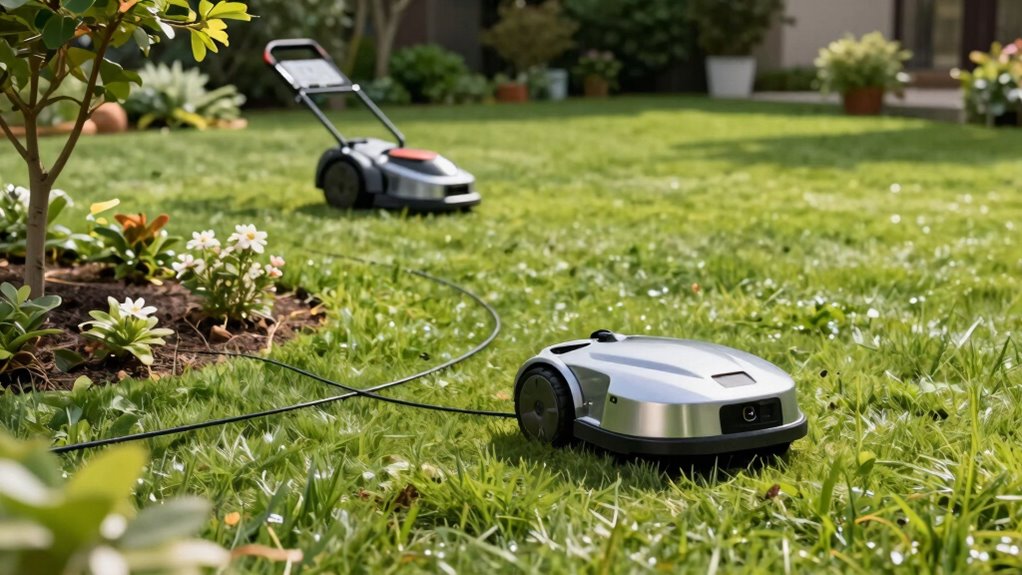

If you want simplicity and reliability, a boundary wire system may suit your lawn best, especially for straightforward shapes and larger areas, since it uses physical wire for clear boundaries and consumes less power. If your yard has obstacles or you want more flexibility, a GPS mower offers easy adjustments and quiet operation, though it may short your battery life. To find the perfect fit for your yard, explore the details ahead and make an informed choice.

Get the latest gadgets delivered free — and shop member deals
- Fast, free delivery on millions of items
- Access to Prime Big Deal Days deals on October 6–7
- Prime Video, Amazon Music and more included
Key Takeaways
- Boundary wire provides a fixed, reliable perimeter ideal for large, straightforward lawns, while GPS offers flexible, obstacle-aware navigation for dynamic yards.
- Boundary wire systems typically have longer battery life and lower power consumption compared to GPS models.
- GPS mowers are more adaptable to yard changes and obstacles, reducing installation time and need for physical adjustments.
- Boundary wire installation is more labor-intensive but offers stable boundary detection; GPS setup is quicker but may require initial calibration.
- GPS-enabled mowers operate more quietly and are better suited for noise-sensitive environments.

When choosing a robotic lawn mower, understanding the differences between boundary wire and GPS navigation is essential. These two systems determine how your mower navigates your yard, affecting everything from battery life to noise levels. Boundary wire mowers rely on a physical wire installed around your lawn’s perimeter, creating a clear boundary the mower recognizes. This setup generally consumes less power, allowing the mower to operate for longer periods on a single charge. You won’t have to worry about frequent recharges, especially if your yard isn’t overly large. However, boundary wire systems can sometimes be less flexible, especially if you want to add or change mowing areas later. Installing and adjusting the wire might require more effort, but once set, they tend to be quite reliable. Additionally, boundary wire systems are often better suited for larger, more straightforward lawns due to their long-lasting batteries and reliable boundaries. Proper installation is crucial for boundary wire systems to function effectively and avoid issues with boundary detection.
In contrast, GPS-enabled robotic mowers use satellite signals to map your yard and navigate autonomously without the need for boundary wires. This technology offers greater flexibility, especially if your lawn layout changes frequently or has obstacles that are difficult to enclose with wire. Because GPS systems plan most effective routes, they tend to be more efficient in coverage, which can translate into shorter mowing times and better battery management. Still, GPS mowers often have a shorter battery life compared to boundary wire models, as GPS modules consume more power. You might find yourself recharging more often, especially if your lawn is large or complex. Additionally, GPS systems tend to produce quieter operation because they don’t rely on the physical wire and the mechanical components involved in boundary detection. This can be a major advantage if you prefer a quieter mowing experience or need to run the mower early in the morning or late at night without disturbing your household. Moreover, installation complexity can vary between the two systems, with GPS models generally requiring less physical setup but more initial configuration.
Ultimately, your choice depends on your yard’s size, layout, and your specific preferences. If your lawn is straightforward, with a well-defined border, boundary wire systems could be more cost-effective and efficient in the long run. They also tend to have longer-lasting batteries, making them suitable for larger areas that require extended operation. On the other hand, if you have a more dynamic yard with obstacles or frequently changing landscaping, GPS navigation offers the convenience of easy adjustments and flexible coverage, even if it means sacrificing some battery longevity. Keep in mind that noise levels are generally lower with GPS systems, adding to their appeal if quiet operation is important to you. By weighing these factors carefully, you can choose a robotic mower that best fits your needs and keeps your lawn perfectly trimmed.
robotic lawn mower boundary wire kit
As an affiliate, we earn on qualifying purchases.
As an affiliate, we earn on qualifying purchases.
Frequently Asked Questions
How Do Robotic Mowers Handle Complex Yard Layouts?
Robotic mowers handle complex yard layouts by using advanced obstacle navigation and adaptable boundary recognition. They analyze yard design to maneuver around obstacles like trees, flower beds, and uneven terrain efficiently. GPS-enabled models plan precise mowing paths, while boundary wire systems create clear boundaries for intricate yard shapes. Your mower’s ability to adapt guarantees thorough coverage, even in challenging layouts, giving you a well-maintained lawn without constant supervision.
Are There Any Safety Risks With Boundary Wire or GPS Systems?
Safety concerns with boundary wire and GPS systems are minimal, but they do exist. Boundary wires can pose tripping hazards if not installed properly, and damage to the wire may cause system failure. GPS systems rely on signal accuracy; if disrupted, they could accidentally mow outside boundaries. Overall, both systems are reliable when installed correctly, but it’s essential to regularly check for potential issues to guarantee safety and system dependability.
What Maintenance Is Required for Boundary Wire Setups?
Sure, maintaining boundary wire setups is a breeze—just like tending to a delicate pet rock. You’ll check the wireless connectivity to confirm signals stay strong and inspect the power supply for any outages or corrosion. Periodically, you’ll need to repair or replace sections of wire that get buried or damaged by weather or lawn care tools. A little vigilance keeps your mower’s boundary line sharp, reliable, and less likely to cause unintended lawn revolts.
How Do GPS Robotic Mowers Perform in Dense Foliage?
GPS robotic mowers can struggle in dense foliage because wildlife disturbance and signal interference often disrupt their navigation. Thick trees and bushes block satellite signals, causing the mower to lose its way or stop unexpectedly. You’ll notice it may not mow evenly or may require frequent manual intervention. To guarantee peak performance, consider trimming foliage or choosing a mower with advanced signal processing to minimize wildlife disturbance and signal interference issues.
Can Boundary Wire Systems Be Easily Relocated or Adjusted?
Yes, boundary wire systems can be easily relocated or adjusted. You simply lay the wire in the new perimeter, and with wireless connectivity, your mower updates its boundaries seamlessly. Keep in mind, relocating may affect battery life initially, as the mower adjusts to the new setup. Overall, boundary wire systems offer flexibility, allowing you to change your lawn’s layout without much hassle, ensuring your mower stays within the desired area.
Conclusion
Ultimately, choosing between boundary wire and GPS for your robotic mower is like selecting a trusted guide or a daring explorer. Boundary wires create a reliable, familiar fencing around your yard, like a sturdy wall, while GPS offers freedom, mapping out every inch like a daring adventurer. Imagine your mower as a loyal companion; whether it sticks to the well-worn path or charts new territory, your choice shapes how effortlessly your lawn stays pristine.
Fall Picks
fall essentials
As an affiliate, we earn on qualifying purchases.