

Augmented reality goes way beyond gaming, transforming how you shop, repair, and learn. You can try on clothes virtually or see accessories in your reflection, making shopping easier and more satisfying. In maintenance, AR offers step-by-step guides overlaid on equipment, speeding up repairs and reducing mistakes. It also enhances training by simulating real-world scenarios in safe ways. If you keep exploring, you’ll discover even more practical ways AR makes everyday tasks smarter and more efficient.
Key Takeaways
- AR enhances retail shopping by virtual fitting of clothing and accessories, improving decision-making and reducing returns.
- It provides real-time, step-by-step guidance for maintenance and repair tasks, increasing efficiency and reducing errors.
- AR enables immersive medical training through virtual simulations, improving skills without risks.
- Field technicians use AR to access data overlays for faster diagnostics and repairs, minimizing downtime.
- Beyond entertainment, AR offers practical solutions in training, manufacturing, support, and safety across various industries.
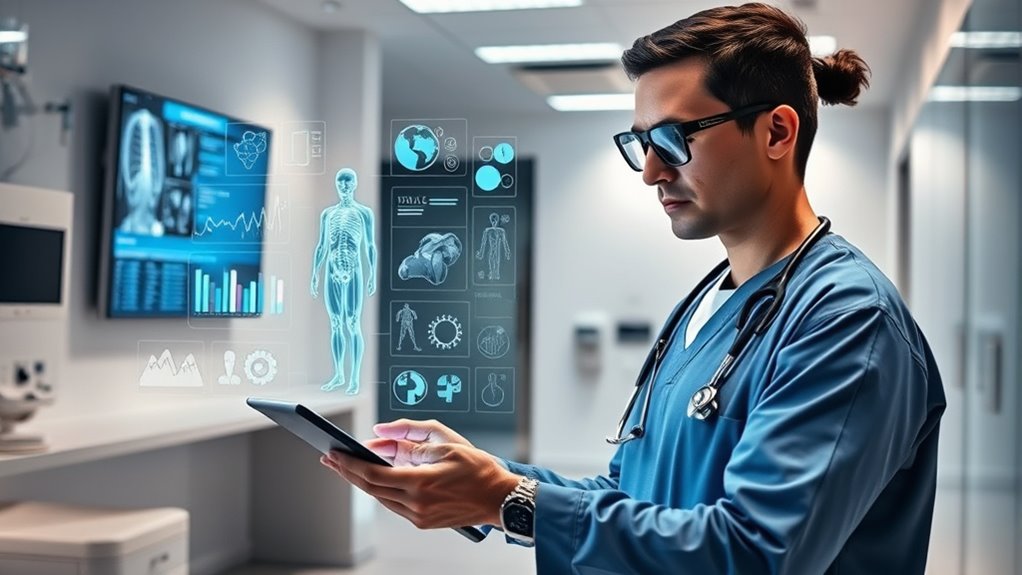
Augmented reality (AR) has transformed the way we interact with digital content by overlaying virtual elements onto the real world. This technology isn’t just for games; it offers practical solutions across various industries. For example, in retail, virtual fitting allows you to see how clothes or accessories look on you without trying them on physically. You simply point your device at yourself or a mirror, and AR displays the clothing or jewelry right on your reflection. This makes shopping more convenient, saves time, and enhances the shopping experience by helping you make better choices before purchasing. Retailers benefit too, as virtual fitting reduces return rates and increases customer satisfaction.
AR in retail lets you try clothes virtually, making shopping easier, faster, and more satisfying.
Beyond retail, AR plays a vital role in training and maintenance. Maintenance training is one area where AR truly shines. Imagine working on complex machinery—AR can overlay step-by-step instructions directly onto the equipment, guiding you through repairs or routine maintenance. This reduces errors, accelerates learning, and minimizes downtime. With AR, you don’t need to sift through manuals or rely solely on training courses; instead, you get real-time, contextual guidance that’s easy to follow. It’s like having a knowledgeable expert right there with you, showing you exactly what to do. This application is especially valuable in fields like manufacturing, aviation, and automotive repair, where precision and safety are paramount.
AR also enhances other aspects of training by simulating real-world scenarios without the risks or costs involved. For instance, in medical training, AR can project virtual patients or surgical environments, allowing students to practice procedures in a safe, controlled setting. Similarly, in military or firefighting training, AR can simulate dangerous situations, helping responders prepare without exposing them to actual hazards. These immersive experiences deepen understanding, improve skills, and build confidence more effectively than traditional methods.
Furthermore, AR’s ability to provide instant, contextual information makes it invaluable for fieldwork and technical support. Technicians can access real-time data overlays about machinery or infrastructure, enabling quicker diagnostics and repairs. This immediate access to information reduces delays and operational costs while improving service quality. As AR technology becomes more accessible and affordable, its impact will only grow, transforming how we learn, repair, and shop in everyday life.
A new application of AR is in training and maintenance, where precise, real-time guidance dramatically improves efficiency and safety.
In essence, AR’s versatility extends far beyond entertainment. It offers innovative, efficient solutions for industries that rely on precision, training, and customer engagement, empowering you to work smarter, learn faster, and shop more confidently.
AR virtual fitting room for clothing
As an affiliate, we earn on qualifying purchases.
As an affiliate, we earn on qualifying purchases.
Frequently Asked Questions
How Does Augmented Reality Impact Data Privacy and Security?
You should be aware that augmented reality impacts data privacy and security by collecting vast amounts of personal information, which could be susceptible to breaches. When using AR devices, your user privacy might be at risk if data security measures aren’t strong enough, leading to potential misuse or unauthorized access. To protect yourself, guarantee the AR platforms you use prioritize robust data security and transparent privacy policies.
What ARe the Main Technical Challenges in AR Deployment?
You face technical hurdles in AR deployment that can feel like stepping into uncharted territory. Hardware limitations, such as processing power and battery life, threaten seamless experiences. Ensuring a smooth user experience demands precise spatial mapping and real-time data processing, which are hard to perfect. These challenges create a suspenseful race against time, pushing developers to innovate rapidly for AR to truly transform how you see and interact with the world.
How Accessible Is Augmented Reality Technology for Small Businesses?
AR adoption is becoming more accessible for small businesses, thanks to affordable tools and platforms. You can easily integrate AR into your operations without huge investments, enabling enhanced customer experiences and innovative marketing. Small business integration of AR is growing as technology simplifies development and deployment. With some effort, you can leverage AR to stand out, improve engagement, and boost sales, making it a practical option for small business growth today.
What ARe Future Trends in AR Beyond Current Applications?
Future AR trends focus on fostering seamless virtual try-ons and enhancing remote collaboration. You’ll see more sophisticated simulations that allow customers to virtually try products, boosting engagement and sales. Remote teams will leverage AR for more immersive collaboration, reducing the need for travel and physical presence. As AR advances, expect more intuitive interfaces and integrated experiences, making it easier for you to connect, create, and customize in real-time, anywhere.
How Does AR Integration Differ Across Various Industries?
You’ll notice AR integration differs across industries like retail shopping and medical training. In retail, you use AR to virtually try on clothes or visualize products in your space, enhancing your shopping experience. Meanwhile, in medical training, AR helps practitioners practice surgeries or diagnose conditions more accurately. These industry-specific applications tailor AR’s capabilities to meet unique needs, making interactions more immersive, efficient, and precise for users like you.

AR-15 Rifle Builder's Manual: An Illustrated, Step-by-Step Guide to Assembling the AR-15 Rifle
As an affiliate, we earn on qualifying purchases.
As an affiliate, we earn on qualifying purchases.
Conclusion
Think of augmented reality as a bridge connecting your world to unseen domains of possibility. Just like a key unlocks hidden doors, AR opens pathways to innovative solutions in medicine, education, and beyond. Embrace this tool, and you’ll discover that the future isn’t just something you observe—it’s something you actively shape. With AR guiding your journey, you’re not just along for the ride—you’re steering toward a brighter, more connected tomorrow.
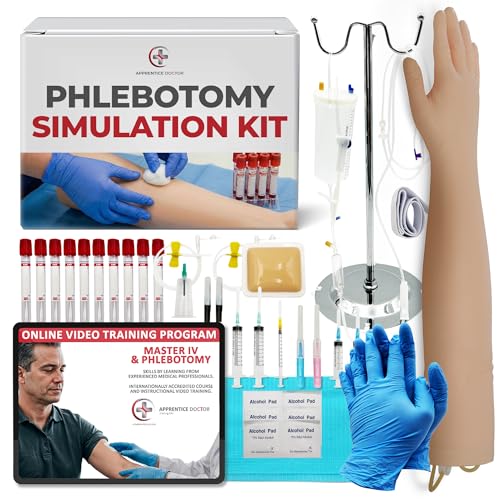
The Apprentice Doctor Phlebotomy Practice Kit – Complete Phlebotomy Training Arm for Venipuncture & IV Simulation | Designed for Medical & Nursing Students (Arm with Kit)
REALISTIC PRACTICE EXPERIENCE – The Apprentice Doctor Phlebotomy Kit includes a lifelike simulation arm that mimics veins and…
As an affiliate, we earn on qualifying purchases.
As an affiliate, we earn on qualifying purchases.
AR data overlay for industrial diagnostics
As an affiliate, we earn on qualifying purchases.
As an affiliate, we earn on qualifying purchases.