
TL;DR

Get the latest gadgets delivered free — and shop member deals
- Fast, free delivery on millions of items
- Access to Prime Big Deal Days deals on October 6–7
- Prime Video, Amazon Music and more included
Avantis Education has announced the launch of Proteus Labs, a mixed reality platform offering VR-based science experiments. The development aims to transform STEM education through immersive learning. Details about deployment and content are still emerging.
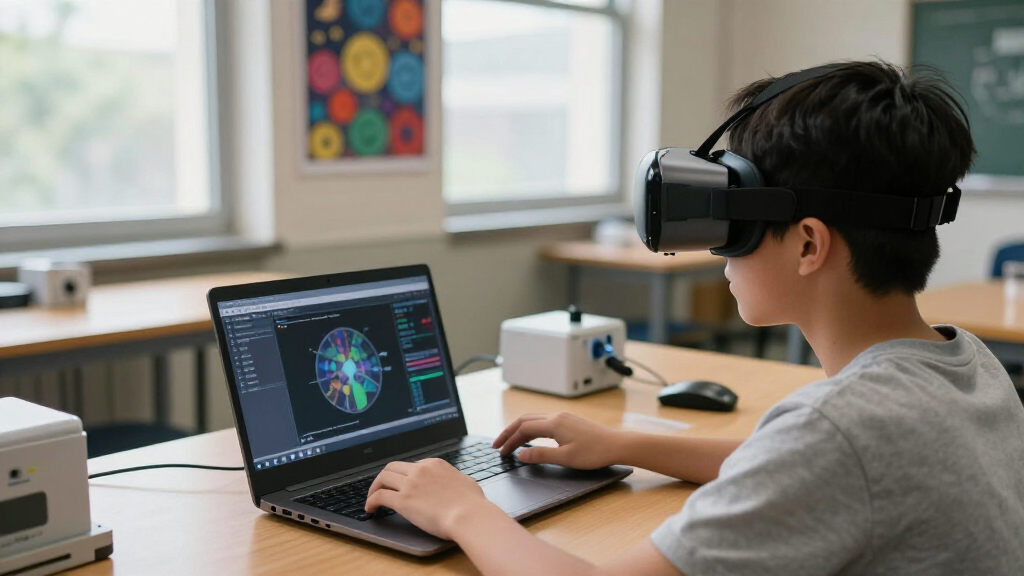
Avantis Education has unveiled Proteus Labs, a new platform that combines virtual and mixed reality (MR) to deliver immersive science experiments for educational purposes. The initiative aims to enhance STEM learning by providing students with realistic, interactive laboratory experiences through VR headsets and MR devices. This development marks a significant step in integrating cutting-edge technology into classroom settings, with the company emphasizing its potential to improve engagement and understanding in science education.
According to Avantis Education, Proteus Labs offers a suite of science experiments accessible through VR and MR devices, allowing students to perform virtual experiments that replicate real-world laboratory procedures. The platform is designed to be compatible with existing VR hardware and can be integrated into school curricula. While specific content details remain limited, the company states that the experiments cover fundamental topics such as biology, chemistry, and physics, with plans to expand the library over time.
Official sources indicate that Proteus Labs aims to address challenges faced by traditional science teaching, such as limited access to laboratory equipment, safety concerns, and resource constraints. By providing a virtual environment, students can explore complex scientific concepts in a safe, controlled setting. The platform also includes interactive features like real-time feedback and data collection, intended to foster active learning.
Avantis Education has not yet disclosed precise deployment timelines or pricing details. However, the company states that pilot programs are underway in select schools, with broader rollout expected later this year. Industry analysts suggest that this move could position Avantis as a key player in the expanding edtech VR market, which has seen increased interest amid ongoing digital transformation efforts in education.
Explore VR with Avantis Education’s Proteus Labs
A mixed reality science platform designed to move laboratory learning beyond physical benches—giving students interactive access to biology, chemistry, and physics experiments through VR and MR devices.
A laboratory without the usual physical limits
Proteus Labs is presented as a curriculum-oriented environment in which students can repeat procedures, manipulate virtual materials, receive feedback, and collect data without exposure to the risks or resource demands of a conventional laboratory.
More experiments, fewer physical constraints
Virtual environments could extend practical science to schools with limited laboratory space, equipment, consumables, or specialist facilities.
Controlled practice before real-world procedures
Students may explore hazardous, costly, or delicate processes in a repeatable simulation where mistakes become learning opportunities.
Abstract concepts become spatial experiences
Immersive interaction can make invisible systems, complex structures, and procedural sequences easier to observe and discuss.
From headset to scientific reasoning
The platform’s value depends on more than visual novelty. A useful classroom experience must connect immersive action to feedback, evidence, reflection, and curriculum goals.
Load the experiment
Select a curriculum-aligned activity on compatible VR or MR hardware.
Handle virtual materials
Follow procedures and manipulate simulated apparatus or specimens.
See cause and effect
Explore changes that may be difficult, slow, costly, or unsafe to reproduce.
Capture feedback and data
Use interactive responses and recorded results to support active learning.
Return to the curriculum
Discuss evidence, test understanding, and link the simulation to real science.
What mixed reality may change
Virtual experiments are best viewed as an additional instructional layer rather than a universal replacement for physical practical work. Each format offers a different balance of access, realism, risk, and tactile experience.
| Learning factor | Traditional laboratory | Proteus Labs model | Educational implication |
|---|---|---|---|
| Physical equipment | ~ Required | ✓ Simulated | Could widen access where equipment is scarce. |
| Exposure to hazards | ~ Managed risk | ✓ Controlled | Supports rehearsal of procedures in a safer setting. |
| Repeatability | ~ Resource dependent | ✓ On demand | Students may repeat experiments without consuming materials. |
| Tactile realism | ✓ Direct handling | ✗ Limited | Physical practical skills still require real-world experience. |
| Immediate feedback | ~ Teacher dependent | ✓ Built-in potential | Digital guidance may help students correct errors earlier. |
| Deployment burden | ~ Space and supplies | ~ Hardware and support | Costs shift from laboratory infrastructure to technology management. |
Strong concept, emerging evidence
This directional view summarizes the maturity signals described in the announcement. The bars are editorial indicators, not measured performance scores or independent research findings.
What schools still need to know
The announcement establishes a direction, but practical procurement and learning decisions require more detailed answers.
Which devices are fully supported?
Standard VR and mixed reality hardware has been referenced, but exact requirements and confirmed compatibility remain subject to finalization.
What experiments are included?
Initial emphasis is on biology, chemistry, and physics, with the breadth, depth, and release sequence of the library still emerging.
When can schools deploy it?
Pilot activity and a wider 2024 rollout were described in the original announcement; current availability should be confirmed directly with the provider.
Will teachers need training?
The experience is intended to integrate with existing curricula, but onboarding time, support materials, and classroom management needs are not yet fully detailed.
How much will adoption cost?
Pricing and licensing details were not disclosed, leaving schools to assess the eventual combination of software, hardware, support, and maintenance costs.
Does immersion improve outcomes?
Engagement potential is compelling, but Proteus Labs still needs independent evaluation of attainment, retention, accessibility, and long-term classroom impact.
Potential Impact on STEM Education Accessibility
The introduction of Proteus Labs could significantly transform how science is taught in schools by making experiments more accessible and engaging. Virtual and mixed reality environments eliminate the need for physical laboratory resources, potentially reducing costs and safety risks. This innovation may help bridge gaps in STEM education, particularly in under-resourced schools, by providing equal access to high-quality scientific experiences. Additionally, immersive learning has been linked to improved retention and understanding, which could lead to better student outcomes in science subjects.
VR science experiment kits for students
As an affiliate, we earn on qualifying purchases.
As an affiliate, we earn on qualifying purchases.
Growing Role of VR and MR in Educational Settings
Over the past few years, educational technology has increasingly incorporated virtual and mixed reality tools to enhance learning experiences. Companies like Oculus, HTC Vive, and Varjo have developed hardware widely adopted in higher education and specialized training. In K-12 education, efforts to integrate VR have focused on science, history, and geography, aiming to boost engagement and comprehension. Avantis Education’s move to develop Proteus Labs aligns with this broader trend, seeking to bring immersive science experiments into mainstream classrooms.
Previous initiatives have demonstrated the potential of VR to improve student motivation and understanding, but widespread adoption has been hindered by costs, content availability, and technical barriers. The launch of a dedicated platform like Proteus Labs could address some of these challenges by offering tailored, curriculum-aligned experiments designed specifically for educational use.
While the platform’s full capabilities and content library are still under development, industry observers note that its success will depend on factors such as ease of use, integration with existing educational systems, and ongoing support for educators and students.
“Proteus Labs aims to revolutionize science education by providing accessible, immersive experiments that foster active learning and curiosity.”
— an anonymous researcher from Avantis Education
Details on Content and Deployment Still Emerging
Specific details regarding the full content library, user interface, and integration processes remain undisclosed. It is also unclear how quickly the platform will be adopted across different educational systems and what the cost structure will be for schools. Additionally, the effectiveness of Proteus Labs in improving learning outcomes is yet to be formally evaluated through independent studies or pilot results.
Broader Rollout and Content Expansion Expected Later This Year
Avantis Education plans to expand pilot programs to more schools in the coming months, with a wider commercial release anticipated later in 2024. The company is also working on adding more experiments and features based on feedback from early users. Educational institutions and edtech partners will closely monitor the platform’s performance and integration success, with potential updates to hardware compatibility and curriculum alignment expected as development continues.
Key Questions
What devices are compatible with Proteus Labs?
Proteus Labs is designed to work with standard VR headsets and mixed reality devices, including Oculus Quest, HTC Vive, and other compatible hardware, though specific device requirements are still being finalized.
When will Proteus Labs be available to schools nationwide?
The platform is currently in pilot testing with select schools, with a broader rollout expected later in 2024. Exact availability dates are yet to be announced.
What subjects will the experiments cover?
Initial content will focus on core STEM subjects such as biology, chemistry, and physics, with plans to expand into other scientific disciplines.
How does Proteus Labs improve upon traditional science labs?
It offers safe, cost-effective, and accessible virtual experiments that replicate real-world laboratory procedures, reducing resource constraints and safety concerns.
Will teachers need special training to use Proteus Labs?
While specific training requirements are not yet detailed, the platform is being developed to be user-friendly and easily integrated into existing curricula, with support resources expected to be provided.
Source: rss
Fall Picks
fall essentials
As an affiliate, we earn on qualifying purchases.