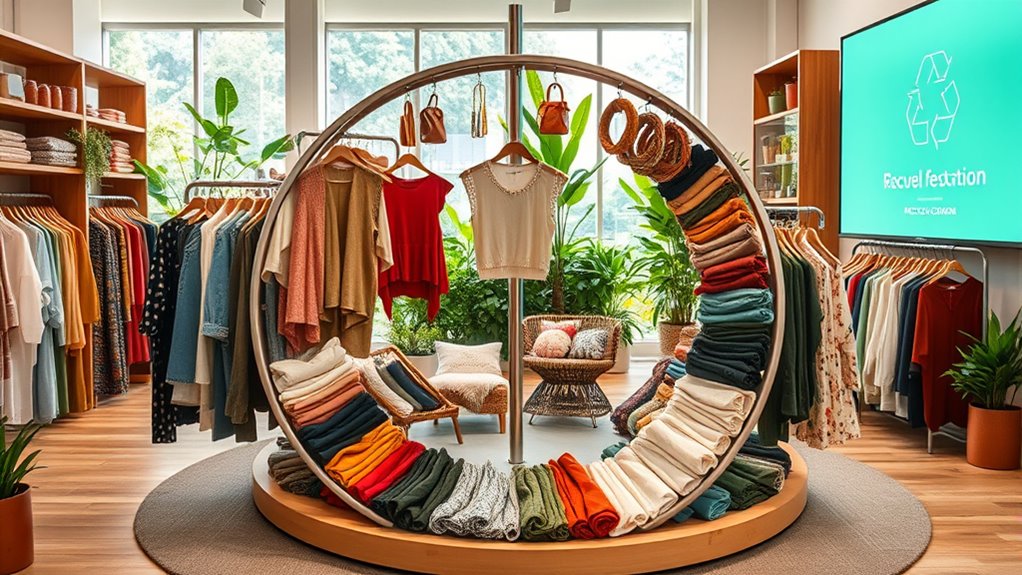

The circular fashion economy focuses on reusing, repairing, recycling, and biodegrading clothes to reduce waste and protect the environment. It encourages you to choose brands committed to sustainability, using durable and recyclable materials. This approach shifts away from fast fashion‘s disposability, aiming for garments that last longer and can be recycled easily. Systemic changes and innovative technologies support this movement, making it more feasible. Keep exploring to discover how this transformation is reshaping the industry.
Key Takeaways
- Prioritizes reuse, repair, recycling, and biodegradation to extend product life and minimize waste.
- Designs garments for durability, recyclability, and reparability using sustainable materials.
- Implements recycling technologies and infrastructure to close the loop on textile waste.
- Encourages systemic industry changes through policies, transparency, and end-of-life management practices.
- Overcomes challenges with technological innovation and rethinking raw materials for regenerative cycles.
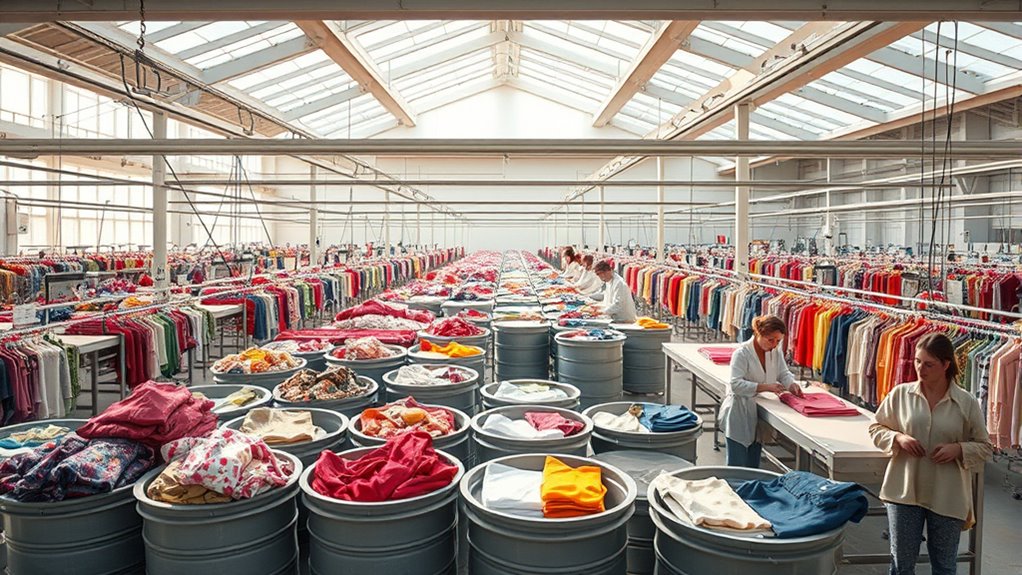
The circular fashion economy is transforming the way we think about clothing by prioritizing reuse, repair, recycling, and biodegradation to minimize waste and reduce resource extraction. This approach aligns with sustainability goals, emphasizing the importance of extending the product lifecycle and decreasing environmental impact.
By integrating principles of the circular economy, the fashion industry aims to shift away from linear models—where garments are produced, used briefly, and discarded—toward a system that values continuous use and regeneration. You can participate in this shift by choosing brands dedicated to textile recycling, sustainable materials, and transparent supply chains.
In circular fashion, designing garments for longevity, recyclability, and reparability becomes essential. Instead of relying on fast fashion‘s disposable mentality, brands now focus on creating eco-friendly textiles that support waste reduction and systemic change. These textiles are crafted from sustainable materials that can be easily reused, repaired, or recycled at the end of their life.
When garments are designed with their entire product lifecycle in mind, it becomes easier to keep textiles in circulation and avoid unnecessary waste. This approach not only conserves resources but also minimizes pollution caused by textile waste in landfills and incineration. Employing durable and recyclable materials is a key step toward achieving true circularity in fashion.
Efforts to promote reuse and repair are gaining momentum, as consumers increasingly demand more sustainable options. Clothing repair initiatives, secondhand markets, and take-back schemes help extend the useful life of garments. These practices are crucial for fostering a circular fashion system, where waste is appreciably reduced. Additionally, innovative recycling technologies are emerging that can process complex textile blends more efficiently, further supporting circularity.
However, true circularity requires more than just individual actions; it demands systemic change across the entire industry, including policies and legislation that drive sustainable practices. For example, the European Union’s digital product passports and bans on destroying unsold clothing are pushing companies to adopt circular practices more broadly. Supporting infrastructure such as collection centers and recycling facilities are vital components for closing the loop effectively.
Despite the buzzwords and marketing claims, achieving genuine circular fashion involves deep transformation. It’s about rethinking the entire product lifecycle—from raw material sourcing to end-of-life management—so that garments become part of a regenerative process rather than a linear one. Incorporating High-quality materials that support durability and recyclability is also crucial for creating a truly sustainable system. Additionally, fostering innovation in recycling technologies can further enhance the efficiency and feasibility of closed-loop systems in fashion.

Koobay 17" Eco-Friendly Cardboard Hangers for Adult Clothes – 50 Pack of Durable, Recyclable Paper Coat Hangers – Perfect for Storage and Drying of Men's and Women's Clothing
- Eco-Friendly Material: Made from 100% recycled cardboard
- Durable and Strong: Supports all clothing types securely
- Space-Saving Design: Ultra-slim at 0.4cm thick, 43cm long
As an affiliate, we earn on qualifying purchases.
As an affiliate, we earn on qualifying purchases.
Frequently Asked Questions
What Is the Circular Fashion Economy?
You’re asking what the circular fashion economy is. It’s a system that keeps clothing in use longer through recycling, repairing, and reusing, instead of discarding it.
You can support this by choosing durable, eco-friendly garments and demanding transparency from brands about their materials and processes.
This approach helps reduce waste, conserves resources, and promotes responsible consumption, creating a more sustainable future for fashion and the planet.
What Are the 4 R’s of Circular Fashion?
They say, “A stitch in time saves nine,” and the 4 R’s of circular fashion embody this wisdom.
You can Reduce your consumption, Reuse garments, Repair clothes to extend their life, and Recycle textiles into new products.
By doing so, you help conserve resources, cut waste, and make fashion more sustainable.
Embracing these steps allows you to make a positive impact on the environment and the industry.
How Is H&M Using Circular Economy?
You’re asking how H&M applies circular economy principles. They do this by launching sustainable collections like the Conscious Collection, promoting recycling through garment collection programs, and providing digital product passports for transparency.
H&M also partners with recycling innovators to increase fiber reuse and aims for 100% recycled or sustainable materials by 2030. Additionally, they participate in industry initiatives, actively supporting practices that extend product life and reduce waste.
What Is Fashion for Good Circular Economy?
You want to know what the circular economy in fashion for good is. It’s a system where you design, produce, and use clothes with sustainability in mind, minimizing waste and resource use.
You promote recycling, repair, and reusing materials, encouraging transparency and collaboration across the industry.
This approach helps you reduce environmental impact, supports innovation, and creates a more sustainable future for fashion.
Conclusion
Imagine a world where your wardrobe blooms endlessly, each piece reborn through eco-friendly cycles. By embracing the circular fashion economy, you become part of a vibrant cycle—where discarded garments turn into new treasures, reducing waste and conserving resources. Picture fabrics weaving stories anew, vibrant and alive, as you choose sustainability with every outfit. Together, we can transform fashion into a sustainable dance, creating a future where style and nature thrive in harmony.