A robotic lawn mower with GPS boundary can cut out perimeter-wire installation, but navigation methods and lawn conditions shape how well that works. My best overall pick is the ECOVACS GOAT O1000 RTK for buyers seeking wire-free boundary setup; the Segway Navimow i215 LiDAR and Roborock RockMow X115H stand out for shoppers comparing advanced obstacle sensing and challenging terrain. The main tradeoffs are boundary reliability under trees or near buildings, slope and traction capability, setup complexity, and how much lawn the mower is designed to cover. A GPS label alone does not tell you how a mower will handle signal obstructions or narrow passages. Read on for the full breakdown and a guide to matching navigation technology to your yard.

Get the latest gadgets delivered free with Prime
- Fast, free delivery on millions of items
- Prime Video, Amazon Music and more included
- Member-only deals all year
Complete the kit


Key Takeaways
- Wire-free does not mean identical navigation: the lineup includes RTK positioning, LiDAR, and vision-based approaches, each with different strengths around signal-blocked areas and yard complexity.
- Terrain separates the all-wheel-drive picks: the Segway Navimow i206 AWD and Roborock RockMow X115H are the more relevant options to compare when traction and uneven ground matter.
- Capacity and feature set are not interchangeable: the ECOVACS GOAT O1000 RTK CARE is explicitly listed for lawns up to 1/4 acre, while buyers should verify each other model’s coverage against their own mapped mowing area.
- Entry-level navigation can involve tradeoffs: the YARDCARE M800Plus is a distinct option in a lineup weighted toward wire-free systems, so buyers should check its boundary setup and navigation limits before treating it as equivalent to RTK or LiDAR models.
- Price-free ranking hinges on fit: the best choice depends less on a single navigation label and more on whether boundary reliability, obstacle handling, terrain, or simple setup is the buyer’s priority.
| ECOVACS GOAT O1000 RTK Wire-Free Robotic Lawn Mower |  | Best for Narrow, Sloped Lawns | Lawn coverage: Up to 1/4 acre (10,890 sq. ft.) | Navigation: RTK, vision, and 3D ToF | Obstacle avoidance: AIVI 3D | VIEW ON AMAZON | See Our Full Breakdown |
| RoboUP Raccoon 2 SE Wire-Free Robot Lawn Mower |  | Best for Smaller Lawns and Longer Runs | Lawn coverage: Up to 0.15 acre (600 m²) | Zone support: Up to 3 zones | Obstacle detection: AI vision and bumper sensors; recognizes 300+ obstacle types | VIEW ON AMAZON | See Our Full Breakdown |
| Segway Navimow i215 LiDAR Robot Lawn Mower |  | Best for Yards with Weak Satellite Signals | Coverage: 0.37 acre | Navigation: Solid-state LiDAR and vision sensors | Maximum slope: 45% | VIEW ON AMAZON | See Our Full Breakdown |
| Segway Navimow i206 AWD Robot Lawn Mower |  | Best for Uneven Ground in a Small Yard | Drive system: All-wheel drive | Mapping: EFLS Network RTK and vision | Maximum slope: 45% | VIEW ON AMAZON | See Our Full Breakdown |
| Roborock RockMow X115H Wire-Free 4WD Robot Lawn Mower | 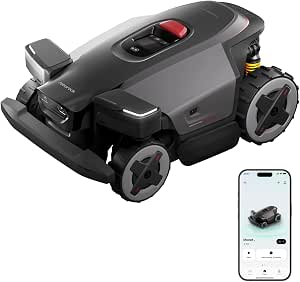 | Best for Steep, Complex Terrain | Maximum lawn coverage: 0.37 acre | Navigation: Full-Band RTK and quad-camera AI vision | Drive system: 4WD with active steering and dynamic suspension | VIEW ON AMAZON | See Our Full Breakdown |
| Segway Navimow i105N Wire-Free Robotic Lawn Mower |  | Best for Multi-Zone Gardens | Coverage: Up to 1/8 acre | Navigation: RTK + vision | Boundary setup: Virtual boundaries; no perimeter wires | VIEW ON AMAZON | See Our Full Breakdown |
| ECOVACS GOAT O1000 RTK CARE Robot Lawn Mower, Wire-Free, Up to 1/4 Acre |  | Best Accessory Bundle | Coverage: Up to 1/4 acre | Navigation: RTK | Battery runtime: 90 minutes | VIEW ON AMAZON | See Our Full Breakdown |
| YARDCARE M800Plus Cordless Robotic Lawn Mower |  | Best for Sloped Small Lawns | Lawn coverage: Up to 8,611 sq ft (approximately 1/5 acre) | Navigation: GPS and 3D vision | Mowing modes: Orderly row, random, and spiral spot mowing | VIEW ON AMAZON | See Our Full Breakdown |
| Neomow X SE Robotic Lawn Mower with 360° 3D LiDAR Navigation | 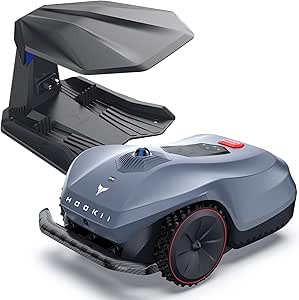 | Best for GPS-Shaded or Signal-Limited Lawns | Maximum lawn area: 0.75 acre | Navigation: 360° 3D LiDAR and AI vision | Positioning error: Under 0.8 inches (2 cm) | VIEW ON AMAZON | See Our Full Breakdown |
| Roborock RockNeo Q110H Wire-Free Robot Lawn Mower |  | Best for Steep, Complex Yards | Lawn coverage: Up to 1/4 acre | Navigation: Full-Band RTK + VSLAM | Mapping: AI auto-mapping and app-controlled manual mapping | VIEW ON AMAZON | See Our Full Breakdown |
| Sunseeker S4 Wire-Free Robot Lawn Mower with 3D LiDAR and Vision AI |  | Best for Complex Small Yards | Maximum yard size: 0.25 acre (10,890 sq. ft.) | Navigation: 360° 3D LiDAR and Vision AI | Cutting width: 7 inches | VIEW ON AMAZON | See Our Full Breakdown |
| robotic lawn mower with gps boundary | Navigation | Maximum slope | Cutting height | Cutting width |
|---|---|---|---|---|
| ECOVACS GOAT O1000 RTK Wire-Fr | RTK, vision, and 3D ToF | 45% (24°) | 1.2–3.2 in | 8.66 in |
| RoboUP Raccoon 2 SE Wire-Free | — | 36% (20°) | — | — |
| Segway Navimow i215 LiDAR Robo | Solid-state LiDAR and vision sensors | 45% | 2–4 in | 8.66 in |
| Segway Navimow i206 AWD Robot | — | 45% | 2–3.6 in | 7.1 in |
| Roborock RockMow X115H Wire-Fr | Full-Band RTK and quad-camera AI vision | 80% (38.7°) | 1.57–3.54 in | 9.49 in (24 cm) |
| Segway Navimow i105N Wire-Free | RTK + vision | — | — | — |
| ECOVACS GOAT O1000 RTK CARE Ro | RTK | — | 1.2–3.2 inches | 8.66 inches |
| YARDCARE M800Plus Cordless Rob | GPS and 3D vision | 35% (20°) | 0.8–2.4 inches | 7 inches |
| Neomow X SE Robotic Lawn Mower | 360° 3D LiDAR and AI vision | — | 1.18–3.35 inches (30–85 mm) | — |
| Roborock RockNeo Q110H Wire-Fr | Full-Band RTK + VSLAM | 45% | — | — |
| Sunseeker S4 Wire-Free Robot L | 360° 3D LiDAR and Vision AI | 22° / 42% | 1.6–3.2 inches | 7 inches |
More Details on Our Top Picks
ECOVACS GOAT O1000 RTK Wire-Free Robotic Lawn Mower
The GOAT O1000 RTK is a strong fit for a modest yard where narrow routes and steep ground make a wire-free mower harder to choose. Its RTK, vision, and 3D ToF navigation combine mapping with obstacle detection, and it can pass through spaces as narrow as 2.3 feet. That is a tighter passage than the RoboUP Raccoon 2 SE’s 31.5-inch minimum, while the O1000 also lists a steeper maximum slope of 45% versus the RoboUP’s 36%. The tradeoff is limited working time: 65 minutes per charge and coverage up to 1/4 acre make it less suited to larger lawns than the Segway Navimow i215 LiDAR, which covers 0.37 acre. Choose this ECOVACS for a compact, challenging layout, not maximum area per charge.
Pros:- No boundary wires, with automatic mapping and route planning
- 2.3-foot minimum passage width suits narrow routes
- Rated for slopes up to 45%
- App supports custom zones, schedules, and no-go areas
Cons:- 65-minute battery runtime may require frequent charging on demanding routes
- Coverage tops out at 1/4 acre
- Plastic construction may not suit buyers seeking a more rugged-feeling mower
Best for: Owners of lawns up to 1/4 acre with narrow passages, steep sections, and a preference for app-managed zones and no-go areas.
Not ideal for: People with larger properties or long mowing windows who want more than 65 minutes of runtime before recharging.
- Lawn coverage:Up to 1/4 acre (10,890 sq. ft.)
- Navigation:RTK, vision, and 3D ToF
- Obstacle avoidance:AIVI 3D
- Minimum passage width:2.3 ft
- Maximum slope:45% (24°)
- Cutting width:8.66 in
- Cutting height:1.2–3.2 in
- Battery runtime:65 minutes
Our verdict“Pick the GOAT O1000 RTK for a compact, steep or passage-heavy lawn; choose a higher-coverage model for a larger property.”
RoboUP Raccoon 2 SE Wire-Free Robot Lawn Mower
For a smaller lawn, the Raccoon 2 SE pairs wire-free mapping with a listed runtime of up to 150 minutes, making it a better match for longer sessions than the ECOVACS GOAT O1000 RTK and its 65-minute runtime. It can manage up to three zones, return to charge automatically, and respond to rain, so owners can set up a routine without constant intervention. AI vision and bumper sensors are described as recognizing more than 300 obstacle types, a useful layer around people, pets, and yard objects. Its limits are more restrictive than the Segway Navimow i215 LiDAR: coverage is capped at 0.15 acre, the slope rating is 36%, and the minimum passage width is 31.5 inches. Boundary stakes are also sold separately, so the wire-free setup may still involve an additional purchase.
Pros:- Wire-free automatic mapping with support for up to three zones
- Up to 150 minutes of runtime and automatic return to charge
- AI vision and bumper sensors help detect people, pets, and obstacles
- Rain detection and IPX6 water resistance
Cons:- Coverage is limited to 0.15 acre
- Boundary stakes are sold separately
- 36% slope limit is lower than the 45% ratings of the ECOVACS GOAT O1000 RTK and Segway Navimow i215 LiDAR
Best for: Owners of lawns up to 0.15 acre who want long runtime, automatic charging, rain response, and management of a few separate zones.
Not ideal for: People with steep yards, passages narrower than 31.5 inches, or larger properties that exceed the mower’s stated coverage.
- Lawn coverage:Up to 0.15 acre (600 m²)
- Zone support:Up to 3 zones
- Obstacle detection:AI vision and bumper sensors; recognizes 300+ obstacle types
- Maximum slope:36% (20°)
- Minimum passage width:31.5 in
- Obstacle clearance:Up to 1.57 in
- Runtime:Up to 150 minutes
- Water resistance:IPX6
Our verdict“Choose the Raccoon 2 SE for a small, multi-zone lawn where longer runtime matters more than steep-slope capacity or broad coverage.”
Segway Navimow i215 LiDAR Robot Lawn Mower
The Navimow i215 LiDAR earns its place for buyers who want wire-free mapping without relying on satellite signals for navigation. Its solid-state LiDAR and vision sensors set it apart from the RTK-and-vision approach of the Segway Navimow i206 AWD, which is designed around RTK mapping. Coverage reaches 0.37 acre, and the app supports up to 20 zones, giving this model more room to handle a segmented property than the three-zone RoboUP Raccoon 2 SE. It also carries a 45% slope rating. The tradeoffs are a cutting-height range limited to 2–4 inches and a 59 dB(A) noise specification; buyers seeking a lower cut should compare other options, including the ECOVACS GOAT O1000 RTK, which starts at 1.2 inches. The supplied data does not specify runtime or cutting-height positions beyond four settings.
Pros:- LiDAR and vision navigation works without satellite signals
- Wire-free setup with one-tap automatic mapping
- Supports up to 20 mowing zones and voice control
- Rated for slopes up to 45% with 0.37-acre coverage
Cons:- Cutting height is limited to 2–4 inches
- At 59 dB(A), it is not the quietest option in this group
- Runtime is not specified in the supplied product data
Best for: Owners of up to 0.37-acre yards with tree cover or other conditions that make satellite-dependent navigation less appealing, especially those managing many zones.
Not ideal for: Buyers who need a cutting height below 2 inches or want a stated runtime to plan mowing around.
- Coverage:0.37 acre
- Navigation:Solid-state LiDAR and vision sensors
- Maximum slope:45%
- Mowing zones:Up to 20
- Cutting width:8.66 in
- Cutting height:2–4 in
- Cutting height positions:4
- Noise level:59 dB(A)
Our verdict“Choose the i215 LiDAR if satellite-independent navigation and extensive zone management matter more than a very low cutting height.”
Segway Navimow i206 AWD Robot Lawn Mower
The Navimow i206 AWD is the specialist pick for buyers whose main problem is uneven ground, not acreage. Its all-wheel drive and 45% slope rating target terrain where a conventional wire-free mower may struggle, while RTK and vision handle automatic mapping and the app can divide the yard into as many as 20 zones. Compared with the Segway Navimow i215 LiDAR, the i206 puts more emphasis on traction than satellite-independent navigation. Its listed coverage per charge is only 1,350 sq. ft., though, and its 7.1-inch cutting width is narrower than the i215’s 8.66 inches. That combination means more charging and more passes across a lawn; this is a focused terrain choice, not the practical pick for a broad property. The supplied data does not state a total lawn-area capacity.
Pros:- All-wheel drive is designed for uneven terrain and slopes up to 45%
- RTK and vision support wire-free automatic mapping
- Supports up to 20 mowing zones
- Zero-turn steering and adjustable cutting height
Cons:- Coverage per charge is listed at only 1,350 sq. ft.
- 7.1-inch cutting width means more passes than the Segway Navimow i215 LiDAR
- The supplied data does not give a total lawn-area capacity
Best for: Owners of a small lawn with uneven ground or steep sections who value all-wheel drive and detailed zone controls.
Not ideal for: People mowing a large property or seeking a wider cutting path and higher stated coverage per charge.
- Drive system:All-wheel drive
- Mapping:EFLS Network RTK and vision
- Maximum slope:45%
- Coverage per charge:Up to 1,350 sq. ft.
- Battery capacity:2.5 Ah
- Cutting width:7.1 in
- Cutting height:2–3.6 in
- Mowing zones:Up to 20
Our verdict“Pick the i206 AWD for a small, uneven lawn where traction matters more than mowing a wide area quickly.”
Roborock RockMow X115H Wire-Free 4WD Robot Lawn Mower
When steep slopes and rough ground are the deciding factors, the RockMow X115H has the strongest terrain specification in this group: its 4WD system is rated for slopes up to 80%, far beyond the 45% ratings of the ECOVACS GOAT O1000 RTK and Segway Navimow i215 LiDAR. Full-Band RTK and quad-camera vision are intended to support mapping in complex or shaded yards, while multi-sensor obstacle avoidance and included 4G add navigation and security functions. Its 9.49-inch cutting width also exceeds the 8.66-inch widths on those two alternatives, potentially reducing passes across open areas. The tradeoff is that coverage still tops out at 0.37 acre, so steep-terrain capability does not make it a large-property mower. Its cutting-height range starts at 1.57 inches, which may not suit lawns that need a shorter cut.
Pros:- 4WD with active steering and dynamic suspension, rated for slopes up to 80%
- Full-Band RTK and quad-camera vision support wire-free navigation
- 9.49-inch cutting width is wider than the ECOVACS GOAT O1000 RTK and Navimow i215 LiDAR
- Included 4G, GPS tracking, PIN lock, and alarm add security options
Cons:- Maximum coverage is 0.37 acre
- Cutting height starts at 1.57 inches
- The advanced traction and sensing may be more than a flat, simple lawn needs
Best for: Owners of up to 0.37-acre properties with steep slopes, uneven ground, or shaded areas who want 4WD and app-based control.
Not ideal for: People with larger lawns or a preference for cutting below 1.57 inches.
- Maximum lawn coverage:0.37 acre
- Navigation:Full-Band RTK and quad-camera AI vision
- Drive system:4WD with active steering and dynamic suspension
- Maximum slope:80% (38.7°)
- Obstacle height:Up to 3.15 in
- Cutting width:9.49 in (24 cm)
- Cutting height:1.57–3.54 in
- Connectivity and security:App control, included 4G, PIN lock, alarm, and GPS tracking
Our verdict“Choose the RockMow X115H for a steep or uneven property where its 4WD capability matters more than coverage beyond 0.37 acre.”
Segway Navimow i105N Wire-Free Robotic Lawn Mower
The Navimow i105N is a strong fit for smaller gardens split into separate mowing areas. Its RTK positioning plus camera vision builds virtual boundaries without perimeter wire, while support for up to 12 zones lets owners schedule distinct lawn sections from the app. That combination is more flexible for divided layouts than the YARDCARE M800Plus, which also uses GPS and vision but is specified for a single coverage area and clear boundaries. The i105N is listed for up to 1/8 acre, so buyers with a larger property should look at the Neomow X SE or another higher-capacity option. Its 58 dB(A) noise level and 150-plus obstacle categories suit gardens with everyday clutter, but 4G anti-theft tracking costs extra.
Pros:- RTK and camera vision create virtual boundaries without perimeter wire.
- Manages schedules across as many as 12 zones.
- Detects more than 150 types of common obstacles.
- 58 dB(A) noise level and a stated three-year warranty.
Cons:- Coverage is limited to up to 1/8 acre.
- The 4G anti-theft tracking module is an optional add-on.
Best for: Owners of compact, divided gardens who want wire-free mapping, quiet operation, and app scheduling across multiple zones.
Not ideal for: Buyers with lawns larger than 1/8 acre or anyone who wants 4G anti-theft tracking included rather than as an add-on.
- Coverage:Up to 1/8 acre
- Navigation:RTK + vision
- Boundary setup:Virtual boundaries; no perimeter wires
- Obstacle detection:150+ types
- Multi-zone management:Up to 12 zones
- Noise level:58 dB(A)
- Warranty:3 years
Our verdict“Choose the Navimow i105N for a compact, multi-zone garden where wire-free setup and quiet mowing matter more than broad coverage.”
ECOVACS GOAT O1000 RTK CARE Robot Lawn Mower, Wire-Free, Up to 1/4 Acre
The ECOVACS GOAT O1000 RTK CARE makes sense for buyers who want RTK wire-free mowing with useful replacement parts ready in the box. Its bundle includes 36 extra blades and an RTK extension cable, a practical advantage over the Navimow i105N, whose 4G tracking hardware is an optional add-on rather than a mowing accessory. Automatic mapping, multi-zone scheduling, and self-recharging reduce routine setup and monitoring, while the stated 90-minute runtime means the mower may need to return to its dock during a work cycle. Coverage reaches up to 1/4 acre, twice the i105N’s stated area, but it falls well short of the Neomow X SE’s 0.75-acre maximum. Its 8.66-inch cutting width is a useful middle ground, though the 44.5-pound body is not a particularly light machine to move by hand.
Pros:- RTK navigation supports precise wire-free mowing.
- Automatically maps the yard and supports multi-zone app scheduling.
- CARE bundle includes 36 extra blades and an RTK extension cable.
- Returns to recharge automatically.
Cons:- The stated battery runtime is 90 minutes.
- Coverage is limited to up to 1/4 acre.
- At 44.5 pounds, it may be cumbersome to reposition manually.
Best for: Owners of lawns up to 1/4 acre who want RTK mapping, automatic recharging, and replacement blades included.
Not ideal for: Buyers with larger properties, a need for long uninterrupted mowing sessions, or a preference for a lighter mower to carry between areas.
- Coverage:Up to 1/4 acre
- Navigation:RTK
- Battery runtime:90 minutes
- Cutting width:8.66 inches
- Cutting height:1.2–3.2 inches
- Weight:44.5 pounds
- Included accessories:36 extra blades and RTK extension cable
- Noise level:62 dB
Our verdict“Pick the O1000 RTK CARE if your lawn fits its coverage and you value bundled mowing supplies over a longer runtime or larger-area capacity.”
YARDCARE M800Plus Cordless Robotic Lawn Mower
The YARDCARE M800Plus pairs GPS with 3D vision for wire-free mowing on lawns up to about 1/5 acre, with a specified 35% slope limit that makes it a better match for angled ground than the ECOVACS GOAT O1000 RTK CARE, which lists no slope figure in the supplied data. Orderly row coverage, random mowing, and spiral spot mode give owners choices for regular upkeep and missed patches. Its 7-inch cutting width is narrower than the ECOVACS mower’s 8.66 inches, so coverage per pass may be less efficient. The app handles scheduling, and the mower recharges automatically, but the product is intended for clear-boundary lawns and grass taller than 2.6 inches should be trimmed first. Buyers who want more specialized multi-zone RTK controls may prefer the Navimow i105N.
Pros:- GPS and 3D vision provide wire-free navigation.
- Handles slopes up to 35% (20°).
- Offers orderly row, random, and spiral spot mowing modes.
- Supports app scheduling and automatic recharging.
Cons:- Designed for lawns with clear boundaries.
- Grass taller than 2.6 inches should be trimmed before mowing.
- The 7-inch cutting width is narrower than the ECOVACS O1000 RTK CARE’s 8.66 inches.
Best for: Owners of smaller, sloped lawns with clear boundaries who want GPS-and-vision mowing and several coverage modes.
Not ideal for: Buyers with overgrown grass, complex divided yards needing extensive zone management, or properties beyond roughly 8,611 square feet.
- Lawn coverage:Up to 8,611 sq ft (approximately 1/5 acre)
- Navigation:GPS and 3D vision
- Mowing modes:Orderly row, random, and spiral spot mowing
- Obstacle detection:Identifies over 150 common obstacles
- Maximum slope:35% (20°)
- Cutting width:7 inches
- Cutting height:0.8–2.4 inches
- Battery capacity:4.0 Ah
Our verdict“Choose the M800Plus for a smaller, sloped lawn with clear boundaries if its grass-height limits and narrower cutting path suit your upkeep routine.”
Neomow X SE Robotic Lawn Mower with 360° 3D LiDAR Navigation
The Neomow X SE is the clearest choice here for a large lawn where satellite reception may be unreliable: its 360° 3D LiDAR and AI vision navigate without boundary wires or satellite signals. That separates it from the RTK-based Navimow i105N and ECOVACS GOAT O1000 RTK CARE, both of which rely on satellite positioning. The stated maximum area is 0.75 acre, and it recognizes more than 200 obstacle types; breakpoint resume helps it continue after returning to charge. The tradeoff is that its stated coverage per charge is only 0.17 acre, so larger properties may involve repeated charging cycles. Its 11-inch deck is wider than the YARDCARE M800Plus’s 7-inch deck, but this mower’s 4G connectivity includes only 1 GB of free data, and its warranty is two years.
Pros:- LiDAR and AI vision navigate without boundary wires or satellite signals.
- Maps lawns up to 0.75 acre and recognizes more than 200 obstacle types.
- Breakpoint resume helps it continue a job after charging.
- 11-inch cutting deck, adjustable height, and IPX5-rated chassis.
Cons:- Covers up to 0.17 acre per charge, so larger lawns require recharge cycles.
- Includes 1 GB of free 4G data.
- The stated warranty is two years.
Best for: Owners of larger or tree-shaded lawns who need wire-free navigation that does not depend on satellite signals.
Not ideal for: Buyers seeking a long single-charge mowing session, or those who want extensive included 4G data or a longer stated warranty.
- Maximum lawn area:0.75 acre
- Navigation:360° 3D LiDAR and AI vision
- Positioning error:Under 0.8 inches (2 cm)
- Obstacle recognition:More than 200 types
- Cutting deck width:11 inches (280 mm)
- Cutting height:1.18–3.35 inches (30–85 mm)
- Runtime:Up to 2 hours per charge
- Water resistance:IPX5
- Warranty:2 years
Our verdict“Choose the Neomow X SE for a large or satellite-challenged lawn if you can accommodate shorter mowing stretches between charges.”
Roborock RockNeo Q110H Wire-Free Robot Lawn Mower
The Roborock RockNeo Q110H is the strongest match in this group for steep or irregular ground: its stated 45% slope capability exceeds the YARDCARE M800Plus’s 35% limit, while Full-Band RTK and VSLAM combine satellite positioning with visual mapping for shaded or complicated areas. Owners can map automatically or guide mapping through the app, then schedule multiple zones. Dual-camera AI is designed to avoid people, pets, and garden obstacles, and the mower can pass through corridors as narrow as 2.3 feet. Its coverage is up to 1/4 acre, however, so the Neomow X SE suits larger properties better. Edge precision of 1.2 inches depends on an optional cutting module, and the 4G tracking module is also sold separately; those extras make the advertised capabilities less complete out of the box.
Pros:- Full-Band RTK and VSLAM support wire-free navigation across complex or shaded yards.
- Handles slopes up to 45%.
- AI auto-mapping and app-guided manual mapping offer flexible setup.
- Dual-camera AI helps avoid people, pets, and garden obstacles.
Cons:- Coverage is limited to up to 1/4 acre, below the Neomow X SE’s 0.75-acre maximum.
- The edge-cutting module is sold separately.
- The 4G tracking and anti-theft module is sold separately.
Best for: Owners of steep, shaded, or irregular lawns up to 1/4 acre who want flexible mapping and multi-zone control.
Not ideal for: Buyers with larger properties or anyone who expects edge-cutting hardware and 4G tracking to come included.
- Lawn coverage:Up to 1/4 acre
- Navigation:Full-Band RTK + VSLAM
- Mapping:AI auto-mapping and app-controlled manual mapping
- Obstacle avoidance:Dual-camera AI vision
- Maximum slope:45%
- Obstacle clearance:1.57 inches
- Narrow passage width:2.3 ft
- Edge precision:1.2 inches with optional cutting module
- Security:PIN code lockout and alarm; optional 4G tracking module
Our verdict“Pick the RockNeo Q110H for a steep or complex lawn that fits within 1/4 acre, but budget for separate edge-cutting or tracking modules if you need them.”
Sunseeker S4 Wire-Free Robot Lawn Mower with 3D LiDAR and Vision AI
The Sunseeker S4 is a strong fit for smaller lawns where trees, narrow routes, or weak signals can complicate wire-free navigation. Its 360° 3D LiDAR and Vision AI map the yard and help the mower plan around obstacles, while support for up to five maps and 100 zones or no-go areas suits properties with separated sections. Compared with the Segway Navimow i105N, the S4’s stated strengths center on LiDAR-assisted mapping and multi-map management rather than a simple compact-yard setup. Its 22° slope capability and 31.5-inch passage specification add flexibility for uneven ground and constrained routes. The tradeoff is scale: a 0.25-acre limit and 7-inch cutting width make it less suited to larger lawns or buyers who want faster coverage. App and voice controls, rain-sensor return, and a two-year warranty round out the package.
Pros:- Wire-free mapping with 3D LiDAR and Vision AI for route planning and obstacle detection
- Stores up to five maps and supports up to 100 zones or no-go areas
- Rated for slopes up to 22° and passages as narrow as 31.5 inches
- Quiet 60 dB operation with app and voice controls
Cons:- Maximum stated lawn area of 0.25 acre limits suitability for larger properties
- Seven-inch cutting width can mean slower coverage than a wider-cutting mower
- Plastic and polypropylene construction may not appeal to buyers seeking a more rugged exterior
Best for: Owners of lawns up to 0.25 acre with trees, uneven patches, narrow passages, or multiple mapped sections who want wire-free navigation.
Not ideal for: Owners of larger properties or broad, open lawns who need a wider cutting path and coverage beyond 0.25 acre.
- Maximum yard size:0.25 acre (10,890 sq. ft.)
- Navigation:360° 3D LiDAR and Vision AI
- Cutting width:7 inches
- Cutting height:1.6–3.2 inches
- Maximum slope:22° / 42%
- Passage width:31.5 inches
- Mapping capacity:Up to 5 maps and 100 zones/no-go areas
- Noise level and weight:60 dB; 25 pounds
- Warranty:2 years
Our verdict“Choose the Sunseeker S4 for a small, complicated yard where LiDAR mapping and flexible zones matter more than fast coverage across a large lawn.”

How We Picked
I compared the 11 listed mowers through the needs implied by GPS-boundary mowing: wire-free boundary setup, the navigation method named for each product, and how a system may fit yards with trees, buildings, obstacles, slopes, and narrow routes. I also weighed stated lawn coverage where supplied, terrain-related features such as all-wheel drive, and the likely setup and maintenance demands implied by each design. Since the product list does not provide consistent specifications for every model, I avoid treating unlisted coverage, slope limits, or runtime as established facts.
The order favors models that appear to offer a strong balance of wire-free mapping, navigation capability, and practical yard fit. The ECOVACS GOAT O1000 RTK leads as a broadly relevant RTK option; LiDAR and all-wheel-drive models rank higher for buyers with specific obstacles or terrain needs. Models with narrower stated coverage or less detail on navigation are more specialized picks rather than universal recommendations. Before buying, check the manufacturer’s current coverage, slope, signal, and installation requirements for your exact lawn.
Factors to Consider When Choosing Robotic Lawn Mower With Gps Boundary
Choosing a robot mower with a GPS boundary starts with the yard, not the feature label. These decisions help reveal whether an RTK, LiDAR, vision-assisted, or simpler setup is a better match for your property.
Match Navigation to Signal Conditions
GPS and RTK systems rely on positioning signals, so a lawn with dense tree cover, tall walls, or close-set buildings may pose a different challenge than an open plot. LiDAR and vision systems can add ways to interpret nearby surroundings, but their presence does not guarantee that every boundary or passage will be handled without adjustment. Walk the yard and mark spots where the sky is blocked, especially along the perimeter and between lawn sections. Check whether the manufacturer describes a base station, antenna placement, or other installation requirements. A common mistake is choosing by “wire-free” alone without checking the conditions needed for dependable mapping. If the lawn has many obstructed areas, prioritize a clear explanation of how the mower maintains position there.
Measure the Mowable Area, Not the Lot
Coverage claims should be compared with the grass area the mower can actually reach, not the full property size. Exclude patios, sheds, planting beds, and disconnected sections that may need separate routes or manual work. Leave room for real-world interruptions, since narrow gates and frequent no-go zones can reduce productive mowing time. Confirm whether the stated capacity refers to a particular mowing schedule or assumes ideal conditions. The ECOVACS GOAT O1000 RTK CARE is listed for up to 1/4 acre, but that figure should not be applied to other models in this roundup. Buying a mower that only just matches your measured area can leave little headroom as the yard changes.
Treat Slope and Traction as Separate Questions
A mower’s ability to handle a slope depends on more than a headline grade limit: surface texture, damp grass, turns, and the approach angle all affect traction. All-wheel drive, as found in the Segway Navimow i206 AWD and Roborock RockMow X115H, makes those models worth comparing for demanding ground, but it does not replace checking the manufacturer’s slope specifications. Map steep sections and identify where the mower must turn or cross a side slope. Buyers with mostly flat lawns may get little practical benefit from paying extra attention to traction features. Avoid assuming that a mower capable of climbing a hill can also navigate safely across it. If the terrain is varied, ask for limits on both slope and operating conditions.
Check Passage Widths and Boundary Layout
Wire-free boundaries still require a mower to travel between mowing zones and follow the mapped edge accurately. Measure narrow gates, corridors, and gaps between beds before choosing; a mower that fits physically may still need enough space to turn or correct its route. Think about where zones meet and whether the mower can return to each area without crossing gravel or other unsuitable surfaces. Mark trees, water features, and places where children or pets regularly use the lawn, then check how the app handles no-go areas. Do not assume obstacle detection replaces careful boundary editing. A simple lawn with broad routes can be easier to manage than a smaller yard split by tight passages.
Compare Navigation Features With Setup Demands
RTK, LiDAR, and vision AI describe different approaches, not a universal ranking from best to worst. RTK can suit open lawns where satellite positioning is available, while LiDAR or vision features may appeal when buyers want additional environmental sensing. The initial mapping process, app controls, and ability to revise boundaries after landscaping changes can matter as much as the sensor type. Ask whether setup needs a clear view of the sky, a specific base location, Wi-Fi coverage, or repeated manual mapping. A buyer who wants minimal configuration may prefer a simpler yard and a straightforward app over a mower with more sensing features. Check what happens after a moved garden bed or newly installed path changes the map.
Budget for Upkeep and Seasonal Changes
A wire-free mower still needs routine care: blades wear, wheels collect grass, and sensors or cameras may need cleaning. Check how replacement blades are sourced and whether the mower’s cutting system is accessible enough for the maintenance you are willing to do. Consider storage and charging needs during periods when the lawn is not growing, along with the maker’s guidance for rain and winter conditions. Extra sensing or traction features can add capability, but they may not be worthwhile if your yard is simple and easy to map. Factor in app support and replacement-part availability, not just the initial feature list. Buyers who want the least ongoing effort should favor a model with clear care instructions and a layout that avoids repeated rescue or repositioning.
Frequently Asked Questions
Will a GPS-boundary mower work under trees or beside a tall house?
It depends on how much the tree cover or building blocks positioning signals and on the mower’s other navigation tools. RTK-based systems can be more sensitive to installation and signal conditions than an open lawn suggests, while LiDAR or vision features may provide additional environmental information. Neither label alone guarantees reliable operation in every blocked area. Check the manufacturer’s guidance for your yard conditions and placement requirements, and ask whether the mower can recover or resume if positioning is interrupted. If possible, map the most obstructed part of the lawn before relying on fully autonomous coverage.
Is LiDAR a better choice than RTK for a complicated lawn?
Not automatically: the better fit depends on what makes the lawn complicated. RTK can be attractive on open ground with clear positioning conditions, while LiDAR may appeal where the buyer values local sensing around nearby objects. Neither technology removes the need to map boundaries and check narrow routes. Compare how each specific model handles signal loss, obstacle avoidance, and map edits rather than deciding from the sensor name alone. For a yard with both heavy tree cover and disconnected zones, ask the maker how those exact conditions are supported.
Do I still need to mark no-go areas with a wire-free mower?
Often, yes, because wire-free describes the boundary setup rather than eliminating the need to define where mowing should stop. Beds, ponds, newly planted areas, and play spaces may need digital exclusion zones or other safeguards. Check how the app creates and changes those zones, and whether the mower can reach the intended boundary without clipping nearby obstacles. Physical hazards can still call for protective edging or a different layout. Revisit the map after landscaping changes, since a previously safe route may no longer fit the yard.
How much extra lawn capacity should I allow for?
There is no single buffer that works for every yard, since mowing schedule, growth rate, obstacles, and travel between zones all affect workload. Measure the grass that the mower can actually access and compare it with the manufacturer’s stated coverage conditions. A lawn split by narrow passages or frequent no-go areas may demand more capacity than an open lawn of the same area. Avoid buying to the exact limit if the grass grows quickly or the mowing window is restricted. For models without clearly stated coverage in the product information, verify the figure directly before deciding.
Should I choose all-wheel drive if my lawn has a few slopes?
All-wheel drive is most relevant when slopes, uneven ground, or low-traction surfaces regularly challenge a mower, but a few gentle inclines may not justify making it the main buying criterion. Compare the manufacturer’s slope limits with the steepest section and note whether the mower must turn or travel sideways there. Wet grass and sharp changes in grade can be harder than a dry, straight climb. The Navimow i206 AWD and RockMow X115H are sensible models to compare for terrain needs, but confirm their exact operating limits. On a mostly flat lawn, boundary reliability and coverage may matter more.
Conclusion
For a broadly useful wire-free option, I would start with the ECOVACS GOAT O1000 RTK as the best overall pick, then verify that its RTK setup suits the lawn’s signal conditions. The YARDCARE M800Plus is the best value candidate for buyers who want a simpler alternative, but I would confirm its boundary method and coverage before purchase. For a premium feature comparison, look at the Segway Navimow i215 LiDAR and Sunseeker S4, especially if advanced sensing is a priority. Beginners should favor a mower with clear mapping instructions and manageable yard coverage rather than the longest feature list; the ECOVACS GOAT O1000 RTK CARE is a focused option when its stated 1/4-acre limit fits. For uneven ground, compare the Segway Navimow i206 AWD with the Roborock RockMow X115H. The right choice is the one whose navigation, coverage, and terrain limits match your actual lawn.