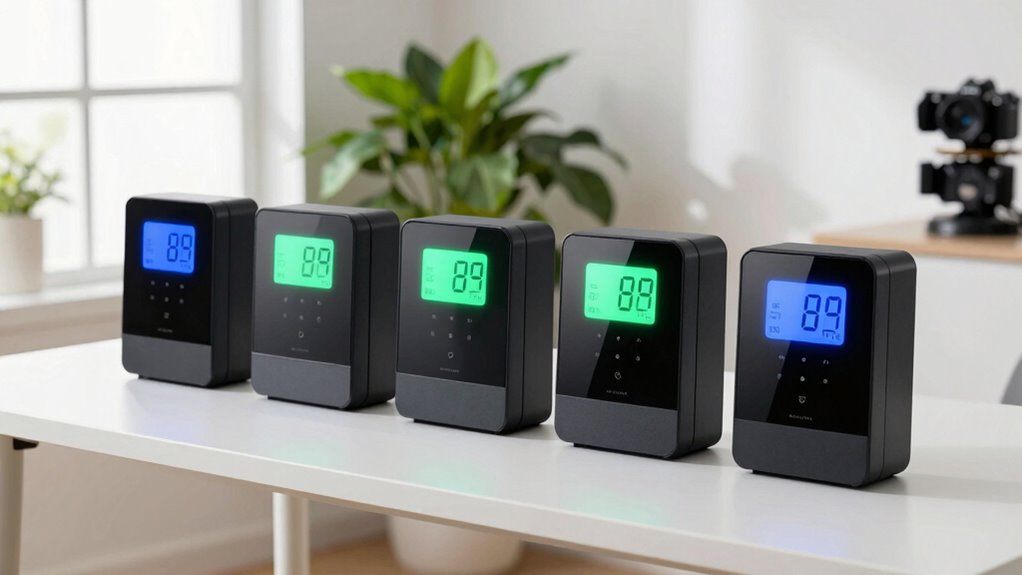
Shopping for a smart indoor air quality monitor means deciding what you actually want to measure — cheap models track PM2.5, while premium units add CO₂, radon, and volatile organic compounds. The AprilAire ZAWTHCPV 5-in-1 earns my best overall pick for its balanced sensor suite and reliable Wi-Fi platform, while the Airthings View Plus is the strongest choice if radon detection is a priority, and the GoveeLife H5106 wins on value for anyone who mainly wants particle and humidity tracking. The core tradeoff in this category is sensor breadth versus price: 10-in-1 and 16-in-1 monitors look impressive on paper but often use lower-grade sensors that drift over time. Accuracy, app polish, and whether a display matters to you also separate the contenders. Read on for the full ranked breakdown.

Get the latest gadgets delivered free with Prime
- Fast, free delivery on millions of items
- Prime Video, Amazon Music and more included
- Member-only deals all year
Complete the kit



Key Takeaways
- Sensor count is often misleading: the 10-in-1 and amazon.com/dp/B0HC6F5WNV?tag=t3chbillion-20&ascsubtag=dc-544337″ target=”_blank” rel=”nofollow sponsored noopener”>16-in-1 models on this list generally measure more parameters less accurately than focused units like the AprilAire and Airthings picks.
- Radon detection remains exclusive territory — only the Airthings View Plus covers it, which alone justifies its premium price for homeowners in radon-prone regions.
- Display-based monitors (the 7-inch and HD color screen models) trade smart-home integration for at-a-glance readability, making them better for wall-mounted or desktop use than for automation.
- Amazon‘s ecosystem monitors — the single-unit, 2-pack, and Ring sensor — win on setup simplicity but lag on exportable data and third-party integrations.
- CO₂ monitoring now appears at mid-range prices, with the GoveeLife H5140 making NDIR-grade carbon dioxide tracking affordable where it was a premium feature two years ago.
| GoveeLife Smart Air Quality Monitor H5106 with PM2.5, Temperature, and Humidity Sensor |  | Best for Smart Home Automation | Model: H5106 | PM2.5 Accuracy: ±15 µg/m³ | Temperature Accuracy: ±0.54°F | VIEW ON AMAZON | See Our Full Breakdown |
| Amazon Smart Air Quality Monitor (2-Pack) |  | Best for Alexa Households | Quantity: 2-pack | Monitored Metrics: PM2.5, VOCs, Carbon Monoxide, Humidity, Temperature | Connectivity: Wi-Fi, Alexa compatible | VIEW ON AMAZON | See Our Full Breakdown |
| AprilAire ZAWTHCPV Smart Indoor 5-in-1 Wi-Fi Air Quality Monitor |  | Best for Whole-Home Air Systems | Model: ZAWTHCPV | Connectivity: Wi-Fi | Sensors: CO2, VOC/TVOC, PM2.5, Humidity, Temperature | VIEW ON AMAZON | See Our Full Breakdown |
| Zemeollo 10-in-1 Smart Indoor Air Quality Monitor |  | Best Portable Multi-Pollutant Tester | Model: ZLJC2 | Sensors: CO2, HCHO, TVOC, Benzene, PM2.5, PM10, Temperature | Display: HD LED color screen | VIEW ON AMAZON | See Our Full Breakdown |
| SONOFF SAWF-07P Smart Indoor Air Quality Monitor |  | Best for Multi-Platform Smart Homes | Model: SAWF-07P | Connectivity: 2.4GHz Wi-Fi, Matter | Display Size: 3.73 inches | VIEW ON AMAZON | See Our Full Breakdown |
| ZEMEOLLO 10-in-1 Indoor Air Quality Monitor |  | Best Battery Life for Portable Monitoring | Measurements: CO₂, TVOC, HCHO, benzene, AQI, PM0.3–1, PM2.5, PM10, temperature | Battery capacity: 2000 mAh | Battery life: Up to 20 hours | VIEW ON AMAZON | See Our Full Breakdown |
| Airthings View Plus Radon & Air Quality Monitor |  | Best Premium Pick for Long-Term Health Monitoring | Model: View Plus (2960) | Sensors: Radon, PM2.5, CO₂, VOC, humidity, temperature, pressure | Connectivity: WiFi | VIEW ON AMAZON | See Our Full Breakdown |
| BREATHE Airmonitor Plus Gen 2 Indoor Air Quality Monitor |  | Best for Connected Data Tracking | Sensors: NDIR CO₂, laser particle, TVOC, formaldehyde, temperature, humidity | Connectivity: 2.4 GHz Wi-Fi | Battery life: 6 hours | VIEW ON AMAZON | See Our Full Breakdown |
| Indoor Air Quality Monitor with 7-Inch Display |  | Best Read-at-a-Glance Display | Display: 7-inch LED | Monitored parameters: CO₂, PM1.0, PM2.5, PM10, HCHO, TVOC, temperature, humidity, AQI | AQI alert functions: 7 types with mute button | VIEW ON AMAZON | See Our Full Breakdown |
| 16-in-1 Indoor Air Quality Monitor with HD Color Screen |  | Best Budget Compact Option | Measured parameters: PM1.0, PM2.5, PM10, TVOC, HCHO, temperature, humidity | Update interval: 1.5 seconds | Display: HD color screen with color-coded readings | VIEW ON AMAZON | See Our Full Breakdown |
| Lwyinp 10-in-1 Indoor Air Quality Monitor |  | Best Budget Multi-Pollutant Snapshot | Brand: Lwyinp | Model: MT13S | Measurements: CO2, HCHO, TVOC, AQI, PM2.5, PM1.0, PM10, temperature, humidity, time | VIEW ON AMAZON | See Our Full Breakdown |
| GoveeLife H5140 Smart Air Quality Monitor and CO₂ Detector |  | Best for CO₂-Focused Alerts and Data | Brand: GoveeLife | Model: H5140 | CO₂ Sensor: SCD4x photoacoustic NDIR | VIEW ON AMAZON | See Our Full Breakdown |
| Amazon Smart Air Quality Monitor |  | Best for Alexa Households | Monitored Metrics: PM2.5, VOCs, Carbon Monoxide, Humidity, Temperature | Connectivity: Wi-Fi, Alexa ecosystem | Interface: Color-coded LED, Alexa app | VIEW ON AMAZON | See Our Full Breakdown |
| Ring Sensors Air Quality Monitor |  | Best Set-and-Forget Notifications | Monitored Parameters: Temperature, Carbon Monoxide (CO), Humidity, PM2.5 | Connectivity: Amazon Sidewalk (no base station required) | Notifications: Instant app notifications with smart suggestions | VIEW ON AMAZON | See Our Full Breakdown |
| SONOFF AirGuard SAWF-08P Smart Indoor Air Quality Monitor |  | Best Cross-Platform Smart Home Pick | Model: SAWF-08P | Connectivity: 2.4GHz Wi-Fi, Matter compatible | Sensors: CO₂ (NDIR), temperature, humidity | VIEW ON AMAZON | See Our Full Breakdown |
| smart air quality monitor indoor | Connectivity | Model |
|---|---|---|
| GoveeLife Smart Air Quality Mo | 2.4G Wi-Fi, Bluetooth | H5106 |
| Amazon Smart Air Quality Monit | Wi-Fi, Alexa compatible | — |
| AprilAire ZAWTHCPV Smart Indoo | Wi-Fi | ZAWTHCPV |
| Zemeollo 10-in-1 Smart Indoor | — | ZLJC2 |
| SONOFF SAWF-07P Smart Indoor A | 2.4GHz Wi-Fi, Matter | SAWF-07P |
| ZEMEOLLO 10-in-1 Indoor Air Qu | — | — |
| Airthings View Plus Radon & Ai | WiFi | View Plus (2960) |
| BREATHE Airmonitor Plus Gen 2 | 2.4 GHz Wi-Fi | — |
| Indoor Air Quality Monitor wit | — | — |
| 16-in-1 Indoor Air Quality Mon | — | — |
| Lwyinp 10-in-1 Indoor Air Qual | Bluetooth | MT13S |
| GoveeLife H5140 Smart Air Qual | App, Alexa, Google Assistant | H5140 |
| Amazon Smart Air Quality Monit | Wi-Fi, Alexa ecosystem | — |
| Ring Sensors Air Quality Monit | Amazon Sidewalk (no base station required) | — |
| SONOFF AirGuard SAWF-08P Smart | 2.4GHz Wi-Fi, Matter compatible | SAWF-08P |
More Details on Our Top Picks
GoveeLife Smart Air Quality Monitor H5106 with PM2.5, Temperature, and Humidity Sensor
Most monitors in this roundup simply report numbers — the GoveeLife H5106 actually acts on them. Its tight integration with GoveeHome smart appliances means a rising PM2.5 reading can trigger a purifier or humidifier without any manual input, which the standalone Zemeollo 10-in-1 simply cannot do. The 2-second refresh rate also beats the slower update cycles typical of app-only devices like the Amazon Smart Air Quality Monitor, so readings feel genuinely live rather than lagging behind reality.
The tradeoff is narrow sensor coverage: this measures PM2.5, temperature, and humidity only, with no CO2, VOC, or carbon monoxide detection. It also needs a constant Type-C power connection — there’s no battery option like the Zemeollo offers.
Pros:- Fast 2-second refresh rate keeps readings genuinely current
- Deep integration with GoveeHome appliances enables true automation, not just monitoring
- 2-year data storage with export for long-term trend analysis
- Clear LED display with night mode for bedroom use
Cons:- Wired-only power source means zero portability around the home
- No CO2, VOC, or carbon monoxide sensors despite the premium smart features
- Only connects to 2.4GHz Wi-Fi networks
Best for: Govee ecosystem owners who want air readings to automatically trigger purifiers, humidifiers, and other smart appliances
Not ideal for: Buyers worried about VOCs, CO2, or carbon monoxide — this monitor covers particulates and climate data only
- Model:H5106
- PM2.5 Accuracy:±15 µg/m³
- Temperature Accuracy:±0.54°F
- Humidity Accuracy:±3% RH
- Response Time:2 seconds
- Connectivity:2.4G Wi-Fi, Bluetooth
- Power Source:Wired (Type-C), no battery
- Dimensions:5.31 x 1.57 x 2.47 inches
Our verdict“This pick makes the most sense for anyone already invested in Govee devices who wants air quality data to drive automatic climate responses rather than sit in an app.”
Amazon Smart Air Quality Monitor (2-Pack)
The two-pack format is the quiet advantage here: while the AprilAire ZAWTHCPV and GoveeLife H5106 cover a single room, this bundle lets you watch air quality in two locations — say a nursery and a kitchen — for one purchase. Sensor coverage is broader than the GoveeLife too, adding VOCs and carbon monoxide alongside PM2.5, temperature, and humidity, and the CO detection alone is something most monitors here skip.
Alexa routines are the real draw: voice announcements and automatic purifier control feel more natural than checking an app. The catch is ecosystem lock-in — without an Alexa speaker or display, much of the value evaporates — and each unit needs its own outlet, so placement stays tethered to wall power.
Pros:- Two units cover two rooms in a single purchase
- Monitors five metrics including carbon monoxide, which most competitors omit
- Alexa routines enable voice announcements and automated purifier or thermostat control
- Plug-and-play setup through the Alexa app in minutes
Cons:- Full functionality depends on owning an Alexa-enabled ecosystem
- Each unit requires a power outlet, limiting flexible placement
- No battery option or on-device detailed display beyond the color-coded LED
Best for: Alexa households that want whole-home coverage and voice-first alerts across two rooms
Not ideal for: Households without Alexa devices — alerts and routines lose most of their appeal without the ecosystem
- Quantity:2-pack
- Monitored Metrics:PM2.5, VOCs, Carbon Monoxide, Humidity, Temperature
- Connectivity:Wi-Fi, Alexa compatible
- Interface:Color-coded LED, Alexa app
- Setup:Plug-in
- Automation:Supports Alexa Routines for compatible devices
Our verdict“If Alexa already runs your home, this two-pack is the simplest path to multi-room air monitoring with carbon monoxide coverage included.”
AprilAire ZAWTHCPV Smart Indoor 5-in-1 Wi-Fi Air Quality Monitor
The AprilAire ZAWTHCPV is the only monitor in this batch built to close the loop with whole-home filtration. Compared with the Amazon Smart Air Quality Monitor, which triggers individual Alexa devices, this one ties into AprilAire thermostats and ventilation systems, so a bad VOC reading can adjust the equipment that actually treats your entire house. Sensor coverage is the full quintet — CO2, VOCs, PM2.5, humidity, and temperature — including CO2, which the GoveeLife H5106 lacks entirely.
The Healthy Air app goes beyond raw numbers with actionable improvement tips, a nice touch for buyers new to air quality. But that automation potential is partly aspirational: the thermostat integration requires a separate purchase, so budget accordingly.
Pros:- Five-metric coverage including CO2, which several rivals here omit
- App delivers actionable air improvement tips, not just raw readings
- Color-coded status light makes at-a-glance checks effortless
- Integrates with AprilAire filtration for automated whole-home mitigation
Cons:- Advanced automation requires separately purchased compatible AprilAire thermostats
- Depends on the smartphone app for full functionality
- No battery backup or portable use option
Best for: Homeowners with AprilAire HVAC or filtration equipment who want automated whole-house air management
Not ideal for: Renters or buyers without AprilAire hardware — the automation advantages disappear and cheaper monitors do the same basic job
- Model:ZAWTHCPV
- Connectivity:Wi-Fi
- Sensors:CO2, VOC/TVOC, PM2.5, Humidity, Temperature
- App:AprilAire Healthy Air App
- Light Options:Default, Always On, Always Off
- Compatibility:AprilAire Wi-Fi Thermostats (S86WMUPR or 8920W)
Our verdict“This model is better suited to AprilAire-equipped homeowners than casual buyers — its value scales directly with how much of the brand’s ecosystem you own.”
Zemeollo 10-in-1 Smart Indoor Air Quality Monitor
Where the SONOFF SAWF-07P and GoveeLife H5106 are fixed appliances, the Zemeollo 10-in-1 is a grab-and-go diagnostic tool. Its rechargeable battery runs up to 20 hours, so you can carry it from a bedroom to a garage to a new car, spotting pollution sources the way a stationary monitor never could. Sensor breadth is its other strength: beyond the usual CO2 and PM2.5, it tracks formaldehyde, benzene, and TVOC — chemicals the Amazon monitor detects only broadly as VOCs.
The tradeoff is intelligence. There’s no app connectivity or data logging, so trends and history are invisible, and it can’t trigger a single smart device. One-click operation keeps things simple, but buyers wanting long-term records should look at the SONOFF’s 12-month archive instead.
Pros:- Detects formaldehyde and benzene individually, not just as generic VOCs
- 20-hour rechargeable battery enables true portable, cord-free use
- HD color screen changes visually when air quality crosses safety thresholds
- One-click operation with no app account or Wi-Fi setup required
Cons:- No app connectivity, data logging, or historical tracking of any kind
- Cannot integrate with smart home devices or send remote alerts
- Sensor calibration and long-term accuracy from a lesser-known brand are less established
Best for: Diagnosing air problems room by room — renters, new homeowners, and anyone checking for formaldehyde or chemical off-gassing
Not ideal for: Smart home users who want historical graphs, app alerts, or automation — this is a standalone device with no connectivity
- Model:ZLJC2
- Sensors:CO2, HCHO, TVOC, Benzene, PM2.5, PM10, Temperature
- Display:HD LED color screen
- Battery:2000mAh rechargeable lithium
- Battery Life:Up to 20 hours
- Accuracy:±5% error margin
- Charging:USB
Our verdict“If your goal is finding out which room or item in your house is polluting — not automating your home — this handheld tester covers more pollutant types than anything else at its size.”
SONOFF SAWF-07P Smart Indoor Air Quality Monitor
The SONOFF SAWF-07P solves the ecosystem problem that limits both the Amazon monitor and the AprilAire ZAWTHCPV: with native Matter compatibility, it plugs into Apple Home, Google Home, Alexa, or Samsung SmartThings without favoring any of them. Its ±10 µg/m³ PM2.5 accuracy is tighter than the GoveeLife H5106’s ±15 µg/m³ spec, and the large 3.73-inch display is the easiest-to-read panel among the compact monitors here.
Alert redundancy is a standout — sound, LED, and app notifications fire together, so a smoke-adjacent PM spike won’t go unnoticed. The gaps: it skips CO2 and VOC sensors entirely, so it measures particulates and climate only, and like the GoveeLife it demands constant wall power and 2.4GHz Wi-Fi.
Pros:- Matter support works across Apple, Google, Alexa, and SmartThings with no ecosystem lock-in
- PM2.5 accuracy tighter than the GoveeLife H5106 at ±10 µg/m³
- Triple alert system combines sound, LED, and app notifications
- 12 months of exportable history for serious trend tracking
Cons:- No CO2 or VOC sensors despite the otherwise strong smart feature set
- Requires continuous wired power with no battery option
- Only supports 2.4GHz Wi-Fi networks
Best for: Smart home owners in mixed ecosystems — especially Apple Home or Google Home users — who want one monitor that works everywhere
Not ideal for: Buyers focused on CO2 buildup or chemical VOCs in sealed bedrooms and offices — this monitor tracks particulates and climate only
- Model:SAWF-07P
- Connectivity:2.4GHz Wi-Fi, Matter
- Display Size:3.73 inches
- PM2.5 Accuracy:±10 µg/m³ (0-100), ±10% (100-500 µg/m³)
- Temperature Accuracy:±1°F
- Humidity Accuracy:±3% RH
- Update Frequency:Every 2 seconds
- Data History:12 months with export
Our verdict“For households that refuse to marry one smart home platform, this Matter-native monitor delivers the most flexible connectivity and best alerting in the batch, as long as particulates are your main concern.”
ZEMEOLLO 10-in-1 Indoor Air Quality Monitor
Among the portable handheld options in this roundup, the ZEMEOLLO 10-in-1 stands out primarily for its 2000 mAh battery rated for up to 20 hours — a meaningful edge over the 16-in-1 HD Color Screen monitor, which taps out at 4–5 hours. That endurance makes this the better choice if you want to carry a monitor between rooms, a workshop, and a vehicle without constantly hunting for a USB port. Its sensor list is broad, covering CO₂, formaldehyde, TVOC, benzene, and particulate matter down to PM0.3, and the one-button interface keeps operation simple for non-technical users. The tradeoff is transparency: detection ranges aren’t fully specified, and calibration details beyond automatic smart calibration are thin. Compared with the BREATHE Airmonitor Plus Gen 2, you also lose app connectivity and data history — this is a glance-at-the-screen device, not a tracking system.
Pros:- Up to 20 hours of battery life, the best runtime among the portable picks here
- Broad 10-in-1 sensor coverage including benzene and ultra-fine PM0.3 particles
- Simple one-button operation with a color alert screen
- Celsius and Fahrenheit switching built in
Cons:- No app connectivity, alerts, or historical data — screen readings only
- Detection ranges and calibration details are sparsely documented, which makes cross-brand accuracy comparisons hard
Best for: Renters and travelers who want long battery runtime for spot-checking air quality across multiple rooms or locations
Not ideal for: Data-driven users who want historical graphs and app alerts — there’s no connectivity or stored data here
- Measurements:CO₂, TVOC, HCHO, benzene, AQI, PM0.3–1, PM2.5, PM10, temperature
- Battery capacity:2000 mAh
- Battery life:Up to 20 hours
- Display:Color LED screen
- Charging:USB charging cable
- Controls:One-button operation
- Temperature units:Celsius and Fahrenheit
Our verdict“This pick makes the most sense for buyers who prioritize all-day portable monitoring over smart features and data logging.”
Airthings View Plus Radon & Air Quality Monitor
The Airthings View Plus is the only monitor in this lineup that detects radon, and it does so with lab-grade alpha spectrometry — a level of seriousness the ZEMEOLLO and BREATHE portables simply don’t attempt. Where those handhelds are built for spot checks, this unit is designed to sit on a wall or shelf and quietly build months of trend data through the Airthings app, including pollen forecasts and long-term radon averaging, which matters because radon risk is judged over weeks, not minutes. The customizable eInk display stays readable without the glow of an LED panel, and battery power means placement isn’t dictated by outlets. The tradeoffs are real, though: it requires an account and internet connection to function at all, and the batteries eventually need replacing. If you want a plug-and-play screen-only device, the 7-Inch Display monitor is the simpler route.
Pros:- Radon detection via alpha spectrometry, unmatched in this roundup
- Cable-free battery power allows flexible wall or shelf placement
- App with long-term trend analysis and pollen forecasts
- 5-year warranty with registration
Cons:- Mandatory account and internet connection required for operation
- Battery-powered design means periodic battery replacement
- No formaldehyde or PM10 tracking — narrower gas coverage than the ZEMEOLLO
Best for: Homeowners in radon-prone regions who want clinically meaningful long-term monitoring with trend analysis
Not ideal for: Anyone who wants a standalone device without accounts or WiFi — this monitor is non-functional offline
- Model:View Plus (2960)
- Sensors:Radon, PM2.5, CO₂, VOC, humidity, temperature, pressure
- Connectivity:WiFi
- Power source:Battery
- Display:Customizable eInk
- Operating temperature:4 to 40°C (39 to 104°F)
- Warranty:5 years with registration
Our verdict“This is the model for buyers treating air quality as a long-term health investment rather than a casual room check.”
BREATHE Airmonitor Plus Gen 2 Indoor Air Quality Monitor
The BREATHE Airmonitor Plus Gen 2 occupies a middle ground the other picks don’t: it combines app connectivity with portability. Unlike the Airthings View Plus, which stays put and builds long-term trends, this unit travels with you and still syncs readings, configurable alerts, and 90 days of exportable history to a free app. Its NDIR CO₂ sensor is a genuine differentiator — most budget monitors in this space, including the ZEMEOLLO 10-in-1, don’t specify their CO₂ method, and NDIR is the technology you want if CO₂ accuracy for ventilation decisions is your priority. The catches: battery life is just 6 hours, a fraction of the ZEMEOLLO’s 20, and the app only works on 2.4 GHz Wi-Fi, which trips up households running mesh networks on 5 GHz only. Compared with the screen-only 7-Inch Display monitor, you give up screen real estate but gain remote visibility.
Pros:- NDIR CO₂ sensor for measurement accuracy most budget rivals don’t specify
- Free app with remote monitoring, alerts, and 90-day data export
- 8-in-1 coverage including PM1, formaldehyde, and TVOC
- Portable design with a rechargeable battery
Cons:- 6-hour battery life is short for all-day unplugged use
- 2.4 GHz-only WiFi limits compatibility with newer mesh networks
Best for: Remote workers and air-quality-conscious homeowners who want accurate CO₂ readings plus phone alerts and exportable data
Not ideal for: Households with 5 GHz-only networks — the 2.4 GHz requirement will block app features entirely
- Sensors:NDIR CO₂, laser particle, TVOC, formaldehyde, temperature, humidity
- Connectivity:2.4 GHz Wi-Fi
- Battery life:6 hours
- Data history:90 days with export
- Warranty:2 years
- Model number:BTL40001
Our verdict“Buy this if app-based tracking and trustworthy CO₂ numbers matter more than battery endurance or screen size.”
Indoor Air Quality Monitor with 7-Inch Display
If the primary job of your monitor is to be seen across a room, this 7-inch display model does something none of the handhelds can match. The ZEMEOLLO and the 16-in-1 monitor squeeze readings onto small pocketable screens; this one puts CO₂, PM1.0 through PM10, formaldehyde, TVOC, humidity, and AQI on a panel visible from a distance — a practical difference for classrooms, studios, gyms, or open-plan offices where nobody is walking up to check a number. The seven AQI alert types with a mute button and three brightness settings make it workable day and night. The compromises are predictable: no app, no data history, and no battery, so it’s a fixed station rather than a diagnostic tool. It’s also more sensitive to environmental interference — the sensors shouldn’t be exposed to perfumes or strong odors, so placement near kitchens or beauty stations is off the table.
Pros:- 7-inch screen readable from across a room, larger than any rival here
- Seven configurable AQI alert types with a mute button
- Three brightness settings for day and night use
- Covers particulates, gases, and AQI simultaneously with a clock display
Cons:- Sensors are easily disrupted by perfumes and strong odors, limiting placement
- No connectivity, alerts to your phone, or historical data
Best for: Classrooms, home gyms, and shared workspaces where multiple people need readable readings at a distance
Not ideal for: Data loggers and mobile users — there’s no app, no history, and no battery for portable checks
- Display:7-inch LED
- Monitored parameters:CO₂, PM1.0, PM2.5, PM10, HCHO, TVOC, temperature, humidity, AQI
- AQI alert functions:7 types with mute button
- Brightness settings:3
- Time format:12-hour or 24-hour
- Sensor accuracy claim:0.001 units
Our verdict“Choose this when visibility for a whole room matters more than smart features or portability.”
16-in-1 Indoor Air Quality Monitor with HD Color Screen
Of the compact portables, this 16-in-1 monitor earns its place through responsiveness and presentation: readings refresh every 1.5 seconds on a color-coded HD screen, so you can watch readings shift in near real time as you open a window or run an air purifier — the ZEMEOLLO, with its longer battery life, doesn’t emphasize that feedback speed. Single-tap controls handle power and temperature units, while a double-tap toggles audio prompts, which keeps operation nearly as simple as the ZEMEOLLO’s one-button design. USB-C charging with an included AC adapter is a nice touch at this tier. But the limits are clear: 4–5 hours of battery is the shortest runtime among the portables here, and the manufacturer is candid that readings are reference-only — this is not a smoke or CO alarm and shouldn’t substitute for one. Compared with the BREATHE Gen 2, you also get no app or data history.
Pros:- 1.5-second refresh rate gives near-instant feedback on air changes
- Color-coded HD screen makes status obvious without reading numbers
- USB-C charging with AC adapter and cable included
- 12-month warranty included at a budget-friendly tier
Cons:- 4–5 hour battery life is the shortest among portable picks here
- Readings are reference-only and no substitute for smoke or carbon monoxide alarms
- No app connectivity or historical data
Best for: Budget-conscious buyers who want fast, visual feedback on air changes in small spaces, cars, or RVs
Not ideal for: Anyone expecting safety-grade accuracy or all-day unplugged use — battery life is short and readings are reference-only
- Measured parameters:PM1.0, PM2.5, PM10, TVOC, HCHO, temperature, humidity
- Update interval:1.5 seconds
- Display:HD color screen with color-coded readings
- Battery life:4–5 hours
- Charging:USB Type-C
- Controls:Single-tap power and °C/°F; double-tap audio toggle
- Warranty:12 months
Our verdict“A sensible low-cost pick for casual spot checks — just don’t mistake it for a safety device or a data logger.”
Lwyinp 10-in-1 Indoor Air Quality Monitor
Most monitors in this roundup ask you to choose between gas tracking and particulate tracking, but the Lwyinp 10-in-1 tries to cover everything at once: CO2, formaldehyde, TVOC, three particle sizes, temperature, and humidity, all on one color screen. Compared with the GoveeLife H5140, which only reads CO2 and climate data, this model gives a much broader picture of what’s floating around a room — useful when you don’t yet know which pollutant is your problem. The tradeoff is depth: there’s no app, no data history, and no smart home integration, so it works purely as a portable readout device you carry from a bedroom to a car to an office. Calibration quirks, like needing Bluetooth just to set the clock, reinforce that this is a snapshot tool rather than a monitoring system.
Pros:- Covers ten measurements including formaldehyde and three particle sizes in a single device
- Color screen makes all readings visible at a glance without opening an app
- Genuinely portable for use across home, car, and office
- Sound and display controls let you silence alerts at night
Cons:- Bluetooth is required just to calibrate the clock, which is an odd dependency
- No published battery life or measurement ranges make accuracy hard to verify
Best for: Budget-conscious buyers and renters who want a quick, screen-based read on multiple pollutants without committing to an app or smart home setup
Not ideal for: Data-driven users who want historical charts, exports, or automation — this device has no app, no logging, and no smart home ties
- Brand:Lwyinp
- Model:MT13S
- Measurements:CO2, HCHO, TVOC, AQI, PM2.5, PM1.0, PM10, temperature, humidity, time
- Connectivity:Bluetooth
- Display:Color screen
- Included Items:Air quality monitor, charging cable, user manual
Our verdict“A reasonable pick if you want the widest metric coverage for the least fuss, but skip it if logging and automation matter to you.”
GoveeLife H5140 Smart Air Quality Monitor and CO₂ Detector
For anyone worried specifically about stuffy rooms, drowsiness, or ventilation timing, the GoveeLife H5140 stands out for its serious CO₂ sensor: a photoacoustic NDIR unit with stated accuracy, refreshed every five seconds. That’s a step up in measurement credibility over generalists like the Lwyinp 10-in-1, whose sensor specs go unpublished. The real value here is the alert and data ecosystem — buzzer, app, and email notifications, two years of stored history, and CSV export for anyone who likes to chart trends. Compared with the Amazon Smart Air Quality Monitor, it skips particulate and CO tracking entirely, so it’s narrower in scope but deeper in its niche. The annoyances are real: it must stay plugged in, the clock only works through the app, and the CO₂ sensor may need occasional outdoor recalibration to stay honest.
Pros:- Photoacoustic NDIR CO₂ sensor with published accuracy specifications
- Two years of historical data with CSV export for long-term trend analysis
- Customizable buzzer, app, and email alerts plus scheduled display brightness
- Works with Alexa and Google Assistant for voice queries
Cons:- Requires continuous AC power with no battery backup option
- Clock display and full feature set depend on an app connection
- CO₂ readings may drift without periodic outdoor calibration
Best for: Home-office and bedroom users who want reliable CO₂ trend tracking with exportable history for tuning ventilation habits
Not ideal for: Households concerned about smoke, dust, or PM2.5 — this device measures no particulates at all
- Brand:GoveeLife
- Model:H5140
- CO₂ Sensor:SCD4x photoacoustic NDIR
- CO₂ Accuracy:±(40 ppm + 5%)
- Measurements:CO₂, temperature, humidity
- Refresh Rate:5 seconds
- Data History:Up to 2 years with CSV export
- Connectivity:App, Alexa, Google Assistant
- Power:AC via Type-C cable
Our verdict“The strongest choice in this batch for CO₂-specific monitoring and record-keeping, as long as you don’t need particulate or CO coverage.”
Amazon Smart Air Quality Monitor
The Amazon Smart Air Quality Monitor earns its place as the easiest on-ramp for anyone already living inside the Alexa ecosystem. Setup is genuinely plug-and-play, and within minutes it feeds PM2.5, VOC, carbon monoxide, humidity, and temperature readings into routines — triggering an air purifier when particles climb, for example, something the screen-only Lwyinp simply cannot do. Its five-metric spread is broader than the GoveeLife H5140 (which adds nothing beyond CO₂ and climate), making it a better all-rounder for whole-home awareness. The catch is structural: without an Alexa-enabled device, the monitor loses most of its purpose, since it has no screen of its own and relies entirely on the app and Echo speakers for feedback. Buyers outside Amazon’s ecosystem get far more capability from the SONOFF AirGuard or GoveeLife alternatives.
Pros:- Tracks five distinct metrics including PM2.5, VOCs, and carbon monoxide
- Deepest Alexa integration of any monitor here, including routine automation
- Plug-and-play setup with fast app pairing
- Real-time notifications and color-coded LED for at-a-glance status
Cons:- Functionally useless without Alexa-enabled devices nearby
- No built-in screen, so all detailed readings live in the app
Best for: Alexa households that want air quality readings tied into voice control and automated purifier or fan routines
Not ideal for: iPhone-first or Google-first homes — the device depends almost entirely on Amazon’s ecosystem to deliver its features
- Monitored Metrics:PM2.5, VOCs, Carbon Monoxide, Humidity, Temperature
- Connectivity:Wi-Fi, Alexa ecosystem
- Interface:Color-coded LED, Alexa app
- Power Source:Plug-in
- Compatibility:Alexa devices, Amazon Smart Thermostat
Our verdict“If Alexa already runs your home, this is the friction-free pick; if it doesn’t, look elsewhere.”
Ring Sensors Air Quality Monitor
What separates the Ring Sensors Air Quality Monitor is that it does the thinking for you. Instead of just pushing raw numbers, it sends smart suggestions — ventilate now, run the purifier, service the furnace — which is friendlier guidance than the plain threshold alerts on the GoveeLife H5140. Its connection over Amazon Sidewalk means no hub and no base station, making installation about as simple as smart monitors get. It covers temperature, humidity, PM2.5, and carbon monoxide, overlapping the metric set of the Amazon Smart Air Quality Monitor but swapping VOCs for actionable advice. The caveats deserve attention: it is not a certified CO alarm, has no speaker for audible warnings, and skips CO₂ and radon entirely, so it complements rather than replaces safety hardware.
Pros:- Smart suggestions turn raw readings into concrete actions like ventilating or running a purifier
- Amazon Sidewalk connection eliminates the need for a hub or base station
- Covers PM2.5, carbon monoxide, humidity, and temperature in one unit
- Instant notifications arrive the moment conditions change
Cons:- Not a certified carbon monoxide alarm and cannot substitute for one
- No CO₂ or radon detection, and no audible on-device alarm
Best for: Hands-off users who want plain-language guidance on ventilation and appliance care rather than dashboards of numbers
Not ideal for: Anyone expecting CO safety coverage or CO₂ tracking — this device cannot replace a certified CO alarm and reads neither gas
- Monitored Parameters:Temperature, Carbon Monoxide (CO), Humidity, PM2.5
- Connectivity:Amazon Sidewalk (no base station required)
- Notifications:Instant app notifications with smart suggestions
- CO₂ Detection:Not supported
- Radon Detection:Not supported
- Alarm Capability:No microphone or speaker; not a certified CO alarm
Our verdict“A low-effort choice for guidance-first monitoring, provided you keep a dedicated CO alarm alongside it.”
SONOFF AirGuard SAWF-08P Smart Indoor Air Quality Monitor
The SONOFF AirGuard SAWF-08P is the pick for households that refuse to be locked into one platform. Thanks to Matter compatibility, it plugs into Apple Home, Alexa, Google Home, SmartThings, and Home Assistant without ceremony — a flexibility the Alexa-tethered Amazon Smart Air Quality Monitor can’t match. Its NDIR CO₂ sensor with published accuracy and five-second refresh puts it in the same credibility tier as the GoveeLife H5140, and its triple notification system (sound, multi-color LED, app) covers more alert channels than most rivals here. Twelve months of exportable history rounds out a genuinely complete package. The compromises: it needs constant wall power, it’s limited to 2.4GHz Wi-Fi, and like the GoveeLife it ignores particulates and CO, so air quality complaints involving dust or smoke fall outside its reach.
Pros:- Matter support works natively with Apple Home, Alexa, Google Home, SmartThings, and Home Assistant
- High-accuracy NDIR CO₂ sensor with 5-second updates and a stated 400–5000 ppm range
- Triple alert system combining sound, multi-color LED, and app notifications
- 12 months of stored history with export through the eWeLink app
Cons:- Requires continuous power with no battery operation
- Only connects to 2.4GHz Wi-Fi networks
Best for: Smart home enthusiasts running mixed or Apple-centric platforms who want accurate CO₂ data wired into their automations
Not ideal for: Households tracking dust, smoke, or combustion concerns — no PM2.5 or CO sensors are on board
- Model:SAWF-08P
- Connectivity:2.4GHz Wi-Fi, Matter compatible
- Sensors:CO₂ (NDIR), temperature, humidity
- CO₂ Accuracy:±(50 ppm + 5%)
- CO₂ Range:400–5000 ppm
- Update Frequency:Every 5 seconds
- Notifications:Sound, multi-color LED, app
- Data History:12 months with export
- Compatibility:Apple Home, Alexa, Google Home, SmartThings, Home Assistant
Our verdict“The most platform-flexible CO₂ monitor in this lineup, ideal for multi-ecosystem homes that can live without particulate sensing.”

How We Picked
I ranked these monitors on four factors: sensor quality and accuracy, app and smart-home integration, usability of the hardware itself, and long-term ownership costs and reliability. Sensor quality carried the most weight because a monitor that reads low or drifts within months is worse than no monitor at all — I favored models using established sensor technologies (NDIR for CO₂, laser scattering for PM2.5) over generic multi-sensor boards that list many parameters but calibrate poorly. Integration came next, since a “smart” monitor earns that label only if it works reliably with Alexa, Google Home, or Home Assistant and can trigger automations like air purifiers.
Ranking also reflected who each product serves. Ecosystem plays like the Amazon and Ring units score high for beginners even with fewer sensors, while display-heavy models rank lower on smart features but earn spots for people who want data without opening an app. Price was judged on value rather than absolute cost — a premium monitor with accurate, calibrated sensors beats a cheap 16-in-1 that overstates its capabilities. Products that require subscriptions or recurring calibration costs were marked down accordingly.
Factors to Consider When Choosing Smart Air Quality Monitor Indoor
Before settling on a monitor, it helps to understand what separates a genuinely useful device from an expensive hygrometer with a screen. These are the factors that shaped my rankings and the mistakes I see buyers make most often.Decide Which Pollutants Actually Matter in Your Home
The single biggest mistake buyers make is paying for sensors they don’t need. If your concern is wildfire smoke, cooking particles, or allergies, a PM2.5-focused monitor like the GoveeLife models covers the core need at a fraction of the price. If you get sleepy or foggy in closed rooms, CO₂ monitoring is the metric that matters — it tells you when to ventilate, not when to purify. Radon is a different decision entirely: it’s odorless, invisible, and a genuine long-term health risk, so anyone in a known radon zone should treat the Airthings premium as health spending rather than gadget spending. Formaldehyde and total VOC sensors, common on the budget multi-in-one units, are the least trustworthy readings in this price class — treat them as directional indicators, not measurements.
Sensor Technology Beats Sensor Count
A monitor listing sixteen parameters with unknown sensor modules will usually serve you worse than one measuring five parameters with quality components. Look for NDIR sensors for CO₂ — they hold calibration far longer than the eCO₂ estimates that some budget units derive from VOC readings, which can be off by thousands of parts per million. For particulate matter, laser scattering sensors with a fan-driven airflow path outperform passive designs that respond slowly or clog. Radon detection requires a dedicated detector that runs over days, not hours; any device promising instant radon readings is not measuring radon. When in doubt, a manufacturer that names its sensor suppliers is a better bet than one that lists only parameter counts.
Smart Features: Ecosystem Lock-In Is Real
Every monitor here pairs with an app, but the ecosystems differ more than the spec sheets suggest. Amazon’s monitors and the Ring sensor tie you into Alexa — setup is nearly effortless, but exporting data or connecting to Home Assistant is limited or impossible. GoveeLife, SONOFF, and AprilAire offer broader integration, including Home Assistant and IFTTT-style automations, which matters if you want a monitor to trigger an air purifier or a smart vent automatically. Airthings has the most polished long-term data platform, with month-over-month trends that help you spot seasonal patterns. The display-only models without Wi-Fi rank last on this dimension: they show you numbers but can’t act on them, which is fine for a workshop and frustrating for a smart home.
Where You Place It Changes What You Learn
Placement mistakes ruin good monitors. A unit stuffed behind a sofa or next to a window will read conditions that have nothing to do with the air you breathe. For CO₂, place the monitor at breathing height in the room where people gather — a bedroom or home office, not a hallway. For PM2.5, keep some distance from the kitchen unless cooking particles are specifically what you’re tracking. Homes with multiple floors genuinely benefit from more than one monitor, which is why Amazon’s 2-pack earns its spot; a single unit upstairs can’t tell you that your basement or kitchen is the actual problem. Battery-powered models offer placement freedom, but only if you remember to charge them — a wall-powered unit in a good location beats a portable one that’s always dead.
Hidden Costs: Subscriptions, Calibration, and Replacement Sensors
The sticker price is rarely the full cost. Some platforms gate historical data beyond a short window behind subscriptions, which quietly turns a one-time purchase into a monthly one — check whether the trend charts you want are free before buying. Electrochemical and metal-oxide sensors degrade over time, typically within one to three years, and few budget brands sell replacements, effectively making the device disposable. NDIR CO₂ sensors last considerably longer, which partly explains their higher upfront cost. Also factor in whether the device self-calibrates: monitors that baseline CO₂ against outdoor air automatically will save you the monthly ritual of leaving them by an open window. Buying one quality monitor you’ll keep for five years usually beats cycling through cheap ones every eighteen months.
Who Should Pay More — and Who Shouldn’t
Paying up makes sense in three situations: you suspect a specific pollutant like radon or CO₂ and need trustworthy numbers, you have asthma or allergies and will act on the data daily, or you want automation that actually runs your purifier and ventilation. For everyone else — the curious, the moderately health-conscious, the smart-home tinkerer — a mid-range PM2.5 and CO₂ monitor answers 90 percent of the questions people actually ask about indoor air. Beginners should resist the multi-in-one arms race entirely; a simple ecosystem monitor that gets set up in ten minutes and consulted daily beats a sixteen-parameter device that’s too confusing to use. Match the spend to how you’ll respond to the readings, because data you won’t act on is decoration.
Frequently Asked Questions
Are 10-in-1 and 16-in-1 air quality monitors actually measuring everything they claim?
Partially, but with important caveats. The budget multi-in-one units on this list genuinely include sensor modules for each listed parameter, yet the quality varies wildly — PM2.5 and temperature/humidity readings are usually reasonable, while formaldehyde and total VOC figures tend to be rough estimates that respond to alcohol, cleaning products, and even new furniture off-gassing in ways that make the numbers hard to interpret. Some models also report “eCO₂” derived from VOC readings rather than a true NDIR measurement, which can drift by a wide margin. If a specific pollutant like carbon dioxide matters to you, verify the spec sheet names an NDIR sensor. The multi-parameter approach is best treated as a dashboard of directional signals rather than a laboratory report.
Do I need a monitor with a screen if I’m already checking the app?
It depends on where the monitor lives and who needs to see the readings. A built-in display shines in shared or high-traffic spaces — a nursery, classroom, or office — where you want a glanceable answer without pulling out a phone, and the 7-inch display model on this list is essentially built around that use case. If your monitor sits in a corner feeding automations and you only check trends occasionally, a screenless puck like Amazon’s or the Ring sensor works fine and often costs less. One middle path: models like the Airthings View Plus use e-ink displays that show current status without draining much power or lighting up a dark bedroom at night. Skip the screen only if you’re confident you’ll actually open the app, because out-of-sight monitoring tends to become ignored monitoring.
Is a smart monitor worth it over a basic CO₂ or PM2.5 gadget with no Wi-Fi?
Smart connectivity earns its keep through history and automation, not the live number — a dumb monitor tells you the air is bad right now, but a smart one tells you it gets bad every night at bedtime or every time you cook, which is what lets you fix the cause. Alerts are the second payoff: a push notification when CO₂ crosses 1,000 ppm in a child’s bedroom does more than a display you never look at. If you own a smart purifier, humidifier, or ERV, a Wi-Fi monitor can trigger it automatically, which is the strongest argument for paying extra. A basic standalone gadget remains a reasonable pick for a single room you physically check often, or as a travel device where Wi-Fi isn’t dependable.
How many indoor air quality monitors does one home actually need?
One well-placed monitor covers a single room’s story accurately, and air quality is highly local — your kitchen during cooking and your bedroom overnight are genuinely different environments. For most homes, two monitors placed at the two ends of your concern (usually bedroom and main living area or kitchen) capture almost everything actionable, which is why the Amazon 2-pack ranks well for whole-home coverage on a budget. Beyond two or three units, diminishing returns kick in unless you have a specific problem zone like a basement with radon risk or a garage-adjacent room. One compromise is a portable battery model you rotate between rooms for a few weeks each, building a picture of the whole house before deciding where to permanently deploy. What doesn’t work is one monitor that migrates around the house without you noting when it moved, because you’ll lose the trend lines that make the data useful.
How accurate are these monitors compared to professional air quality testing?
Consumer monitors are best understood as trend detectors, not precision instruments — they’ll reliably tell you whether CO₂ rose from 600 to 1,200 ppm or whether PM2.5 spiked during cooking, but the exact figure may be off by a meaningful margin. Laser PM2.5 sensors in devices like the GoveeLife and Airthings units correlate reasonably well with reference equipment, while NDIR CO₂ sensors hold accuracy for years with occasional fresh-air calibration. Radon is the exception in the other direction: continuous long-term monitoring, as the Airthings View Plus provides, is actually the recommended methodology, because radon fluctuates hourly and single professional snapshots can miss it. VOC and formaldehyde readings are the least trustworthy across the board and shouldn’t drive health decisions on their own. If you get consistently alarming readings on any parameter, a one-time professional test is the right follow-up.
Conclusion
The right choice here depends less on budget and more on what question you’re trying to answer about your air. For best overall, the AprilAire ZAWTHCPV 5-in-1 hits the sweet spot of credible sensors, solid app integration, and no subscription nagging — it’s the monitor I’d point most households toward. The GoveeLife H5106 takes best value for PM2.5-first buyers, with the H5140 as the value pick if CO₂ is your concern. Best premium goes to the Airthings View Plus, which remains the only option with radon detection and the strongest long-term data platform — worth every dollar if radon or serious respiratory concerns apply to your home. For beginners, the Amazon Smart Air Quality Monitor (or the 2-pack for whole-home coverage) offers the easiest setup in the lineup. Best for specific needs: the 7-inch display model for glanceable wall-mounted readings, the SONOFF units for Home Assistant tinkerers, and the Ring sensor for Alexa households wanting instant alerts with zero setup friction. Whatever you pick, place it where you actually breathe, and let the trends — not the single readings — guide your changes.
Halloween Picks
halloween
As an affiliate, we earn on qualifying purchases.