A whole house water filter system treats water where it enters your home, but the right choice depends on what is in your supply and which problems you want to address. My best overall pick is the iSpring WGB32B for its practical three-stage setup; the Aquasana Rhino stands out for buyers seeking UV and salt-free scale control, while the Culligan WH-S200-C is a simpler sediment-focused option. The main tradeoffs are targeted contaminant reduction versus broader treatment, upfront installation demands versus ease of upkeep, and filtration capacity versus flow needs. A filter that suits a city-water home may not address iron or other well-water concerns. Read on for the full comparison, selection criteria, and guidance on matching a system to your water.

Get the latest gadgets delivered free with Prime
- Fast, free delivery on millions of items
- Prime Video, Amazon Music and more included
- Member-only deals all year
Complete the kit



Key Takeaways
- The iSpring WGB32B is my best overall pick because its three-stage design offers a balanced fit for buyers seeking broader filtration without moving to a more involved treatment setup.
- Aquasana Rhino is the most feature-rich choice in this lineup, adding UV and salt-free scale control, but those extra functions may be unnecessary if a buyer only needs sediment or chlorine reduction.
- Well water calls for a test-led choice: the iSpring WGB32BM specifically targets iron and manganese, while a general-purpose three-stage system should not be assumed to solve those problems.
- Not every whole-house system is a broad-spectrum filter. Culligan’s WH-S200-C is a sediment-focused option, making it a more limited fit than multi-stage systems.
- The 13 options cluster around three-stage filtration, so cartridge compatibility, replacement workload, flow requirements, and the contaminants each system addresses are key ways to separate otherwise similar-looking choices.
| 3-Stage Whole House Water Filter System for Well or City Water |  | Best Starter Kit for Routine Sediment and Chlorine Filtering | Filtration stages: 3 | Included filters: PP, GAC, and CTO; 3 of each | Filter supply: 9 cartridges; up to 1.5–2 years | VIEW ON AMAZON | See Our Full Breakdown |
| iSpring WGB21B Two-Stage Whole House Water Filtration System | 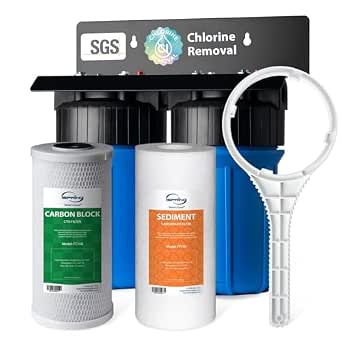 | Best Value for Sediment and Chlorine Reduction | Filtration stages: 2 | Sediment filter: 5-micron polypropylene | Carbon filter: CTO carbon block | VIEW ON AMAZON | See Our Full Breakdown |
| iSpring WGB32BM 3-Stage Whole-House Water Filter System for Iron and Manganese |  | Best for Iron and Manganese in Well Water | Model: WGB32BM | Filtration stages: 3 | Maximum iron reduction: 3.0 ppm | VIEW ON AMAZON | See Our Full Breakdown |
| Express Water 3-Stage Whole House Water Filter Set |  | Best Replacement Filter Set for Multi-Target Treatment | Model number: FLTWH2045CKP2 | Filtration stages: 3 | Filter types: Polyphosphate, KDF, activated carbon block | VIEW ON AMAZON | See Our Full Breakdown |
| iSpring Ultimate Whole House Water Filter with Auto-Flush Sediment Filter |  | Best High-Capacity System with Auto-Flush Sediment Filter | Filtration capacity: 250,000 gallons | Maximum flow rate: 15 GPM | Inlet/outlet size: 1 in. NPT | VIEW ON AMAZON | See Our Full Breakdown |
| Aquasana Rhino Whole House Water Filter System with UV and Salt-Free Scale Control |  | Best for Multi-Stage Treatment | Model: WH-1000-CS-UVS-B | Maximum flow rate: 14.6 gpm | Filtration methods: Carbon, copper-zinc KDF, salt-free scale control, and UV | VIEW ON AMAZON | See Our Full Breakdown |
| Culligan WH-S200-C Whole-House Sediment Water Filter System with P5 Cartridge |  | Best for Sediment-Only Protection | Model: WH-S200-C | Included cartridge: P5 | Filtration method: Sedimentation | VIEW ON AMAZON | See Our Full Breakdown |
| Waterdrop WHF3T-PG 3-Stage Whole House Water Filter System, 5 Micron |  | Best for Higher Flow on a Moderate Capacity | Model: WD-WHF3T-PG | Filtration stages: Listed as 3-stage; description also states 7-stage | Maximum flow rate: 15 GPM | VIEW ON AMAZON | See Our Full Breakdown |
| Express Water Ultimate Protection 3-Stage Whole House Water Filter System |  | Best for Easier Filter Upkeep | Model: WH300SCKP-S | Stages: 3 | Maximum flow rate: 17 gpm | VIEW ON AMAZON | See Our Full Breakdown |
| A. O. Smith AO-WH-Filter Whole House Water Filter System |  | Best for Long-Life Chlorine Reduction | Model: AO-WH-Filter | Filtration method: Activated carbon | Chlorine reduction: 96.9% | VIEW ON AMAZON | See Our Full Breakdown |
| iSpring WGB32B 3-Stage Whole House Water Filter System |  | Best for Chlorine and Taste Reduction | Filtration stages: 3 | Filter configuration: One 5-micron sediment filter and two CTO carbon block filters | Maximum chlorine reduction: Up to 99% | VIEW ON AMAZON | See Our Full Breakdown |
| Express Water 3-Stage Whole House Water Filter System |  | Best for Scale Support and System Monitoring | Model: WH300SCKP | Filtration stages: 3 | Purification methods: Activated carbon, KDF, and polyphosphate | VIEW ON AMAZON | See Our Full Breakdown |
| HQUA WF3-01 3-Stage Whole House Water Filtration System | 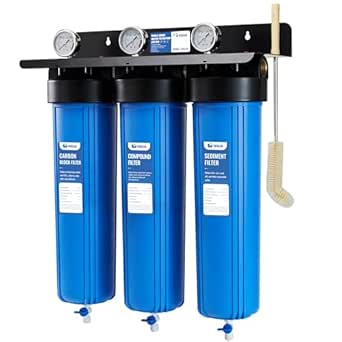 | Best for Maintenance Reminders | Model: WF3-01 | Filter stages: 3 | Purification methods: Sediment, carbon block, and GAC+KDF | VIEW ON AMAZON | See Our Full Breakdown |
| whole house water filter system | Maximum flow rate | Capacity | Model | Filtration stages |
|---|---|---|---|---|
| 3-Stage Whole House Water Filt | 15 gpm | 10,000 gallons | — | 3 |
| iSpring WGB21B Two-Stage Whole | 15 gpm | Up to 50,000 gallons | — | 2 |
| iSpring WGB32BM 3-Stage Whole- | 15 gpm | 100,000 gallons | WGB32BM | 3 |
| Express Water 3-Stage Whole Ho | 0.25 gallons per second | — | — | 3 |
| iSpring Ultimate Whole House W | 15 GPM | — | — | — |
| Aquasana Rhino Whole House Wat | 14.6 gpm | — | WH-1000-CS-UVS-B | — |
| Culligan WH-S200-C Whole-House | 4 gpm | 16,000 gallons | WH-S200-C | — |
| Waterdrop WHF3T-PG 3-Stage Who | 15 GPM | 100,000 gallons | WD-WHF3T-PG | Listed as 3-stage; description also states 7-stage |
| Express Water Ultimate Protect | 17 gpm | 100,000 gallons | WH300SCKP-S | — |
| A. O. Smith AO-WH-Filter Whole | 7 gpm | 600,000 gallons | AO-WH-Filter | — |
| iSpring WGB32B 3-Stage Whole H | 15 GPM | 100,000 gallons | — | 3 |
| Express Water 3-Stage Whole Ho | 17 GPM | 100,000 gallons | WH300SCKP | 3 |
| HQUA WF3-01 3-Stage Whole Hous | 15 GPM | 100,000 gallons | WF3-01 | — |
More Details on Our Top Picks
3-Stage Whole House Water Filter System for Well or City Water
I’d shortlist this system for households that want a straightforward whole-house setup and replacement cartridges included from the start. Its three stages use PP, GAC, and CTO filters to target sediment, chlorine, and odors while leaving natural minerals in the water. The package includes nine cartridges, which can reduce the hassle of sourcing replacements early on, and built-in shut-off valves make cartridge changes more manageable.
Compared with the iSpring WGB21B, this option offers an extra filtration stage and supports standard 3/4-inch plumbing, but its stated capacity is only 10,000 gallons and its cartridges may need changing every six months. It also does not reduce TDS, so it is not a solution for dissolved minerals. I’d choose it for basic filtration needs, not as a treatment system for a specific well contaminant without water testing.
Pros:- Three PP, GAC, and CTO stages target sediment, chlorine, and odors.
- Includes nine cartridges, with three of each filter type.
- Built-in bypass and shut-off valves simplify filter changes.
- Designed for well or city water and preserves natural minerals.
Cons:- Does not lower TDS levels.
- Stated capacity is 10,000 gallons, with filters listed for six-month cycles.
- Maximum flow rate is 15 gpm, which may not suit every high-demand household.
Best for: Homeowners seeking basic sediment, chlorine, and odor reduction who value included replacement cartridges and have standard 3/4-inch plumbing.
Not ideal for: Households with high water use or a need to reduce dissolved solids; its 10,000-gallon capacity and six-month filter cycle may mean more frequent upkeep than the iSpring WGB21B.
- Filtration stages:3
- Included filters:PP, GAC, and CTO; 3 of each
- Filter supply:9 cartridges; up to 1.5–2 years
- Maximum flow rate:15 gpm
- Capacity:10,000 gallons
- Installation:Under sink or whole-house; standard 3/4-inch plumbing
- Dimensions:14 × 13 × 10 in
- TDS reduction:Does not lower TDS levels
Our verdict“Choose this as a basic whole-house filter when included cartridges and simpler maintenance matter more than long capacity or TDS reduction.”
iSpring WGB21B Two-Stage Whole House Water Filtration System
The WGB21B is a sensible pick when the main goal is reducing sediment, chlorine, taste, and odor across the home without adding a more specialized treatment stage. Its 5-micron sediment filter pairs with a CTO carbon block, and the stated capacity of up to 50,000 gallons gives it a longer service interval than the 10,000-gallon 3-Stage Whole House Water Filter System for Well or City Water. One-inch ports and a 15-gpm maximum flow rate suit a main-line installation where flow matters.
There is less contaminant-specific coverage here than with the iSpring WGB32BM, which is built to reduce iron and manganese. The WGB21B also does not reduce TDS, and its two-stage design is aimed at general filtration rather than a broad range of water problems. I’d favor it for city water or tested water without a known iron issue; well owners should match treatment to test results.
Pros:- Combines a 5-micron sediment filter with a CTO carbon block.
- Stated capacity of up to 50,000 gallons and filter life up to 12 months.
- One-inch inlet and outlet ports with a maximum flow rate of 15 gpm.
- Preassembled system includes an installation set, filter wrench, and pressure-release valve.
Cons:- Does not reduce TDS.
- Two-stage filtration is not targeted to iron or manganese reduction.
- Filters require periodic replacement, and the system needs space for its 26-inch dimension.
Best for: Households wanting general sediment, chlorine, taste, and odor reduction with one-inch main-line connections and a stated capacity suited to longer filter intervals.
Not ideal for: Owners dealing with iron or manganese, or anyone seeking TDS reduction; the WGB32BM has more targeted iron and manganese filtration.
- Filtration stages:2
- Sediment filter:5-micron polypropylene
- Carbon filter:CTO carbon block
- Capacity:Up to 50,000 gallons
- Filter life:Up to 12 months
- Inlet/outlet ports:1 inch
- Maximum flow rate:15 gpm
- Operating pressure:80 psi
- TDS reduction:Does not reduce TDS
Our verdict“Pick the WGB21B for general whole-house sediment and chlorine filtering when you do not need specialized iron treatment.”
iSpring WGB32BM 3-Stage Whole-House Water Filter System for Iron and Manganese
Among these options, the WGB32BM is the clearest fit when water testing points to iron or manganese alongside sediment and chlorine. Its three-stage setup is rated to reduce up to 3.0 ppm iron and 1.0 ppm manganese, while the sediment stage filters down to 5 microns. The stated 100,000-gallon capacity and 15-gpm flow rate make it more suited to whole-home use than a point-of-use filter.
That specialization sets it apart from the iSpring WGB21B, which focuses on sediment and carbon filtration but does not list iron and manganese reduction. The tradeoff is a heavier, larger system that must go on the main supply line; at 55 pounds, installation takes more planning than a compact starter system. It also does not reduce TDS, and its listed one-year warranty is shorter than some buyers may expect for a main-line investment. I’d choose it only when its targeted filtration matches test results.
Pros:- Targets iron up to 3.0 ppm and manganese up to 1.0 ppm.
- Three-stage filtration also addresses sediment, chlorine, and rust.
- Stated capacity of 100,000 gallons and maximum flow rate of 15 gpm.
- Includes three filters and a wrench.
Cons:- Does not reduce TDS.
- Requires installation on the home’s main water supply line.
- At 55 pounds and 24.5 × 8 × 28 inches, it needs room and installation planning.
Best for: Well-water households with test results showing iron and/or manganese, plus a need to filter sediment and chlorine throughout the home.
Not ideal for: Homes without an iron or manganese concern, or owners who need TDS reduction; its larger main-line installation may be more system than basic city-water filtration requires.
- Model:WGB32BM
- Filtration stages:3
- Maximum iron reduction:3.0 ppm
- Maximum manganese reduction:1.0 ppm
- Sediment filtration:Down to 5 microns
- Maximum flow rate:15 gpm
- Capacity:100,000 gallons
- Inlet/outlet:1 in. NPT
- Filter life:Up to 1 year
Our verdict“Choose the WGB32BM when well-water testing identifies iron or manganese and you can accommodate a substantial main-line system.”
Express Water 3-Stage Whole House Water Filter Set
This Express Water set is best understood as a six-filter replacement bundle, rather than a complete whole-house system: the supplied product details describe replacement filters and their performance, not a full housing assembly. Its polyphosphate, KDF, and activated carbon block stages are intended to address scale formation, heavy metals, chlorine, sediment, and odors. That broader target list distinguishes it from the iSpring WGB21B, which is focused on sediment and carbon filtration.
The stated capacity reaches 100,000 gallons, but actual filter life varies with incoming water and is listed as six to 12 months. The maximum flow rate of 0.25 gallons per second is specified in different units from the other products, so I would not treat it as directly comparable to their gpm figures without conversion and context. Installation also calls for a dry, level location protected from freezing and direct sunlight. I’d pick this set when its media matches your treatment plan and compatible housing is already in place.
Pros:- Six replacement filters are included.
- Three media types target scale formation, heavy metals, chlorine, sediment, and odors.
- Stated capacity reaches up to 100,000 gallons.
- Filter life is listed as six to 12 months, depending on water quality.
Cons:- Product details describe replacement filters, not a complete housing system.
- Actual filter life depends on incoming water quality and conditions.
- Installation area must be dry and level, and protected from freezing and direct sunlight.
Best for: Owners of a compatible whole-house filter setup who need replacement cartridges with KDF, polyphosphate, and carbon media for several common water concerns.
Not ideal for: Buyers looking for a clearly described complete system or a simpler general sediment-and-chlorine setup; the product data describes a filter set and calls for specific installation conditions.
- Model number:FLTWH2045CKP2
- Filtration stages:3
- Filter types:Polyphosphate, KDF, activated carbon block
- Filter size:4.5 × 20 in
- Included components:6 whole-house replacement filters
- Filter capacity:Up to 100,000 gallons
- Filter life:6–12 months
- Maximum flow rate:0.25 gallons per second
- Operating pressure:45–80 psi
Our verdict“Choose this set when you already have compatible whole-house filter housings and want replacement media aimed at several water concerns.”
iSpring Ultimate Whole House Water Filter with Auto-Flush Sediment Filter
The iSpring Ultimate is the strongest fit here for buyers prioritizing fewer sediment-filter chores and a long stated service capacity. Its reusable auto-flush sediment filter is designed to clear collected sediment, while compound and coconut-shell carbon block stages address scale formation, chlorine, metals, and other listed contaminants. At 250,000 gallons and up to 15 gpm, it has more stated capacity than the WGB32BM’s 100,000 gallons, though actual maintenance still depends on water conditions.
This is a substantial main-line installation, not a compact starter option: it weighs 66.7 pounds and measures 25 × 22 × 17 inches. Its polyphosphate stage is intended to prevent scale formation but does not remove calcium or magnesium, and the system does not reduce TDS. Compared with the iSpring WGB21B, it offers auto-flush and greater stated capacity, but asks for much more space and installation planning. I’d pick it when those tradeoffs suit the home.
Pros:- Reusable sediment filter has an automatic flushing module.
- Stated filtration capacity of 250,000 gallons.
- Maximum flow rate of 15 gpm with one-inch NPT connections.
- DIY installation design and no power source required.
Cons:- Does not reduce TDS.
- Polyphosphate helps prevent scale formation but does not remove calcium or magnesium.
- Large, heavy assembly needs substantial installation space.
Best for: Homeowners with room for a large main-line system who want auto-flushing sediment maintenance, a 15-gpm flow rate, and high stated capacity.
Not ideal for: Small utility spaces, renters, or households seeking softened water or TDS reduction; its size is substantial and its scale-control stage does not remove calcium or magnesium.
- Filtration capacity:250,000 gallons
- Maximum flow rate:15 GPM
- Inlet/outlet size:1 in. NPT
- Cartridge size:20 in. × 4.5 in.
- Installation:DIY
- Purification methods:Carbon block, sedimentation
- Maximum supported TDS:300 ppm
- Dimensions:25 in. L × 22 in. W × 17 in. H
- Weight:66.7 lb
Our verdict“Choose the iSpring Ultimate if you have installation room and want auto-flush sediment handling with greater stated capacity than the WGB32BM.”
Aquasana Rhino Whole House Water Filter System with UV and Salt-Free Scale Control
I’d put the Aquasana Rhino ahead of simpler carbon-only systems when a household wants several kinds of treatment at the main line. Its sediment, carbon, KDF, salt-free scale-control, and UV stages target different concerns, while the UV component is certified to NSF/ANSI Standard 55, Class B. The 1-million-gallon rating also sets it apart from shorter-capacity options such as the Waterdrop WHF3T-PG and Express Water Ultimate Protection, whose stated capacity is 100,000 gallons.
The tradeoff is that this breadth does not make it a water softener: it preserves minerals and is best suited to water below 15 gpg hardness. Its 14.6 gpm flow rate is substantial, but the system’s 69-inch listed height calls for careful space planning. I’d choose it for varied treatment needs, not for reducing TDS or solving hard water beyond its scale-control range.
Pros:- Combines sediment, carbon, KDF, salt-free scale control, and UV treatment
- Rated for up to 1 million gallons or 10 years
- UV component is certified to NSF/ANSI Standard 55, Class B
- Salt-free scale control requires no backwashing or drain line
Cons:- Does not soften or demineralize water
- Best suited to water below 15 gpg hardness
- Listed dimensions include a 69-inch height, which may restrict installation locations
Best for: Households seeking several treatment stages, including UV, and a long rated capacity, with water hardness below 15 gpg
Not ideal for: Homes needing true water softening, TDS reduction, or treatment for water above the stated hardness range
- Model:WH-1000-CS-UVS-B
- Maximum flow rate:14.6 gpm
- Filtration methods:Carbon, copper-zinc KDF, salt-free scale control, and UV
- Chlorine reduction:Up to 97%
- UV certification:NSF/ANSI Standard 55, Class B
- Operating pressure:20–100 psi
- Dimensions:46 × 9 × 69 in
- Warranty:10-year limited warranty
Our verdict“Choose the Aquasana Rhino if you want multi-stage whole-house treatment with UV and have water within its stated hardness range.”
Culligan WH-S200-C Whole-House Sediment Water Filter System with P5 Cartridge
I’d choose the Culligan WH-S200-C when the main problem is visible sediment, not taste or dissolved contaminants. Its P5 sediment cartridge targets dirt, sand, and silt entering the home, and the clear housing lets owners check cartridge condition without opening it. That focused job makes it a simpler fit than the Aquasana Rhino, which adds carbon, KDF, scale control, and UV for households seeking broader treatment.
The Culligan also has a built-in bypass shut-off and pressure relief button, useful when changing a cartridge, but its 4 gpm maximum flow rate is modest beside the Waterdrop WHF3T-PG’s 15 gpm. I’d treat it as a targeted protective stage for plumbing and appliances, not a complete solution for chlorine taste, odors, or microbial concerns. Cartridge compatibility is another ongoing constraint: replacements need to match the listed compatible types.
Pros:- Targets dirt, sand, and silt throughout the home
- Clear housing makes cartridge condition easy to inspect
- Built-in bypass shut-off and pressure relief button simplify cartridge changes
- Compact housing measures about 16 inches tall
Cons:- Sedimentation filtration does not claim to remove other contaminants
- Maximum flow rate is 4 gpm
- Requires compatible replacement cartridges
Best for: Homeowners with sediment-prone supply who want a compact main-line filter and a visible cartridge check
Not ideal for: Households seeking chlorine, odor, or broad contaminant reduction, or those whose water demand may exceed the 4 gpm flow rating
- Model:WH-S200-C
- Included cartridge:P5
- Filtration method:Sedimentation
- Inlet/outlet connections:3/4 inch
- Maximum flow rate:4 gpm
- Capacity:16,000 gallons
- Operating pressure range:30–100 psi
- Compatible cartridges:P5, CW-F, CW-MF, S1A-D
Our verdict“Pick the Culligan if sediment is your specific concern and you do not need the broader treatment offered by systems such as the Aquasana Rhino.”
Waterdrop WHF3T-PG 3-Stage Whole House Water Filter System, 5 Micron
The Waterdrop WHF3T-PG is a practical middle ground for households that want chlorine, odor, taste, and particle reduction without stepping up to the Aquasana Rhino’s UV and scale-control setup. Its 15 gpm maximum flow rate is higher than the Culligan WH-S200-C’s 4 gpm, making it the more suitable of those two for a home with greater simultaneous water demand. Sediment, carbon, and KDF stages are intended to handle common aesthetic issues, and the system is listed for both well and municipal water.
Its limits are just as relevant: 100,000-gallon capacity is far below the Aquasana’s rating, and filter life depends on incoming water quality. The product information also calls the system both three-stage and seven-stage, so I would verify the exact configuration before buying. With a 1-inch inlet and outlet, it may fit a higher-flow installation, but it is not a substitute for testing and treating a specific well-water contaminant.
Pros:- Sediment, carbon, and KDF filtration targets particles and common taste and odor concerns
- Maximum flow rate is 15 gpm
- Designed for well and municipal water
- Filter life is rated for up to 12 months, depending on water quality
Cons:- Capacity is rated at 100,000 gallons, well below the Aquasana Rhino’s 1 million gallons
- Stage count is described inconsistently as both three and seven
- Actual filter life depends on source-water quality
Best for: Households on well or municipal water that want common chlorine, odor, taste, and sediment reduction with a stated flow rate of 15 gpm
Not ideal for: Buyers who need clearly documented stage configuration, very long rated capacity, or targeted treatment for a tested contaminant
- Model:WD-WHF3T-PG
- Filtration stages:Listed as 3-stage; description also states 7-stage
- Maximum flow rate:15 GPM
- Capacity:100,000 gallons
- Filter life:Up to 12 months, depending on water quality
- Inlet/outlet:1 inch
- Maximum supported TDS:1,000 ppm
- Dimensions:22.9 × 8.46 × 26.1 in
Our verdict“Choose the Waterdrop if you want a higher-flow, three-stage-style system for common aesthetic concerns and can accept shorter, water-dependent filter life.”
Express Water Ultimate Protection 3-Stage Whole House Water Filter System
I’d shortlist the Express Water Ultimate Protection for owners who want maintenance cues and a reusable first-stage screen rather than a long interval between service. The 50-micron sediment prefilter can be reused, helping catch larger particles before they reach the other stages, while pressure gauges and quick-change cartridges make upkeep more structured than on the A. O. Smith AO-WH-Filter. Its 17 gpm maximum flow rate is also the highest among these five products.
That service-friendly design comes with space and labor costs: the unit weighs 66 pounds and measures 29 × 8.5 × 30 inches, so installation needs a suitable location and secure plumbing. The stated filter life cycle is six months, despite the 100,000-gallon capacity, so owners should plan around the shorter interval rather than capacity alone. I’d select it for accessible maintenance and flow, not for a low-intervention setup like the A. O. Smith’s six-year rated filter life.
Pros:- Reusable 50-micron sediment prefilter can protect later filtration stages
- Pressure gauges help monitor system conditions
- Quick-change cartridges support simpler routine servicing
- Maximum flow rate is 17 gpm
Cons:- Listed filter life cycle is six months, requiring regular replacement
- Large and heavy at 29 × 8.5 × 30 inches and 66 pounds
- Requires whole-house installation and adequate mounting space
Best for: Homeowners who want a high-flow whole-house system with gauges, quick-change cartridges, and a reusable sediment prefilter
Not ideal for: Buyers with limited installation space, those unable to support a 66-pound unit, or anyone seeking infrequent cartridge service
- Model:WH300SCKP-S
- Stages:3
- Maximum flow rate:17 gpm
- Sediment prefilter:Reusable, 50 micron
- Connections:1 inch
- Capacity:100,000 gallons
- Filter life cycle:6 months
- Operating pressure:20–80 psi
- Dimensions and weight:29 × 8.5 × 30 inches; 66 pounds
Our verdict“Pick the Express Water if high flow and visible, service-friendly upkeep matter more than a compact footprint or long replacement intervals.”
A. O. Smith AO-WH-Filter Whole House Water Filter System
The A. O. Smith AO-WH-Filter is the straightforward pick here for reducing chlorine taste and odor throughout the home. Its activated carbon filtration is rated to reduce 96.9% of chlorine, and its six-year or 600,000-gallon service rating offers a simpler maintenance schedule than the Express Water Ultimate Protection’s listed six-month filter cycle. A shut-off valve, nipple, and hose adapter are included, which can help buyers planning a DIY installation.
This focused approach is also its main limitation. Unlike the Aquasana Rhino, it has no UV, KDF, or salt-free scale-control stages; it does not soften water or reduce TDS, sulfur, or iron. Its 7 gpm maximum flow rate is lower than the Waterdrop and Express Water options, too. I’d choose it for chlorine-related taste and odor concerns and skip it when the water report points to hardness, iron, sulfur, or other treatment needs.
Pros:- Rated to reduce up to 96.9% of chlorine taste and odor
- Rated for up to 600,000 gallons or six years
- Includes a shut-off valve, nipple, and hose adapter
- No drain or backflushing is required
Cons:- Does not soften water or reduce TDS, sulfur, or iron
- Maximum flow rate is 7 gpm, below the Waterdrop and Express Water listings
- A prefilter is recommended, and installation may require additional tools
Best for: Homeowners focused on reducing chlorine taste and odor across household taps who prefer a long rated filter life
Not ideal for: Households needing water softening, TDS, sulfur, or iron reduction, or needing flow above the stated 7 gpm maximum
- Model:AO-WH-Filter
- Filtration method:Activated carbon
- Chlorine reduction:96.9%
- Capacity:600,000 gallons
- Filter life:Up to 6 years
- Maximum flow rate:7 gpm
- Connections:3/4 in NPT
- Certification:NSF/ANSI 42
- Warranty:6-year limited warranty
Our verdict“Choose the A. O. Smith for long-life, whole-house chlorine taste and odor reduction when you do not need softening or broader contaminant treatment.”
iSpring WGB32B 3-Stage Whole House Water Filter System
The iSpring WGB32B is a strong match for households on treated water that want to reduce chlorine taste and odor, rust, and sediment while keeping naturally occurring minerals. Its 5-micron sediment filter and two coconut-shell carbon block filters give it a clearer focus on particulate and chlorine reduction than the Express Water 3-Stage Whole House Water Filter System, which adds KDF and polyphosphate for heavy-metal reduction and scale support. The iSpring’s 15 GPM flow rate and stated 100,000-gallon capacity suit a whole-home setup, while its one-year filter life may mean less frequent changes than HQUA WF3-01’s 180-day timer suggests. The tradeoff is scope: it does not reduce total dissolved solids, and installation plus cartridge changes are the owner’s responsibility. Choose it for routine taste and sediment concerns, not broad water purification.
Pros:- Three stages target sediment, rust, chlorine, tastes, and odors.
- Two coconut-shell carbon block filters focus filtration on chlorine and taste concerns.
- 100,000-gallon capacity and stated one-year filter life support less frequent routine replacement.
- Maintains healthy minerals rather than removing them.
Cons:- Does not remove total dissolved solids.
- Requires DIY installation and periodic cartridge replacement.
- Its 15 GPM maximum flow rate is lower than the Express Water system’s stated 17 GPM.
Best for: Households on municipal water seeking less chlorine taste, odor, rust, and sediment while retaining minerals.
Not ideal for: Well-water owners needing treatment for specific contaminants or buyers seeking TDS reduction, since this system does not remove total dissolved solids.
- Filtration stages:3
- Filter configuration:One 5-micron sediment filter and two CTO carbon block filters
- Maximum chlorine reduction:Up to 99%
- Maximum flow rate:15 GPM
- Capacity:100,000 gallons
- Filter size:20 × 4.5 inches
- Inlet/outlet:1-inch NPT
- Operating pressure:25–80 psi
- Installation and warranty:DIY; 1-year limited warranty
Our verdict“Choose the iSpring WGB32B if your main goal is whole-house chlorine, taste, and sediment reduction without removing minerals.”
Express Water 3-Stage Whole House Water Filter System
Express Water’s three-stage setup is the most monitoring-focused of these three picks: its pressure gauges and filter pressure-release buttons give owners a practical way to check system pressure and make cartridge servicing easier. Activated carbon, KDF, and polyphosphate broaden its stated targets beyond the iSpring WGB32B’s emphasis on chlorine, sediment, and taste, with support for reducing heavy metals and limiting scale buildup. It also lists a 17 GPM maximum flow rate, above the 15 GPM listed for both the iSpring and HQUA systems. That added capacity and monitoring come with real costs in upkeep and space: filters have a six-month replacement cycle, and the 63-pound stainless-steel unit is heavier than either alternative. Its freestanding design suits buyers who have room for a dedicated installation area, but it is less appealing for owners seeking lighter equipment or longer stated intervals between changes.
Pros:- Activated carbon, KDF, and polyphosphate target chlorine, heavy metals, and scale buildup.
- 17 GPM maximum flow rate is higher than the 15 GPM listed for the iSpring WGB32B and HQUA WF3-01.
- Pressure gauges and release buttons support monitoring and filter servicing.
- Stainless-steel freestanding construction provides a dedicated stand.
Cons:- Filters have a stated six-month replacement cycle.
- At 63 pounds, it is heavier than the iSpring WGB32B and HQUA WF3-01.
- Its 29 × 8.5 × 30-inch dimensions call for a dedicated installation area.
Best for: Homeowners with room for a freestanding system who want heavy-metal and scale support, higher listed flow, and visible pressure monitoring.
Not ideal for: Buyers with limited installation space or those who prefer fewer scheduled cartridge changes, given its 63-pound build and six-month filter cycle.
- Model:WH300SCKP
- Filtration stages:3
- Purification methods:Activated carbon, KDF, and polyphosphate
- Maximum flow rate:17 GPM
- Capacity:100,000 gallons
- Filter life cycle:6 months
- Operating pressure:20–80 psi
- Dimensions and weight:29 × 8.5 × 30 inches; 63 pounds
- Installation and warranty:Freestanding; 1-year manufacturer warranty
Our verdict“Pick Express Water if you want scale support, monitoring features, and a higher stated flow rate, and can accommodate frequent filter changes and a heavy freestanding unit.”
HQUA WF3-01 3-Stage Whole House Water Filtration System
The HQUA WF3-01 is a practical pick for owners who want maintenance cues built into the system rather than relying only on memory. Its pressure gauges and 180-day filter-life timers make routine checks more visible, while its sediment, carbon block, and GAC+KDF stages are described as targeting sediment, chlorine, odors, and heavy metals. Compared with the iSpring WGB32B, HQUA places more emphasis on monitoring and heavy-metal reduction than on a stated chlorine-reduction percentage; unlike Express Water’s freestanding stainless-steel design, it offers bracket or free-standing installation options. The stated 15 GPM flow and 100,000-gallon capacity fit whole-house use, but its 31-inch height and 23-inch width demand substantial clearance. At 44 pounds, it is also a substantial unit to position, and the supplied data does not specify a warranty or filter replacement interval beyond the timer.
Pros:- Pressure gauges and 180-day filter-life timers make routine maintenance easier to track.
- Sediment, carbon block, and GAC+KDF stages target sediment, chlorine, odors, and heavy metals.
- Offers bracket or freestanding installation options.
- Includes a cleaning brush and maintenance card.
Cons:- The 31 × 23 × 8-inch footprint needs substantial installation clearance.
- At 44 pounds, positioning and mounting may take added effort.
- The supplied product data does not state a warranty or capacity-based filter replacement interval.
Best for: Homeowners who want visible pressure monitoring and filter-life reminders, with enough room for a large bracket-mounted or freestanding system.
Not ideal for: People with tight utility-room space or anyone needing a compact, lightweight installation; this unit is 31 inches tall, 23 inches wide, and weighs 44 pounds.
- Model:WF3-01
- Filter stages:3
- Purification methods:Sediment, carbon block, and GAC+KDF
- Filter size:20 × 5.5 inches
- Maximum flow rate:15 GPM
- Capacity:100,000 gallons
- Operating pressure:25–116 psi
- Dimensions and weight:31 × 23 × 8 inches; 44 pounds
- Temperature range:40–125 °F
Our verdict“Choose the HQUA WF3-01 if maintenance reminders and flexible mounting matter more to you than a compact footprint.”

How We Picked
I compared these systems as whole-house solutions, prioritizing what each is designed to reduce, how its filtration stages fit common city- and well-water concerns, and whether its configuration gives buyers a clear reason to choose it over a simpler alternative. I also weighed practical ownership factors: expected cartridge upkeep, installation complexity, stated flow and capacity information, and whether added features such as UV treatment, scale control, or automatic flushing serve a specific need. I did not treat a higher stage count or a longer feature list as proof of better water quality.
The ranking favors systems with a useful balance of treatment scope and day-to-day practicality for a broad range of homes. Targeted options rank well for buyers whose water has the matching issue, but lower as general recommendations when their treatment scope is narrower. Before buying, compare each manufacturer’s contaminant claims with a current water test and confirm replacement cartridges, plumbing connections, and household flow requirements; product names alone do not establish that a system treats a particular contaminant.
Factors to Consider When Choosing Whole House Water Filter System
Choosing a whole-house filter starts with the water, not the product label. I would use these factors to narrow the field before comparing cartridges or features, since a mismatch can leave the main concern untreated or add maintenance the household does not need.
Match Treatment to a Water Test
Start with a laboratory test for private well water or a water-quality report for municipal supply, then identify the specific contaminants or nuisance issues you want to address. A filter marketed for iron and manganese is not automatically a solution for bacteria, hardness, or every dissolved contaminant. Likewise, a sediment stage can catch particles without changing dissolved minerals or disinfectants. Compare the test results with the system’s published reduction claims and the conditions attached to them. A common mistake is buying based on a symptom, such as staining or odor, without finding its cause. If the test identifies a concern outside a filter’s stated scope, ask a qualified water-treatment professional about an appropriate treatment method.
Decide Whether You Need Whole-House or Point-of-Use Treatment
A whole-house system treats water at the entry point, so it can serve showers, laundry, and faucets throughout the home. That broad coverage is useful when the issue affects multiple uses, but it may not be the most direct answer for drinking-water concerns alone. A point-of-use filter at the kitchen tap can target drinking and cooking water without filtering every gallon used for bathing or cleaning. Some households choose both, but each unit needs its own maintenance plan. Before paying for whole-house treatment, ask where the problem matters and whether a single-tap solution would meet the need. This distinction can prevent buying a larger system than the household requires.
Size for Peak Flow, Not Just Household Size
Check the system’s rated flow and pressure information against the number of bathrooms and appliances that may run at once. A filter that restricts flow can become frustrating during simultaneous showers, laundry, or other high-demand use. Household size is a rough clue, but it does not replace the manufacturer’s specifications or a plumber’s assessment of pipe size and pressure. Fine sediment filtration and multiple stages may affect flow differently from a simple cartridge housing. Do not assume that a larger-looking unit or more stages guarantees better performance at peak demand. Confirm the system’s service-flow guidance and connection size before installation.
Work Out the Full Maintenance Burden
Compare replacement intervals, cartridge availability, and the number of consumables—not only the initial filter configuration. Multiple stages can target different concerns, but they also mean more parts to track and replace. Automatic flushing or other convenience features may reduce some routine tasks, yet they do not remove the need to follow the maker’s service schedule. Ask whether replacement elements are standard or proprietary and whether you can get them when needed. A frequent mistake is choosing a system that seems low-maintenance without checking its actual cartridge schedule. The best fit is one whose upkeep you can realistically keep up with.
Separate Filtration from Water Softening and Disinfection
Many buyers use “filter” to mean any equipment that improves water, but filtration, softening, scale control, and disinfection are different jobs. Salt-free scale-control media do not function like a conventional salt-based softener, and a UV stage addresses microorganisms only under the system’s specified operating conditions. A sediment or carbon cartridge should not be assumed to disinfect water or remove hardness. If hard water is the concern, first confirm the hardness level and choose equipment designed for that purpose. If a well-water test shows a microbial issue, seek treatment matched to that risk rather than relying on a general filter. Understanding these distinctions helps prevent paying for a feature that does not solve the household’s actual problem.
Check Installation Fit Before Ordering
Whole-house systems need space near the main water line, access for cartridge changes, and plumbing connections compatible with the home. Allow room beneath and around housings so a filter can be opened without dismantling nearby equipment. Some installations may call for a bypass, shutoff valves, a drain connection, or electrical access, depending on the system’s features. Confirm whether the package includes the fittings and mounting parts you need, and decide whether a licensed plumber should handle the work. A compact unit is not automatically easy to service if its cartridge access is blocked. Measuring the installation area and tracing the main line before purchase can prevent avoidable fit problems.
Frequently Asked Questions
Should I choose a whole-house filter before testing my well water?
I would test well water first, since the results determine whether a general three-stage filter is suitable or a targeted treatment is needed. The iSpring WGB32BM is specifically positioned for iron and manganese, but that does not mean it addresses every possible well-water concern. A test can also identify issues that call for disinfection or a different treatment method. Use the results to check the system’s exact reduction claims and operating limits. If the test shows a health-related concern, get qualified advice before relying on a standard filter.
Is a sediment-only system enough for a whole house?
It can be enough when the main goal is catching visible particles or protecting plumbing and downstream equipment from sediment. The Culligan WH-S200-C is a more focused choice than the multi-stage systems in this roundup. A sediment filter does not automatically reduce chlorine, dissolved contaminants, hardness, or microorganisms. Start by identifying the source and impact of the particles, then decide whether broader treatment is needed. If drinking-water taste or a specific dissolved contaminant is also a concern, check for a separate stage certified or documented for that purpose.
Can a whole-house filter replace a water softener?
Usually not: a filter and a softener serve different purposes. Many filtration systems are designed to reduce particles or particular contaminants, while a conventional softener addresses hardness minerals through a different process. Salt-free scale-control systems, such as the feature set offered by the Aquasana Rhino, should not be assumed to soften water in the same way as a salt-based unit. Test the water hardness and check the maker’s description of what its system does and does not change. If you need both contaminant reduction and hardness treatment, plan for equipment matched to each job.
How do I avoid buying a system that reduces water pressure?
Compare the manufacturer’s rated service flow and pressure-drop information with your home’s expected peak demand. Consider how often multiple showers, appliances, or outdoor taps run at once, rather than sizing only by the number of residents. Check the connection size and whether your plumbing layout can support the unit. Cartridge condition matters too: clogged or overdue filters can affect flow, so maintenance is part of the performance equation. If the system’s published specifications do not answer your questions, ask the manufacturer or a plumber before choosing it.
Is a UV stage useful if my water is treated by the city?
A UV stage may be unnecessary for many homes on treated municipal water, but the answer depends on the source, local conditions, and the concern you are addressing. UV is a disinfection feature, not a substitute for filtration aimed at sediment, taste, or dissolved chemicals. If you are on a private well or have a specific microbial concern, base the decision on water testing and professional guidance. Also check the unit’s operating requirements, including power and maintenance needs. The Aquasana Rhino adds UV alongside other features, so compare that broader setup with your actual water concerns before choosing it.
Conclusion
My best overall recommendation is the iSpring WGB32B for buyers who want a balanced three-stage whole-house option. For best value, compare the simpler iSpring WGB21B with the other basic multi-stage systems and choose based on the contaminants and replacement cartridges that match your water; there is no reason to pay for stages you do not need. The Aquasana Rhino is my best premium-style pick for households that have a use for its UV and salt-free scale-control features, while the Culligan WH-S200-C is the most approachable choice for a narrower sediment-only job. For well water with confirmed iron or manganese, the iSpring WGB32BM is the more targeted option. Before ordering any system, match its documented treatment claims to a current water test, then confirm flow, installation space, and maintenance fit.
Halloween Picks
halloween
As an affiliate, we earn on qualifying purchases.