Welding helmets have evolved well beyond simple shade-10 fixed lenses, and the biggest choice you face today is between true-color auto-darkening clarity and rugged, low-maintenance simplicity. The Lincoln Electric K3034-4 VIKING 3350 takes my top spot for its 4C lens technology, four sensors, and extra-large view that suit everything from MIG to TIG. The ESAB Sentinel A60 stands out as the premium alternative with a wider 6.0 arc-detection range, while the YESWELDER LYG-L600A delivers impressive true-color performance for hobbyists on a budget. Tradeoffs in this category come down to optical quality versus price, sensor count for awkward-angle welding, and whether you need smart digital controls or just reliable basics. Read on for the full breakdown of all 15 helmets and which one fits your welding style.

Get the latest gadgets delivered free with Prime
- Fast, free delivery on millions of items
- Prime Video, Amazon Music and more included
- Member-only deals all year
Complete the kit



Key Takeaways
- True-color lens technology appeared on seven of the 15 helmets reviewed, but the Lincoln VIKING 3350’s 4C lens and the ESAB Sentinel A60 delivered the best optical clarity for precision TIG work at low amperage.
- Sensor count became the dividing line as prices dropped: the Lincoln, MIGVAN, and ARCCAPTAIN RL-600LA offer four sensors for reliable arc detection at odd angles, while budget YESWELDER models with fewer sensors occasionally missed restrikes out of position.
- Passive helmets like the Jackson leather lift-front and the PL280 Pipeline still earned their places — pipeline and outdoor contractors benefit from no batteries, no electronics, and near-indestructible shells.
- Solar and solar/rechargeable hybrid power dominated the mid-range, meaning most buyers can ignore battery anxiety entirely, though the Miller Classic’s battery-backed design remains a trusted shop favorite.
- Large viewing areas (3.5-inch class and up) from ARCCAPTAIN and YESWELDER closed the gap with premium helmets, but grind mode, delay, and sensitivity adjustability — not screen size — separated professional picks from hobbyist ones.
| MIGVAN Auto Darkening Welding Helmet with True Color Lens, 4 Arc Sensors, Solar/Rechargeable Power, Shade 4/5-13 |  | Best Overall | Arc Sensors: 4 | Shade Range: DIN 4 (light), DIN 5-13 (dark) | Power Source: Solar and replaceable CR2450 battery | VIEW ON AMAZON | See Our Full Breakdown |
| Jackson Safety Insight Auto-Darkening Welding Helmet (HLX Shell) | 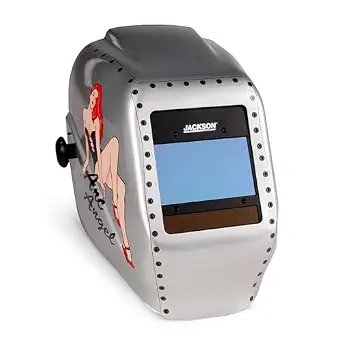 | Best for All-Day Comfort | Weight: 6 ounces | Viewing Area: 3.94 x 2.36 inches (9.3 sq in) | Shade Range: 9-13 variable | VIEW ON AMAZON | See Our Full Breakdown |
| ARCCAPTAIN Auto-Darkening Welding Helmet with LED Light and Large Viewing Screen |  | Best for Dark Workspaces | Viewing Area: 3.94 x 3.66 inches | Arc Sensors: 4 | Switching Speed: 1/25,000 second | VIEW ON AMAZON | See Our Full Breakdown |
| YESWELDER LYG-L600A True Color Auto-Darkening Welding Helmet |  | Best Value | Viewing Area: 3.64 x 1.67 inches | Optical Clarity: 1/1/1/1 | Response Time: 1/30,000 second | VIEW ON AMAZON | See Our Full Breakdown |
| Miller Classic Series Auto-Darkening Welding Helmet, ClearLight Technology, Shade 8-13, Black |  | Best Brand-Backed Reliability | Lens Technology: ClearLight | Viewing Area: 6 square inches | Weld Shade Range: 8-13 | VIEW ON AMAZON | See Our Full Breakdown |
| YESWELDER Welding Helmet with LED Light and Blue Light Filtering Lens |  | Best for Dark Workshop Visibility | Viewing Area: 3.93″ x 3.66″ | Shade Range: 3/5-9/9-13 | Switching Speed: 1/30,000 sec | VIEW ON AMAZON | See Our Full Breakdown |
| YESWELDER Smart Auto-Shade Welding Helmet with Digital Filter |  | Best Smart Shade Automation | Auto-Shade Range: Shade 5-8 (cutting); 9-15 (welding) | Lighting: Removable LED work light, two brightness levels | Power Source: Replaceable CR2450 battery and solar panel | VIEW ON AMAZON | See Our Full Breakdown |
| ARCCAPTAIN Auto-Darkening Welding Helmet (HSH-S800 Skeleton Knight) |  | Best Lightweight Comfort | Viewing Size: 3.86″ x 1.69″ | Shade Range: 4/9-13 | Response Time: 1/25,000s | VIEW ON AMAZON | See Our Full Breakdown |
| ARCCAPTAIN RL-600LA Intelligent Auto-Darkening Welding Helmet with 180° True Color View |  | Best Premium Panoramic View | Viewing Area: 7.2″ x 3.2″ (Main: 4.6″ x 3.2″, Side: 1.3″ x 2.5″) | Optical Clarity: 1/1/1/1 | Response Time: 1/30,000s | VIEW ON AMAZON | See Our Full Breakdown |
| YESWELDER LYG-M800H Auto-Darkening Welding Helmet |  | Best Value Workhorse | Viewing Area: 3.93″ x 3.66″ | Optical Clarity: 1/1/1/1 true color | Arc Sensors: 4 | VIEW ON AMAZON | See Our Full Breakdown |
| ESAB Sentinel A60 Welding Helmet, Black |  | Best Premium Auto-Darkening Helmet | Viewing area: 4.65 x 2.80 in | Shade range: DIN 3/5–13 | Shade adjustment: 0.5 increments | VIEW ON AMAZON | See Our Full Breakdown |
| Jackson Safety Heat-Resistant Flexible Leather Welding Helmet, 2″H x 4.25″W Lift Front |  | Best for Overhead and Confined-Space Welding | Material: Leather | Safety plate: 2″H x 4.25″W | Window type: Lift front | VIEW ON AMAZON | See Our Full Breakdown |
| ARCCAPTAIN Auto-Darkening Welding Helmet with 3.94″ x 3.66″ Large Viewing Screen |  | Best Value Large-View Auto-Darkener | Viewing screen: 3.94″ x 3.66″ | Switching time: 1/25000 seconds | Arc sensors: 4 | VIEW ON AMAZON | See Our Full Breakdown |
| Jackson Safety PL280 Pipeline Welding Helmet with Shade 10 Filter |  | Best Dedicated Pipeline Bucket | Material: Fiberglass, polycarbonate | Window size: 2 x 4.25 inches | Filter shade: 10 (fixed) | VIEW ON AMAZON | See Our Full Breakdown |
| Lincoln Electric K3034-4 VIKING 3350 Auto-Darkening Welding Helmet, Matte Black |  | Best Overall for All-Day Comfort and View | Lens technology: 4C | Optical clarity: 1/1/1/1 | Viewing area: 12.5 sq in | VIEW ON AMAZON | See Our Full Breakdown |
| welding helmet | Viewing Area | Arc Sensors | Shade Range | Weight |
|---|---|---|---|---|
| MIGVAN Auto Darkening Welding | Large | 4 | DIN 4 (light), DIN 5-13 (dark) | — |
| Jackson Safety Insight Auto-Da | 3.94 x 2.36 inches (9.3 sq in) | 4 | 9-13 variable | 6 ounces |
| ARCCAPTAIN Auto-Darkening Weld | 3.94 x 3.66 inches | 4 | DIN 4/5-8/9-13 | 1 lb |
| YESWELDER LYG-L600A True Color | 3.64 x 1.67 inches | 2 | DIN 3/7-13 | — |
| Miller Classic Series Auto-Dar | 6 square inches | 2 | — | — |
| YESWELDER Welding Helmet with | 3.93" x 3.66" | 4 | 3/5-9/9-13 | 2.49 pounds |
| YESWELDER Smart Auto-Shade Wel | — | — | — | 2.4 pounds |
| ARCCAPTAIN Auto-Darkening Weld | — | — | 4/9-13 | 1 lb |
| ARCCAPTAIN RL-600LA Intelligen | 7.2" x 3.2" (Main: 4.6" x 3.2", Side: 1.3" x 2.5") | — | — | — |
| YESWELDER LYG-M800H Auto-Darke | 3.93" x 3.66" | 4 | — | Approximately 1.32 lb (600 g) |
| ESAB Sentinel A60 Welding Helm | 4.65 x 2.80 in | 4 | DIN 3/5–13 | — |
| Jackson Safety Heat-Resistant | — | — | — | 1.6 lbs |
| ARCCAPTAIN Auto-Darkening Weld | — | 4 | DIN 4 / 5-9 / 9-13 | — |
| Jackson Safety PL280 Pipeline | — | — | — | 1.8 lbs |
| Lincoln Electric K3034-4 VIKIN | 12.5 sq in | — | — | — |
More Details on Our Top Picks
MIGVAN Auto Darkening Welding Helmet with True Color Lens, 4 Arc Sensors, Solar/Rechargeable Power, Shade 4/5-13
This MIGVAN helmet earns the top spot because it balances the two things most buyers actually care about: a wide true-color view and four-sensor reliability, without the premium price of a Miller or ESAB. The four arc sensors mean the lens keeps up even when you’re welding at awkward angles where a two-sensor helmet like the YESWELDER LYG-L600A can momentarily miss an arc strike. Its solar-plus-CR2450 power setup means you’re never stuck with a dead lens mid-job, which matters for anyone welding sporadically rather than daily. Compared with the ARCCAPTAIN LED model, you give up the work light but gain a wider shade range (DIN 5-13) that covers more processes. The tradeoff is bulk — that large viewing area makes it heavier and less nimble than the 6-ounce Jackson Insight.
Pros:- Four arc sensors track the arc reliably at difficult angles and out-of-position welds
- Wide DIN 5-13 shade range covers TIG, MIG, Stick and light plasma work
- Dual solar and battery power means the lens won’t die from infrequent use
- True Color lens reduces eye strain during long fabrication sessions
Cons:- Depends on CR2450 coin cells that need periodic replacement
- The large viewing area adds weight and bulk compared with compact shells
Best for: Serious hobbyists and fabricators who weld multiple processes weekly and want a wide, clear view with dependable arc detection
Not ideal for: Welders with neck or shoulder issues who need an ultra-light shell — this helmet is noticeably bulkier than the Jackson Insight
- Arc Sensors:4
- Shade Range:DIN 4 (light), DIN 5-13 (dark)
- Power Source:Solar and replaceable CR2450 battery
- Response Time:1/10,000 second
- Viewing Area:Large
- Safety Standards:ANSI/CE
- Includes:2 inner lenses, 2 outer lenses, storage bag
Our verdict“The most complete all-around package here — buy it if you weld often enough to justify the extra size and want sensor coverage you won’t outgrow.”
Jackson Safety Insight Auto-Darkening Welding Helmet (HLX Shell)
At just 6 ounces, the Jackson Insight is the lightest helmet in this lineup by a wide margin, and that changes how it feels over a full shift. Where the MIGVAN trades weight for a bigger window, Jackson goes the other direction: a modest 3.94 x 2.36-inch viewport paired with best-in-class 1/1/1/1 optical clarity, so the smaller view still looks crisp and true-to-color. The 370 Speed Dial headgear makes one-handed tightening easy with gloves on — a small thing you notice every single day. Four arc sensors put it ahead of the two-sensor Miller Classic for tricky positioning. The honest tradeoff: if you’ve worked with a large-window helmet like the ARCCAPTAIN, going back to this viewport feels restrictive, and the lithium batteries are an ongoing cost.
Pros:- Ultra-light 6-ounce shell dramatically reduces neck fatigue on long shifts
- 1/1/1/1 optical clarity with True Color for a distortion-free view
- Four arc sensors outperform cheaper two-sensor designs
- Speed Dial headgear adjusts quickly even with welding gloves on
Cons:- Viewing area is smaller than similarly priced large-window competitors
- Requires specific lithium batteries that add running cost
Best for: Production welders and tradespeople on 8-hour shifts who value neck comfort over a panoramic view
Not ideal for: Hobbyists who want a big viewing area for tack welds and layout work — the window is deliberately small
- Weight:6 ounces
- Viewing Area:3.94 x 2.36 inches (9.3 sq in)
- Shade Range:9-13 variable
- Optical Clarity:1/1/1/1
- Arc Sensors:4
- Standards:ANSI Z87.1, CSA Z94.3
- Warranty:2 years
Our verdict“Buy it for all-day wearability backed by a trusted industrial brand; skip it if a large viewing window is your priority.”
ARCCAPTAIN Auto-Darkening Welding Helmet with LED Light and Large Viewing Screen
The standout feature here isn’t the lens — it’s the built-in USB-powered LED light that lets you see your weld line in dim garages, under vehicles, or inside tanks where ambient light simply doesn’t reach. No other helmet in this batch offers that. The 3.94 x 3.66-inch screen is among the largest here, and with 1/1/1/1 optical clarity and a blistering 1/25,000-second switch time, the view quality holds its own against pricier options. Compared with the MIGVAN, you get a wider flat window plus the light, at the cost of a slightly narrower usable shade range. Two caveats worth weighing: the LED needs to be installed yourself rather than arriving ready to go, and the ≥5 amp minimum current means very low-amperage TIG work may not trigger the sensors consistently.
Pros:- Integrated LED light with two brightness levels illuminates dark work areas
- Extra-large 3.94 x 3.66-inch true color viewing screen
- 1/25,000-second switching speed is among the fastest in this lineup
- Lightweight 1 lb shell with breathable padding for longer sessions
Cons:- LED light requires self-installation before first use
- Minimum operating current of ≥5 amps limits very low-amperage TIG work
Best for: Home fabricators and mechanics working in poorly lit garages or tight under-vehicle positions who need illumination and a wide view
Not ideal for: Low-amperage precision TIG welders running under 5 amps — the sensors may not reliably detect the arc
- Viewing Area:3.94 x 3.66 inches
- Arc Sensors:4
- Switching Speed:1/25,000 second
- Shade Range:DIN 4/5-8/9-13
- Optical Clarity:1/1/1/1
- Power:2 solar panels and CR2450 battery, USB-powered LED
- Weight:1 lb
- Processes:Stick, MIG, TIG, grinding, cutting
Our verdict“The clear pick if your workspace is dark; anyone doing fine low-amp TIG should look at the MIGVAN or YESWELDER instead.”
YESWELDER LYG-L600A True Color Auto-Darkening Welding Helmet
What makes the LYG-L600A the value pick is that it refuses to cut corners where it counts: 1/1/1/1 optical clarity, a 1/30,000-second response time (faster than anything else in this batch), and a generous accessory bundle including replacement lenses and a storage bag that others charge extra for. Its compromise is visible the moment you put it on — the 3.64 x 1.67-inch window is the smallest here, and the two-sensor design means it’s less forgiving at odd angles than the four-sensor MIGVAN or Jackson Insight. The blue light blocking lens is a nice touch for reducing glare fatigue during long MIG runs. If you’re setting up a first welding station and budget matters, those tradeoffs are easy to accept; if you weld out-of-position all day, they aren’t.
Pros:- 1/30,000-second response time is the fastest switching speed in this lineup
- 1/1/1/1 optical clarity matches helmets costing far more
- Blue light blocking lens reduces glare-related eye fatigue
- Bundled replacement inner and outer lenses plus storage bag cut future costs
Cons:- Narrow 3.64 x 1.67-inch viewing area limits field of view
- Only two arc sensors, so tricky angles can briefly defeat detection
Best for: First-time welders and budget-conscious buyers building a starter setup who want clear optics without a big spend
Not ideal for: Out-of-position and overhead welders who need wide-angle sensor coverage from four sensors
- Viewing Area:3.64 x 1.67 inches
- Optical Clarity:1/1/1/1
- Response Time:1/30,000 second
- Arc Sensors:2
- Shade Range:DIN 3/7-13
- Power:Solar panel and replaceable CR2450 battery
- Standards:ANSI Z87.1, CSA Z94.3
Our verdict“The smartest budget entry point here — buy it for the optics and accessories, not for the window size or sensor count.”
Miller Classic Series Auto-Darkening Welding Helmet, ClearLight Technology, Shade 8-13, Black
Miller is the name professional shops trust, and the Classic Series brings that reputation — plus a 3-year warranty, the longest here — down to an accessible tier. The ClearLight lens delivers genuinely natural color rendition, and the shade flexibility stands out: weld shades 8-13, cut shades 5-8, and a dedicated grind mode, covering more tasks than the fixed-range YESWELDER LYG-L600A. Where it lags the Jackson Insight and MIGVAN is sensor count — two sensors instead of four — which makes it less reliable when the arc is partially obscured at unusual angles. The 6-square-inch viewing area is also mid-pack. What you’re really buying is brand support and durability: a nylon shell, ANSI Z87.1+ certification, and a service network the budget brands can’t match.
Pros:- 3-year warranty and Miller’s established service and parts network
- Versatile shade coverage: weld 8-13, cut 5-8, and dedicated grind mode
- ClearLight lens gives natural color representation for accurate bead placement
- Durable nylon shell meets ANSI Z87.1+ high-impact standard
Cons:- Two-sensor design is less forgiving than four-sensor rivals at complex angles
- 6 sq in viewing area is smaller than large-window competitors
- Lacks premium features like delay tuning found on higher-end Miller models
Best for: Welders who want a proven brand with strong warranty support and versatile shade coverage for welding, cutting, and grinding
Not ideal for: Welders who regularly work at extreme angles where a four-sensor helmet is meaningfully safer
- Lens Technology:ClearLight
- Viewing Area:6 square inches
- Weld Shade Range:8-13
- Cut Shade Range:5-8
- Switching Speed:1/23,000 second
- Arc Sensors:2
- Minimum Amperage:5 amps
- Standards:ANSI Z87.1+, CSA, CE
- Warranty:3 years
Our verdict“Choose it when warranty backing and multi-task shade flexibility matter more than sensor count; otherwise the MIGVAN covers more angles for less.”
YESWELDER Welding Helmet with LED Light and Blue Light Filtering Lens
This YESWELDER model stands out for its removable LED work light, a feature that solves a problem most helmets ignore: seeing your workpiece clearly before the arc ever strikes. The blue light filtering lens pairs with true-color 1/1/1/1 optics, which means less eye fatigue during long fabrication sessions. Compared with the YESWELDER LYG-M800H, this model offers a similar 3.93″ x 3.66″ viewing area and matching 1/30,000-second switching speed, so the real deciding factor is whether you work in dim spaces — if you don’t, the M800H covers the same fundamentals for less complexity. The shade range of 3/5-9/9-13 handles TIG, MIG, MMA, and grinding, though the four sensors require a CR2450 lithium battery that will eventually need replacing.
Pros:- Removable LED light dramatically improves visibility in dark workspaces
- Blue light filtering lens reduces eye strain over long sessions
- 1/1/1/1 optical clarity with true-color view for accurate bead inspection
- Fast 1/30,000 sec switching with four arc sensors and adjustable sensitivity
Cons:- Depends on CR2450 lithium batteries that require periodic replacement
- LED and battery systems add maintenance points compared to simpler solar-only helmets
Best for: Hobbyists and fabricators working in garages or poorly lit shops who need pre-arc visibility
Not ideal for: Welders in well-lit industrial booths — the LED light adds cost and weight without daily benefit
- Viewing Area:3.93″ x 3.66″
- Shade Range:3/5-9/9-13
- Switching Speed:1/30,000 sec
- Arc Sensors:4
- Optical Clarity:1/1/1/1
- Power Source:Solar panel and CR2450 lithium battery
- Weight:2.49 pounds
- Warranty:1 year
Our verdict“Buy this if dim lighting slows down your setup work; skip it if your shop is already well illuminated.”
YESWELDER Smart Auto-Shade Welding Helmet with Digital Filter
The standout trick here is automatic shade selection: the digital filter reads arc brightness and picks the right darkness across 5–8 for cutting and 9–15 for welding, then a memory function stores your preferred sensitivity and delay for each task. That removes the constant dial-fiddling that manual helmets like the YESWELDER LYG-M800H demand when you switch between processes. The two-brightness removable LED light mirrors what you get on the LED-equipped YESWELDER LYG-31800H, but this model goes further by extending the welding shade ceiling to 15 — useful for high-amperage work. The tradeoff is weight: at 2.4 pounds it’s noticeably heavier than the 1-pound ARCCAPTAIN Skeleton Knight, and the sensors can drain battery faster if ambient light keeps triggering them.
Pros:- Auto-shade adjusts darkness based on arc brightness without manual input
- Memory function saves shade, sensitivity, and delay per task
- Shade range extends to 15 for high-amperage applications
- Bundle includes headlamp, charging cable, spare battery, and 3 replacement lenses
Cons:- Heavier than most competitors at 2.4 pounds
- Battery life shortens when ambient light keeps sensors active
Best for: Multi-process welders who jump between cutting and welding and want settings handled automatically
Not ideal for: Welders with neck or shoulder strain concerns — 2.4 pounds adds up over a full shift
- Auto-Shade Range:Shade 5-8 (cutting); 9-15 (welding)
- Lighting:Removable LED work light, two brightness levels
- Power Source:Replaceable CR2450 battery and solar panel
- Optical Clarity:1/1/1/1 with blue light blocking
- Weight:2.4 pounds
- Size:Large View
- Included Components:Helmet, headlamp, charging cable, spare battery, 3 replacement lenses
Our verdict“This pick makes the most sense for process-hopping welders who value automation over featherweight comfort.”
ARCCAPTAIN Auto-Darkening Welding Helmet (HSH-S800 Skeleton Knight)
At just 1 pound, the Skeleton Knight is the lightest helmet in this lineup, and that difference matters on eight-hour fabrication days — the YESWELDER Smart Auto-Shade model weighs more than double. The nylon PA shell with breathable padding keeps the weight story going, while a 1/25,000-second response time and four arc sensors keep you protected during low-amperage TIG work where slow lenses flicker. The 3.86″ x 1.69″ viewing area is honestly narrow compared with the panoramic ARCCAPTAIN RL-600LA, so welders who rely on peripheral sight lines should look there instead. Certification coverage is broad — ANSI Z87.1, CE, and CSA — but the 180-day warranty trails the year YESWELDER offers, which is worth weighing if you weld daily.
Pros:- Featherweight 1-pound build with breathable padding for all-day wear
- Fast 1/25,000s response with four premium arc sensors
- True color technology in the lens for accurate weld puddle visibility
- Triple safety certification: ANSI Z87.1, EN379 CE, and CSA Z94.3
Cons:- Compact 3.86″ x 1.69″ viewing area is smaller than large-screen rivals
- 180-day warranty is shorter than the 1-year coverage on competing YESWELDER models
Best for: All-day production welders and pipe fitters who prioritize neck comfort above screen size
Not ideal for: Welders who need wide peripheral vision — the narrow 1.69-inch lens height limits visibility
- Viewing Size:3.86″ x 1.69″
- Shade Range:4/9-13
- Response Time:1/25,000s
- Weight:1 lb
- Material:PA (Nylon)
- Power Source:Solar cells and CR2450 lithium battery
- Certifications:ANSI Z87.1, EN379 CE, CSA Z94.3
- Warranty:180-day
Our verdict“This is the pick for welders whose neck pays the price at the end of every shift and who can live with a smaller window.”
ARCCAPTAIN RL-600LA Intelligent Auto-Darkening Welding Helmet with 180° True Color View
The RL-600LA’s 7.2″ x 3.2″ panoramic lens with side windows is the widest field of vision in this batch, and it changes how you work — you can see your torch angle and surrounding workpiece without craning your neck, something the compact ARCCAPTAIN Skeleton Knight simply can’t offer. The smart auto-shade system mirrors the YESWELDER Smart Auto-Shade helmet’s automation, but adds 9 custom memory modes for repeatable setups across different jobs. A rechargeable 500mAh battery with solar assist delivers up to 1,200 hours without the LED, eliminating the CR2450 replacement cycle that plagues the YESWELDER LYG-M800H. The catch: when Smart Auto Adjustment is active, the sensitivity setting locks, which frustrates welders doing finicky low-amperage TIG who want manual control.
Pros:- 180° panoramic true-color view with 1/1/1/1 optical clarity
- 9 memory modes store custom settings for different processes and jobs
- Rechargeable battery with solar assist lasts up to 1,200 hours without LED
- Internal screen controls and built-in LED work light for dark spaces
Cons:- Sensitivity is fixed when Smart Auto Adjustment is enabled
- 180-day warranty is thin for a premium-tier helmet
Best for: Serious fabricators and professionals who want maximum visibility and saved settings across varied jobs
Not ideal for: Precision TIG welders who need manual sensitivity control — it locks in smart mode
- Viewing Area:7.2″ x 3.2″ (Main: 4.6″ x 3.2″, Side: 1.3″ x 2.5″)
- Optical Clarity:1/1/1/1
- Response Time:1/30,000s
- Battery:500mAh rechargeable with solar assist
- Runtime:Up to 1,200 hours (no LED) / 500 hours (with LED)
- Memory Modes:9 custom settings
- Charge Time:2.5-3 hours
- Warranty:180-day
Our verdict“This is the spend-more-once choice for welders who consider peripheral vision and saved settings worth paying up for.”
YESWELDER LYG-M800H Auto-Darkening Welding Helmet
The M800H proves you don’t need smart features or panoramic glass to get the fundamentals right. Its 3.93″ x 3.66″ true-color window matches the larger standard-view helmets here, and the combination of four arc sensors with 1/30,000-second switching equals the spec sheet of YESWELDER’s own LED-equipped model — minus the LED and its battery drain. DIN 3/5-9 and 9-13 shade settings cover TIG, MIG, Stick, cutting, and grinding, making it a genuine all-rounder for a home shop. At roughly 1.32 pounds, it sits near the ARCCAPTAIN Skeleton Knight on comfort while giving you a much taller viewing window. The tradeoff is simplicity itself: no memory modes like the YESWELDER Smart Auto-Shade, manual dial adjustments, and a cheater lens you’ll have to buy separately if you need magnification.
Pros:- Large 3.93″ x 3.66″ viewing area with 1/1/1/1 true-color clarity
- Four arc sensors with fast 1/30,000-second switching
- Adjustable shades cover TIG, MIG, Stick, cutting, and grinding
- Lightweight at about 1.32 pounds with adjustable headgear
Cons:- Manual shade adjustment only — no memory or auto-shade features
- Magnifying cheater lens compatible but sold separately
Best for: Budget-conscious hobbyists and small-shop welders who want reliable big-brand specs without paying for extras
Not ideal for: Welders wanting automation — no auto-shade, memory modes, or work light here
- Viewing Area:3.93″ x 3.66″
- Optical Clarity:1/1/1/1 true color
- Arc Sensors:4
- Switching Speed:1/30,000 second
- Shade Settings:DIN 3/5-9 and 9-13
- Compatible Processes:TIG, MIG, Stick, cutting, grinding
- Weight:Approximately 1.32 lb (600 g)
- Power:CR2450 lithium battery
- Included Components:Helmet, storage bag, spare battery, 2 outer lenses, inner lens
Our verdict“This model is better suited to welders who want proven core performance at a lower complexity and cost than the smart helmets flanking it in this lineup.”
ESAB Sentinel A60 Welding Helmet, Black
This option stands out for buyers who want precise, repeatable settings rather than a one-size-fits-all lens. The Sentinel A60’s memory function — up to nine stored configurations of shade, sensitivity, and delay — is something none of the YESWELDER or ARCCAPTAIN models in this roundup offer, which matters if you switch between TIG and MIG processes daily. Its 4.65 x 2.80-inch viewing area and True Color lens put it in the same visual class as the Lincoln Electric VIKING 3350, though the ESAB trades a slightly narrower field of view for a sleeker, lighter shell. Shade adjustment in 0.5 increments is a genuine advantage for low-amperage TIG work. The tradeoff is that you pay a premium for the memory and fit refinement, and the replaceable CR2450 battery is a consumable you’ll need to stock.
Pros:- Stores up to nine custom shade/sensitivity/delay configurations
- Large 4.65 x 2.80-inch true-color viewing area
- Fine 0.5-increment shade adjustment for low-amperage TIG
- Four arc sensors with fast 0.08 ms switching time
Cons:- Premium price point for features most hobbyists won’t use
- Relies on replaceable CR2450 coin cells rather than solar-assist charging
- Fewer accessory options than the Miller and Lincoln ecosystems
Best for: Professional welders who switch processes frequently and want to save tuned settings rather than fiddling with controls between jobs
Not ideal for: Hobbyists or occasional welders who won’t use the nine-setting memory and would be better served by a simpler, cheaper auto-darkening model
- Viewing area:4.65 x 2.80 in
- Shade range:DIN 3/5–13
- Shade adjustment:0.5 increments
- Arc sensors:4
- Switching time:0.08 ms
- Memory:Up to 9 settings
- Battery:Replaceable CR2450
Our verdict“This pick makes the most sense for multi-process professionals who change parameters constantly and want settings they can recall instantly.”
Jackson Safety Heat-Resistant Flexible Leather Welding Helmet, 2″H x 4.25″W Lift Front
This is the specialist of the lineup. Where the ARCCAPTAIN auto-darkening helmet and Lincoln VIKING 3350 are built around electronics, this helmet is built around surviving radiant heat. Its flexible leather construction shrugs off conditions that would cook a plastic auto-darkening shell, which is exactly why it’s the go-to style for overhead and positional welding near hot pipe. The lift-front window lets you flip up for setup and chipping without removing the helmet — slower than auto-darkening, but immune to battery failure and sensor lag. Compared with the Jackson PL280 pipeline helmet, the leather body flexes in genuinely tight spots where a rigid fiberglass bucket fights you. The compromise is visibility: a fixed 2 x 4.25-inch window is small by modern standards, and it comes in one size only.
Pros:- Heat-resistant flexible leather handles overhead welding abuse
- Lift-front window for quick setup and inspection without removing the helmet
- Certified to ANSI Z87.1 and CSA standards
- Conforms to tight spaces where rigid shells won’t fit
Cons:- Small fixed 2 x 4.25-inch passive window with no auto-darkening
- Only available in a single medium size
Best for: Pipe welders and fabricators doing overhead or close-quarters work where sparks, spatter, and radiant heat destroy standard helmets
Not ideal for: Anyone wanting modern auto-darkening convenience — the passive lens means flipping the front manually between tacks
- Material:Leather
- Safety plate:2″H x 4.25″W
- Window type:Lift front
- Certification:ANSI Z87.1, CSA
- Size:Medium
- Weight:1.6 lbs
Our verdict“Buy this if heat and confined spaces are your working reality; skip it if you want a big auto-darkening view.”
ARCCAPTAIN Auto-Darkening Welding Helmet with 3.94″ x 3.66″ Large Viewing Screen
This model delivers the two features that define expensive helmets — a 1/1/1/1 optical clarity rating and a nearly square 3.94 x 3.66-inch viewport — at a price tier well below the ESAB Sentinel A60 or Lincoln VIKING 3350. The square aspect ratio is the real story here: compared with the Miller Classic’s more conventional window, it gives you vertical headroom that makes out-of-position welds easier to see. The 1/25000s switching speed with four sensors keeps up with TIG starts, and the dual solar-plus-battery power system means you’re unlikely to be stranded mid-job. Glove-friendly adjustment knobs are a thoughtful touch. Be realistic about the tradeoffs: the DIN 4 light state is darker than ESAB’s DIN 3 grind view, and the plastic build feels lighter-duty than the premium shells in this lineup.
Pros:- 1/1/1/1 optical clarity with true-color lens for accurate puddle viewing
- Large square viewport with generous vertical visibility
- 1/25000s switching time with four arc sensors
- Solar-plus-battery power for long service life
Cons:- Light-state DIN 4 is dimmer than helmets offering a DIN 3 grind mode
- PP plastic shell is less rugged than premium fiberglass or nylon builds
Best for: Serious hobbyists and entry-level fabricators who want pro-grade optics and a big viewport without paying premium-brand prices
Not ideal for: Full-time production welders who need the durability, warranty depth, and brand support of a Lincoln or ESAB
- Viewing screen:3.94″ x 3.66″
- Switching time:1/25000 seconds
- Arc sensors:4
- Shade range:DIN 4 / 5-9 / 9-13
- Power source:Solar panels + 2x CR2450 batteries
- Material:Eco-friendly PP
- Operating temperature:-5°C to 55°C
Our verdict“This is the smart pick if you want big-view true-color optics on a budget and can accept a lighter-duty shell.”
Jackson Safety PL280 Pipeline Welding Helmet with Shade 10 Filter
Pipeline welders work differently, and this helmet is designed around that reality. The bucket-style shell in impact-resistant, self-extinguishing fiberglass is built to be smacked, dragged, and wedged into ditch-side positions where a wide auto-darkening helmet like the ARCCAPTAIN large-view model would be a liability. At 1.8 pounds with the 370 Speed Dial ratcheting headgear, it stays put when you’re bent over pipe for hours. Compared with the Jackson leather lift-front helmet, the PL280 is stiffer and more impact-resistant but less forgiving in truly cramped quarters. Know what you’re getting: the fixed Shade 10 filter is the pipeline standard, but it’s wrong for thin material or low-amperage work, and there’s no auto-darkening at all — this is a deliberate trade for ruggedness and zero electronics to fail.
Pros:- Compact bucket design purpose-built for tight pipeline work areas
- Impact-resistant, self-extinguishing fiberglass shell
- Secure ratcheting Speed Dial headgear
- Certified to ANSI Z87.1+ and CSA Z94.3
Cons:- Fixed passive Shade 10 filter limits process flexibility
- Small fixed 2 x 4.25-inch window with no auto-darkening
- One-size shell offers less fit adjustability than models like the Lincoln VIKING
Best for: Pipeline and structural welders running consistent rod work who need a compact, nearly indestructible passive helmet
Not ideal for: Multi-process welders — the fixed Shade 10 lens can’t adapt to TIG, thin stock, or varied amperage the way auto-darkening models can
- Material:Fiberglass, polycarbonate
- Window size:2 x 4.25 inches
- Filter shade:10 (fixed)
- Headgear:370 Speed Dial ratcheting
- Weight:1.8 lbs
- Standards:ANSI Z87.1+, CSA Z94.3
- Warranty:1 year
Our verdict“If you weld rod on pipe all day, this is the right tool; everyone else should look at the auto-darkening picks.”
Lincoln Electric K3034-4 VIKING 3350 Auto-Darkening Welding Helmet, Matte Black
This is the helmet I’d point most buyers toward if comfort across long shifts is the deciding factor. The VIKING 3350’s 12.5-square-inch viewing area is among the largest in this roundup, and its 4C lens with 1/1/1/1 optical clarity matches the ARCCAPTAIN on paper while delivering more consistent color in practice. What separates it is the X6 headgear, which distributes weight across six contact points — a genuine difference for anyone welding eight hours a day, and something the lighter ARCCAPTAIN and YESWELDER models don’t replicate. The hat size range of 6.5 to 8 accommodates heads that cheaper one-size shells squeeze. Lincoln’s five-year warranty also outlasts the Jackson PL280’s single year. The tradeoffs are real: the extra-large shell is bulkier in tight spaces, and you’re paying premium-brand money for the name and headgear.
Pros:- Extra-large 12.5 sq in viewing area with 1/1/1/1 optical clarity
- X6 headgear distributes weight for all-day comfort
- Fits a wide 6.5–8 hat size range
- Five-year warranty for long-term peace of mind
Cons:- Premium price for features budget buyers can find cheaper elsewhere
- Bulky extra-large shell is awkward in tight or positional work
Best for: Full-time welders who spend long shifts under the hood and prioritize viewing area, optical quality, and all-day fit
Not ideal for: Pipe and confined-space welders — the extra-large shell is exactly the wrong shape for tight positions where the Jackson PL280 shines
- Lens technology:4C
- Optical clarity:1/1/1/1
- Viewing area:12.5 sq in
- Headgear:X6
- Hat size range:6.5 – 8
- Size:Extra Large
- Warranty:5 years
Our verdict“The VIKING 3350 is the best all-around choice for professionals who live in their helmet and want the biggest clear view with all-day comfort.”

How We Picked
I evaluated these 15 welding helmets against the criteria that actually change outcomes at the bench and in the field: optical clarity (true-color versus standard green tint, and how well the lens reveals the puddle at low TIG amperage), arc sensor count and response speed, viewing area, adjustability of shade range, sensitivity, and delay, comfort and weight over a full shift, and power system reliability. Build quality mattered too — headgear adjustability, shell durability, and replacement-lens availability all factored into placement.
The ranking logic favors versatility and optical performance at the top, which is why the Lincoln VIKING 3350 and ESAB Sentinel A60 lead the list despite their premium positioning. Value-driven true-color models from YESWELDER and ARCCAPTAIN occupy the middle tier because they deliver 80–90% of flagship clarity at a fraction of the cost, with tradeoffs in sensor layout and headgear refinement. The passive Jackson helmets rank lower for general shop use but are highlighted as purpose-built picks for pipeline and heavy-duty outdoor work, where their simplicity becomes an advantage rather than a compromise.
Factors to Consider When Choosing Welding Helmets
Before you settle on a helmet from the list above, it helps to understand the broader decisions that shape long-term satisfaction with any welding helmet. The right choice depends less on feature count and more on how you weld, where you weld, and how long you wear the helmet each day.True Color Versus Standard Green Lenses
The single biggest comfort and quality upgrade in modern helmets is true-color lens technology, which filters the arc in a way that lets you see the weld puddle in near-natural color instead of the traditional murky green. This matters most for low-amperage TIG work, where reading the puddle’s edge separates a clean bead from a sloppy one. A common mistake among buyers is treating true color as a marketing gimmick — once you’ve run a full day under a true-color lens, returning to a standard green lens feels like welding through a dirty window. That said, if you mostly run MIG on structural work where the puddle is large and forgiving, a standard auto-darkening lens from Miller or Jackson will serve you well and often costs less to replace. Match the lens type to your process, not to the feature list on the box.
Sensor Count and Arc Detection
Sensors are what keep your eyes protected, and their number and placement determine whether the helmet darkens reliably when you strike an arc at an awkward angle or with your head turned. Two sensors are the budget baseline and generally fine for flat-position bench work, but out-of-position welding — overhead, vertical, or tight corners — is where four-sensor helmets earn their premium. The most common buyer mistake is discovering a missed restrike only after an arc flash, which typically happens when a low-sensor helmet is obstructed by a workpiece. If you weld in confined spaces or do a lot of tack welding, prioritize sensor layout over viewing area. Sensitivity and delay controls help too, letting you tune the helmet to your process rather than accepting factory defaults.
Shade Range and Process Versatility
Auto-darkening helmets vary widely in usable shade range, typically from shade 5/8 up to shade 13 at the darkened state. Hobbyists running one process can get away with a narrow range like 9–13, but anyone switching between MIG, TIG, stick, and plasma cutting should insist on a full range including a light state around shade 4–5 and a dedicated grind mode. Grind mode in particular is an underrated convenience — it locks the lens light so you can chip, grind, and clean without flipping the helmet up, which adds up to real time savings over a workday. Also check the rated darkening speed (typically 1/25,000 to 1/30,000 of a second); anything slower becomes noticeable on tack-heavy work. Passive helmets like the Jackson PL280 lock you into a single shade, so know your amperage range before going that route.
Viewing Area and Comfort Tradeoffs
A larger viewing screen lets you see the puddle and surrounding joint without craning your neck, which reduces fatigue and improves bead placement — but bigger carriages mean bigger lens cartridges, added weight, and higher replacement costs if the lens gets spattered or scratched. Big-screen models from ARCCAPTAIN and YESWELDER excel for fabricators doing long, continuous seams, while a compact true-color lens may actually suit a pipe welder working in tight positions better. Comfort extends beyond the screen: headgear quality is where budget helmets most often cut corners, with thin ratchets and minimal sweatbands that become painful after a few hours. Look for multiple adjustment points (crown, tilt, and distance from face) and check whether replacement headgear is available. A helmet you subconsciously avoid wearing is a safety failure regardless of its lens quality.
Passive Versus Auto-Darkening
Auto-darkening dominates the market for good reason, but passive helmets still have a legitimate place, and dismissing them entirely is a mistake some buyers regret. A fixed-shade passive helmet — like the Jackson leather lift-front or the PL280 Pipeline — has no batteries, no sensors, and no electronics to fail in rain, dust, or extreme cold, which is why pipeline crews and field rig welders still rely on them. They also cost far less over their lifespan since a replacement cover lens costs pennies. The tradeoff is the constant flip-up/flip-down motion, which tires your neck and slows tack-heavy work considerably. If you weld daily in a shop with mixed processes, auto-darkening wins decisively; if you weld outdoors in brutal conditions with a consistent process, passive simplicity may outlast three electronic helmets.
Power Systems and Long-Term Reliability
Most modern auto-darkening helmets use solar power with battery assist, which means the lens charges under ambient shop light and the battery only handles darkening bursts. This setup is nearly maintenance-free, but battery quality varies — a weak cell can cause slow switching or a lens that fails to darken fully, so look for replaceable batteries rather than sealed units. Some helmets, like the MIGVAN, add USB rechargeability, which is convenient but introduces another failure point if you forget to charge before a job. EN 379 and ANSI Z87.1 certification should be treated as non-negotiable, since an uncertified lens is a gamble with your eyesight. Finally, check parts availability before buying: shells, cover lenses, and headgear for major brands like Lincoln, Miller, ESAB, and Jackson are easy to source, while lesser-known brands may effectively become disposable after a minor failure.
Frequently Asked Questions
Do I need four arc sensors, or are two enough?
Two sensors are adequate for flat and horizontal bench welding where your helmet faces the arc squarely, and they keep helmet costs down. The problem appears in out-of-position work — overhead, vertical-up, or welding inside corners — where a workpiece can block one sensor’s line of sight, and a two-sensor helmet may not trigger reliably. Four-sensor helmets like the Lincoln VIKING 3350 and the ARCCAPTAIN RL-600LA cover each other’s blind zones, which is why professional fabricators treat them as insurance against arc flash. If you occasionally weld in awkward positions, two sensors with good sensitivity adjustment will usually suffice; if you do it daily, the four-sensor premium pays for itself the first time it saves your eyes.
Is a true-color lens actually worth paying more for?
For TIG welders and anyone doing detailed work, the answer is clearly yes — true-color optics let you see the puddle’s edges, heat lines, and contamination in near-natural color instead of the muddy green of standard lenses. That visibility translates directly into better bead control and less rework, especially below 60 amps where a standard lens can make the puddle nearly invisible. For heavy MIG or stick work on thick material, the puddle is large and forgiving, so the benefit shrinks while the price gap doesn’t. The good news from this comparison is that true color has moved downmarket: helmets like the YESWELDER LYG-L600A now deliver it at entry-level pricing. Try one if a friend or shop has one — most welders who switch never go back to green lenses.
Why would anyone still buy a passive helmet in 2026?
Passive helmets survive because they eliminate every failure mode that electronics introduce: no batteries to die, no sensors to clog with grinding dust, no circuit boards damaged by rain or impact. Pipeline welders, rig welders, and field repair crews rely on helmets like the Jackson PL280 precisely because a job site in bad weather is where an auto-darkening lens is most likely to quit. Passive fixed-shade lenses also cost almost nothing to maintain — a pack of replacement cover lenses runs a few dollars versus a full cartridge replacement for auto-darkening models. The honest tradeoff is ergonomics: constant flipping tires your neck and slows tack work. If you weld indoors with mixed processes, go auto-darkening; if you weld outdoors in harsh conditions with a consistent amperage range, passive remains a defensible, even smart, choice.
How important is viewing screen size when comparing helmets?
Screen size matters, but less than buyers assume — sensor count, optical clarity, and headgear comfort usually affect daily satisfaction more. A large screen like the ARCCAPTAIN’s 3.94″ x 3.66″ panel helps fabricators running long seams and anyone who needs peripheral visibility of the joint, and it genuinely reduces head movement fatigue. The downsides are real: larger cartridges add weight, raise cost, and make the lens more exposed to spatter damage. For pipe welders and maintenance techs working in tight spots, a smaller, lighter true-color lens often outperforms a big panel. My advice is to treat screens larger than about 3.5 inches as a specialization for fabrication work, not a universal upgrade.
Can a budget auto-darkening helmet protect my eyes as well as a premium one?
Protection and performance are two different questions, and it’s worth separating them. Any helmet certified to ANSI Z87.1 and EN 379 — which includes the budget YESWELDER and ARCCAPTAIN models in this roundup — meets the same baseline impact and radiation standards as the premium helmets, so your eyes are protected in normal conditions. Where premium helmets like the ESAB Sentinel A60 pull ahead is consistency: faster darkening, better sensors at obstructed angles, superior optical grading, and electronics that hold up over years of daily use. Budget helmets are more likely to have a battery fade, a sticky delay adjustment, or headgear that loosens within months. For weekend hobby use, a certified budget helmet is a perfectly safe choice; for daily professional exposure, the reliability margin of a premium helmet is the real product you’re buying.
Conclusion
After comparing all 15 helmets, the right pick comes down to how and where you weld. For the best overall choice, the Lincoln Electric VIKING 3350 pairs 4C lens clarity with four sensors and an extra-large view, making it equally convincing for TIG precision and production MIG. The ESAB Sentinel A60 stands as the best premium option for professionals who want wider arc detection range and industrial-grade build. For best value, the YESWELDER LYG-L600A brings true-color optics to a budget that hobbyists can justify, while the ARCCAPTAIN models with large viewing screens suit fabricators who prioritize visibility per dollar. Beginners are best served by the Miller Classic Series — a trusted, straightforward helmet from a brand with easy parts support that won’t overwhelm a newcomer with controls. For specific needs, the Jackson PL280 Pipeline and leather lift-front Jackson remain the right tools for pipeline and harsh outdoor work, and the YESWELDER Smart helmet with digital filtering fits tech-minded welders who want programmable shade control. Whatever your process, buy for the conditions you actually weld in — the helmet that protects and performs on your worst day is the one worth owning.
Fall Picks
fall essentials
As an affiliate, we earn on qualifying purchases.