Choosing the right automated pet feeder balances convenience with reliability, and the Frienhund Automatic Pet Feeder with 2K Camera stands out as the best overall pick for owners who want visual confirmation of feeding times. For households with multiple pets, the PETLIBRO RFID Automatic Cat Feeder offers precise individual access control, while the Yuposl Automatic Cat Feeder provides a solid, budget-friendly option for single-pet homes. The main tradeoff in this category is between advanced connectivity features and mechanical simplicity; smart models offer app control but depend on stable internet, whereas basic models rely on battery backup and physical dials. I have evaluated these fourteen options to help you decide which level of technology suits your pet’s routine and your lifestyle. Continue reading for a detailed breakdown of features, drawbacks, and ideal use cases for each model.

Get the latest gadgets delivered free with Prime
- Fast, free delivery on millions of items
- Prime Video, Amazon Music and more included
- Member-only deals all year
Complete the kit



Key Takeaways
- The Frienhund model leads the pack by combining a high-resolution 2K camera with a large 7L capacity, making it ideal for owners who prioritize visual monitoring over pure mechanical simplicity.
- For multi-pet households, RFID and microchip-enabled feeders like the PETLIBRO RFID and SureFeed are the only reliable ways to prevent food stealing, a feature absent in standard timed dispensers.
- Wi-Fi connectivity is not universal; several lower-cost options like the Yuposl and Voluas rely on manual programming, which reduces failure points but eliminates remote adjustment capabilities.
- Stainless steel bowls, seen in the Heartgon and some PETLIBRO variants, are superior for hygiene and durability compared to the plastic bowls found on budget models like the ANDOLL HOME.
- Dual power supply options are a critical reliability feature; models like the IMIPAW and PETLIBRO Wi-Fi series offer battery backups that prevent missed meals during power outages, a gap in many cheaper units.
| Frienhund Automatic Pet Feeder with 2K Camera and 7L Storage |  | Best for Remote Monitoring | Food capacity: 7L (29 cups) | Meal schedule: Up to 15 meals per day; up to 20 portions per meal | Camera: 3-megapixel camera with infrared night vision | VIEW ON AMAZON | See Our Full Breakdown |
| SureFeed Microchip Pet Feeder |  | Best for Multi-Pet Food Separation | Capacity: 13.5 fl oz | Food compatibility: Wet or dry food | Microchip compatibility: 9-digit Avid Secure, 10-digit FDXA, and 15-digit FDXB | VIEW ON AMAZON | See Our Full Breakdown |
| Yuposl Automatic Cat Feeder, 3L |  | Best for Simple, Offline Scheduling | Capacity: 3L (12 cups) | Meals per day: 1–6 | Suitable food: Dry food sized 2–15 mm | VIEW ON AMAZON | See Our Full Breakdown |
| PETLIBRO WiFi Automatic Pet Feeder, 3 L, White |  | Best for App-Based Portion Control | Capacity: 3 liters | Schedule: Up to 10 meals per day; 1–48 portions per meal | Portion size: 1/12 cup per portion | VIEW ON AMAZON | See Our Full Breakdown |
| ANDOLL HOME Automatic Cat and Dog Feeder, 3 L |  | Best for Voice Meal Calls | Capacity: 3 liters | Meal schedule: Up to 8 meals daily | Voice recording: 10 seconds; plays 3 times at feeding time | VIEW ON AMAZON | See Our Full Breakdown |
| ANDOLL HOME Automatic Cat Feeder, 4L |  | Best for Budget-Conscious Basics | Capacity: 4 liters | Meal Schedule: Up to 8 meals daily | Bowl Material: Stainless steel | VIEW ON AMAZON | See Our Full Breakdown |
| Heartgon Automatic Cat Feeder with Stainless Steel Bowl |  | Best for Small Spaces | Capacity: 5 liters | Meals per Day: Up to 6 | Portion Control: 20 portions | VIEW ON AMAZON | See Our Full Breakdown |
| IMIPAW Automatic Cat Feeder with Programmable Meals, Portion Control, and Dual Power Supply |  | Best for Easy Maintenance | Capacity: 3 liters (12 cups) | Serving Size: 7–9 grams | Meals per Day: Up to 6 | VIEW ON AMAZON | See Our Full Breakdown |
| PETLIBRO Wi-Fi Automatic Pet Feeder, 5L, Granary Black |  | Best Overall Smart Feeder | Capacity: 5 liters | Meal Schedule: Up to 10 meals per day | Wi-Fi: 2.4GHz and 5GHz | VIEW ON AMAZON | See Our Full Breakdown |
| PETLIBRO RFID Automatic Cat Feeder with Wi-Fi and Collar Tag Sensor |  | Best for Multi-Pet Households | Capacity: 3 liters | Connectivity: Dual-band Wi-Fi, Bluetooth | RFID Compatibility: Included collar tag only | VIEW ON AMAZON | See Our Full Breakdown |
| oneisall 5G Wi-Fi Automatic Cat Feeder for Two Cats, 5 L |  | Best for Dual-Pet Households with Smart Integration | Capacity: 5 liters (20 cups) | Connectivity: 2.4 GHz and 5 GHz Wi-Fi | Portion Size: ~10 g (1/12 cup) per portion | VIEW ON AMAZON | See Our Full Breakdown |
| Voluas Automatic Cat Feeder, 4L Programmable Dry Food Dispenser |  | Best Budget-Friendly Simple Timer | Capacity: 4 L (16.9 cups) | Meal Schedule: 1–4 meals per day | Portion Settings: 0–40 portions | VIEW ON AMAZON | See Our Full Breakdown |
| oneisall Automatic Cat Feeder for Two Cats |  | Best Non-Connected Dual-Bowl Option | Capacity: 5 L (20 cups) | Feeding Schedule: Up to 6 meals per day | Portion Size: ~10 g (1/12 cup) per bowl | VIEW ON AMAZON | See Our Full Breakdown |
| PETLIBRO Automatic Cat Feeder with Portion Control and Voice Meal Call | 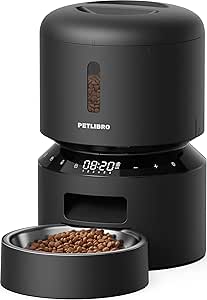 | Best for Jam Prevention and Reliability | Capacity: 3 liters | Feeding Schedule: Up to 6 meals per day | Portion Size: 1–50 portions (2.5 tsp each) | VIEW ON AMAZON | See Our Full Breakdown |
| automated pet feeder | Capacity | Dimensions | Power | Warranty |
|---|---|---|---|---|
| Frienhund Automatic Pet Feeder | — | — | 5V DC adapter and 3 D-cell batteries | — |
| SureFeed Microchip Pet Feeder | 13.5 fl oz | — | — | 3 years |
| Yuposl Automatic Cat Feeder | 3L (12 cups) | — | Wall power or 3 D-size alkaline batteries | — |
| PETLIBRO WiFi Automatic Pet Fe | 3 liters | 7.95 × 7.72 × 11.54 inches | Corded electric | — |
| ANDOLL HOME Automatic Cat and | 3 liters | 12 × 7 × 13 inches | 5V DC adapter or 3 AA batteries | — |
| ANDOLL HOME Automatic Cat Feed | 4 liters | 12 x 7 x 13 inches | — | 1 year |
| Heartgon Automatic Cat Feeder | 5 liters | 7 x 7 x 10 inches | Dual power supply | — |
| IMIPAW Automatic Cat Feeder wi | 3 liters (12 cups) | 7 × 12 × 7 inches | — | — |
| PETLIBRO Wi-Fi Automatic Pet F | 5 liters | — | — | 24 months |
| PETLIBRO RFID Automatic Cat Fe | 3 liters | 10.43 x 9.45 x 17.13 inches | — | — |
| oneisall 5G Wi-Fi Automatic Ca | 5 liters (20 cups) | 16.73 × 7.09 × 13.4 inches | — | 2 years |
| Voluas Automatic Cat Feeder | 4 L (16.9 cups) | — | — | 1 year |
| oneisall Automatic Cat Feeder | 5 L (20 cups) | — | DC power; backup with 4 AA batteries | 2 years |
| PETLIBRO Automatic Cat Feeder | 3 liters | 7.9 × 7.7 × 7.6 in | USB-C with 3 D-cell battery backup | 24 months |
More Details on Our Top Picks
Frienhund Automatic Pet Feeder with 2K Camera and 7L Storage
The Frienhund is the most monitoring-focused option here: its 3-megapixel camera, infrared night vision, motion alerts, and two-way audio let you check on feeding as well as schedule it. Its 7L hopper also holds more than the 3L Yuposl and PETLIBRO models, which can mean fewer refills in a busy household. Scheduling reaches 15 meals per day, with up to 20 portions per meal, giving it more flexibility than the PETLIBRO’s 10-meal schedule. The tradeoff is reliance on Wi-Fi and an app for remote features, and the camera’s storage options add setup choices. Backup batteries can keep feeding going during a power interruption, but the required D-cell batteries are not specified as included. I’d choose it for remote oversight, not for a simple, screen-free setup.
Pros:- Camera offers infrared night vision, motion alerts, and two-way audio.
- 7L capacity reduces how often the hopper needs refilling compared with the 3L models in this group.
- Schedules up to 15 meals daily with up to 20 portions per meal.
- Detachable food tank and dishwasher-safe stainless steel bowl support easier cleaning.
Cons:- Remote monitoring and app features require Wi-Fi.
- Backup requires 3 D-cell batteries, which are not specified as included.
- Camera storage uses a TF card or cloud storage, adding setup considerations.
Best for: Pet owners who spend time away from home and want a large-capacity feeder with live camera monitoring and two-way audio.
Not ideal for: Buyers who want a simple feeder without Wi-Fi, app setup, or camera-related storage decisions.
- Food capacity:7L (29 cups)
- Meal schedule:Up to 15 meals per day; up to 20 portions per meal
- Camera:3-megapixel camera with infrared night vision
- Connectivity:2.4GHz and 5GHz Wi-Fi
- Audio:Two-way audio
- Storage:TF card up to 128GB and cloud storage
- Bowl:Stainless steel
- Power:5V DC adapter and 3 D-cell batteries
Our verdict“Choose the Frienhund if remote camera checks and a large hopper matter more than keeping the feeder simple.”
SureFeed Microchip Pet Feeder
The SureFeed solves a different problem from the scheduled dispensers in this roundup: it controls which pet can access a meal, rather than releasing portions on a clock. The lid opens for a registered microchip or RFID collar tag and closes when that pet moves away, helping protect a diet or stop food stealing. That makes it a stronger fit for shared homes than the Frienhund or PETLIBRO WiFi feeder, neither of which identifies an individual pet at the bowl. Its sealed lid works with wet or dry food, while the Yuposl is limited to dry food. The tradeoff is its 13.5 fl oz capacity: it’s a controlled-access bowl, not a bulk hopper for multiple scheduled meals. I’d also factor in that extra collar tags may be needed, and separate feeders are generally needed for separate pets.
Pros:- Registered microchip or RFID collar tag restricts access to the intended pet.
- Sealed lid helps keep wet or dry food fresher.
- Training mode can help timid pets adjust to the moving lid.
- Stores up to 32 pet IDs and includes bowls, a mat, and one RFID collar tag.
Cons:- The 13.5 fl oz capacity is much smaller than the scheduled hopper feeders in this lineup.
- Additional RFID collar tags may need to be purchased separately.
- Separate feeders are generally needed when multiple pets require individual access.
Best for: Multi-pet households where one cat or dog needs protected access to wet or dry food, including pets on different diets.
Not ideal for: Owners seeking automatic timed portions, a large food reservoir, or one feeder that serves several pets in sequence.
- Capacity:13.5 fl oz
- Food compatibility:Wet or dry food
- Microchip compatibility:9-digit Avid Secure, 10-digit FDXA, and 15-digit FDXB
- Stored IDs:Up to 32
- Included RFID tags:1
- Included bowls:One single grey bowl and one split grey bowl
- Included mat:One grey mat
- Warranty:3 years
Our verdict“Pick the SureFeed when preventing food stealing matters more than automated meal scheduling or large capacity.”
Yuposl Automatic Cat Feeder, 3L
The Yuposl keeps feeding automation straightforward: its LCD screen and buttons set one to six daily meals without app pairing or Wi-Fi. That makes it a more direct choice than the connected PETLIBRO WiFi feeder, which adds remote scheduling, feeding records, and alerts but also depends on a network and phone app. The Yuposl’s dual power options let it run from a wall adapter or three D-size alkaline batteries, with the product data listing battery life over 180 days. Its 3L capacity is modest beside the Frienhund’s 7L hopper, so households with larger pets or longer refill intervals may prefer the latter. This model is dry-food only and accepts pieces 2–15 mm across. I’d shortlist it for dependable, local scheduling, while skipping it if phone control or frequent, highly customized meal timing is a priority.
Pros:- Schedules one to six meals daily using a local LCD screen and buttons.
- Runs on wall power or three D-size alkaline batteries.
- Sealed lid and rotor help keep dry food fresh and limit access to extra food.
- Removable washable parts and a dishwasher-safe stainless steel bowl ease cleanup.
Cons:- No Wi-Fi or smartphone controls for remote changes or feeding checks.
- 3L capacity is smaller than the Frienhund’s 7L hopper.
- D-size batteries are not included.
Best for: Cat owners and small-dog households who want button-operated meal scheduling, backup power options, and no Wi-Fi dependency.
Not ideal for: Owners who want remote app control, more than six scheduled meals daily, or a high-capacity hopper.
- Capacity:3L (12 cups)
- Meals per day:1–6
- Suitable food:Dry food sized 2–15 mm
- Power:Wall power or 3 D-size alkaline batteries
- Listed battery life:Over 180 days
- Bowl:Dishwasher-safe stainless steel
- Target animals:Cats, small dogs, and small animals
- Model:YPF03-PW00
Our verdict“Choose the Yuposl for simple offline scheduling and power flexibility, but not for remote control or a large food reserve.”
PETLIBRO WiFi Automatic Pet Feeder, 3 L, White
The PETLIBRO stands out among the 3L feeders for fine-grained app scheduling: it supports up to 10 meals daily and 1–48 portions per meal, with feeding records and alerts for an empty tank or jam. Compared with the offline Yuposl, it gives owners remote schedule changes and more meals per day; compared with the camera-equipped Frienhund, it keeps the focus on dispensing rather than live pet monitoring. A twist-lock lid, sealing strip, and desiccant bag help protect dry food, while blockage detection can flag a feeding problem instead of leaving it unnoticed. Those conveniences come with limits: it’s corded, requires Wi-Fi for app functions, and is designed for dry food only. The desiccant bag also needs frequent replacement according to the supplied guidance, adding a recurring maintenance task.
Pros:- App supports up to 10 meals per day and 1–48 portions per meal.
- Feeding records and alerts help owners track meals and spot an empty tank or jam.
- Twist-lock lid, sealing strip, and desiccant bag help protect dry food freshness.
- Stainless steel bowl and blockage detection support cleaner, more reliable dispensing.
Cons:- Designed for dry food only.
- Corded power is listed, with no battery backup specified.
- Desiccant bag is recommended for replacement every two weeks.
Best for: Owners who want to adjust dry-food portions from an app and receive alerts about feeding interruptions.
Not ideal for: Households that feed wet food, need battery backup, or prefer a feeder that works without Wi-Fi and an app.
- Capacity:3 liters
- Schedule:Up to 10 meals per day; 1–48 portions per meal
- Portion size:1/12 cup per portion
- Connectivity:2.4 GHz and 5 GHz Wi-Fi
- Voice recording:Up to 10 seconds; up to 10 meal calls
- Bowl:Stainless steel
- Dimensions:7.95 × 7.72 × 11.54 inches
- Power:Corded electric
Our verdict“Choose this PETLIBRO for app-based portion control and feeding alerts, provided dry food and corded power fit your setup.”
ANDOLL HOME Automatic Cat and Dog Feeder, 3 L
The ANDOLL HOME is a basic programmable feeder with a personal touch: its 10-second voice recording plays three times at mealtime, which may help pets associate a scheduled portion with a familiar call. It schedules up to eight meals daily, sitting between the Yuposl’s six-meal limit and the PETLIBRO’s ten-meal app schedule. Unlike that PETLIBRO, this model lists backup battery power, so it can keep operating through an outlet interruption when three AA batteries are installed. Its 3L hopper suits routine feeding but offers less reserve than the Frienhund’s 7L container. The tradeoffs are a lack of stated Wi-Fi or app control and hand-wash-only care; owners seeking remote monitoring should look to the Frienhund instead. I’d choose this for scheduled meals and voice calls, not advanced tracking or minimal cleanup.
Pros:- Schedules up to eight meals daily.
- Recorded 10-second voice call plays three times at feeding time.
- Can use three AA batteries as backup to the included 5V DC adapter.
- Lid and desiccant compartment are intended to help keep food fresh.
Cons:- Three AA backup batteries are not included.
- Hand-wash-only care requires more effort than models with dishwasher-safe bowls.
- No Wi-Fi, app control, or remote monitoring is specified.
Best for: Pet owners who want a simple dry-food schedule with a recorded meal call and backup power for outages.
Not ideal for: Buyers who need app-based remote control, camera monitoring, dishwasher-safe parts, or a larger food reservoir.
- Capacity:3 liters
- Meal schedule:Up to 8 meals daily
- Voice recording:10 seconds; plays 3 times at feeding time
- Power:5V DC adapter or 3 AA batteries
- Connectivity:USB
- Dimensions:12 × 7 × 13 inches
- Material and color:Plastic; Snow White
- Care:Hand wash only; wipe clean
Our verdict“Pick the ANDOLL HOME for scheduled meals and a familiar voice call, but choose another model for app control or easier washing.”
ANDOLL HOME Automatic Cat Feeder, 4L
The ANDOLL HOME Automatic Cat Feeder strips away the complexity of smart connectivity, offering a straightforward solution for owners who prefer physical programming over app dependencies. With a 4-liter capacity and support for up to 8 meals daily, it handles more frequent, smaller portions better than the Heartgon Automatic Cat Feeder, which caps out at six meals. The stainless steel bowl is a welcome hygiene feature often missing in cheaper plastic-bowl alternatives, resisting bacteria and odors more effectively. However, the lack of Wi-Fi means you cannot monitor feeding remotely or receive alerts for jams, a significant tradeoff compared to the PETLIBRO Wi-Fi Automatic Pet Feeder. It includes a voice recorder to call pets to dinner, adding a touch of personal interaction. While the desiccant compartment helps maintain kibble freshness, you must remember to replace the desiccant regularly. This model suits those who want reliability without the subscription-free but app-heavy overhead of smart devices.Pros:- High meal frequency limit of 8 meals per day
- Hygienic stainless steel bowl included
- Simple operation without app or Wi-Fi requirements
Cons:- No remote monitoring or alert system
- Backup batteries are not included
- Limited to dry kibble only
Best for: Owners who want simple, offline scheduling without needing a smartphone app or Wi-Fi setup.
Not ideal for: Users who need remote monitoring capabilities or alerts for food jams and low supply.
- Capacity:4 liters
- Meal Schedule:Up to 8 meals daily
- Bowl Material:Stainless steel
- Power Source:5V DC adapter or 3 AA batteries
- Voice Recording:10 seconds
- Dimensions:12 x 7 x 13 inches
- Warranty:1 year
Our verdict“This feeder is the ideal choice for tech-averse owners who prioritize simple, reliable scheduling over remote connectivity.”
Heartgon Automatic Cat Feeder with Stainless Steel Bowl
At just 7 x 7 x 10 inches, the Heartgon Automatic Cat Feeder is significantly more compact than the bulkier ANDOLL HOME Automatic Cat Feeder, making it a strong candidate for tight apartments or crowded kitchen counters. The 5-liter capacity is generous for its footprint, reducing refill frequency for single-cat households. It features smart app operation, allowing for remote adjustments that the offline ANDOLL model cannot offer. However, the app connectivity seems basic compared to the robust ecosystem of the PETLIBRO Wi-Fi Automatic Pet Feeder, lacking detailed feeding records or advanced alert systems. The portion control helps prevent obesity, but the listing lacks specific measurement details, which can lead to guesswork. While it includes a voice recorder and dual power supply, the absence of clear battery life specifications is a drawback for those in areas with frequent power outages. This model balances size and smart features well for space-constrained users.Pros:- Compact footprint saves counter space
- Large 5-liter capacity for its size
- Includes smart app operation for remote control
Cons:- Lacks detailed portion size specifications
- No clear data on battery backup duration
- App features are less comprehensive than premium competitors
Best for: Apartment dwellers with limited floor space who still want basic app control.
Not ideal for: Multi-cat households needing strict portion tracking or users requiring detailed feeding logs.
- Capacity:5 liters
- Meals per Day:Up to 6
- Portion Control:20 portions
- Connectivity:Smart app
- Dimensions:7 x 7 x 10 inches
- Bowl Material:Stainless steel
- Power:Dual power supply
Our verdict“This compact smart feeder is perfect for small homes where floor space is at a premium but app control is still desired.”
IMIPAW Automatic Cat Feeder with Programmable Meals, Portion Control, and Dual Power Supply
The IMIPAW Automatic Cat Feeder distinguishes itself with a removable tray, a feature that simplifies cleaning compared to the fixed bowls of the Heartgon Automatic Cat Feeder. Its 3-liter capacity is smaller than the ANDOLL HOME model, making it better suited for single cats or smaller breeds. The 7–9 gram serving size provides precise portion control, which is critical for weight management. Unlike the app-dependent PETLIBRO Wi-Fi Automatic Pet Feeder, this unit operates offline, reducing the risk of connectivity issues. However, the ABS plastic construction feels less premium than the stainless steel components found in higher-end models, and the hand-wash-only instruction for the tray adds a minor maintenance chore. The dual power supply ensures continuity during outages, though the required D-cell batteries are not included. This feeder is a pragmatic choice for owners who value ease of cleaning and precise portioning over smart features.Pros:- Removable tray simplifies cleaning
- Precise 7–9 gram portion control
- Reliable offline operation with dual power
Cons:- Smaller 3-liter capacity
- Plastic construction feels less durable
- Backup batteries not included
Best for: Owners prioritizing easy cleaning and precise portion control for single-cat households.
Not ideal for: Users with multiple pets or those who need high-capacity feeding for large breeds.
- Capacity:3 liters (12 cups)
- Serving Size:7–9 grams
- Meals per Day:Up to 6
- Power Source:5V DC adapter or 3 D-cell batteries
- Dimensions:7 × 12 × 7 inches
- Material:ABS Plastic
- Care:Hand wash only
Our verdict“This model is the best choice for single-cat owners who want precise portions and a feeder that is easy to keep clean.”
PETLIBRO Wi-Fi Automatic Pet Feeder, 5L, Granary Black
The PETLIBRO Wi-Fi Automatic Pet Feeder sets the standard for smart connectivity with its dual-band Wi-Fi support and comprehensive app-based scheduling. Unlike the Heartgon Automatic Cat Feeder, which offers basic app control, this model provides feeding records and low-food alerts, giving owners peace of mind. The 5-liter capacity matches the Heartgon but offers superior freshness with a sealed tank and desiccant bag. It supports up to 10 meals per day, far exceeding the ANDOLL HOME model’s limit. The infrared sensor detects jams and blockages, a critical safety feature absent in most budget competitors. However, the desiccant bag requires replacement every two weeks, adding a recurring maintenance task. The feeder base cannot be washed, which contradicts the IMIPAW model’s removable tray design. Despite this, the combination of reliability, smart alerts, and large capacity makes it the most versatile option for tech-savvy pet owners.Pros:- Robust app with feeding records and alerts
- Supports up to 10 meals daily with adjustable portions
- Dual-band Wi-Fi ensures stable connectivity
Cons:- Desiccant bag needs frequent replacement
- Feeder base is not washable
- Requires 2.4GHz or 5GHz Wi-Fi network
Best for: Tech-savvy owners who want remote monitoring, alerts, and detailed feeding history.
Not ideal for: Users who want a feeder that is fully dishwasher safe or requires zero maintenance.
- Capacity:5 liters
- Meal Schedule:Up to 10 meals per day
- Wi-Fi:2.4GHz and 5GHz
- Portions:1–48 portions per meal
- Voice Recording:Up to 10 seconds
- Bowl Material:Stainless steel
- Warranty:24 months
Our verdict“This is the definitive smart feeder for owners who demand reliability, remote control, and proactive alerts.”
PETLIBRO RFID Automatic Cat Feeder with Wi-Fi and Collar Tag Sensor
The PETLIBRO RFID Automatic Cat Feeder solves the common problem of food stealing by using RFID collar tag technology to restrict access to the designated pet. This is a distinct advantage over the open-access PETLIBRO Wi-Fi Automatic Pet Feeder, which allows any pet to eat at any time. The 3-liter capacity is smaller than most competitors, requiring more frequent refills for larger cats. However, the app integration provides eating alerts and portion tracking, ensuring each pet receives their specific diet. Unlike the Heartgon Automatic Cat Feeder, which relies on open bowls, this model physically blocks unauthorized access, making it ideal for managing separate diets. The battery backup ensures operation during outages, though the RFID reader and base cannot be washed, similar to its non-RFID sibling. This feeder is essential for households where one cat is overweight or on a prescription diet, as it enforces compliance automatically.Pros:- RFID tag restricts access to specific pets
- App tracks individual eating habits
- Prevents food stealing between pets
Cons:- Smaller 3-liter capacity
- Requires pets to wear collar tags
- Base and RFID reader are not washable
Best for: Multi-pet homes where one cat needs a specific diet or food stealing is an issue.
Not ideal for: Owners with multiple cats who don’t need diet separation or have pets that dislike wearing collars.
- Capacity:3 liters
- Connectivity:Dual-band Wi-Fi, Bluetooth
- RFID Compatibility:Included collar tag only
- Dimensions:10.43 x 9.45 x 17.13 inches
- Weight:7.7 pounds
- Power Source:Corded electric with battery backup
- Included Components:Feeder, RFID tag, bowl shields
Our verdict“This feeder is the only viable option for multi-pet households needing strict dietary control and access management.”
oneisall 5G Wi-Fi Automatic Cat Feeder for Two Cats, 5 L
This model stands out for multi-cat households needing remote control and dual-bowl capability. Unlike the Voluas Automatic Cat Feeder, which is single-bowl and lacks app connectivity, this unit lets you adjust portions from your phone and view feeding logs, offering peace of mind when you are away. The 5-liter capacity supports two cats for roughly ten days, reducing refill frequency. However, the 0.5-inch kibble limit is a strict constraint; if your cats eat large or irregular kibble, this feeder will jam. It also requires a constant power connection, so it is less reliable during outages compared to battery-first options.
Pros:- Supports both 2.4 GHz and 5 GHz Wi-Fi for stable connectivity
- Dual stainless steel bowls prevent food competition between cats
- App allows remote manual feeding and detailed feeding history logs
- Family sharing feature lets multiple users manage schedules
Cons:- Strict kibble size limit (under 0.5 inches) restricts food choices
- Main electronic unit cannot be submerged or washed with water
- Requires constant corded power; no battery backup option mentioned for primary operation
Best for: Owners of two cats who want app-based control, feeding logs, and the ability to share management access with family members.
Not ideal for: Owners of cats who eat large kibble (over 0.5 inches) or those in areas with frequent power outages without a UPS.
- Capacity:5 liters (20 cups)
- Connectivity:2.4 GHz and 5 GHz Wi-Fi
- Portion Size:~10 g (1/12 cup) per portion
- Kibble Size Limit:Less than 0.5 inch
- Voice Recording:10 seconds
- Dimensions:16.73 × 7.09 × 13.4 inches
- Warranty:2 years
Our verdict“Choose this if you need smart app integration and dual-bowl feeding, but only if your cats eat small, uniform kibble.”
Voluas Automatic Cat Feeder, 4L Programmable Dry Food Dispenser
This feeder is the most affordable entry point for basic automated feeding, lacking the complexity of app-connected units like the oneisall 5G Wi-Fi model. It uses a physical interface to set up to four meals daily, making it ideal for users who prefer a set-and-forget approach without smartphone dependencies. The dual power options (USB or batteries) provide reliability during outages, a feature the oneisall lacks. However, the smaller portion size (6-7 g) means you must set higher counts for larger meals, and the plastic construction feels less durable than stainless steel alternatives. It is strictly for dry food and lacks any smart features.
Pros:- No Wi-Fi setup required; easy manual programming
- Dual power support (USB or D-cell batteries) ensures continuity during outages
- Removable parts make cleaning easier than complex sealed units
- Compact footprint fits well on small countertops
Cons:- No app connectivity or remote manual feeding option
- Small portion size (6-7 g) requires setting high numbers for full meals
- Plastic construction may feel less premium than metal alternatives
Best for: Budget-conscious owners who want a simple, reliable timer for one pet and do not need remote app access.
Not ideal for: Tech-savvy users who want feeding logs, remote adjustments, or multi-cat feeding capabilities.
- Capacity:4 L (16.9 cups)
- Meal Schedule:1–4 meals per day
- Portion Settings:0–40 portions
- Portion Size:~6–7 g per portion
- Power Source:5 V USB adapter or 3 D-cell batteries
- Voice Recorder:Up to 10 seconds
- Warranty:1 year
Our verdict“A solid, no-nonsense choice for single-pet households who value simplicity and reliability over smart features.”
oneisall Automatic Cat Feeder for Two Cats
This unit offers robust dual-bowl feeding without the need for Wi-Fi, making it a great alternative to the oneisall 5G Wi-Fi model for those who dislike smart home integration. It schedules up to six meals daily and dispenses to two stainless steel bowls spaced 16 inches apart, reducing territorial stress between cats. The sealed hopper with desiccant helps keep food fresher than the open designs of budget competitors like the Voluas. However, it lacks remote control; if you are away and want to add a treat or skip a meal, you cannot do so. It also relies on AA batteries for backup, which must be purchased separately.
Pros:- Wide 16-inch bowl spacing reduces competition between two cats
- Sealed storage with desiccant maintains kibble freshness longer
- Stainless steel bowls are hygienic and easy to clean
- No Wi-Fi setup or app download required for operation
Cons:- No remote manual feeding or app-based monitoring
- Backup batteries (AA) are not included in the box
- Main unit cannot be washed with water, limiting deep cleaning options
Best for: Owners of two cats who want reliable scheduled feeding and fresh food storage without using an app.
Not ideal for: Users who want to monitor feeding activity or adjust schedules remotely via smartphone.
- Capacity:5 L (20 cups)
- Feeding Schedule:Up to 6 meals per day
- Portion Size:~10 g (1/12 cup) per bowl
- Bowl Spacing:16 inches
- Kibble Size Limit:Less than 0.5 inch
- Power:DC power; backup with 4 AA batteries
- Warranty:2 years
Our verdict“Ideal for two-cat households prioritizing reliability and hygiene over smart connectivity.”
PETLIBRO Automatic Cat Feeder with Portion Control and Voice Meal Call
The PETLIBRO distinguishes itself with infrared anti-jam detection, a feature absent in the Voluas Automatic Cat Feeder and basic timers. If food gets stuck, the sensors detect it and alert you or stop the cycle, preventing missed meals—a common failure point in cheaper units. The USB-C power with battery backup ensures operation during outages, and the airtight design keeps kibble crisper than the oneisall dual-bowl model, which has a larger opening. However, the 3-liter capacity is smaller, requiring more frequent refills for multiple pets. The desiccant bag also needs regular replacement to maintain freshness, adding minor maintenance.
Pros:- Infrared sensors detect and prevent food jams automatically
- USB-C power with 3 D-cell battery backup for outage protection
- Airtight seal and desiccant bag preserve kibble texture
- Fine portion control (2.5 teaspoons) for precise diet management
Cons:- Smaller 3-liter capacity requires more frequent refilling
- Desiccant bag needs replacement every two weeks
- Feeder base is not waterproof and cannot be submerged
Best for: Owners who prioritize mechanical reliability and want to avoid the frustration of jammed feeders.
Not ideal for: Multi-cat households needing high capacity or dual-bowl feeding in a single unit.
- Capacity:3 liters
- Feeding Schedule:Up to 6 meals per day
- Portion Size:1–50 portions (2.5 tsp each)
- Power:USB-C with 3 D-cell battery backup
- Kibble Size:2–15 mm
- Dimensions:7.9 × 7.7 × 7.6 in
- Warranty:24 months
Our verdict“The smartest choice for single-pet owners who hate the hassle of jammed dispensers and want reliable backup power.”

How We Picked
I selected these fourteen automated pet feeders by prioritizing three core criteria: dispensing accuracy, reliability mechanisms, and ease of maintenance. A feeder is only as good as its ability to consistently release the correct portion size without jamming, so I focused on models with proven auger designs and clear user feedback on food compatibility. I also examined how each unit handles power interruptions, giving preference to those with dual power sources (AC adapter plus battery backup) to ensure pets are fed even during outages.
Connectivity and specific household needs played a major role in the ranking. I separated models into categories based on their primary strength: smart connectivity for app control, multi-pet security via RFID or microchips, and basic reliability for simple scheduling. Products that lacked clear documentation on food size limitations or had reported issues with motor durability were ranked lower. This approach ensures the list reflects real-world usability rather than just spec sheets, helping you match a feeder to your specific pet situation and technical comfort level.
Factors to Consider When Choosing Automated Pet Feeder
Selecting an automated feeder requires looking beyond the price tag to understand how the technology interacts with your pet’s behavior and your home infrastructure. The following factors will help you filter through the noise and identify the model that fits your specific constraints.
Power Redundancy and Reliability
One of the most overlooked aspects of automated feeders is their behavior during a power outage. Many budget-friendly models rely solely on a wall adapter, meaning a blackout could result in a missed meal. I strongly recommend choosing a feeder with dual power capability, which allows the unit to automatically switch to battery power if the main connection fails. This feature is standard on mid-range to premium models like the IMIPAW and most PETLIBRO units but is often missing on entry-level devices. Check if the batteries are included or if you need to purchase them separately, and verify how long the battery backup lasts under normal usage. This redundancy is not just a convenience; it is a safety net for your pet’s routine.
Food Type and Hopper Compatibility
Not all kibble fits in all feeders. The internal auger design determines which food shapes and sizes can pass through without jamming. Round, medium-sized kibble is the easiest to dispense, while large, irregular, or triangular pieces often cause blockages in standard augers. If your pet eats grain-free or raw-coated food, you must check the manufacturer’s specifications for maximum kibble size, usually measured in millimeters. Some models, like the Heartgon with its stainless steel bowl, may have different clearance issues than plastic-bowl models. Always test the feeder with your specific brand of food for a few days before committing to a long-term schedule to avoid mid-week jams.
Hygiene and Material Safety
Plastic components can harbor bacteria and develop scratches that are difficult to clean, which is a concern for pets with sensitive stomachs or feline acne. Stainless steel bowls and removable, dishwasher-safe hoppers are significantly better for long-term hygiene. While plastic feeders are lighter and cheaper, they often require more frequent disassembly to prevent mold buildup in the auger area. Look for models that advertise BPA-free materials and easy disassembly without tools. The Heartgon and select PETLIBRO models excel here by prioritizing cleanable surfaces, whereas some ultra-compact plastic units may be harder to deep clean over time.
Multi-Pet Access Control
If you have more than one pet, a standard timed feeder will result in food bullying or overeating by the dominant animal. In this scenario, RFID or microchip-activated feeders are not optional upgrades but necessities. These devices lock the lid until the specific collar tag or microchip of the authorized pet is detected. Models like the SureFeed and PETLIBRO RFID are designed specifically for this purpose. However, they are bulkier and more expensive. If you have a single pet, paying for this technology is an unnecessary cost; if you have two cats, a standard feeder will likely fail to manage their diets effectively.
Connectivity and App Stability
Wi-Fi enabled feeders offer the convenience of adjusting schedules remotely, but they introduce a dependency on your home network. If your internet goes down or the app server experiences downtime, you may lose the ability to manually trigger a feed via your phone. I advise checking the offline functionality of any smart feeder; the best models continue to run their existing schedules locally even when disconnected from the cloud. The Frienhund and oneisall models offer robust app features, but ensure they have a physical manual override button. For owners who rarely travel, a non-Wi-Fi model might be more reliable and less prone to software glitches.
Frequently Asked Questions
Can automated pet feeders handle wet food?
Most standard automated feeders are designed exclusively for dry kibble because wet food spoils quickly and can clog the auger mechanism. If you need to feed wet food, you must look for specific models with refrigerated compartments, which are rare and expensive, or use a feeder with an ice pack compartment, though these are less common. The products in this roundup are primarily for dry food. For wet food, it is better to use a manual timed bowl with an ice pack or a separate, dedicated wet-food dispenser. Attempting to put wet food in a standard dry-feeder will likely result in mold growth and mechanical failure.
How loud are automated feeders during operation?
Noise levels vary significantly between models, which matters if the feeder is in a bedroom or a quiet apartment. Most feeders produce a distinct whirring sound from the motor and a clattering noise as the food hits the bowl. Some models, like the ANDOLL HOME series, are marketed as quiet, but user experiences suggest that the food drop sound is often the loudest part. If noise is a concern, look for models with stainless steel bowls lined with silicone or rubber mats to dampen the sound. You can also place a towel under the feeder to reduce vibration noise, which helps if the unit is on a hard floor.
What happens if the kibble jams in the feeder?
Jamming is the most common complaint with automated feeders, usually caused by kibble that is too large or irregularly shaped. When a jam occurs, the feeder may continue to run but dispense nothing, or it may shut off to prevent motor damage. Wi-Fi enabled models often send an alert to your phone if the motor detects resistance, allowing you to check the unit remotely. Non-smart models will simply fail to dispense without notification. To prevent jams, always start with small batches of your specific kibble to test compatibility and avoid using food with large, chunky pieces or excessive dust that can compact in the hopper.
Are RFID feeders difficult to set up for multiple cats?
Setting up an RFID feeder like the PETLIBRO RFID or SureFeed requires some patience but is generally straightforward. You will need to program each cat’s unique collar tag or microchip into the feeder’s memory. The main challenge is ensuring the cats are comfortable wearing the collar tags, as some resist them initially. Unlike microchip feeders that read implanted chips, RFID collar tags require the pet to wear a specific accessory. If your cats are not microchipped yet, you will need to purchase the tags separately and attach them to breakaway collars. It may take a few days for shy cats to trust the lid opening mechanism.
How often do I need to clean an automated feeder?
Regular cleaning is essential to prevent bacterial growth and food residue buildup, which can affect the taste of the food and the mechanical function of the auger. I recommend wiping down the bowl daily and disassembling the hopper and auger for a thorough wash every one to two weeks. Models with removable, dishwasher-safe parts make this process much easier. Stainless steel bowls, like those on the Heartgon, resist staining and odors better than plastic. If you notice the food sticking to the walls of the hopper or the auger turning sluggishly, it is time for an immediate deep clean to prevent a jam during your next scheduled feeding.
Conclusion
Choosing the right automated pet feeder depends largely on your household composition and your tolerance for technology maintenance. For most owners seeking a balance of features and reliability, the Frienhund Automatic Pet Feeder is the best overall choice due to its large capacity and integrated 2K camera, which provides peace of mind when you are away. If you are managing multiple pets, the PETLIBRO RFID Automatic Cat Feeder is the superior option because it strictly controls access, preventing food aggression and overeating, a capability that standard timers simply cannot match. For those on a budget or with a single pet who doesn’t need app connectivity, the Yuposl Automatic Cat Feeder offers dependable mechanical scheduling without the complexity of Wi-Fi setup. Beginners who want a simple, no-fuss experience should look at the ANDOLL HOME series, while premium buyers requiring advanced health tracking and multi-pet security should invest in the SureFeed Microchip Pet Feeder. Ultimately, match the feeder’s complexity to your need for remote control and your pet’s specific dietary management requirements.