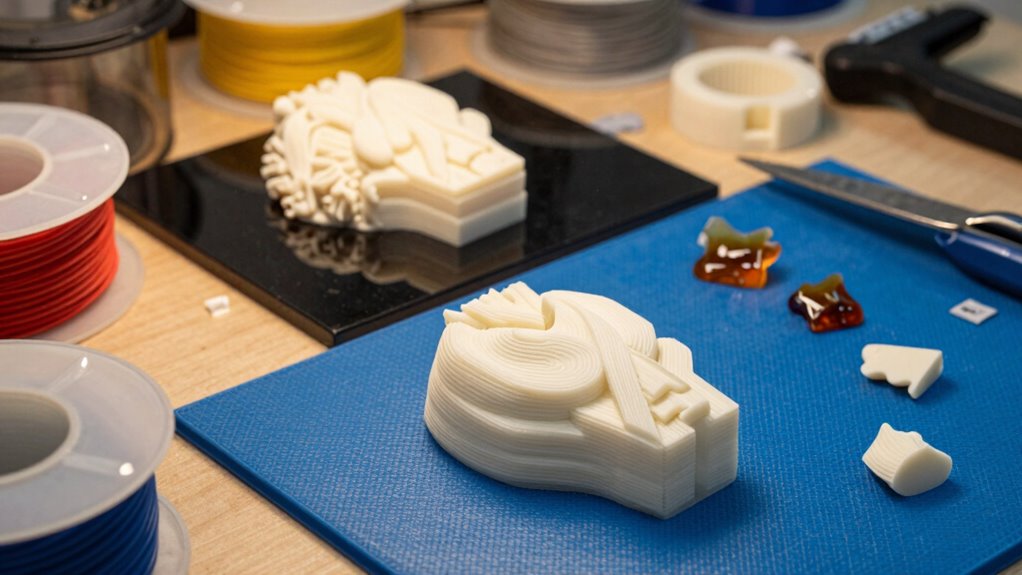
Choosing the wrong 3D printing method can waste weeks of your time and money. If you pick FDM for ultra-detailed miniatures or jewelry, you’ll be disappointed by rough surfaces and longer print times. Conversely, resin is better for high-detail projects but can be tricky for larger, durable parts. To avoid costly mistakes, you need to match your project’s needs with the right method. Keep going to discover how to make the best choice.
Key Takeaways
- Choosing FDM for detailed miniatures causes delays and extra post-processing, wasting time on unnecessary complexity.
- Opting for resin when speed and larger builds are needed leads to longer project timelines and higher costs.
- Misjudging material strengths or finish quality results in failed prints and weeks of troubleshooting.
- Selecting the wrong method increases waste due to failed prints, improper supports, or unsuitable surface finishes.
- Properly matching project needs with FDM or resin prevents costly reprints and ensures efficient, timely completion.

FLASHFORGE Adventurer 5M 3D Printer with Fully Auto Leveling, Max 600mm/s High Speed Printing, 280°C Direct Extruder with 3S Detachable Nozzle, CoreXY All Metal Structure, Print Size 220x220x220mm
- Automatic Bed Leveling: One-click hassle-free printing
- High-Speed Printing: Max 600mm/s travel speed
- Fast Nozzle Changes: 3-second quick nozzle swaps
As an affiliate, we earn on qualifying purchases.
As an affiliate, we earn on qualifying purchases.
FDM vs Resin: Key Differences
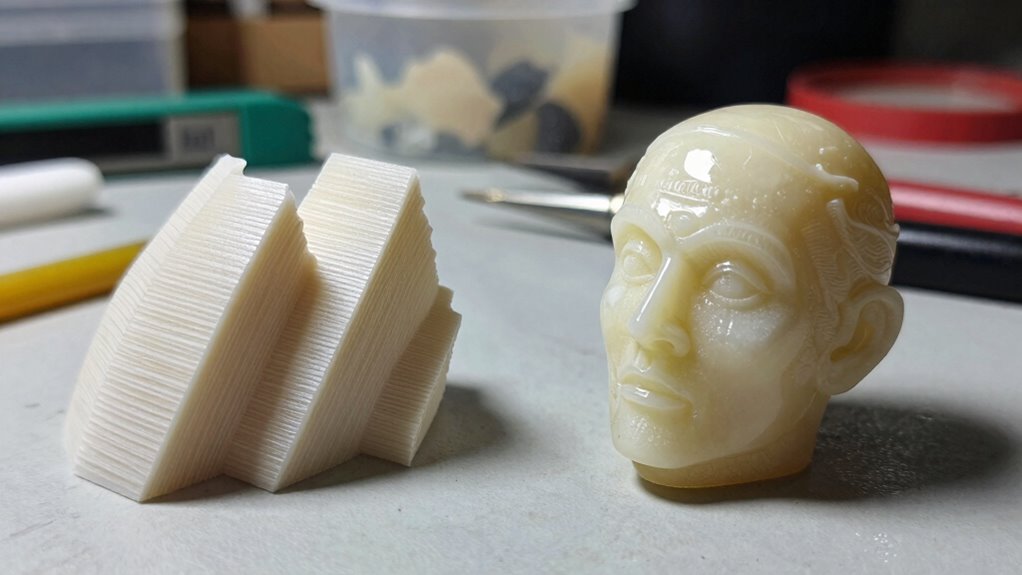
While both FDM and resin 3D printing serve the purpose of creating detailed models, they differ markedly in their processes and outcomes. With FDM, your filament choice greatly impacts your results; materials like PLA, ABS, or PETG offer different strengths, flexibility, and finish qualities. Resin printing, on the other hand, involves selecting from various resin types, such as standard, tough, or flexible resins, each delivering unique surface finishes and mechanical properties. FDM builds models layer by layer with melted filament, resulting in visible layer lines and potentially rougher surfaces. Resin printing uses UV light to cure liquid resin, producing high-resolution, smooth surfaces ideal for intricate details. Understanding these core differences helps you choose the right material for your project’s finish quality and durability requirements. Additionally, the material selection plays a crucial role in achieving optimal results for specific applications. Being aware of the layer resolution can further inform your choice based on the detail and precision needed for your models. Moreover, considering the cost and accessibility of different materials can influence your overall project planning and budget. Recognizing the compatibility with printers also ensures that your chosen materials are suitable for your equipment and desired outcomes.
Which 3D Printing Method Fits Your Skill Level?

Choosing the right 3D printing method depends largely on your experience level and comfort with technology. If you’re a beginner, FDM printers are typically easier to learn, with straightforward setup and wide material compatibility. They also offer more forgiving print orientation, making it simpler to avoid common issues like warping. Resin printing, on the other hand, demands more precision, understanding of material properties, and careful handling of chemicals. It requires learning how different resin types impact print quality, and print orientation becomes pivotal to minimize supports and improve surface finish. If you prefer a process with less complexity and faster setup, FDM suits your skill level. But if you’re ready to handle detailed, high-resolution prints and manage sensitive materials, resin printing might be the better fit.
How Much Do FDM and Resin Printing Cost?
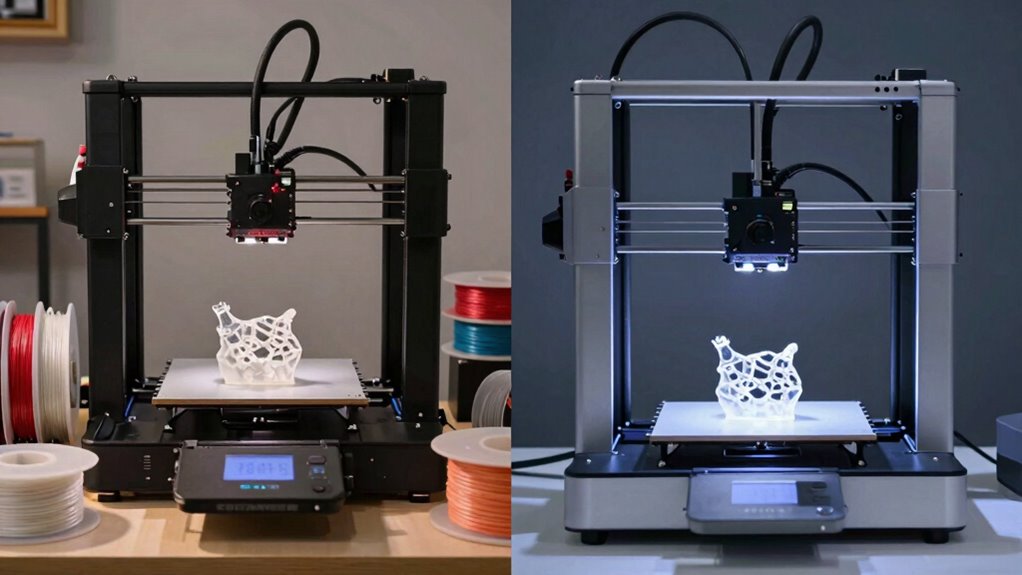
The upfront costs of FDM and resin 3D printing vary considerably, impacting your decision based on your budget. FDM printers tend to be more affordable initially, with entry-level models starting around a few hundred dollars. Resin printers, however, often require a larger investment upfront, sometimes exceeding a thousand dollars. When considering a cost comparison, material expenses play a significant role. FDM filament costs are generally lower at roughly $20–$50 per kilogram, making long-term printing more economical. Resin costs are higher, often around $50–$100 per liter, increasing ongoing expenses. While resin printing can save time and produce detailed parts, your budget must account for both the initial investment and ongoing material expenses. Additionally, color accuracy and surface finish quality can influence your choice depending on project requirements. Proper chemical safety and handling procedures are essential to ensure safe operation and longevity of your equipment. To make an informed decision, it’s important to evaluate the total cost of ownership, including maintenance and potential upgrades, to avoid unexpected costs down the line. Understanding printer durability can also help you select a model that remains reliable over time and minimizes replacement costs. Moreover, considering long-term operational costs can help you better plan your investment and avoid surprises later.
What Kind of Detail Can You Expect From FDM and Resin?

When comparing FDM and resin printing, you’ll notice a difference in layer resolution that affects detail. Resin printers typically produce smoother surfaces and finer details, while FDM prints may show visible layer lines. Understanding these distinctions helps you choose the right method for your desired finish. Additionally, ethical considerations in choosing the appropriate technology can impact resource use and waste. For instance, resin printing often involves chemical waste that requires careful disposal, whereas FDM uses filament that can be more easily recycled or reused. Moreover, water-based cleaning methods in resin printing can help reduce environmental impact, emphasizing the importance of sustainable practices in 3D printing. Considering air quality and proper ventilation during printing can further mitigate health risks associated with chemical fumes and dust. Implementing sustainable materials in 3D printing can also contribute to reducing the environmental footprint of your projects.
Layer Resolution Differences
While both FDM and resin 3D printing produce detailed models, their layer resolutions differ markedly. FDM printers typically have larger layer heights, around 100 to 300 microns, which limits layer precision and results in less fine print clarity. This means you’ll notice visible layer lines and less intricate detail, especially in small or complex features. Resin printers, on the other hand, can achieve layer heights as low as 25 microns, offering exceptional layer precision. This allows for smoother surfaces and finer details, making resin prints ideal for highly detailed models. If your project demands sharp, crisp details with minimal visible layering, resin printing provides superior layer resolution. Conversely, FDM’s coarser layers are better suited for larger, less intricate objects where speed and cost matter more than fine detail.
Surface Finish Quality
Layer resolution directly influences the surface finish of your 3D printed models. With FDM printing, you’ll notice a rougher layer finish, especially on curved surfaces, because the filament layers create visible lines. The surface smoothness is limited by nozzle size and print speed, often requiring post-processing to improve appearance. Resin printing, however, offers superior surface smoothness, producing a much finer layer finish with minimal visible layer lines. This results in highly detailed, smooth surfaces ideal for intricate models or prototypes demanding high accuracy. Resin prints tend to require less post-processing for surface refinement, saving you time. Overall, if surface finish quality and detail are critical, resin provides a much cleaner, more polished look compared to FDM. Additionally, resin printing typically achieves a higher layer resolution, contributing to its superior surface finish quality. For those seeking precision detail, resin printing is often the preferred choice. Furthermore, understanding the material properties of resin versus filament can help optimize your print results and longevity. The choice between FDM and resin also impacts cost considerations, especially over multiple projects or larger models. Being aware of how print parameters influence the final surface can help you make better choices for your specific needs.
Which Method Is Faster for Large or Complex Prints?

For large or complex prints, FDM (Fused Deposition Modeling) generally takes longer than resin-based methods due to its slower layer-by-layer extrusion process. The print speed is limited by the nozzle movement, and a larger build volume increases total printing time. Resin printers can cure entire layers simultaneously, making them faster for intricate designs. Additionally, the printing process and material properties play a significant role in overall speed and efficiency. While FDM is better suited for large models, expect longer times. Resin printers excel at rapid production of detailed, complex objects, but their smaller build volume might restrict size. Choose based on your project’s complexity and size to save time.
Troubleshooting Common FDM and Resin Printing Problems
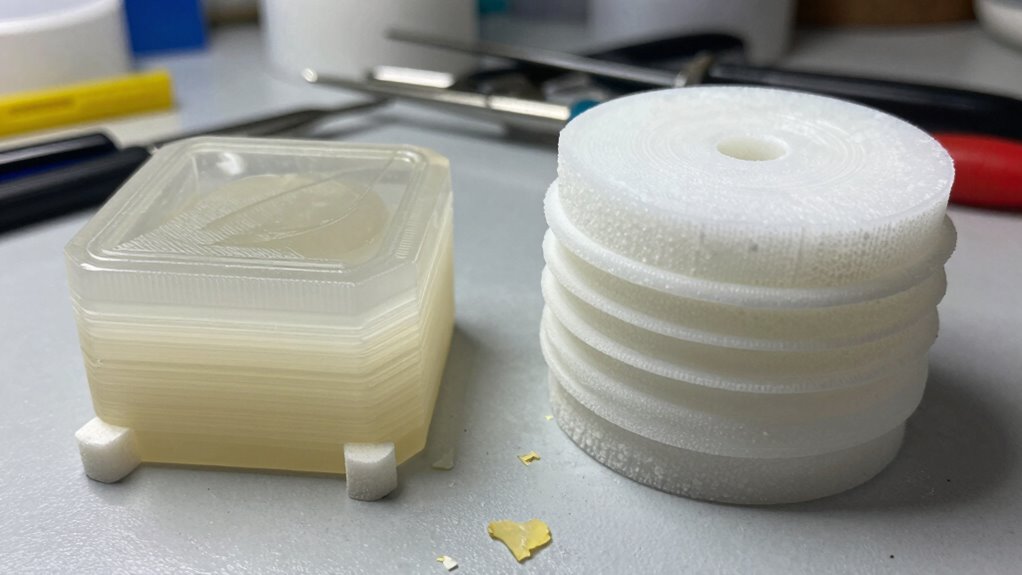
Troubleshooting common issues with FDM and resin 3D printers can save you time and frustration. If your prints aren’t sticking properly, check your print bed leveling—an uneven bed causes failed prints or warping. For FDM printers, ensure your filament is stored correctly; moisture can cause clogs and weak extrusion, so keep filament in a sealed container with desiccants. Resin printers often face layer adhesion problems; clean and level the build platform thoroughly. For FDM, filament tangling or slipping can halt progress, so keep spool tension consistent. Regularly recalibrate your print bed and monitor filament storage conditions to prevent common failures. Additionally, using smart lock systems to secure your workspace can prevent unauthorized access and protect your equipment. Maintaining proper environmental conditions, such as temperature and humidity, is also crucial for consistent printing results. Keeping your filament storage area dry and organized can further reduce issues and improve print quality. Addressing these issues early guarantees smoother prints and saves you from wasting weeks on failed attempts.
Safety Tips and Post-Processing for FDM and Resin Prints
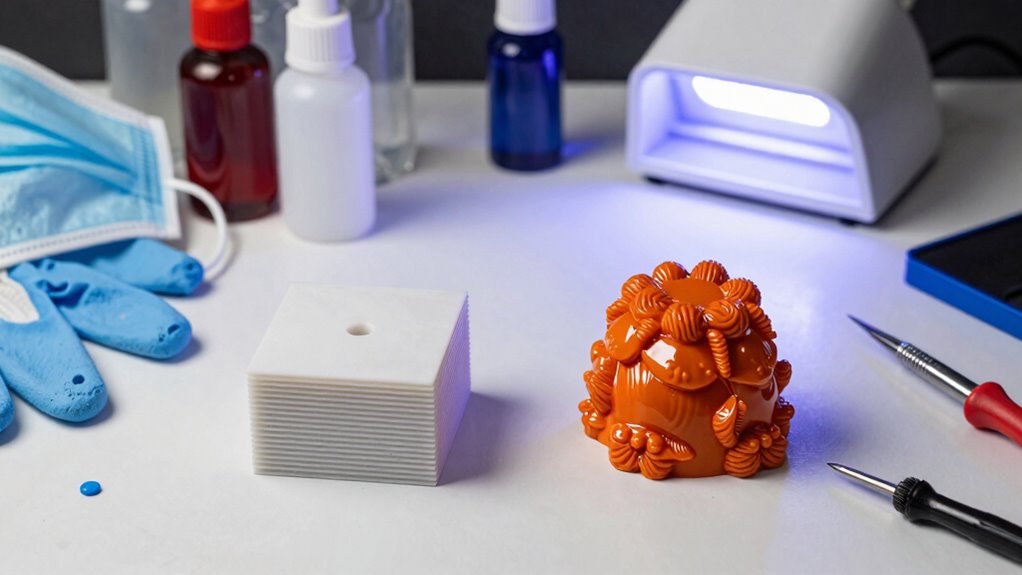
Safety is paramount when working with FDM and resin 3D printers, as both involve potentially hazardous materials and processes. Always wear gloves, masks, and eye protection, especially during post curing, to prevent exposure to fumes and chemicals. When handling resin, guarantee proper ventilation and avoid skin contact, as it can cause irritation. For FDM prints, check layer adhesion to prevent weak spots that could break unexpectedly. During post curing, follow manufacturer instructions carefully—overexposure can weaken parts or cause safety risks. Keep workspaces clean and well-ventilated, and dispose of waste responsibly. Proper post curing safety ensures your printed parts are safe to handle and durable. Prioritize safety at every step to avoid health hazards and achieve the best print quality.
When Should You Choose FDM Over Resin, and Vice Versa?
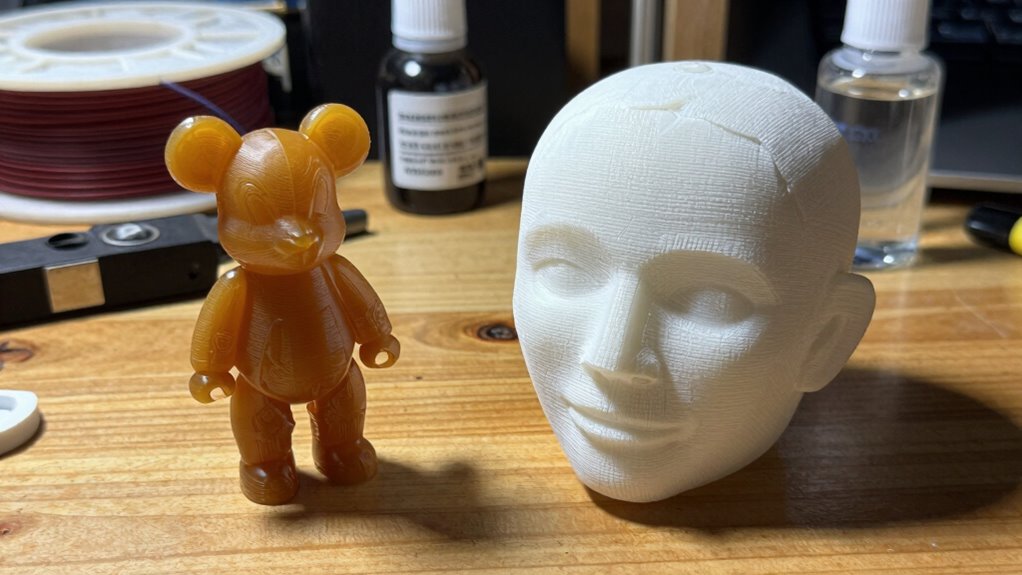
Deciding between FDM and resin 3D printing depends on your project’s specific requirements, such as detail, speed, and material compatibility. FDM is ideal for larger, functional parts that need durability and easier printer maintenance, making it suitable for prototypes or mechanical components. Resin printing excels when high detail and smooth finishes are essential, especially for jewelry or miniatures. Consider these factors:
- Choose FDM if you need robust, large parts with straightforward material compatibility.
- Opt for resin if fine detail and surface quality are priorities, even if it requires more post-processing.
- Think about printer maintenance: FDM printers are generally easier to maintain, while resin printers demand careful handling of chemicals and regular cleaning.
Matching your project needs to these criteria ensures you pick the right method and avoid wasted time.
How to Pick the Right 3D Printing Method and Save Weeks
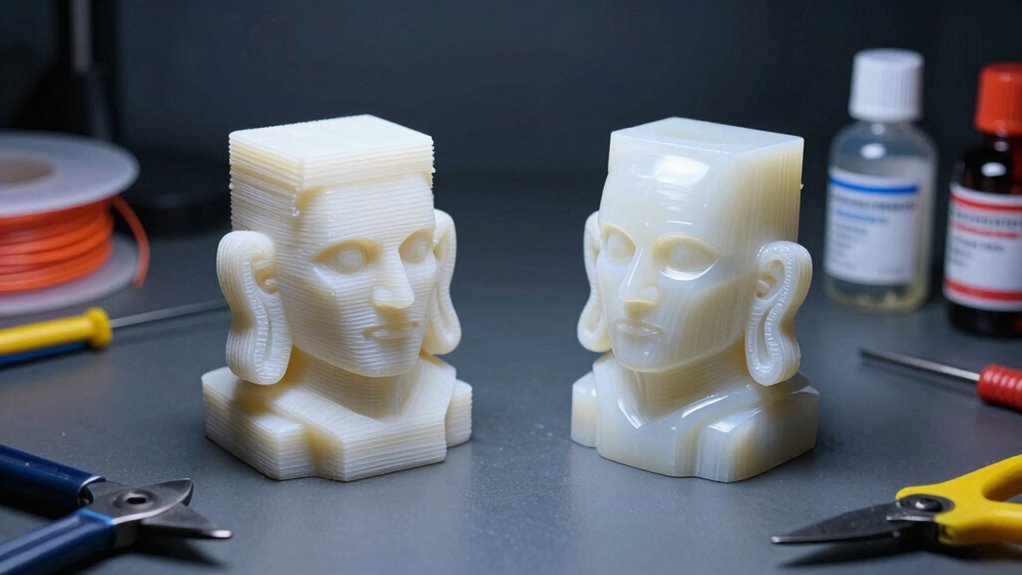
To choose the right 3D printing method, you need to understand the differences in materials and how they fit your project needs. Consider your timeline and budget to determine whether speed or cost savings are more important. By matching your project requirements with the right process, you can save weeks and avoid costly mistakes.
Understand Material Differences
Choosing the right 3D printing method hinges on understanding the material differences between FDM and resin printing. Your choice impacts flexibility, surface quality, and durability. Here are key points to contemplate:
- Material flexibility: Resin prints generally offer more flexibility, making them ideal for detailed, delicate parts. FDM plastics tend to be more rigid and tougher.
- Surface adhesion: Resin materials provide excellent surface adhesion, resulting in smooth, high-detail finishes. FDM parts may require extra support to improve surface quality.
- Wash and cure compatibility: Resin materials often need post-processing like washing and curing, affecting workflow. FDM parts can often be used directly after printing with minimal finishing.
Understanding these differences helps you select the right material for your project, saving time and avoiding costly mistakes.
Match Project Requirements
Matching your project requirements with the right 3D printing method can substantially streamline your workflow and prevent costly delays. If your project demands high material flexibility, resin printing often delivers smoother, detailed surfaces ideal for intricate designs. Conversely, FDM is better suited for functional prototypes requiring durability. Consider your need for precise printer calibration—resin printers demand careful setup to achieve ideal detail, while FDM printers may require calibration for dimensional accuracy. Understanding these factors helps you choose the method that aligns with your project’s goals, reducing trial-and-error and avoiding weeks of rework. By matching your requirements with the appropriate technology, you ensure efficient production, save time, and minimize waste—ultimately making your 3D printing process more predictable and successful.
Assess Time and Cost
Evaluating time and cost effectively can make or break your 3D printing project, especially when tight deadlines and budgets are at stake. To choose the right method, consider these factors:
- Material Compatibility: FDM uses thermoplastics like PLA and ABS, which are generally less expensive and easier to work with, while resin offers finer detail but may require specialized materials, impacting overall costs.
- Production Speed: FDM typically prints faster for larger parts, saving time, whereas resin printing excels with small, detailed objects but can be slower.
- Environmental Impact: FDM materials are often more eco-friendly and easier to recycle, reducing environmental impact and long-term costs.
Assessing these points helps you avoid waste and select a method aligned with your project’s time, cost, and sustainability goals.
Frequently Asked Questions
Can FDM or Resin Printers Print With Flexible or Soft Materials?
You can print flexible or soft materials with both FDM and resin printers. FDM printers work well with flexible filaments like TPU or TPE, allowing you to create bendable, soft objects. Resin printers, on the other hand, offer resin flexibility options that produce slightly more flexible and detailed parts. Just make certain your printer is compatible with these materials, and you’ll achieve the desired flexibility without wasting weeks on failed prints.
What Are the Environmental Impacts of FDM Versus Resin Printing?
You might not realize it, but your choice between FDM and resin printing impacts environmental pollution and material recyclability. FDM generally produces less harmful waste and allows for easier filament recycling, reducing pollution. Resin printing, however, involves chemicals that can be tricky to dispose of safely, increasing environmental concerns. So, if eco-friendliness matters, FDM could be the better option to minimize your environmental footprint.
How Do You Handle Support Removal Without Damaging Your Print?
To handle support removal without damaging your print, you should start by softening supports with warm water or isopropyl alcohol, depending on your material. Use precision tools like pliers or tweezers carefully to avoid support removal challenges that could lead to print surface damage. Always work slowly and gently, and if needed, sand or file rough spots afterward to ensure a smooth finish without harming your delicate details.
Are There Health Risks Associated With Resin Curing Fumes?
You should know that resin fumes can pose health hazards, especially with prolonged exposure. Studies show that certain chemicals in resin fumes can cause respiratory irritation, skin issues, or even more serious health problems over time. To stay safe, always work in a well-ventilated area, wear protective gear, and avoid inhaling fumes directly. Ignoring these risks could lead to long-term health consequences, so prioritize proper safety measures.
Which Printer Type Offers Better Scalability for Production?
You’ll find FDM printers generally better for scaling and improving production efficiency because they can handle larger volumes more easily. Resin printers often face scaling challenges due to longer print times and limited build sizes, making them less ideal for high-volume production. If you want quick, cost-effective scale-up, FDM offers more consistent results. Resin is better suited for detail-focused projects rather than mass production.
Conclusion
Choosing between FDM and resin 3D printing is like selecting the right brush for a masterpiece. If you rush into the wrong method, you’ll waste weeks sanding, curing, and troubleshooting. But with the right choice, you’ll watch intricate details come alive like a painter revealing vibrant strokes on canvas. So, weigh your skills, budget, and project complexity carefully—because the right method turns your ideas into stunning reality, not frustrating delays.