
TL;DR

Get the latest gadgets delivered free with Prime
- Fast, free delivery on millions of items
- Prime Video, Amazon Music and more included
- Member-only deals all year
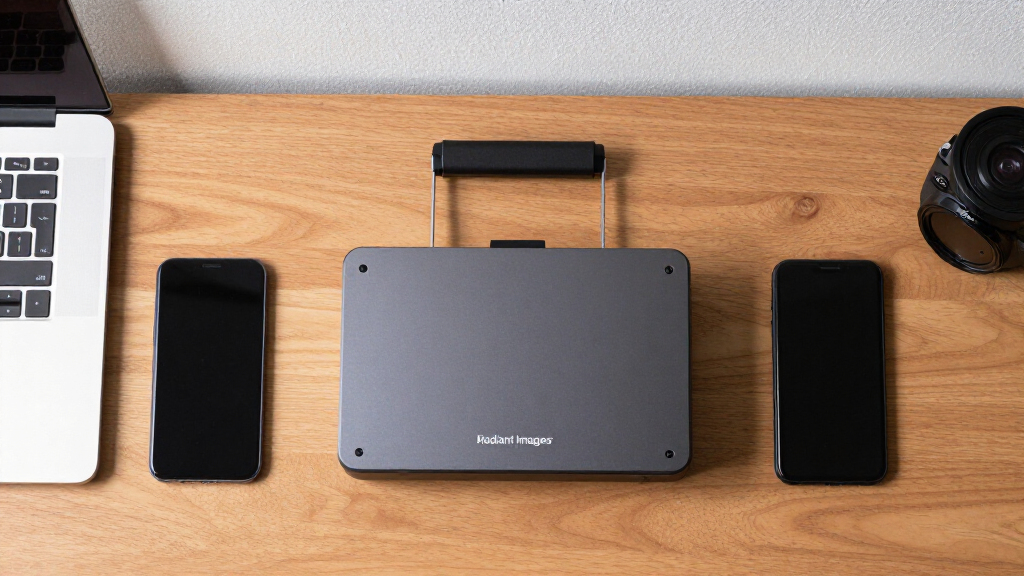
Radiant Images introduced a portable, modular system that uses iPhones to capture Gaussian Splat videos. This innovation allows for flexible, high-quality volumetric recording outside traditional studio setups, potentially transforming the industry.
Radiant Images has launched a portable, modular system for capturing Gaussian Splat volumetric videos, a technology that creates realistic 3D representations of people. This system, which uses independent iPhone-based recording units powered by batteries, can be transported and deployed anywhere, significantly reducing the need for traditional, expensive capture studios. The development is confirmed by the company’s CEO, Michael Mansouri, and marks a notable step forward in making high-quality volumetric video production more flexible and accessible.
The system consists of independent columns of iPhones, each equipped with LiDAR and capable of recording 4K video at 60fps. These modules operate on battery power, eliminating the need for external power sources or wired connections, which allows for easy relocation and setup in various environments. The iPhones also handle pre-processing tasks like color grading and image cropping locally, reducing data transfer and processing time.
Radiant Images’ approach differs from traditional volumetric capture setups, which often require large, fixed studios with many cameras. Instead, their modular design enables users to customize the number of recording units based on the desired quality and budget. The company emphasizes that their system can be shipped in checked baggage, enabling on-location recordings anywhere, including at events like golf tournaments or remote shoots.
While Radiant Images handles the data capture, the final volumetric videos are produced by partners such as Gracia, which specializes in creating 4D Gaussian Splats. The collaboration has already produced visually impressive results, demonstrating the system’s potential for professional applications in entertainment, advertising, and virtual reality.
Impact of Portable Gaussian Splat Capture on Industry
This innovation could significantly lower the barriers to high-quality volumetric video production by making it more mobile and cost-effective. It enables content creators, studios, and event organizers to record actors or subjects in diverse locations without expensive infrastructure. The ability to pre-process data locally also speeds up workflows, reducing costs and time-to-delivery. Overall, this development could accelerate the adoption of Gaussian Splat technology in various fields, including entertainment, training, and virtual experiences.
iPhone LiDAR 4K volumetric video capture
As an affiliate, we earn on qualifying purchases.
As an affiliate, we earn on qualifying purchases.
Evolution of Volumetric Video Capture Technologies
Traditional volumetric capture relies on large, fixed studios with multiple cameras arranged in complex rigs, often requiring significant investment and logistical planning. Companies like Microsoft have built extensive capture environments for hologram creation, but these are limited by their size and cost. Recent advances aim to democratize the technology, making it more accessible to smaller studios and on-location shoots. Radiant Images’ portable system builds on this trend, leveraging smartphone technology to create a flexible solution that can be deployed virtually anywhere, marking a shift toward more adaptable volumetric capture methods.
“Our modular system allows high-quality Gaussian Splat capture anywhere, without the need for fixed studios or extensive infrastructure.”
— Michael Mansouri, CEO of Radiant Images
Unanswered Questions About System Capabilities and Adoption
While the system’s design and initial demonstrations are promising, it is not yet clear how it performs in diverse real-world conditions over extended periods. Details about the final cost, scalability for larger productions, and the quality of the resulting Gaussian Splat videos compared to traditional setups remain to be confirmed. Additionally, the industry’s readiness to adopt this new approach at scale is still uncertain, as the technology is relatively new and primarily targeted at professional studios.
Next Steps for Radiant Images and Industry Adoption
Radiant Images plans to continue refining their portable capture system and expand its deployment in various professional settings. They are likely to seek partnerships with content creators and studios to demonstrate the system’s capabilities in live or on-location shoots. Further testing, user feedback, and potential upgrades—such as integrating newer iPhone models—will shape the system’s future development and broader industry adoption.
Key Questions
How does Radiant Images’ portable system differ from traditional volumetric capture setups?
The system uses independent, battery-powered iPhone modules instead of fixed, large camera rigs, making it portable, flexible, and easier to deploy in various locations.
Can this system produce professional-quality Gaussian Splat videos?
Yes, according to Radiant Images and their partners, the system can capture high-quality data suitable for professional Gaussian Splat production, though final quality depends on the processing and output partners.
What are the main advantages of using iPhones for capture units?
iPhones offer excellent camera quality, LiDAR sensors, and local processing capabilities, which reduce data transfer needs and simplify upgrades by replacing only the phones.
Is this system ready for mass commercial use?
While promising, the system is still in early deployment stages, primarily demonstrated at industry events. Broader commercial availability and cost details are yet to be announced.
What kinds of projects could benefit most from this technology?
Projects requiring on-location volumetric capture, such as live events, virtual reality experiences, advertising campaigns, and remote actor recordings, could see significant benefits.
Source: The Ghost Howls
Halloween Picks
halloween
As an affiliate, we earn on qualifying purchases.