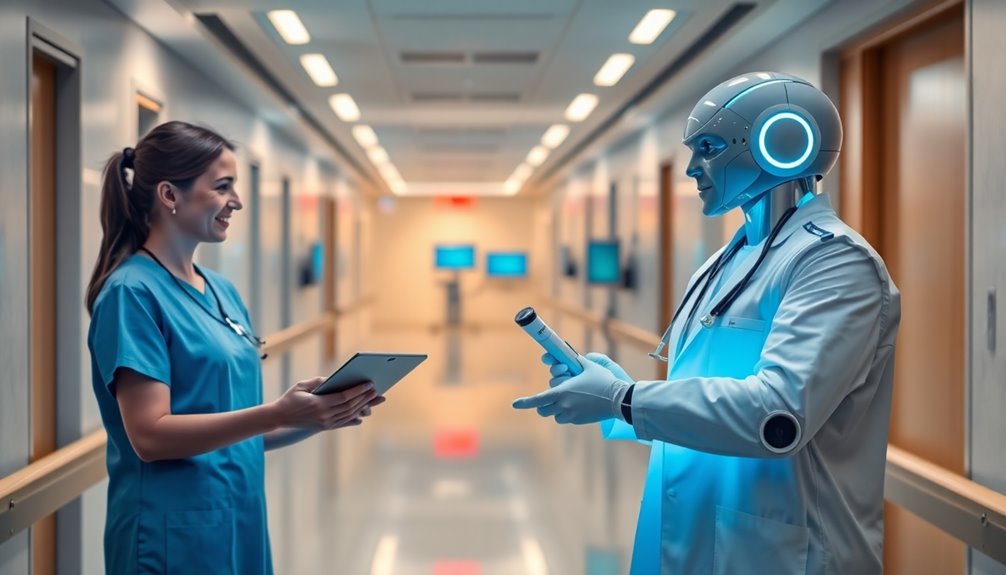

As someone involved in healthcare, you’ve likely noticed how artificial intelligence is reshaping patient care in Virginia facilities. From faster diagnoses to personalized treatments, AI tools are becoming integral to daily operations. But how exactly does this technology impact your work and patient outcomes? Exploring these advancements reveals a shift toward more efficient, accurate care—a change that could redefine the future of healthcare in the region.

Artificial Intelligence is transforming patient care by making healthcare more efficient, accurate, and personalized. In Virginia hospitals, you’ll notice AI increasingly integrated into daily operations, with about 80% of facilities utilizing these tools by 2025. This shift isn’t experimental anymore; it’s routine, reflecting growing confidence in AI-driven medical devices and systems. Hospitals are leveraging AI for tasks like image analysis, predictive analytics, and natural language processing (NLP) transcription, streamlining workflows and improving diagnostic precision.
Clinical departments employ AI in real-time imaging analysis, automated patient intake, and intelligent monitoring, enabling faster, more informed decisions. These advancements help reduce errors, accelerate diagnoses, and optimize resource use, ultimately elevating patient outcomes.
Predictive analytics plays a critical role in enhancing care. Nearly 65% of U.S. hospitals, including those in Virginia, have adopted AI-powered predictive models within their electronic health record (EHR) systems. About 70% of healthcare providers rely on these analytics to identify high-risk patients early, allowing for timely interventions. This proactive approach has shown to cut hospital readmissions by up to 50%, demonstrating its effectiveness.
Moreover, predictive models help avoid unnecessary tests and procedures by around 30%, reducing patient discomfort and lowering costs. These tools enable you and your healthcare team to make smarter, data-driven decisions that benefit both individual patients and the healthcare system at large.
While AI’s benefits are clear, trust remains a key factor for successful adoption. Most clinicians—around 63%—believe AI improves patient outcomes, but only 48% of patients share this confidence initially. Patient trust significantly increases when physicians explain AI’s role in their care, boosting acceptance to 79%.
As a patient, you’re more likely to feel comfortable with AI-supported decisions when your doctor guides you through the process transparently. Clinicians’ involvement in implementing AI and clear communication are vital for building that trust. The more you understand how AI supports your care, the more confident you’ll feel in these technological advances.
AI also enables personalized treatment plans that go beyond one-size-fits-all approaches. By analyzing vast amounts of data, AI helps develop therapies tailored specifically to your needs, improving outcomes and minimizing side effects. It supports clinicians in choosing the most effective interventions while reducing unnecessary procedures, making care more cost-effective.
Additionally, AI alleviates some of the burdens caused by healthcare staffing shortages by assisting in decision-making and operational tasks. For patients managing chronic conditions, AI-powered tools foster better self-management through customized treatment support.
In radiology, AI’s real-time image analysis enhances diagnostic accuracy—speeding up workflows, flagging abnormalities, and reducing errors. Automated patient interactions, like virtual assistants, streamline administrative tasks and facilitate continuous monitoring for high-risk patients, enabling timely interventions before deterioration occurs. Furthermore, the integration of current news about healthcare advancements showcases the ongoing evolution in patient care technologies.

Professional AI-Powered Skin Analyzer, 36MP HD Facial Diagnosis Machine with 8 Spectral Imaging Technology, Comprehensive Skin Analysis Device for Beauty Salons
AI-POWERED SKIN ANALYSIS: Advanced artificial intelligence technology provides comprehensive facial skin diagnosis with accurate comparison and deep understanding…
As an affiliate, we earn on qualifying purchases.
As an affiliate, we earn on qualifying purchases.

Green Computing and Predictive Analytics for Healthcare
As an affiliate, we earn on qualifying purchases.
As an affiliate, we earn on qualifying purchases.

Launchcode: AI, Pharma and the Next Frontier: Volume 2: The Commercial AI Playbook
As an affiliate, we earn on qualifying purchases.
As an affiliate, we earn on qualifying purchases.

Virtual Assistant: A Smart Home Tech Thriller
As an affiliate, we earn on qualifying purchases.
As an affiliate, we earn on qualifying purchases.