📊 Full opportunity report: Phone-based injury-risk movement screening for hiring on IdeaNavigator AI — validation score, market gap, and execution plan.

Get the latest gadgets delivered free — and shop member deals
- Fast, free delivery on millions of items
- Access to Prime Big Deal Days deals on October 6–7
- Prime Video, Amazon Music and more included
TL;DR
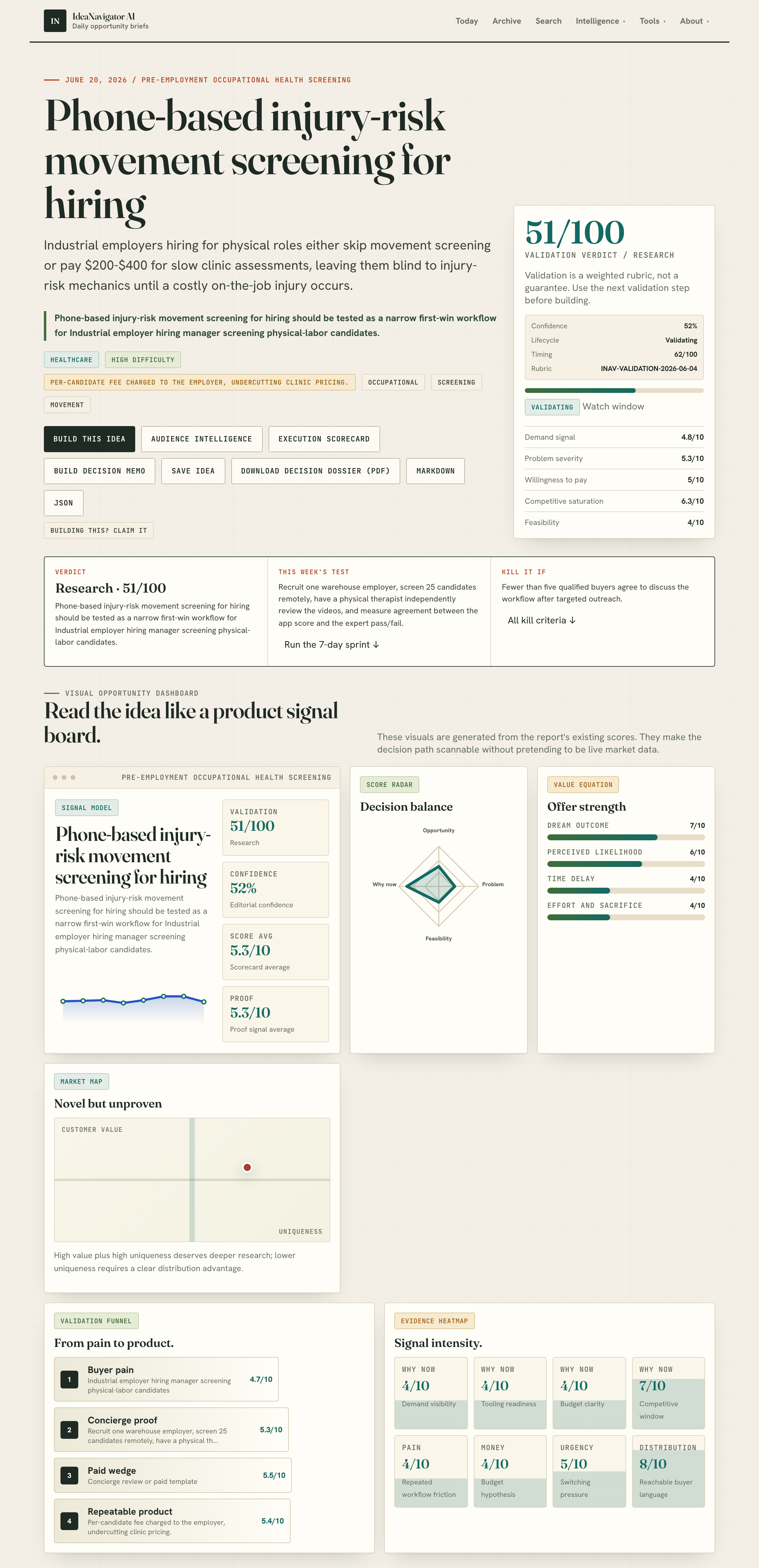
A pilot program is testing a phone-based movement screening tool for pre-employment injury risk assessment in industrial hiring. Early results suggest it could replace costly clinic assessments, with initial validation plans underway.
A new phone-based movement screening tool is being tested for pre-employment injury risk assessment among industrial job candidates, offering a potential alternative to traditional clinic assessments and addressing rising workers’ compensation costs.
The approach leverages phone cameras and pose estimation technology to remotely capture and analyze candidate movements such as squats, reaching, lifting simulations, and balance holds. The goal is to deliver a pass/fail injury risk score within 24 hours at a cost of $30-50 per candidate, significantly lower than the $200-$400 charged by clinics.
The initiative is targeting hiring managers in the industrial sector, where assessing physical capabilities early can prevent costly on-the-job injuries. The proposed workflow involves guiding candidates through a series of 5-7 movements via their phones, with the videos reviewed either automatically or manually by a physical therapist for validation.
Initial validation involves screening 25 candidates from a warehouse employer, with independent review of the videos to compare app-generated scores against expert assessments. The project aims to determine whether this remote screening can reliably identify injury risks and be adopted at scale.
Potential Impact on Industrial Hiring and Injury Prevention
If successful, this phone-based movement screening could transform pre-employment assessments by providing a faster, more affordable, and scalable method to evaluate injury risk. It addresses a key gap where employers currently either skip movement screening or rely on expensive clinic assessments, leaving them vulnerable to costly injuries and workers’ compensation claims.
Reducing injury risk early in the hiring process could lead to lower insurance costs for employers and improved worker safety. The approach also aligns with broader trends toward remote health assessments and AI-driven diagnostics, potentially expanding into other occupational health applications.
As an affiliate, we earn on qualifying purchases.
Rise of Remote Movement Analysis and Occupational Screening
Traditional movement screening in industrial hiring involves in-person clinic assessments, which are costly and time-consuming. Many employers either forego screening or pay premium prices for evaluations, often only identifying injury risks after an injury occurs. Recent advances in phone camera technology and AI pose an opportunity to shift this paradigm by enabling remote, automated movement analysis.
This development builds on prior efforts to incorporate biomechanical assessments into pre-employment screening, but until now, practical remote solutions have been limited. The rising costs of workers’ compensation and the need for scalable screening tools have increased interest in leveraging consumer devices like smartphones for occupational health assessments.
“Using phone cameras and pose estimation, we can now remotely capture and analyze candidate movements, providing a quick injury risk score that could match clinic assessments.”
— an anonymous researcher
Validation and Reliability of Phone-Based Screening Remain Uncertain
It is not yet confirmed how accurately the app-based scores will align with expert assessments or whether the method can reliably identify all injury risks. The pilot testing is ongoing, and results are pending validation against clinical standards.
Planned Validation and Broader Pilot Testing Phases
The next steps include completing the initial screening of 25 candidates, analyzing the agreement between app scores and physical therapist reviews, and refining the system based on findings. If initial validation is successful, larger-scale pilots and potential commercial rollout are expected in the coming months.
Key Questions
How accurate is the phone-based injury risk assessment?
Accuracy is still being evaluated. The current pilot aims to compare app scores with expert reviews to determine reliability.
What movements are assessed in this screening?
The screening includes movements such as squats, reaching, lifting simulations, and balance holds.
How much does the screening cost per candidate?
The estimated cost is between $30 and $50 per candidate, significantly lower than traditional clinic assessments.
When will this approach be available for widespread use?
Pending validation results, a broader rollout could occur within the next year or two.
Could this replace in-person assessments entirely?
It is too early to say; initial trials focus on supplementing or replacing certain screening steps, but full replacement is uncertain.
Source: IdeaNavigator AI
Fall Picks
fall essentials
As an affiliate, we earn on qualifying purchases.