
TL;DR

Get the latest gadgets delivered free with Prime
- Fast, free delivery on millions of items
- Prime Video, Amazon Music and more included
- Member-only deals all year
A new open-source web application enables a Steam Controller to autonomously dock onto its magnetic charging puck using computer vision. The system leverages optical flow tracking and WebHID telemetry to guide the controller precisely, with confirmed functionality demonstrated via a prototype setup.
A new open-source project has demonstrated a system that automatically guides a Steam Controller into its magnetic charging puck using computer vision and WebHID telemetry. This development, confirmed through a prototype setup, represents a significant step toward autonomous controller docking, leveraging optical flow tracking and haptic navigation.
The project employs OpenCV.js to track the controller and puck via an overhead webcam, enabling precise alignment. It connects to the Steam Controller through the WebHID API, streaming input and telemetry data. The system uses 70Hz haptic pulses to navigate the controller toward the puck, with proximity detection adjusting pulse frequency for gentle docking.
Setup requires a webcam mounted overhead, a web browser supporting WebHID, and a simple build process using the Nix package manager. Once configured, users can activate the auto-tracking mode, which autonomously maneuvers the controller into position, with manual control still available as an option. The project is licensed under MIT and credits an anonymous researcher for inspiration.
Innovative Approach to Controller Charging Automation
This development could transform how users manage wireless controller charging, reducing manual effort and improving convenience. It demonstrates the potential of combining computer vision, haptic feedback, and web APIs to create autonomous device interactions, possibly influencing future gaming hardware and accessory designs. The open-source nature encourages further experimentation and customization by the community.
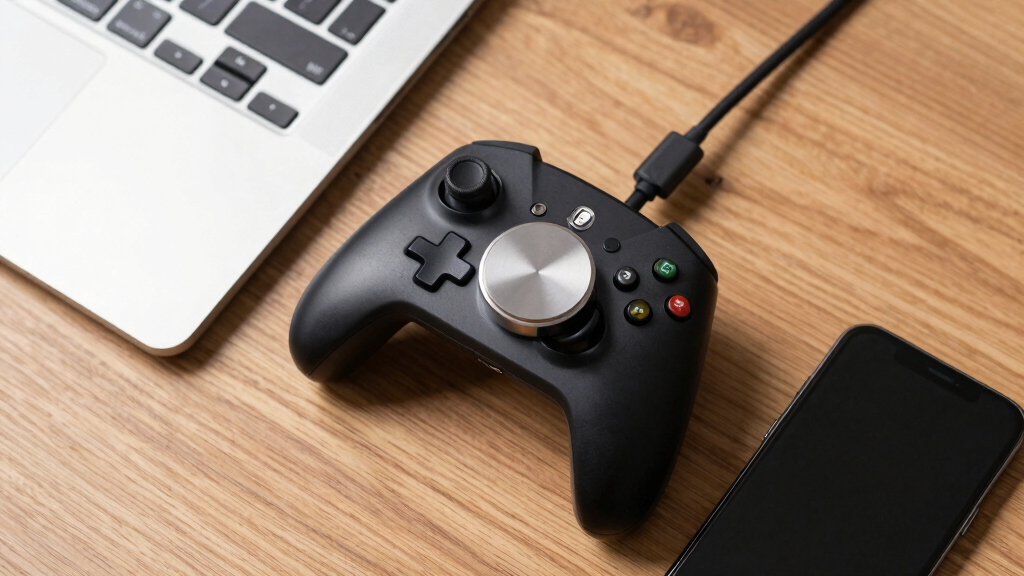
Steam Controller magnetic charging puck
As an affiliate, we earn on qualifying purchases.
As an affiliate, we earn on qualifying purchases.
Progress in Automated Gaming Hardware Interactions
While manual docking of controllers remains standard, recent projects explore automation for enhanced user experience. Prior efforts have focused on robotic docking mechanisms or proprietary solutions, but this project stands out by utilizing web technologies and open-source software. The use of optical flow tracking and real-time telemetry represents a novel approach in this niche.
The project builds on existing computer vision techniques and web API capabilities, highlighting a trend toward more intelligent, user-friendly gaming peripherals. The prototype’s success indicates a possible shift toward more autonomous hardware interactions in gaming setups.
“This system leverages the WebHID API and computer vision to autonomously guide the controller, which could pave the way for smarter, more convenient gaming accessories.”
— an anonymous researcher
Unconfirmed Aspects and Potential Limitations
While the prototype has demonstrated successful docking in controlled conditions, it is not yet clear how well the system performs in varied lighting, desk setups, or with different controller models. The robustness, safety, and reliability of fully autonomous operation remain to be tested extensively. Additionally, the system’s integration into commercial products or official support is not confirmed.
Next Steps for Development and Adoption
Developers plan to refine the system for broader testing, improve its robustness, and potentially develop a user-friendly interface for wider adoption. Further experiments could explore integration with different controllers and environments. Community feedback and contributions will likely shape future iterations, with potential for open-source collaboration to enhance reliability and usability.
Key Questions
Is this system ready for commercial use?
No, it is currently a prototype demonstrated in controlled conditions. Further testing and development are needed before it could be considered for commercial deployment.
What hardware is required to run this system?
An overhead webcam, a computer running a Chromium-based browser supporting WebHID, and a Steam Controller with its magnetic puck are needed. The setup involves some configuration and build steps.
Can this system work with other controllers or charging mechanisms?
Currently, it is designed specifically for the Steam Controller and its magnetic puck. Adapting it to other controllers would require modifications to the detection and navigation algorithms.
Does this project have official support or endorsement?
No, it is an open-source project created by independent developers, with no official affiliation or endorsement from Steam or Valve.
Source: Hacker News
Columbus Day / Indigenous Peoples' Day Picks
long weekend sales
As an affiliate, we earn on qualifying purchases.