
TL;DR

Get the latest gadgets delivered free with Prime
- Fast, free delivery on millions of items
- Prime Video, Amazon Music and more included
- Member-only deals all year
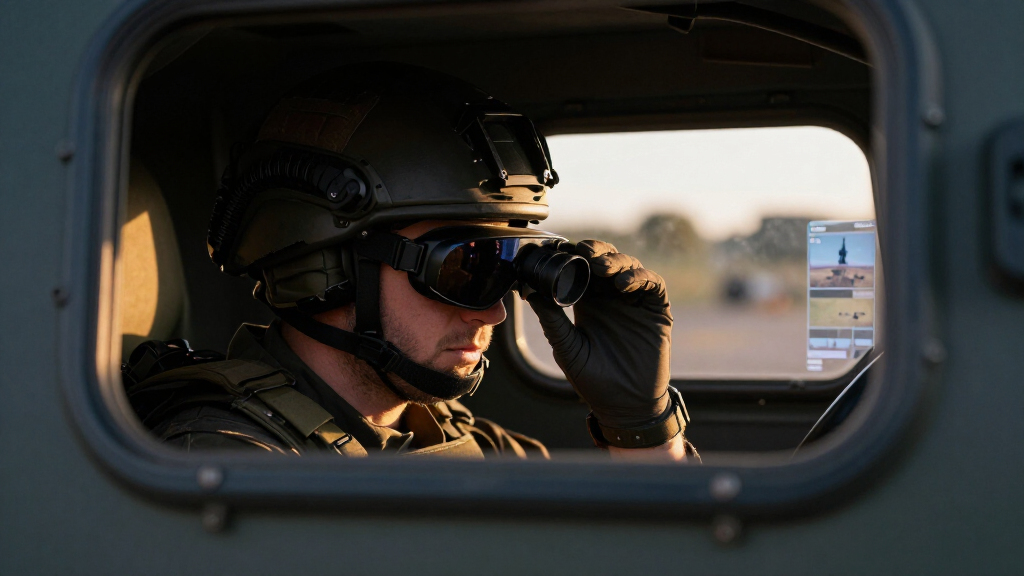
Indra has developed new AR goggles that enable tank crews to see through their vehicle’s armor. This innovation promises to improve battlefield awareness but is still in testing stages. The technology could significantly impact armored warfare strategies.
Indra has introduced a new augmented reality (AR) system that allows tank crews to see through their vehicle’s armor, marking a technological development in armored warfare. The system, which integrates specialized AR goggles, enhances battlefield situational awareness by providing real-time visual data from outside the tank, directly to the crew. This development is confirmed to be in testing stages and could influence future operational procedures.
The AR goggles developed by Indra are designed to project external views directly onto the user’s visor, effectively allowing crew members to ‘see through’ thick armor that traditionally obstructs visibility. According to Indra, this technology leverages advanced sensors, LIDAR, and real-time data processing to generate accurate images of the environment outside the tank. The goggles are intended to improve crew safety, reduce situational blind spots, and support faster decision-making during engagements.
Indra has demonstrated the goggles in controlled environments, where they successfully displayed external terrain, obstacles, and potential threats, even through heavy armor plating. Officials confirmed that the system is still in the testing phase, with field trials scheduled for later this year. The company emphasizes that the goggles are compatible with existing tank systems and can be integrated into current armored vehicle fleets.
Armored vision system / Indra
How AR goggles let tank crews peer through armor
Indra’s experimental system combines external cameras, LIDAR, real-time processing, and visor-mounted augmented reality to reconstruct the world beyond a tank’s armored shell—giving crews a more immediate view of terrain, obstacles, and potential threats.
01 / Operational concept
Armor remains solid. Vision becomes permeable.
The goggles do not make armor physically transparent. They display a processed reconstruction of external sensor data, aligned with the crew member’s view.
Reveal obstructed terrain
External feeds can show terrain and obstacles that are difficult to inspect through fixed viewing ports or narrow periscopes.
Keep crews under armor
Better internal visibility may reduce the need for manual observation that exposes personnel outside the vehicle’s protected envelope.
Shorten the decision loop
Placing visual information directly on the visor could help crews identify hazards, orient the vehicle, and react more quickly.
02 / Data pipeline
From exterior sensors to an interior field of view
The value depends on a continuous chain: sensing, processing, alignment, and presentation must all work fast enough to feel natural to the wearer.
Scan outside
Cameras collect imagery while LIDAR measures the surrounding geometry and distance to objects.
Build the scene
Onboard computing combines incoming data into a coherent representation of the tank’s environment.
Match the wearer
The system positions the reconstructed view so it corresponds with the crew member’s direction of attention.
Overlay the visor
The goggles present terrain, obstacles, and potential threats as an immediate external view.
03 / Capability comparison
A wider interface than the traditional viewing port
AR can consolidate multiple external feeds into a crew-centered view, but conventional optics remain simpler and more proven in harsh field conditions.
| Capability | Traditional periscope | Fixed camera display | Indra AR concept |
|---|---|---|---|
| View follows head direction | ~ Limited | ✗ No | ✓ Intended |
| Multiple sensor feeds in one view | ✗ No | ~ Possible | ✓ Core feature |
| Direct optical fallback | ✓ Yes | ✗ No | ✗ Not inherent |
| Exposure outside armor required | ~ Sometimes | ✗ Typically no | ✗ Intended to avoid |
| Dependence on power and processing | ~ Low | ✓ High | ✓ High |
| Combat validation reported | ✓ Established | ✓ Established | ✗ Still unconfirmed |
Potential tactical shift
More complete visual information could influence vehicle positioning, threat detection, target identification, and coordination between crew roles.
Design implication
If validated, future armored vehicles may place greater emphasis on distributed sensors, crew displays, data fusion, and protected internal observation.
04 / Readiness gap
Promising in demonstrations, unproven in combat
Controlled tests establish the concept. Field deployment requires reliable performance across shock, dust, weather, long missions, and contested battlefield networks.
Traceability / Intended effect chain
How sensor data could translate into crew protection
Key questions answered
What the technology can—and cannot—claim
Does it literally see through armor?
No. External sensors capture the environment, onboard processing reconstructs it, and the goggles display the result as though the armor were visually transparent.
Is it ready for combat?
Not yet, based on the supplied report. The technology remained in testing, with deployment dependent on successful field evaluation.
Will it work with every tank?
Indra described compatibility with existing systems, but actual integration will depend on each vehicle’s architecture, available sensors, power, and upgrade constraints.
What is the central advantage?
The concept gives protected crew members a more natural external view without relying solely on narrow optical ports or separate fixed displays.
Potential Impact on Armored Warfare and Crew Safety
This development could enhance the operational capabilities of tank crews by providing additional visual information. The ability to see beyond physical barriers may assist in threat detection and target identification. The technology also aims to support crew safety by reducing the need for manual observation and physical exposure. These advancements could influence future tank design and tactical approaches, emphasizing increased situational awareness and crew protection.
As an affiliate, we earn on qualifying purchases.
Advances in AR and Sensor Technologies in Military Vehicles
Indra’s AR goggles build upon ongoing developments in military sensor and display technologies aimed at enhancing battlefield awareness. Similar systems have been tested in drone and aircraft applications, but integrating such capabilities into armored vehicles represents a new area of development. Historically, tank crews rely on periscopes, cameras, and external sensors, which can be limited by terrain, weather, and armor. The new AR system aims to address these limitations by providing a seamless, real-time visual feed directly to the crew via lightweight goggles.
This development follows recent announcements by defense contractors about integrating augmented reality into combat vehicles, but Indra’s approach is among the more advanced, combining high-resolution imaging with real-time data processing. The system’s effectiveness in combat conditions remains to be validated, but initial demonstrations suggest potential for battlefield application.
Limitations and Challenges in Field Deployment
While the AR goggles have shown promising results in controlled environments, their performance in actual combat conditions remains unconfirmed. Challenges such as sensor durability under harsh conditions, battery life, potential latency issues, and integration with other battlefield systems are still being addressed. It is unclear how well the technology will perform in diverse terrains, weather, or during sustained combat operations.
Upcoming Field Trials and Potential Deployment Timeline
Indra plans to conduct extensive field trials of the AR goggles later this year, with evaluations involving operational tank crews in simulated combat scenarios. If successful, the company aims to begin integrating the system into existing armored units within the next 12-18 months. Future development may include improvements to sensor resolution, user interface, and battlefield data integration.
Key Questions
How do the AR goggles work to see through armor?
The goggles use advanced sensors, including LIDAR and cameras, combined with real-time data processing to generate external images, which are then displayed directly onto the visor, allowing soldiers to see beyond their tank’s physical barriers.
Are these AR goggles ready for combat deployment?
The technology is currently in testing phases. While initial demonstrations are promising, full deployment depends on successful field trials and addressing technical challenges under combat conditions.
Will this system be compatible with all tanks?
Indra states that the AR goggles are designed for easy integration with existing tank systems, but compatibility may vary depending on the vehicle’s specifications and the specifics of the military’s upgrade programs.
What advantages do these goggles offer over traditional periscopes?
The goggles provide a real-time external view without the need for physical periscopes or external cameras, potentially reducing blind spots and improving reaction times during combat.
What are the main technical challenges remaining?
Remaining challenges include ensuring sensor durability in harsh environments, minimizing latency, extending battery life, and seamless integration with battlefield communication and targeting systems.
Source: rss
Fall Picks
fall essentials
As an affiliate, we earn on qualifying purchases.