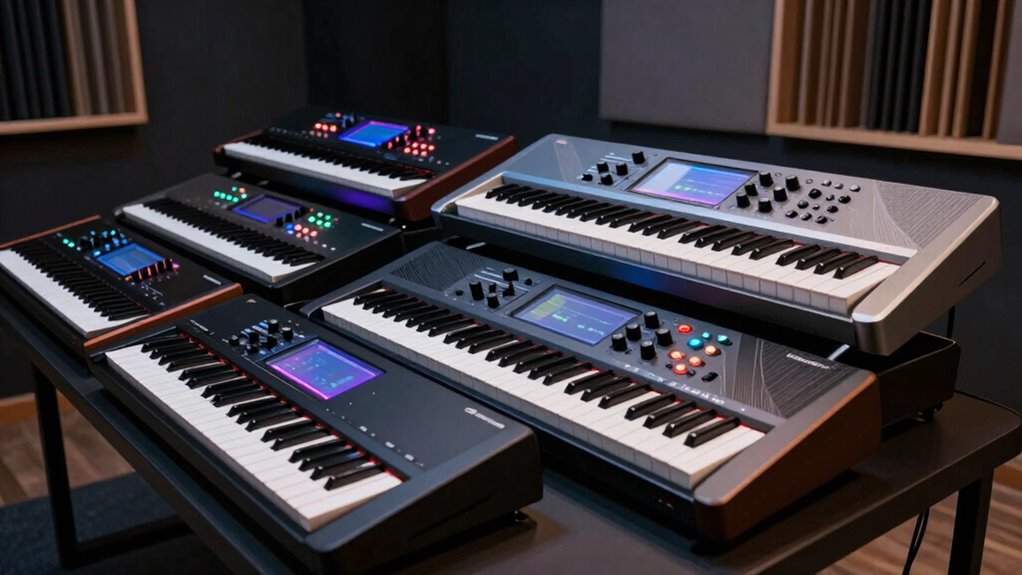

A synthesizer keyboard workstation can mean an all-in-one instrument for composing and performing, or a focused synth with a keyboard and hands-on sound design. My best overall pick for this group is the Korg Kross 2-61, thanks to its workstation-oriented approach; the Yamaha MODX M7 stands out for players who want a broader modern synth platform, while the Roland JUNO-D6 suits straightforward stage use. The key tradeoffs are workstation features versus sound-design focus, portability versus a full-size keyboard, and advanced controls versus a simpler learning curve. This lineup also includes compact instruments that are better treated as creative sidekicks than complete workstations. Read on for the full breakdown and guidance on matching an instrument to the way you write, practice, and perform.

Get the latest gadgets delivered free with Prime
- Fast, free delivery on millions of items
- Prime Video, Amazon Music and more included
- Member-only deals all year
Complete the kit
Key Takeaways
- The Korg Kross 2-61 is the closest fit to a traditional workstation. It is the most natural starting point for buyers who want one keyboard to support songwriting and performance rather than a dedicated synth alone.
- The Yamaha MODX M models offer a more modern, expandable synth direction. The M6, M7, and M8 share a family identity, with key count and action shaping which player each suits.
- Key feel changes the job the instrument can do. The MODX M8, Yamaha MX88, and Montage M8X are the weighted-action choices here; the smaller and lighter-key models favor synth parts and portability.
- The Montage M8X is a specialist premium choice, not an automatic upgrade for everyone. Its flagship feature set and 88-key GEX action make the most sense for demanding players who will use the expressive control and full-range keyboard.
- The MicroFreak, MiniFreak, and Stylophone are not substitutes for a workstation. They suit sound exploration or compact creative setups, but buyers seeking a central composition keyboard should look to the Kross, MODX, MX, JUNO-D6, or Montage options.
| Arturia MicroFreak Hybrid Synthesizer |  | Best for Experimental Sound Design | Keys: 25 touch-plate keys | Oscillator modes: 17 | Keyboard response: Per-note pressure and aftertouch | VIEW ON AMAZON | See Our Full Breakdown |
| Yamaha MODX M7 76-Key Synthesizer |  | Best for Stage and Studio Flexibility | Keys: 76 semi-weighted | Sound engines: 3 | Performance controls: 8 physical faders and Super Knob | VIEW ON AMAZON | See Our Full Breakdown |
| Arturia MiniFreak 37-Key Polyphonic 6-Voice Hybrid Synthesizer |  | Best Compact Hybrid Keyboard | Keys: 37 | Polyphony: 6 voices | Sound profile: Hybrid digital and analog | VIEW ON AMAZON | See Our Full Breakdown |
| Yamaha Montage M8X 88-Key Flagship Synthesizer with GEX Action and Polyphonic Aftertouch |  | Best Premium 88-Key Performance Synth | Keys: 88 | Key action: GEX | Total polyphony: 400 notes | VIEW ON AMAZON | See Our Full Breakdown |
| Yamaha MX61 Music Production Synthesizer, Blue |  | Best Value for USB-Based Production | Keys: 61 | Polyphony: 128 notes | Voices: Over 1,000 | VIEW ON AMAZON | See Our Full Breakdown |
| Roland JUNO-D6 61-Key Synthesizer |  | Best Portable Workstation-Style Pick | Keys: 61 synth-action keys | Sound engine: ZEN-Core | Onboard sounds: Over 3,800 | VIEW ON AMAZON | See Our Full Breakdown |
| Yamaha MX49BK Music Production Synthesizer, Black |  | Best for Computer-Based Production | Keys: 49 | Polyphony: 128 notes | Voice library: Over 1,000 Motif voices | VIEW ON AMAZON | See Our Full Breakdown |
| Yamaha MODX M8 88-Key Synthesizer with Graded Hammer Action |  | Best Premium Piano-Action Workstation | Keys: 88 | Key action: Graded hammer weighted action | Sound engines: 3 | VIEW ON AMAZON | See Our Full Breakdown |
| Yamaha MX88 88-Key Weighted Action Synthesizer |  | Best Value 88-Key Weighted Option | Keys and action: 88-key GHS weighted action | Polyphony: 128 notes | Sound engine: MOTIF | VIEW ON AMAZON | See Our Full Breakdown |
| Stylophone Original Pocket Electronic Synthesizer |  | Best Pocket Sound-Design Companion | Playing surface: Touch-sensitive metal surface played with a stylus | Range: 3 octaves | Power: 3 AA batteries | VIEW ON AMAZON | See Our Full Breakdown |
| Korg Kross 2-61 61-Key Synthesizer Workstation |  | Best for Onboard Sequencing | Keys: 61 | Keybed: Synth-action | Sound engine: Korg EDS-i | VIEW ON AMAZON | See Our Full Breakdown |
| Yamaha MX61BK 61-Key Music Production Synthesizer, Black |  | Best for MOTIF Sounds and Computer Integration | Keys: 61 | Voices: Over 1,000 MOTIF-series voices | Polyphony: 128 notes | VIEW ON AMAZON | See Our Full Breakdown |
| Yamaha MODX M6 61-Key Synthesizer |  | Best for Advanced Sound Design | Keys: 61 | Keyboard action: Semi-weighted | Sound engines: 3 | VIEW ON AMAZON | See Our Full Breakdown |
| synthesizer keyboard workstation | Keys | Weight |
|---|---|---|
| Arturia MicroFreak Hybrid Synt | 25 touch-plate keys | 2.3 lb |
| Yamaha MODX M7 76-Key Synthesi | 76 semi-weighted | — |
| Arturia MiniFreak 37-Key Polyp | 37 | 2.94 kg |
| Yamaha Montage M8X 88-Key Flag | 88 | — |
| Yamaha MX61 Music Production S | 61 | 15.4 lb |
| Roland JUNO-D6 61-Key Synthesi | 61 synth-action keys | 12.8 pounds |
| Yamaha MX49BK Music Production | 49 | 12.5 pounds |
| Yamaha MODX M8 88-Key Synthesi | 88 | 40.5 pounds |
| Yamaha MX88 88-Key Weighted Ac | — | 30.6 pounds |
| Stylophone Original Pocket Ele | — | 8.8 ounces |
| Korg Kross 2-61 61-Key Synthes | 61 | 3.8 kg |
| Yamaha MX61BK 61-Key Music Pro | 61 | — |
| Yamaha MODX M6 61-Key Synthesi | 61 | 22.7 pounds |
More Details on Our Top Picks
Arturia MicroFreak Hybrid Synthesizer
The MicroFreak is the most exploratory instrument in this group, prioritizing unusual sound creation over a conventional workstation layout. Its 17 oscillator modes, five-by-seven modulation matrix, and step sequencer give sound designers plenty to shape, while the resonant analog filter adds a hands-on tonal counterpoint to the digital engines. The touch-plate keyboard responds to per-note pressure and aftertouch, but it does not feel like the moving keys on the Yamaha MODX M7 or Arturia MiniFreak. That tradeoff suits expressive textures and compact setups better than traditional piano-style playing. CV, USB, and MIDI make it flexible alongside other gear, though its 25-key range and advanced sound-design focus make it a poor choice as a single, all-purpose workstation.
Pros:- 17 oscillator modes cover a wide range of experimental tones
- Per-note pressure and aftertouch add expressive control despite the compact layout
- Sequencer and 5 x 7 modulation matrix support hands-on sound and pattern design
- CV, USB, and MIDI connect it to modular, computer, and hardware setups
Cons:- The 25-key touch-plate layout lacks moving keys and may not suit traditional keyboard technique
- Its sound-design depth can be challenging for beginners
- Narrow keyboard range limits it as a main performance instrument
Best for: Electronic musicians who want a compact sound-design instrument with sequencer, modulation, and CV integration.
Not ideal for: Players seeking a conventional keyboard feel, broad playing range, or an easy all-in-one workstation for songs and arrangements.
- Keys:25 touch-plate keys
- Oscillator modes:17
- Keyboard response:Per-note pressure and aftertouch
- Filter:State-variable 12 dB Oberheim SEM analog filter
- Sequencer:Arpeggiator and step sequencer
- Modulation matrix:5 x 7
- Connectivity:CV, USB, and MIDI
- Weight:2.3 lb
Our verdict“Choose the MicroFreak when experimental synthesis and flexible connections matter more than a conventional keyboard or broad workstation coverage.”
Yamaha MODX M7 76-Key Synthesizer
The MODX M7 is a strong fit for players who need one instrument to cover stage parts and studio production without carrying a heavier 88-key model. Its three sound engines span synth and instrument tones, while eight physical faders and the Super Knob put performance changes within reach instead of burying every adjustment in menus. Compared with the compact Yamaha MX61, the M7 offers a more hands-on control setup and a 76-key playing range; the MX61 is the simpler, lighter option for players focused on a large voice library and USB connection. A color touchscreen and MODX M7 ESP Plugin help bridge hardware and DAW work. The tradeoff is size: this is still a substantial keyboard, and its professional feature set may take time for beginners to master.
Pros:- Three sound engines provide varied synth and instrument sounds
- Eight faders and the Super Knob enable direct performance control
- 76 semi-weighted keys provide more playing range than the 61-key Yamaha MX61
- ESP Plugin supports working with MODX M7 sounds in a DAW
Cons:- Its 49-inch listed width makes it a poor match for small desks or tight stages
- Professional-level workflow can be demanding for new players
- The listed specifications do not identify a built-in sequencer or workstation-style song arranger
Best for: Gigging keyboardists and home-studio producers who want a 76-key instrument with multiple sound engines, physical performance controls, and DAW integration.
Not ideal for: Beginners seeking a simple first keyboard or players who need a truly compact instrument with a shorter footprint.
- Keys:76 semi-weighted
- Sound engines:3
- Performance controls:8 physical faders and Super Knob
- Display:Color touchscreen
- Supported software:MODX M7 ESP Plugin
- Supported operating systems:Windows and macOS
- Dimensions:49 x 18 x 9.25 in
- Warranty:1 year manufacturer warranty
Our verdict“Pick the MODX M7 if you need broad stage and studio control in a 76-key format and can accommodate its size and learning curve.”
Arturia MiniFreak 37-Key Polyphonic 6-Voice Hybrid Synthesizer
The MiniFreak fills the middle ground between the MicroFreak’s unusual touch-plate format and larger stage keyboards. Its 37-key keyboard gives players more room for two-handed phrases, while six-voice hybrid synthesis keeps it focused on layered electronic sounds rather than serving as a full-range workstation. Compared with the Arturia MicroFreak, it favors a more familiar keybed and a simpler stated feature set; the MicroFreak, by contrast, offers more explicitly listed oscillator modes, modulation routing, and CV connections for adventurous system builders. The included MiniFreak VST counterpart is useful for carrying sounds into computer-based work, but the supplied data lists USB connectivity without detailing broader hardware connections. Its corded power requirement also makes it less convenient for untethered setups.
Pros:- Hybrid digital and analog sound profile supports varied electronic tones
- 37 keys offer more playing room than the 25-key MicroFreak
- Portable form suits smaller studios and mobile setups
- Includes a MiniFreak VST counterpart for computer-based work
Cons:- Corded electric power limits use away from a power source
- Six-voice polyphony is less suited to dense layered arrangements
- Listed connectivity is limited to USB, with no CV or MIDI details supplied
Best for: Electronic musicians who want a portable 37-key synthesizer for hybrid tones and a matching software instrument for computer-based production.
Not ideal for: Players who need a battery-powered instrument, extensive listed external connections, or a full-range keyboard workstation.
- Keys:37
- Polyphony:6 voices
- Sound profile:Hybrid digital and analog
- Connectivity:USB
- Power source:Corded electric
- Included software:MiniFreak VST counterpart
- Weight:2.94 kg
- Dimensions:22.76 x 9.09 x 2.17 in
Our verdict“Choose the MiniFreak for a compact hybrid synthesizer with a more familiar keyboard and software counterpart, not as a full workstation replacement.”
Yamaha Montage M8X 88-Key Flagship Synthesizer with GEX Action and Polyphonic Aftertouch
The Montage M8X is the most expansive performance instrument in this batch, built around an 88-key GEX action and three engines for analog-style, FM, and instrument sounds. Its 400-note total polyphony gives complex parts room to sustain, while polyphonic aftertouch lets pressure on individual keys shape expressive performances. Compared with the Yamaha MODX M7, the M8X offers a full 88-key action and a stated polyphonic-aftertouch feature; the M7 is the more compact 76-key choice. Seamless Sound Switching is useful when a live set calls for moving between sounds without an abrupt break. The scale and flagship focus come with a practical compromise: this is a large, specialized instrument, and the supplied product information does not list a sequencer, DAW workflow details, or other workstation production tools.
Pros:- Three sound engines cover analog-style, FM, and instrument sounds
- 400-note total polyphony accommodates dense sustained parts
- Polyphonic aftertouch allows pressure control per key
- Seamless Sound Switching supports smooth changes between sounds
Cons:- 88-key GEX action calls for substantial stage and studio space
- Flagship feature set may be excessive for players needing a basic synth keyboard
- Supplied product details do not specify sequencing or song-production functions
Best for: Experienced stage players who need an 88-key performance synthesizer with broad sound engines, high polyphony, and expressive key response.
Not ideal for: Space-limited home producers, players who need a lightweight portable board, or buyers prioritizing clearly specified sequencing and workstation tools.
- Keys:88
- Key action:GEX
- Total polyphony:400 notes
- Sound engines:Three: AN-X, FM, and instrument sounds
- Key feature:Polyphonic aftertouch
- Sound switching:Seamless Sound Switching
- Color:Black
- Warranty:1 year manufacturer warranty
Our verdict“Choose the Montage M8X for expressive 88-key performance and broad sound engines, provided its size and performance-first focus suit your setup.”
Yamaha MX61 Music Production Synthesizer, Blue
The Yamaha MX61 makes the most sense for players who want a broad palette of ready-to-use sounds and a straightforward link to a computer, rather than extensive hands-on synthesis controls. Its more than 1,000 MOTIF-series voices and 128-note polyphony offer range for layered parts, while class-compliant USB carries audio and MIDI to Mac, PC, or iOS devices. Compared with the Yamaha MODX M7, the MX61 is a more direct, 61-key option with a specified USB workflow; the MODX M7 adds three sound engines, faders, a touchscreen, and a longer keyboard for deeper performance shaping. The MX61’s compact-for-its-class weight helps with transport, but its plastic-and-metal construction is less premium, and the supplied details do not describe an onboard sequencer or full song-arranging workflow.
Pros:- More than 1,000 MOTIF-series voices cover a wide range of playing needs
- 128-note polyphony supports layered arrangements
- Class-compliant USB provides audio and MIDI connection to Mac, PC, and iOS
- At 15.4 lb, it is easier to transport than the 88-key Yamaha Montage M8X
Cons:- Plastic-and-metal construction is less premium than a more substantial performance instrument
- 61 keys provide less playing range than the MODX M7 or Montage M8X
- Supplied product details do not specify an onboard sequencer or arrangement workflow
Best for: Budget-conscious home producers and gigging players who need a broad voice library and direct USB audio/MIDI connection to a computer or iOS device.
Not ideal for: Players who want extensive real-time controls, a premium-feeling chassis, or clearly specified onboard sequencing and arrangement tools.
- Keys:61
- Polyphony:128 notes
- Voices:Over 1,000
- USB:Class-compliant audio and MIDI
- Compatible devices:Mac, PC, and iOS
- Weight:15.4 lb
- Materials:Plastic and metal
- Color:Blue
Our verdict“Pick the MX61 for an accessible, USB-connected sound library and portable 61-key format, but choose the MODX M7 for deeper performance control.”
Roland JUNO-D6 61-Key Synthesizer
The JUNO-D6 is the strongest fit here for players who want a portable, self-contained production setup rather than a keyboard mainly for controlling a computer. Its eight-track sequencer and WAV sample import support sketching and arranging directly on the instrument, while more than 3,800 onboard sounds give performers plenty of starting points without loading a laptop first. Compared with the Yamaha MX49BK, it offers more built-in sequencing and sample workflow; the Yamaha instead stands out for class-compliant USB audio/MIDI and Motif voices. The Roland’s 61 synth-action keys keep the package manageable for gigs, but they are less suited to piano-focused playing than the weighted 88-key Yamaha MX88. USB-C mobile battery power adds flexibility, though the supplied data does not specify battery runtime or included battery accessories.
Pros:- Eight-track sequencer supports arranging ideas on the instrument.
- More than 3,800 onboard sounds provide broad coverage for performance and production.
- WAV sample import lets players incorporate their own audio material.
- USB-C mobile battery power and a 12.8-pound weight suit portable setups.
Cons:- Synth-action keys are less piano-like than the weighted action on the Yamaha MX88 and MODX M8.
- The 61-key range can limit two-handed piano parts and wide splits.
- Battery runtime and whether a mobile battery is included are not specified.
Best for: Gigging keyboardists and home producers who want 61 keys, extensive onboard sounds, and a built-in sequencer without relying on a computer.
Not ideal for: Pianists seeking weighted 88-key action, or players whose main need is a compact USB audio/MIDI keyboard like the Yamaha MX49BK.
- Keys:61 synth-action keys
- Sound engine:ZEN-Core
- Onboard sounds:Over 3,800
- Sequencer:Eight-track
- Sample import:WAV files
- Connectivity:USB Type-C and MIDI
- Power:Battery powered; supports USB-C mobile battery power
- Weight:12.8 pounds
Our verdict“Choose the JUNO-D6 if you want a portable 61-key instrument with substantial onboard sound and sequencing, rather than a weighted piano-style workstation.”
Yamaha MX49BK Music Production Synthesizer, Black
The Yamaha MX49BK makes the most sense when a keyboard needs to connect quickly to a computer or iOS setup and provide a broad palette of ready-to-play sounds. Its class-compliant USB audio/MIDI is the key distinction: it can join a compatible production rig without a separate driver-installation step, while the 1,000-plus Motif voices cover common studio and stage parts. The Roland JUNO-D6 is the more compelling choice for arranging away from a computer, thanks to its built-in eight-track sequencer and WAV import. The MX49BK instead offers 128-note polyphony and a straightforward, lightweight 49-key format. That smaller range is a real limitation for pianists and players who need broad splits, and there are no built-in speakers, so live use requires external amplification or headphones.
Pros:- More than 1,000 Motif voices provide a substantial onboard sound library.
- Class-compliant USB audio/MIDI supports straightforward connection to compatible computers and iOS devices.
- 128-note polyphony accommodates dense parts and layered sounds.
- At 12.5 pounds, it is relatively easy to move between studio and stage.
Cons:- The 49-key range can restrict piano parts and performance splits.
- No built-in speakers; external amplification or headphones are needed.
- Compared with the Roland JUNO-D6, it lacks the listed eight-track sequencer and WAV sample import.
Best for: Producers and performers who want a lightweight 49-key controller-style synth with Motif sounds and simple USB integration in a computer-based setup.
Not ideal for: Pianists who need a full range of keys, or players seeking an all-in-one instrument with speakers and onboard multitrack sequencing.
- Keys:49
- Polyphony:128 notes
- Voice library:Over 1,000 Motif voices
- USB:Class-compliant USB audio/MIDI
- Weight:12.5 pounds
- Dimensions:38.6 x 15.2 x 7.2 inches
- Included component:USB cable
- Warranty:1 year
Our verdict“Pick the MX49BK for a compact, computer-friendly Motif sound source, but choose the JUNO-D6 if onboard sequencing matters more than USB simplicity.”
Yamaha MODX M8 88-Key Synthesizer with Graded Hammer Action
For players who want a full piano range without giving up synth-focused sound design and live controls, the Yamaha MODX M8 is the most performance-oriented 88-key option in this group. Its graded hammer action favors pianists, while three sound engines and eight physical faders give players more hands-on control than the simpler interface described for the Yamaha MX88. The color touchscreen and Super Knob also support direct editing and expressive changes on stage; Expanded Softsynth Plugin support extends the workflow to a compatible DAW. This broader control set comes with a transport cost: at 40.5 pounds, it is heavier than the MX88 and far less convenient than the 12.8-pound Roland JUNO-D6. It is also corded, so mobile battery operation is not part of the listed setup.
Pros:- Graded hammer action provides a piano-oriented feel across 88 keys.
- Three sound engines support a broad range of keyboard and synthesizer sounds.
- Eight physical faders and the Super Knob give direct performance control.
- Color touchscreen and ESP support connect instrument editing with a compatible DAW workflow.
Cons:- At 40.5 pounds, it is substantially heavier than the MX88 and portable 61-key options.
- Corded electric power limits use away from a powered setup.
- The full-size, 57.5-inch body requires more transport and stage space than the JUNO-D6.
Best for: Professional pianists and synth players who need weighted 88-key action, multiple sound engines, and hands-on control for stage or studio work.
Not ideal for: Musicians who regularly carry their keyboard alone, need battery-powered operation, or prefer a compact 61-key instrument.
- Keys:88
- Key action:Graded hammer weighted action
- Sound engines:3
- Controls:8 physical faders and Super Knob
- Display:Color touchscreen
- DAW support:Expanded Softsynth Plugin (ESP) for MODX M
- Power:Corded electric
- Weight:40.5 pounds
Our verdict“Choose the MODX M8 if weighted 88-key playing and hands-on sound control outweigh the burden of transporting a larger, corded instrument.”
Yamaha MX88 88-Key Weighted Action Synthesizer
The Yamaha MX88 offers a direct route to full-range piano-style playing in a synthesizer, pairing 88-key GHS weighted action with the MOTIF sound engine and 128-note polyphony. That makes it a better match for piano parts and broad two-handed arrangements than the 49-key MX49BK or 61-key JUNO-D6. Its class-compliant USB audio/MIDI also suits players who want to connect to a computer or iOS device without installing drivers. Against the more advanced Yamaha MODX M8, the MX88 is the simpler proposition: it has a basic display and does not list the MODX’s three sound engines, touchscreen, or physical faders. The tradeoff is portability; at 30.6 pounds with a 52-inch body, it is no small carry, though it is lighter than the MODX M8.
Pros:- GHS weighted action spans 88 keys and has a heavier low register and lighter high register.
- MOTIF sound engine provides a broad source for keyboard and layered parts.
- 128-note polyphony supports dense playing and full sequences.
- Class-compliant USB audio/MIDI connects with computers and iOS devices.
Cons:- At 30.6 pounds, it is less convenient to transport than the JUNO-D6 or MX49BK.
- The three-digit LED and small character LCD are less direct for editing than the MODX M8 touchscreen.
- The 88-key body takes more stage and storage space than the 49- and 61-key alternatives.
Best for: Pianists and keyboardists who want 88 weighted keys, MOTIF sounds, and USB integration without moving up to the MODX M8’s larger control set.
Not ideal for: Players who need a lightweight gigging keyboard, synth-action keys, or a touchscreen and extensive hands-on controls.
- Keys and action:88-key GHS weighted action
- Polyphony:128 notes
- Sound engine:MOTIF
- Tempo range:5–300 BPM
- Display:3-digit LED and backlit 20 x 2 character LCD
- Connectivity:USB audio/MIDI
- Weight:30.6 pounds
- Dimensions:6.6 x 52 x 16 inches
Our verdict“Choose the MX88 for weighted 88-key playing and USB connectivity in a simpler package than the MODX M8, provided its size and weight fit your setup.”
Stylophone Original Pocket Electronic Synthesizer
The Stylophone Original is the outlier in this roundup: it is a pocket-sized sound-making instrument, not a full keyboard workstation. Its stylus-played metal surface produces a distinctive retro tone and makes quick melodic experiments possible without setting up the 61-key JUNO-D6 or a full-size Yamaha. A built-in speaker, headphone socket, and 3.5 mm connection give it a few ways into a practice or recording setup. It is best treated as a portable creative companion rather than a substitute for the Yamaha MX49BK, which offers conventional keys, a large voice library, and USB audio/MIDI. The Stylophone’s three-octave range is unusual to play and takes practice, and its small speaker and simple controls are not a replacement for the broader sound editing and production features of the workstation-class options.
Pros:- Pocket-sized, 8.8-ounce design is easy to carry as a secondary instrument.
- Distinctive vintage-style sound with optional vibrato adds a characterful texture.
- Built-in speaker and headphone socket allow standalone listening.
- 3.5 mm connection supports recording or connection to other gear.
Cons:- Stylus control on a touch-sensitive surface takes practice and differs from a conventional keyboard.
- Three AA batteries are required for power.
- It lacks the sequencer, keybed, and broad production workflow available on the JUNO-D6 and Yamaha MX49BK.
Best for: Songwriters, sound-design hobbyists, and electronic musicians who want a tiny, battery-powered source of distinctive retro phrases and textures.
Not ideal for: Players seeking a conventional keyboard workstation for sequencing, full-band arrangements, piano parts, or detailed sound editing.
- Playing surface:Touch-sensitive metal surface played with a stylus
- Range:3 octaves
- Power:3 AA batteries
- Audio connections:Headphone socket and 3.5 mm auxiliary
- Speaker:Built-in
- Dimensions:2.05 x 3.41 x 1.86 inches
- Weight:8.8 ounces
- Material:Metal
Our verdict“Buy the Stylophone as a highly portable retro-tone companion, not as your primary synthesizer keyboard workstation.”
Korg Kross 2-61 61-Key Synthesizer Workstation
The Korg Kross 2-61 is the clearest fit here for players who want sequencing built into a 61-key workstation rather than relying mainly on a computer. Its step and MIDI sequencers support sketching and arranging ideas from the instrument, while mic/line inputs add options for bringing in external sources. Compared with the Yamaha MX61, which emphasizes its large MOTIF voice library and USB audio/MIDI integration, the Kross puts more weight on onboard sequencing features. The synth-action keybed suits quick parts and layered sounds, though players who prefer a more substantial playing feel may favor the semi-weighted keys on the Yamaha MODX M6. The product information gives limited detail about its sound library and recording functions, so buyers seeking clearly documented studio capabilities should compare those specifics before choosing.
Pros:- Step and MIDI sequencers support idea development on the instrument
- Mic/line inputs allow external audio connections
- 61-key synth-action keyboard suits fast synth parts
- USB connectivity and EDS-i sound engine are included
Cons:- Available product details provide little information about the sound selection
- Recording capabilities are not clearly described
- Synth-action keys may feel less substantial than the MODX M6’s semi-weighted action
Best for: Keyboard players who want a portable 61-key workstation with onboard step and MIDI sequencing plus inputs for external audio sources.
Not ideal for: Studio buyers who need detailed, clearly specified recording functions or a well-documented sound library before making a decision.
- Keys:61
- Keybed:Synth-action
- Sound engine:Korg EDS-i
- Sequencers:Step and MIDI
- Inputs:Mic/line
- Connectivity:USB
- Weight:3.8 kg
- Warranty:1 year
Our verdict“Choose the Kross 2-61 if onboard sequencing and external inputs matter more to you than a fully documented sound and recording feature set.”
Yamaha MX61BK 61-Key Music Production Synthesizer, Black
The Yamaha MX61 makes sense for players who want a broad, ready-to-use sound palette and straightforward studio connection in a compact 61-key instrument. Its more than 1,000 MOTIF-series voices give it a wider stated selection than the Korg Kross 2-61’s product details specify, while class-compliant USB audio and MIDI can simplify connecting to compatible computers and iOS setups. With 128-note polyphony, it is suited to layered arrangements that could strain instruments with less voice capacity. The tradeoff is that the MX61’s appeal centers on voices and integration, not the Kross’s onboard step and MIDI sequencing. Its plastic body keeps the design lightweight, but buyers looking for hands-on, expressive controls and multiple synthesis engines may find the Yamaha MODX M6 a stronger, more advanced fit. Remote-control functions also vary by software.
Pros:- More than 1,000 MOTIF-series voices cover varied playing needs
- 128-note polyphony supports dense or layered arrangements
- Class-compliant USB supports audio and MIDI connectivity
- Compact, lightweight design suits studio and stage setups
Cons:- Remote-control functions vary depending on the software used
- Plastic body may feel less substantial than a more performance-focused instrument
- Does not have the Kross 2-61’s listed step and MIDI sequencers
Best for: Home-studio musicians and gigging keyboardists who want a large preset library, 128-note polyphony, and USB audio/MIDI in a compact 61-key instrument.
Not ideal for: Players who prioritize onboard step sequencing, detailed hands-on sound shaping, or controls that work consistently across different software.
- Keys:61
- Voices:Over 1,000 MOTIF-series voices
- Polyphony:128 notes
- USB:Class-compliant audio and MIDI
- Body material:Plastic
- Color:Black
- Included component:USB cable
- Warranty:1 year manufacturer warranty
Our verdict“Pick the MX61 if you want a large MOTIF-derived voice selection and convenient USB integration more than onboard sequencing or advanced hands-on synthesis controls.”
Yamaha MODX M6 61-Key Synthesizer
The Yamaha MODX M6 is the most advanced sound-design choice among these three 61-key options, with three sound engines spanning analog, FM, and instrument sounds. That breadth gives players more routes to build distinct textures than the MX61’s emphasis on a large MOTIF voice library. Its eight faders, Super Knob, and color touch screen put parameter changes within reach during editing or performance, and the DAW plugin supports creating and editing sounds from a computer. The semi-weighted keys offer a firmer feel than the Kross 2-61’s synth-action keybed, although neither description points to a weighted piano-style action. At 22.7 pounds, it is specified as lightweight for stage and studio use, but its professional skill level and extensive controls can make it a steep starting point for new players.
Pros:- Three sound engines cover analog, FM, and instrument sounds
- Eight faders and a Super Knob provide hands-on control
- Color touch screen supports direct navigation and editing
- DAW plugin supports sound creation and editing
Cons:- Professional-level feature set may challenge beginners
- Onboard step or MIDI sequencing is not specified in the supplied product details
- Semi-weighted keys may not suit players seeking a fully weighted piano action
Best for: Experienced synthesists and performing keyboardists who want multiple sound engines, physical controls, and a DAW-connected editing workflow in a 61-key instrument.
Not ideal for: First-time workstation buyers seeking a simple interface, or players who want onboard step sequencing as a stated feature.
- Keys:61
- Keyboard action:Semi-weighted
- Sound engines:3
- Controls:8 physical faders and Super Knob
- Display:Color touch screen
- Weight:22.7 pounds
- Skill level:Professional
- Warranty:1 year manufacturer warranty
Our verdict“Choose the MODX M6 if you are ready for a more involved sound-design instrument with broad synthesis options and hands-on controls.”

How We Picked
I ranked these instruments by how well they serve as a synthesizer keyboard workstation: not just the range of sounds, but the balance of sound creation, composition and performance usefulness, keyboard feel, controls, and portability. I gave more weight to models that can plausibly anchor a setup than to compact synths designed mainly for experimentation. Key count and action matter because a 61-key synth-action board supports a different style of playing than an 88-key weighted instrument.
The order reflects role fit and breadth, not a claim that one instrument is best for every musician. The Kross 2-61 leads for its workstation-oriented purpose; MODX M models follow for players prioritizing a contemporary synth platform, while the JUNO-D6 and MX series offer simpler or more focused alternatives. Flagship capability earns the Montage M8X a premium-specific place, while the MicroFreak, MiniFreak, and Stylophone rank lower for this particular category because their appeal centers on sound design and compact creativity rather than all-in-one workstation use. Yamaha MX61 and MX61BK are treated as the same basic model in different finishes, so color does not change their functional ranking.
Factors to Consider When Choosing Synthesizer Keyboard Workstation
Choosing a workstation starts with how you expect it to function in your setup: as the main songwriting instrument, a stage keyboard, a controller for other gear, or a source of unusual sounds. I would decide on that job before comparing sound lists, since a long feature sheet cannot make up for an unsuitable keybed or an awkward workflow.
Decide Whether You Need a Workstation or a Dedicated Synth
The word workstation is used loosely, so check whether an instrument supports the full process you care about: building parts, combining sounds, and arranging or performing them without relying on extra gear. A synth can have unusual oscillators and deep sound editing yet still be a poor central writing tool if it lacks the workflow you expect. Before buying, list the tasks you want to handle on the keyboard itself, such as layering, sequencing, or preparing live setups. If your computer already handles recording and arrangement, a focused synth may be a better fit than paying for workstation functions you will not use. A common mistake is treating a broad sound library as proof of a complete production workflow. Match the feature set to your actual setup rather than the label on the front panel.
Choose Key Count and Action for Your Playing
Key count is a workflow choice, not just a question of how much space the instrument takes up. A 61-key board is often easier to place in a home studio or carry to rehearsals, while 76 keys reduce octave switching for two-handed synth parts. An 88-key weighted action is more suitable when piano technique and a broad playing range matter, but it is bulkier and can feel less natural for fast synth articulation. Try to account for the sounds you will play most: weighted keys can help with piano dynamics, while synth-action keys are often a more comfortable match for leads and organ-style parts. Do not choose a larger keyboard simply because it appears more capable. Pick the smallest range that still lets you perform your regular parts without workarounds.
Pay for the Sound Engine You Will Actually Use
Some buyers want a wide palette of ready-to-play sounds; others care more about shaping a small number of patches in detail. Those priorities can point toward very different instruments, even when both are called synthesizers. Consider how you prefer to create: selecting and layering existing tones, editing a familiar synth architecture, or experimenting with less conventional sound sources. A distinctive engine is valuable if it inspires writing, but it does not automatically make an instrument a better workstation. Likewise, a large collection of sounds is less useful if getting to the right patch slows down rehearsals. Compare the sound-design approach with your habits before treating specifications or novelty as a deciding factor.
Think Through Live and Studio Connections
A keyboard that works well in a studio may not be the easiest one to use on stage. Look at the connections and control layout you need for your current equipment, including sustain pedals, external sound modules, audio interfaces, and any computer-based setup. For live use, ask whether you can reach the sounds and controls you need quickly, and whether the instrument’s size and weight suit your transport routine. In a studio, integration with a computer can matter more than built-in performance controls. A frequent buying error is assuming every modern keyboard will replace a controller, audio interface, and production software at once. Map your signal chain first, then check which jobs the instrument can genuinely take over.
Set a Realistic Limit for Portability and Expansion
Portability involves more than the number of keys: dimensions, weight, power needs, and the amount of extra equipment required all affect how often an instrument travels. Compact synths are easy to fit into a setup, but they may require a separate keyboard or production system to cover broader composition needs. Larger models can be more comfortable as a main instrument while becoming harder to move and place. Think about where the keyboard will live and how it will be used most weeks, not just where you might take it occasionally. Also check whether your plans depend on software, storage, or external accessories, since those can add setup work. Spending more for expansion only pays off when you have a clear use for the added capability.
Frequently Asked Questions
Can the Arturia MicroFreak or MiniFreak replace a workstation?
They are better treated as focused sound-design instruments than as direct replacements for a workstation. Their appeal is the character and creative control of their synth engines, while a central composition keyboard needs to fit a wider set of arranging and performance tasks. If you already use a computer, sequencer, or another keyboard to handle those jobs, either Arturia model could be a distinctive part of that setup. If you want one instrument to anchor songwriting and stage duties, compare them with the Kross 2-61 or the Yamaha MODX M range. The right answer depends on whether you want a primary instrument or a specialized voice.
Should I choose a 61-key, 76-key, or 88-key model?
Choose 61 keys if space, transport, or synth-focused playing matters most, and 76 keys if you regularly split your hands across a broader range but do not need weighted piano action. An 88-key model is the clearest fit for piano-style playing and full-range parts, especially when weighted action matters to your technique. More keys do not automatically make a keyboard more useful; a large instrument can be a burden if it rarely leaves one room. Think about your main sounds, the way you play two-handed parts, and the available stand or desk space. If possible, try the action before committing, since key feel can matter more than a small difference in sound selection.
Is the Yamaha MX61BK a different instrument from the Yamaha MX61?
The MX61 and MX61BK listings refer to the same basic model family, with the suffix indicating a black finish rather than a different workstation capability. A separate MX49BK is the more compact key-count option, so check the exact model name rather than assuming the numbers or suffixes are interchangeable. For a choice between MX61 color listings, focus on the condition, included accessories, and seller details rather than expecting a different sound engine. If you need a distinct feature set, compare the MX range with MODX M or Kross instead. The finish should not be the deciding factor in a functional comparison.
When does the Montage M8X make more sense than a MODX M8?
The Montage M8X makes more sense when you will use its flagship performance capabilities and expressive GEX weighted action as part of demanding studio or stage work. A MODX M8 is a more sensible direction when you want an 88-key Yamaha synth platform but do not need every premium feature of the flagship. Before choosing the Montage, identify the specific performance controls, expression, or workflow advantages you expect to use regularly. If those needs are unclear, the added capability may not change your music-making enough to justify the larger commitment. For piano-oriented playing alone, compare the action and feel directly rather than assuming the flagship label guarantees a better personal fit.
Is a small instrument like the Stylophone suitable as a first keyboard?
The Stylophone can be an accessible way to explore electronic sound, but it is not a conventional keyboard workstation and should not be treated as a full-size practice instrument. Its compact format makes it better suited to playful sound experiments, portable sketches, or an additional sound in a larger setup. A beginner seeking a main instrument for learning keyboard parts should prioritize a layout and key range that support regular practice. Decide whether your first goal is exploring electronic tones or learning to play broader parts, since those call for different tools. If you want one instrument for lessons, composing, and performance, compare full keyboard options rather than relying on a pocket synth.
Conclusion
For a single instrument with a workstation-minded role, my best overall pick is the Korg Kross 2-61. The Yamaha MX49BK is my best value-minded compact choice for buyers who want a smaller music-production synth; choose the MX61 or MX61BK if you want the same family with more keys. For a current Yamaha synth platform, the MODX M7 is the most balanced middle ground, while the MODX M6 favors portability and the MODX M8 favors full-range weighted playing. The Montage M8X is my best premium pick for players who will use its flagship features and expressive action. Beginners should look first at a straightforward full keyboard such as the Roland JUNO-D6, while sound-design seekers may prefer the Arturia MiniFreak or MicroFreak; the Stylophone is best as a compact creative extra, not a main workstation. Match the instrument to your playing and production workflow, and the right choice becomes much clearer.