Portable generators range from 26-pound camping inverters to 14,500-watt whole-home backup machines, and the right pick depends almost entirely on what you’re powering. For most homeowners, the Westinghouse 14500 Peak Watt Dual Fuel stands out as the best overall choice — it pairs transfer-switch-ready output with the flexibility to run on gasoline or propane. If you need serious power on a tighter budget, the DuroStar DS13000MX delivers 13,000 dual-fuel watts at a lower tier of the market, while the Genkins 1600W inverter at 26 pounds is the clear choice for campers who value quiet and portability over raw wattage. The main tradeoff in this category is always power versus portability, with fuel flexibility and inverter-clean electricity complicating the decision further. Keep reading for the full breakdown of all 12 models.

Get the latest gadgets delivered free with Prime
- Fast, free delivery on millions of items
- Prime Video, Amazon Music and more included
- Member-only deals all year
Complete the kit


Key Takeaways
- Westinghouse dominates the high-wattage end of this lineup with four entries, and its 14500-watt tri-fuel model is the only generator here that runs on natural gas — a genuine advantage for whole-home backup.
- Three nearly identical Oxseryn inverter models (1600W to 4400W) fill the mid-range, and the differences between them come down to open-frame versus closed-frame design and noise, not capability.
- Dual-fuel capability now appears on half the lineup, which means paying extra for gasoline-only operation rarely makes sense unless the price gap is large.
- The sub-30-pound inverter class (Genkins and AIVOLT) is best treated as a category of its own — fine for tailgating and camping, underpowered for any real home backup.
- Only the top-tier Westinghouse models include remote electric start and transfer-switch-ready outlets, so buyers planning a permanent backup setup should plan their budget around those features rather than retrofitting later.




| portable generator | Engine | Outlets | Weight | Warranty |
|---|---|---|---|---|
| DuroStar DS13000MX 13,000-Watt | — | — | — | — |
| Genkins 1600W Portable Inverte | 60.4 cc 4-stroke OHV | 2 × 120V AC, 2 × USB | 26 lbs | — |
| Oxseryn 4400-Watt Inverter Gen | — | 2 × 120V AC, 1 × 30A RV, 1 × 12V DC | 56 lbs | — |
| PowerSmart 2500-Watt Portable | 80 cc 4-stroke | 120V duplex, 12V DC, 2 × USB | — | 2-year limited |
| Westinghouse WGen9500DF Dual F | 457cc 4-stroke OHV | 2 × GFCI 120V 20A, 120V 30A, 120/240V 50A | — | 3-year limited |
| Oxseryn 4400 Watts Inverter Ge | — | — | 56 lbs | — |
| Oxseryn 2800-Watts Portable In | 79.8cc 4-stroke OHV | — | 39 lbs | — |
| Westinghouse 14500 Peak Watt D | 550cc 4-stroke OHV Westinghouse | — | — | — |
| Westinghouse 14500 Peak Watt T | 550cc 4-stroke OHV Westinghouse | — | — | 3-year limited service, labor, and parts |
| WEN 3600-Watt Portable Inverte | 149cc | 2x 120V three-prong, 1x TT-30R RV, 1x 12V DC, 2x 5V USB | 46 pounds | Three years |
| AIVOLT 1600W Portable Quiet In | 60cc 4-stroke OHV | 2 x 120V, USB-A, USB-C | 28 lbs | 2 years |
| Westinghouse 6500W Dual-Fuel P | 274 cc 4-Stroke OHV | 5-20R 120V, TT-30R 30A RV, L14-30R 30A Transfer Switch | — | 3-Year Limited Service, Labor & Parts |
More Details on Our Top Picks
DuroStar DS13000MX 13,000-Watt Dual-Fuel Portable Generator
When a storm knocks out the whole house, a small inverter won’t cut it, and that’s exactly where the DuroStar DS13000MX earns its place. With 13,000 watts and a 500 cc engine, this is the most powerful option in this lineup — nearly 40% more running capacity than the Westinghouse WGen9500DF. The 50-amp transfer-switch-ready outlet means an electrician can wire it straight into your panel, so you’re not running extension cords through windows. Dual-fuel flexibility lets you store propane long-term without the stale-gas problem. Compared with the Genkins 1600W, it’s a completely different animal: that unit powers a campsite, this one powers a refrigerator, furnace, and well pump simultaneously. The tradeoff is real, though — all-steel construction makes it genuinely hard to move solo, and DuroStar doesn’t publish runtime or noise figures, so plan for a loud, thirsty machine.
Pros:- Massive 13,000-watt output handles whole-home loads
- Dual-fuel flexibility between gasoline and propane
- 50-amp transfer switch-ready outlet for direct panel connection
- Carbon monoxide detection with automatic shutdown
Cons:- Heavy-duty steel build makes it difficult to move without help
- No published runtime or noise specifications
Best for: Homeowners who want true whole-house backup power wired through a transfer switch
Not ideal for: Campers and tailgaters — it’s far too heavy and loud for portable, recreational use
- Model:DS13000MX
- Power Output:13,000 watts
- Engine Displacement:500 cc
- Fuel Type:Gasoline or propane
- Starting Method:Push-button electric start
- Safety Feature:Automatic CO shutdown
- Outlet:50-amp transfer switch-ready
- Construction:Steel frame, reinforced power panel
Our verdict“Buy this if losing power means losing your furnace, fridge, and well pump at once — skip it if you just need a quiet box for the campsite.”
Genkins 1600W Portable Inverter Generator – 26 lbs, Low Noise
At 26 pounds, the Genkins 1600W is the lightest generator in this roundup by a wide margin — less than half the weight of the Oxseryn 4400-Watt. That difference changes how you use it: this is a unit you can carry to a tent site with one hand, not something you load with a ramp. Its pure-sine output under 2% THD is cleaner than the PowerSmart 2500-Watt‘s sub-3% figure, making it the safer choice for laptops, camera gear, and CPAP machines. Running at 56 dBA, it’s quiet enough that neighboring campers won’t complain. The compromises are predictable: a tiny 0.58-gallon tank means frequent refueling on longer trips, 1,200 running watts won’t run a microwave, and the parallel kit that would double output costs extra.
Pros:- Pure-sine power under 2% THD protects sensitive electronics
- Ultra-quiet at 56 dBA for campsites and quiet neighborhoods
- Featherweight 26-pound build with a compact footprint
- Up to 10 hours of runtime at quarter load
Cons:- Small 0.58-gallon tank requires frequent refueling on longer outings
- Parallel kit for doubled output is sold separately
Best for: Car campers, van lifers, and anyone charging sensitive electronics away from home
Not ideal for: Home backup buyers — 1,200 running watts won’t run a refrigerator, let alone a household
- Peak Power:1,600 W
- Running Power:1,200 W
- Engine:60.4 cc 4-stroke OHV
- Runtime at 25% Load:10 hours
- Noise Level:56 dBA at 23 ft
- Weight:26 lbs
- Outlets:2 × 120V AC, 2 × USB
- Safety:CO sensor, overload protection
Our verdict“The obvious choice if portability and clean, quiet power matter more than raw wattage.”
Oxseryn 4400-Watt Inverter Generator, Open Frame, Gas Powered, Emergency Home Backup, RV Ready 30A Outlet, EPA Compliant
The Oxseryn 4400-Watt sits in the sweet spot this roundup keeps circling: enough power for an RV or an emergency fridge-and-lights scenario, without the bulk of the Westinghouse WGen9500DF. Its 30A RV outlet means travel-trailer owners can plug in directly, something the smaller Genkins 1600W can’t offer at all. Inverter technology plus ECO mode stretches a 2-gallon tank to a claimed 14 hours at quarter load — a better runtime-to-capacity ratio than the PowerSmart despite similar operating principles. At 56 pounds, it’s genuinely portable for its class. The open-frame design is the compromise: you get more watts per pound than a fully enclosed inverter, but more noise and less weather protection. And that 2-gallon tank, while efficient, still caps realistic full-load runtimes well below the quoted figure.
Pros:- 3,400 running watts covers RV air conditioners and essential home circuits
- Dedicated 30A RV outlet plus household and DC ports
- Up to 14 hours of runtime at quarter load with ECO mode
- Light 56-pound build for this wattage class
Cons:- 2-gallon tank limits continuous runtime under heavier loads
- Open-frame design is noisier and less weather-protected than enclosed inverters
Best for: RV owners and homeowners who want a single generator for both camping trips and essential-circuits backup
Not ideal for: Anyone planning to run a whole house or high-draw appliances like a well pump
- Peak Wattage:4,400 W
- Running Wattage:3,400 W
- Fuel Type:Gasoline
- Tank Capacity:2 gallons
- Runtime (25% load):14 hours
- Weight:56 lbs
- Outlets:2 × 120V AC, 1 × 30A RV, 1 × 12V DC
- Features:ECO mode, low-oil shutdown, overload protection, cold start
Our verdict“The best watts-per-dollar middle ground if you want one generator that handles both the campground and a short home outage.”
PowerSmart 2500-Watt Portable Inverter Generator
First-time generator buyers usually overbuy or underbuy, and the PowerSmart 2500-Watt threads that needle: 1,900 rated watts runs a fridge, some lights, and phone chargers during an outage, without the intimidation of the DuroStar DS13000MX‘s size and fuel appetite. At 52 dBA, it’s actually quieter than the lighter Genkins 1600W, which matters in close quarters. The 2-year limited warranty with lifetime technical support is unusual at this size and genuinely reassuring for someone who’s never maintained a small engine. Output is clean enough for electronics at under 3% THD, and the built-in USB ports mean you can skip a separate charger. Know the limits: 1,900 watts won’t start most RV air conditioners, and the 1.06-gallon tank means topping off every several hours under real loads.
Pros:- Clean power under 3% THD safe for laptops and phones
- Quiet 52 dBA operation, quieter than smaller competitors
- Built-in USB ports alongside household and DC outlets
- 2-year warranty with lifetime technical support
Cons:- 1,900 running watts can’t start most RV air conditioners
- Small 1.06-gallon tank needs frequent refueling under real loads
Best for: First-time owners who want simple, quiet essential-circuit backup with support if things go wrong
Not ideal for: RV travelers needing to run an air conditioner or anyone powering multiple large appliances
- Starting Wattage:2,500 W
- Running Wattage:1,900 W
- Engine:80 cc 4-stroke
- Fuel Tank:1.06 gallons
- Runtime:Up to 8 hours at 25% load
- Noise Level:52 dBA at 23 ft
- Outlets:120V duplex, 12V DC, 2 × USB
- Warranty:2-year limited
Our verdict“A sensible, low-stress entry point for backup power beginners who value quiet operation and hand-holding support.”
Westinghouse WGen9500DF Dual Fuel Portable Generator
The Westinghouse WGen9500DF hits a balance the DuroStar DS13000MX overshoots: 9,500 running watts is enough for most homes’ essential circuits, but with a 6.6-gallon tank delivering up to 12 hours of runtime — something DuroStar doesn’t even publish. Where this model pulls ahead of everything else here is starting flexibility: remote, electric, and recoil options mean you can fire it up from inside the house during a storm. The outlet selection covers every scenario — GFCI household plugs, a 30A twist-lock, and a 50A 14-50R for transfer switches and 50-amp RVs, matching the DuroStar’s panel-readiness with better documentation. The built-in voltage and lifetime-hours display makes maintenance scheduling obvious. Downsides: it ships requiring assembly, it’s bulky to store and move, and propane output drops to 8,500 running watts.
Pros:- 9,500 running watts with dual-fuel gasoline/propane flexibility
- Remote, electric, and recoil start for any situation
- Up to 12 hours runtime on the 6.6-gallon tank
- Transfer switch-ready 50A outlet plus GFCI household and RV outlets
Cons:- Requires assembly out of the box
- Bulky footprint makes storage and transport awkward for one person
Best for: Suburban homeowners and 50-amp RV owners who want long runtime, remote start, and transfer-switch readiness in one unit
Not ideal for: Apartment dwellers or occasional campers — it’s too big to store and haul casually
- Running Watts:9,500 (gasoline); 8,500 (propane)
- Peak Watts:12,500 (gasoline); 11,200 (propane)
- Engine:457cc 4-stroke OHV
- Fuel Tank:6.6 gallons
- Runtime:Up to 12 hours
- Start Options:Remote, electric, recoil
- Outlets:2 × GFCI 120V 20A, 120V 30A, 120/240V 50A
- Display:Voltage, frequency, lifetime hours
- Warranty:3-year limited
Our verdict“The most complete package here for serious home backup — if you have the garage space and the budget for it.”
Oxseryn 4400 Watts Inverter Generator, Gas Powered Portable Open Frame with ECO Mode
Sitting in the sweet spot between the smaller Oxseryn 2800W and heavyweights like the Westinghouse 14500W, this model makes sense for RV owners who need real starting power without a trailer-bound machine. The 4400 peak watts can start an RV air conditioner that would stall a 2000-class unit, and the dedicated 30A RV port means no adapter juggling at the campsite. At 56 lbs, it is genuinely portable for its output class — lighter than comparable enclosed inverters. ECO mode stretching runtime to 14 hours means overnight cooling without refueling. The tradeoff is the open frame design, which trades weather protection and polish for weight savings, and a slight gas smell out of the box from factory testing is common.
Pros:- 4400 peak watts enough to start RV air conditioners
- Dedicated 30A RV-ready outlet
- Up to 14 hours runtime in ECO mode
- Relatively light at 56 lbs for this output class
Cons:- Open frame offers less protection than fully enclosed inverter housings
- 72 dBA is loud compared with enclosed compact inverters
Best for: RV owners who need to run an air conditioner and want long overnight runtime in a carryable package
Not ideal for: Tailgaters and campers who need near-silent operation — 72 dBA is noticeably louder than the sub-58 dBA compact inverters in this lineup
- Peak Watts:4400 W
- Running Watts:3400 W
- Weight:56 lbs
- Noise Level:<72 dBA at 23 ft
- Fuel Tank Capacity:2 gallons
- Runtime:Up to 14 hours at 25% load
- Outputs:2x 120V AC, 1x 12V DC, 1x RV port
- Type:Gas-powered inverter generator
Our verdict“The strongest choice here for RV travelers who need AC-starting power and marathon runtime in one carryable unit.”
Oxseryn 2800-Watts Portable Inverter Generator, Super Quiet Emergency Home Backup
Compared with its bigger sibling, the Oxseryn 4400W, this unit trades raw power for what campers actually notice: quiet. At under 58 dBA, it runs at conversation level — a full class quieter than open-frame options — which matters at a crowded campground or on a balcony during an outage. The 2000 running watts covers fridges, lights, phones, and laptops comfortably, and with less than 3% THD you can charge laptops and cameras without worry. The built-in USB and Type-C ports eliminate the need for a separate charging brick, something the WEN 56360i matches but few budget models do. The 1.1-gallon tank limits you to about 9 hours at light load, and anyone camping above 4,000 feet will need to source a high-altitude kit separately.
Pros:- Very quiet at under 58 dBA
- Clean power under 3% THD safe for sensitive electronics
- Built-in USB-A and Type-C charging ports
- Light 40 lbs with integrated handle for easy carrying
Cons:- Small 1.1-gallon tank caps runtime around 9 hours at light load
- High-altitude use requires a separately purchased jet kit
Best for: Car campers and apartment-dwelling backup users who prioritize quiet operation and clean power for electronics
Not ideal for: Anyone hoping to run an RV air conditioner or a well pump — 2000 running watts won’t start them
- Peak Watts:2800 W
- Running Watts:2000 W
- Engine:79.8cc 4-stroke OHV
- Weight:39 lbs
- Noise Level:<58 dBA at 23 ft
- Fuel Tank Capacity:1.1 gallons
- Runtime:Up to 9 hours at 25% load
- Outputs:2x 120V AC, 1x 12V DC, 1x USB-A, 1x Type-C
- THD:<3%
Our verdict“The right pick for campers who want near-silent, electronics-safe power on a modest budget, as long as big appliances aren’t on the menu.”
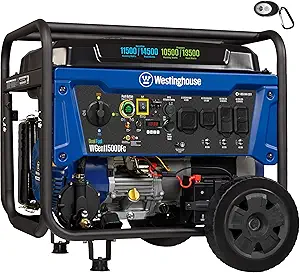
Westinghouse 14500 Peak Watt Dual Fuel Home Backup Portable Generator with Remote Electric Start
This is the generator you buy when a power outage means keeping an entire house running, not just a fridge. With 11,500 running watts on gasoline, it outmuscles the Westinghouse 6500W dual-fuel and the DuroStar DS13000MX in sustained output, and the dual-fuel flexibility lets you fall back to propane when gasoline goes stale or stations are down after a storm. The remote electric start and transfer-switch readiness mean you can wire it into your panel and activate it without stepping into the rain. The cost of all this capability is physical: this is a heavy, bulky machine that realistically lives on a pad or in a trailer, not in a trunk. Compared with the tri-fuel version below, you give up natural gas capability but the rest of the package is nearly identical.
Pros:- 11,500 running watts on gasoline handles whole-home loads
- Dual-fuel flexibility with gasoline and propane
- Up to 19 hours runtime on the 9.5-gallon tank
- Remote electric start and transfer-switch ready
Cons:- Heavy and bulky — transport without wheels or a trailer is impractical
- Large fuel tank demands significant storage space and fuel management
Best for: Homeowners who want transfer-switch-ready, whole-house backup power with gasoline and propane flexibility
Not ideal for: Campers, tailgaters, or anyone without help moving a large machine — this is not a carry-to-the-campsite generator
- Peak Wattage (Gasoline):14,500 W
- Running Watts (Gasoline):11,500 W
- Peak Wattage (Propane):13,500 W
- Running Watts (Propane):10,500 W
- Fuel Tank Capacity:9.5 gal
- Run Time (Gasoline):Up to 19 hours
- Engine:550cc 4-stroke OHV Westinghouse
- Key Features:Remote electric start, transfer switch ready, low THD
Our verdict“A serious home-backup machine for buyers who need transfer-switch-ready power and can accommodate its size.”
Westinghouse 14500 Peak Watt Tri-Fuel Home Backup Portable Generator, Remote Electric Start, Transfer Switch Ready
Think of this as the Westinghouse 14500W dual-fuel with one more ace up its sleeve: natural gas compatibility. If your home has a natural gas line, this generator can run indefinitely during an extended outage without refueling — something no gasoline-only or dual-fuel model in this roundup can claim. Peak output on gasoline matches the dual-fuel version at 14,500 watts, and the 3-year limited warranty covering service, labor, and parts signals confidence in the build, including a cast-iron sleeve engine with copper windings. The honest tradeoffs: it is every bit as heavy as its dual-fuel sibling, propane runtime drops to roughly 7 hours, and unlike true inverters such as the WEN 56360i, it relies on low THD rather than pure sine wave output — fine for most homes, but purists should take note.
Pros:- Runs on gasoline, propane, or natural gas for unmatched fuel flexibility
- Natural gas hookup enables unlimited runtime during extended outages
- 3-year limited warranty covering service, labor, and parts
- Cast-iron sleeve engine with copper windings built for longevity
Cons:- Heavy and bulky — transport and storage are challenging
- Propane runtime limited to about 7 hours
- Not a true inverter; power quality depends on low THD rather than pure sine wave
Best for: Homeowners with a natural gas line who want maximum fuel flexibility and indefinite runtime during extended outages
Not ideal for: Buyers who need to move the generator regularly or who want true pure sine wave inverter output for delicate electronics
- Peak Watts (Gasoline):14,500 W
- Running Watts (Gasoline):11,500 W
- Peak Watts (Propane):13,500 W
- Peak Watts (Natural Gas):12,000 W
- Fuel Tank Capacity:9.5 gal
- Run Time (Gasoline):Up to 19 hours
- Engine:550cc 4-stroke OHV Westinghouse
- Warranty:3-year limited service, labor, and parts
Our verdict“The most versatile home-backup generator in this lineup, best suited to buyers with natural gas service who never want to worry about fuel supply again.”
WEN 3600-Watt Portable Inverter Generator (56360i)
The WEN 56360i lands between the Oxseryn 2800W and the Oxseryn 4400W, and that middle position is its whole argument. With 2900 rated watts, it handles more than the 2800-class units — a small air compressor, a microwave, or a mini-split — while staying fully enclosed, quiet, and at just 46 pounds, lighter than the open-frame Oxseryn 4400 despite the closer output. The TT-30R RV receptacle plus two USB ports give it genuine weekend versatility, and the fuel shutoff feature drains the carburetor before shutdown, which prevents the gummed-up starting problems that sideline seasonal generators. Backed by a three-year warranty, it is a low-drama choice. The main limitation is headroom: buyers who plan to start a 13,500 BTU RV air conditioner will want the Oxseryn 4400W instead.
Pros:- Clean inverter power safe for sensitive electronics
- Light 46-pound weight with fully enclosed quiet design
- TT-30R RV outlet plus USB and DC ports in one panel
- Fuel shutoff prevents carburetor gumming during storage
Cons:- Limited starting headroom for large RV air conditioners
- 2900 rated watts sit awkwardly between light-duty and true mid-size needs
Best for: Weekend campers and occasional home-backup users who want a quiet, light inverter with honest mid-range power and a strong warranty
Not ideal for: RV owners with large air conditioners — 2900 rated watts lacks the starting headroom of the 4400W class
- Engine:149cc
- Surge Power:3600 watts
- Weight:46 pounds
- Outlets:2x 120V three-prong, 1x TT-30R RV, 1x 12V DC, 2x 5V USB
- Fuel Shutoff:Uses remaining carburetor fuel before shutdown
- Warranty:Three years
Our verdict“A well-rounded, warranty-backed inverter for buyers who want quiet clean power and portability without paying for watts they won’t use.”
AIVOLT 1600W Portable Quiet Inverter Generator
At just 28 lbs, this is the lightest way to carry real power into a campsite or tailgate, and that alone justifies its place here. The clean inverter output (under 3% THD) means laptops, phones, and camera batteries can charge directly through the onboard USB-A and USB-C ports without an adapter — a small convenience the comparably lightweight Genkins 1600W doesn’t match as cleanly. Compared with the heavier Oxseryn 2800-Watt, the AIVOLT trades raw output for portability and quiet operation at 57 dBA, which keeps it welcome at close-range campsites. The tradeoff is endurance: push it near its 1,260 running watts and the tank drains in roughly two hours, far short of the Westinghouse 6500W’s overnight capability. The parallel kit also costs extra, and California residents can’t buy it at all.
Pros:- Only 28 lbs — genuinely one-person carryable with one hand
- Under 3% THD makes it safe for phones, laptops, and other sensitive electronics
- Built-in USB-A and USB-C charging without needing an adapter
- CO shutoff, low-oil shutdown, and overload protection included at this size
Cons:- Runtime drops to roughly 2 hours at full load — fine for evenings, not for overnight
- Parallel kit for doubling output is sold separately
- Not compliant for sale or use in California
Best for: Campers, tailgaters, and van lifers who prioritize carry weight and quiet operation over long runtimes
Not ideal for: Anyone shopping for home backup during outages — the wattage and full-load runtime are too limited to run appliances
- Starting Wattage:1600 watts
- Running Wattage:1260 watts
- Engine:60cc 4-stroke OHV
- Fuel Type:Gas
- Weight:28 lbs
- Noise Level:57 dBA at 23 ft
- Runtime:Up to 8 hours at 25% load
- Outlets:2 x 120V, USB-A, USB-C
- Warranty:2 years
Our verdict“Buy this if you carry your generator to where power is needed; skip it if you need it to run all night.”
Westinghouse 6500W Dual-Fuel Portable Generator with Transfer Switch and RV Outlets, CO Sensor
This model earns its spot as the smart middle ground between small inverters and whole-house monsters. With 5,300 running watts on gasoline and 4,800 on propane, it covers a refrigerator, furnace blower, and lights simultaneously — something the AIVOLT 1600W simply can’t attempt. Where the bigger Westinghouse WGen9500DF overshoots for many households, this one keeps things manageable while still including the outlets that matter: a TT-30R RV plug, a transfer-switch-ready L14-30R, and a standard household outlet, so one unit serves both the driveway and the campground. The 14.5-hour runtime from the 4.7-gallon tank means fewer midnight refuels than most open-frame rivals. Real tradeoffs exist: it’s heavy and genuinely needs the included wheel kit to move, and there’s no electric start, so you’ll be pulling a recoil on a 274cc engine.
Pros:- Dual-fuel flexibility lets you run gasoline for max watts or propane for cleaner storage and easier starts
- RV, household, and transfer-switch outlets are all built in — no adapters to buy
- Up to 14.5 hours of runtime on a single tank minimizes overnight refueling
- Arrives with oil, funnel, propane hose, and tool kit for near-immediate setup
Cons:- Heavy, bulky frame that’s awkward to move without the wheel kit attached
- No electric start — recoil starting a 274cc engine takes some effort
- Conventional (non-inverter) output isn’t ideal for charging sensitive electronics directly
Best for: RV owners and suburban homeowners who want one dual-fuel unit for both travel and essential home circuits
Not ideal for: Anyone who needs to carry the generator by hand across rough terrain or load it solo into a truck bed
- Peak Watts (Gasoline):6,500 W
- Running Watts (Gasoline):5,300 W
- Peak Watts (Propane):5,800 W
- Running Watts (Propane):4,800 W
- Engine:274 cc 4-Stroke OHV
- Fuel Tank Capacity:4.7 gallons
- Run Time:Up to 14.5 hours
- Outlets:5-20R 120V, TT-30R 30A RV, L14-30R 30A Transfer Switch
- Warranty:3-Year Limited Service, Labor & Parts
Our verdict“One of the most practical do-it-all buys here if you want RV and home-backup coverage without paying for 9,500+ watts you may never use.”

How We Picked
I evaluated these 12 generators against the criteria that actually determine satisfaction: rated and peak wattage matched against realistic loads, fuel type flexibility (gasoline, propane, natural gas), noise and clean power output for sensitive electronics, starting method and ergonomics, and safety features like CO sensors. Portability mattered too — a 200-pound dual-fuel unit and a 26-pound inverter serve entirely different buyers, so I grouped models into weight and wattage classes before ranking within them.
The ranking logic favors versatility and long-term value. Models that run on multiple fuels or support transfer switches scored higher because they age better as a household’s needs grow. Inverter models earned credit for clean sine-wave power and quieter operation, offsetting their higher cost per watt. Budget open-frame generators like the DuroStar and PowerSmart placed well for raw value but were marked down where they lacked fuel flexibility or clean power. The result is a lineup ordered roughly by capability tier, with clear picks by use case rather than a single winner for everyone.
Factors to Consider When Choosing Portable Generators
Before settling on a specific model, it helps to understand the bigger decisions that shape any portable generator purchase. These are the factors that separate a satisfying buy from an expensive mistake.Match Wattage to Your Actual Loads
The most common mistake in this category is buying either far too much or far too little power. Add up the running watts of everything you genuinely need during an outage — refrigerator, furnace fan, a few lights, phone chargers — then add the starting surge of any motor-driven appliance, which can be two to three times its running draw. A refrigerator alone may spike over 1,200 watts at startup. A 2,000-watt inverter handles camping and essential appliances; a 13,000-to-14,500-watt unit can carry most of a house through a transfer switch. Buying double what you need wastes fuel every hour it runs, since generators are most efficient at 50 to 70 percent load, while buying too little means tripping breakers every time the fridge compressor kicks on.
Fuel Type and Runtime Tradeoffs
Gasoline packs the most energy per gallon but degrades in storage within months and is hard to source during widespread outages — the very time you need it most. Propane stores indefinitely, burns cleaner, and never gums up a carburetor, though it delivers roughly 10 percent less power than gasoline on dual-fuel machines. Tri-fuel models that accept natural gas free you from refueling entirely if your home has a gas line, which is why the top Westinghouse picks earn their premium. A practical strategy many owners adopt: run gasoline for short jobs, propane for standby power. Whichever fuel you choose, check the runtime at 50 percent load — a tank figure at 25 percent load is marketing, not a real-world number.
Inverter Versus Conventional Output
Conventional generators produce raw alternating current with enough harmonic distortion to damage or shorten the life of sensitive electronics — laptops, TVs, CPAP machines, and modern furnace controls. Inverter generators produce clean sine-wave power safe for anything with a circuit board, and they also throttle their engine to match load, cutting noise and fuel burn dramatically. The tradeoff is cost per watt: an inverter model typically costs substantially more for the same output as an open-frame conventional unit. If your plan is purely running power tools or well pumps, conventional output is fine and cheaper. If you’ll ever charge electronics or run an RV’s electrical system, the inverter premium pays for itself in peace of mind.
Noise Levels and Where You’ll Run It
Noise matters more than most buyers expect, both for camping etiquette and for neighborhood harmony during a multi-day outage. Closed-frame inverters in the 1,600-to-2,800-watt class typically run quiet enough for conversation nearby, while large open-frame dual-fuel units can be loud enough to require placement far from the house. Some campgrounds enforce decibel limits that effectively ban conventional generators. Placement also affects safety: every manufacturer specifies minimum clearance from walls and windows, and CO-sensing shutoff features — included on several Westinghouse models here — have become a baseline expectation rather than a luxury. Plan where the unit will sit before you buy, not after.
Starting System and Setup Complexity
Recoil starting is cheap and reliable, but yanking a starter rope on a cold high-compression engine at 6 a.m. during a storm gets old fast. Electric start with a remote fob, included on the larger Westinghouse units, is one of those features that seems like a luxury until the first real emergency. Also think through the connection path: a generator feeding appliances via extension cords works fine for basics, but powering a furnace or well pump requires a transfer switch and a 30-amp or 50-amp twist-lock outlet. Models labeled transfer-switch-ready save you an electrician’s compatibility headaches. Budget for that installation when comparing prices, because it can rival the cost of a mid-size generator itself.
Weight, Portability, and Storage
Every generator is portable until you have to move it. The lightest inverter here weighs 26 pounds — carryable by one person to a campsite — while the 14,500-watt units weigh over 200 pounds and need wheels, never-flat tires, and a folded-handle design just to reposition in a garage. Ask yourself honestly how often the unit will move. A heavy dual-fuel machine parked permanently near a transfer switch is fine; the same machine hauled to tailgates is misery. Also consider storage footprint and fuel storage requirements, since propane tanks and stabilized gasoline cans need ventilated, temperature-stable space separate from living areas. Portability you don’t use is just cost.
Frequently Asked Questions
Can a portable generator power my whole house?
For most homes, yes — but only the largest units in this lineup can realistically do it. A 14,500-peak-watt model like the Westinghouse tri-fuel can run central air conditioning, a well pump, and general household circuits simultaneously, but it requires a transfer switch installed by an electrician to connect safely to your panel. Mid-size units in the 4,400-to-6,500-watt range can power essential circuits — fridge, freezer, furnace fan, lights, and electronics — but not everything at once. The practical approach is to list your essential loads, measure their starting surge, and buy to that number rather than chasing whole-house coverage you may not need. Also remember that peak watts are a startup rating; the lower running wattage is what the generator sustains continuously.
Is dual-fuel really worth the extra cost over gasoline-only?
In most cases, yes, and the reason has more to do with storage and emergencies than performance. Gasoline goes stale within a few months, is awkward to stockpile safely, and sells out quickly during regional outages, while propane stores for years without degrading and many households already own tanks. Propane also burns cleaner, so the carburetor stays free of the gumming that ruins small engines that sit unused between storms. The tradeoff is roughly a 10 percent power reduction on propane and slightly harder cold starting. If your generator will sit idle most of the year as storm insurance, dual-fuel capability is one of the highest-value upgrades you can buy. If it’s a job-site workhorse running daily, gasoline’s extra output may matter more.
What size generator do I need for camping or an RV?
RV owners should start with the electrical service their rig supports. A 30-amp RV connection tops out around 3,600 watts, which makes a 3,600-to-4,400-watt inverter with a 30-amp RV outlet the sweet spot — enough for air conditioning without wasted capacity. For tent camping, tailgating, or van life, the sub-2,000-watt class handles charging, lights, a portable fridge, and a small fan, with the major benefit being weight and quiet operation. One caution: a single rooftop RV air conditioner can draw over 2,000 watts at startup, which rules out the smallest inverters for air-conditioned camping. Check whether the model has a parallel kit option if you might expand later, since linking two small inverters can be easier to move than one big unit.
Are open-frame inverter generators as quiet as closed-frame models?
No — open-frame inverters sit between conventional generators and fully enclosed units on the noise spectrum. Enclosed inverters like the Genkins or AIVOLT muffle sound with insulated housing, while open-frame designs like the Oxseryn 4400-watt models trade some quiet for better cooling, easier service access, and more watts per pound and per dollar. Expect an audible difference you’d notice across a campsite, though both are far quieter than a conventional open-frame generator of equivalent output. Open-frame inverters still produce clean power safe for electronics, so the decision is really about noise tolerance versus value. If you’ll run it in a campground near neighbors, spend for the enclosed design; if it lives at a work site or rural property, the open frame’s advantages win.
Do I need a CO sensor in a portable generator?
Carbon monoxide detection has become one of the most meaningful safety features in modern generators, and I’d treat it as close to mandatory for any unit used near a home. A CO sensor monitors buildup around the unit and automatically shuts the engine down before concentrations reach dangerous levels — a response to real fatalities caused by generators placed too close to windows, doors, or vents. Several Westinghouse models in this lineup include it, and the feature costs little relative to the machine. A sensor is not a substitute for proper placement, though: the rule remains at least 20 feet from any structure, with exhaust pointed away, and never in a garage or under a deck. If two similar models differ mainly on this feature, choose the one with the sensor.
Conclusion
Mapping this lineup to buyer types makes the decision straightforward. For best overall, the Westinghouse 14500 Peak Watt Tri-Fuel is the most capable and future-proof machine here — transfer-switch ready, remote start, natural-gas compatible, and able to back up nearly an entire home. The best value pick is the DuroStar DS13000MX, which delivers 13,000 dual-fuel watts at a lower tier of the market, provided you don’t need tri-fuel flexibility. For best premium, the Westinghouse 14500 Dual Fuel covers buyers who want maximum backup capability without a natural gas hookup, while the Westinghouse 6500W Dual-Fuel earns the value spot for mid-size needs with its included transfer switch and CO sensor.
Beginners and casual users are best served by the PowerSmart 2500-Watt inverter — simple, quiet, and forgiving of first-time mistakes. Campers and minimalists should choose the Genkins 1600W for its 26-pound carry weight, with the AIVOLT as a like-for-like alternative. RV owners get the best fit from the WEN 3600i or the Oxseryn 4400 with its 30-amp RV outlet, and budget-conscious buyers needing mid-range clean power can look to either Oxseryn open-frame model. Whatever your choice, buy to your measured loads and planned fuel source rather than peak numbers — that single discipline separates the owners who love their generator from the ones who regret it.
Halloween Picks
halloween
As an affiliate, we earn on qualifying purchases.