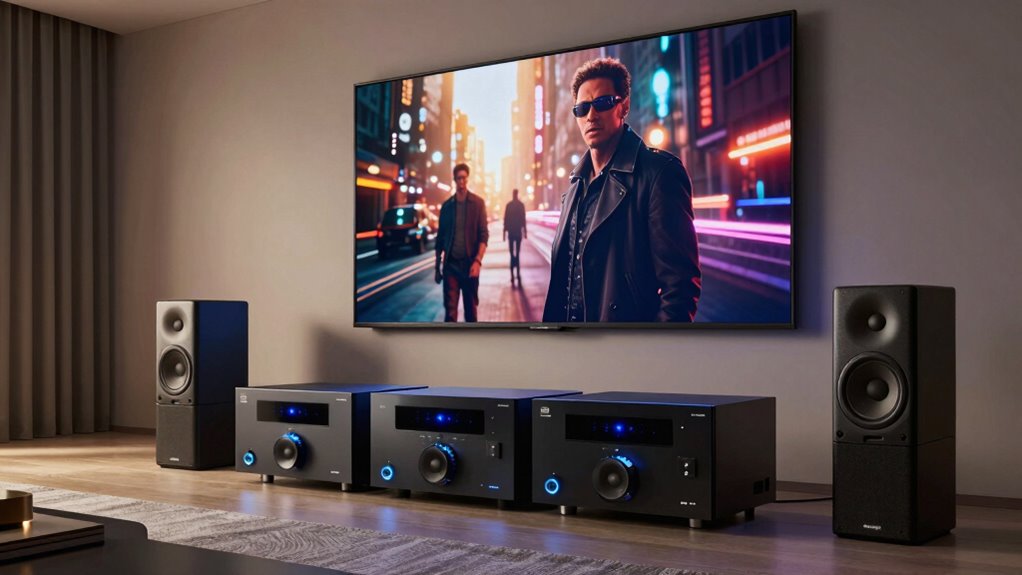

For a home theater receiver with Dirac Live, my best overall pick is the Onkyo TX-RZ50: it combines nine amplified channels, THX certification, and room correction that can help tame uneven bass and speaker-to-speaker differences. The TX-NR7100 is a strong alternative for buyers who want a similar nine-channel setup, while the TX-RZ70 suits larger systems that need more processing channels. The main tradeoffs are channel capacity, model generation, and renewed condition—not every receiver in this lineup is the same value or fit. Dirac Live’s capabilities can also depend on the receiver, software, and optional upgrades, so check what is included before choosing. Continue reading for the full comparison and guidance on matching a receiver to your room and system.

Get the latest gadgets delivered free with Prime
- Fast, free delivery on millions of items
- Prime Video, Amazon Music and more included
- Member-only deals all year
Complete the kit



Key Takeaways
- The TX-RZ50 is the best overall balance in this lineup, pairing nine amplified channels with THX certification and Dirac Live room correction.
- The TX-RZ70 is the clear step-up choice for buyers who need 11.2-channel processing; its added capacity matters more than its name when planning a larger layout.
- The TX-NR7100 and TX-RZ50 are the closest alternatives for nine-channel systems, so compare their feature set and connectivity against your exact installation rather than assuming one is a universal upgrade.
- Renewed versions are separate buying decisions: the RZ50, NR7100, and RZ30 renewed listings may suit buyers open to previously owned equipment, but condition, included accessories, and return terms need careful checking.
- The RZ30 is the more straightforward route within its family, while the RZ50 and NR7100 make more sense for buyers whose planned speaker layout benefits from their specific feature and channel combinations.
| Onkyo TX-RZ50 9.2-Channel THX Certified AV Receiver |  | Best Overall | Channels: 9.2 | Listed power output: 250 W | HDMI inputs: 8 | VIEW ON AMAZON | See Our Full Breakdown |
| Onkyo TX-RZ50 9.2-Channel THX-Certified AV Receiver (Renewed) |  | Best Renewed RZ50 Option | Model: Onkyo TX-RZ50 | Condition: Renewed | Channels: 9.2 | VIEW ON AMAZON | See Our Full Breakdown |
| Onkyo TX-NR7100 9.2-Channel THX Certified AV Receiver |  | Best for Gaming Setups | Channels: 9.2 | Room correction: Dirac Live | Video connection: HDMI 2.1; 8K/4K transfer up to 40 Gbps | VIEW ON AMAZON | See Our Full Breakdown |
| Onkyo TX-RZ30 9.2-Channel AV Receiver (Renewed) |  | Best for Dirac Full Bandwidth | Model: Onkyo TX-RZ30 | Condition: Renewed | Channels: 9.2 | VIEW ON AMAZON | See Our Full Breakdown |
| Onkyo TX-NR7100 9.2-Channel THX Certified AV Receiver (Renewed) |  | Best Renewed Gaming Pick | Model: Onkyo TX-NR7100 | Condition: Renewed | Channels: 9.2 | VIEW ON AMAZON | See Our Full Breakdown |
| Onkyo TX-RZ70 11.2-Channel AV Receiver |  | Best for Large, Expandable Theaters | Channels: 11.2 | Output power: 140 watts per channel | HDMI ports: 10 | VIEW ON AMAZON | See Our Full Breakdown |
| Onkyo TX-RZ30 9.2-Channel AV Receiver | | Best for Streamlined Dirac Live Systems | Channels: 9.2 | Output power: 100 watts | Frequency response: 5 Hz–100 kHz | VIEW ON AMAZON | See Our Full Breakdown |
| home theater receiver with dirac live | Channels | Room correction | HDMI ports | Audio formats |
|---|---|---|---|---|
| Onkyo TX-RZ50 9.2-Channel THX | 9.2 | Dirac Live | — | — |
| Onkyo TX-RZ50 9.2-Channel THX- | 9.2 | Dirac Live | 8 | Dolby Atmos, DTS:X |
| Onkyo TX-NR7100 9.2-Channel TH | 9.2 | Dirac Live | — | Dolby Atmos, DTS:X |
| Onkyo TX-RZ30 9.2-Channel AV R | 9.2 | Dirac Live Full Bandwidth | — | Dolby Atmos, stereo, surround |
| Onkyo TX-NR7100 9.2-Channel TH | 9.2 | Dirac Live | 8 | — |
| Onkyo TX-RZ70 11.2-Channel AV | 11.2 | — | 10 | — |
| Onkyo TX-RZ30 9.2-Channel AV R | 9.2 | Dirac Live Full Bandwidth | 8 | Dolby Atmos, Dolby Vision, IMAX Enhanced |
More Details on Our Top Picks
Onkyo TX-RZ50 9.2-Channel THX Certified AV Receiver
The TX-RZ50 is my strongest all-around pick when Dirac Live is the priority but you still need room for a substantial home theater system. Its 9.2-channel layout supports immersive formats, while eight HDMI inputs with up to 40 Gbps bandwidth give multiple 8K/4K sources a place in the setup. Compared with the TX-NR7100, it lists higher power output and pairs Dirac with THX certification, making it a more compelling fit for a large room or demanding speakers. The tradeoff is physical: at 36.1 pounds, it needs a sturdy, well-ventilated shelf, and its extensive settings may take time to configure. I would choose the TX-NR7100 instead if gaming features or a lighter stated weight matter more than the RZ50’s listed power.
Pros:- Dirac Live room correction can adapt speaker response to the listening room.
- Nine-channel layout supports immersive home theater configurations.
- Eight HDMI inputs with up to 40 Gbps bandwidth accommodate several modern video sources.
- THX certification and listed 250 W output suit buyers seeking a high-capacity, cinema-focused receiver.
Cons:- Its 36.1-pound weight and large dimensions can complicate installation.
- The broad feature set may take time for beginners to configure.
- The supplied description does not clarify the conditions behind the 250 W output figure.
Best for: Home theater owners building a 9.2-channel system in a larger room who want Dirac Live, many HDMI connections, and THX certification.
Not ideal for: Buyers with a shallow or lightly built equipment cabinet, or first-time receiver owners who want a simple setup.
- Channels:9.2
- Listed power output:250 W
- HDMI inputs:8
- Video support:8K/4K up to 40 Gbps
- Room correction:Dirac Live
- Certification:THX
- Wireless audio:Bluetooth
- Dimensions:15.68 x 17.13 x 7.94 inches
- Weight:36.1 lb
Our verdict“Choose the TX-RZ50 for a full-size, Dirac Live-centered theater where connection count and listed power matter more than easy installation.”
Onkyo TX-RZ50 9.2-Channel THX-Certified AV Receiver (Renewed)
This renewed TX-RZ50 gives buyers the same core draw as the new TX-RZ50: 9.2 channels, Dirac Live, and THX certification. Dolby Atmos and DTS:X support make it suited to an immersive speaker layout, and eight HDMI ports plus Wi-Fi and Bluetooth help consolidate sources and streaming. Compared with the TX-NR7100, it shares the listed channel count and HDMI input count, but the supplied details do not establish a clear performance advantage; the strongest distinction is access to the RZ50 model in renewed condition. That status comes with a 90-day limited warranty, so condition and warranty coverage deserve more attention than a feature checklist alone. I would favor the new TX-RZ50 for buyers who want the clearest purchase condition, or the TX-NR7100 for its explicitly listed 4K/120Hz gaming features.
Pros:- Dirac Live room correction is included.
- 9.2-channel processing supports immersive speaker layouts.
- Eight HDMI ports and Bluetooth and Wi-Fi provide flexible source and network connections.
- Dolby Atmos and DTS:X support a range of immersive movie soundtracks.
Cons:- Renewed condition and a 90-day limited warranty offer less purchase reassurance than a new unit.
- The supplied listing gives inconsistent output-power information.
- The listed dimensions differ from the new TX-RZ50 listing, making installation fit worth verifying.
Best for: Buyers specifically seeking the TX-RZ50’s Dirac Live and THX feature set who are comfortable purchasing a renewed receiver with a limited warranty.
Not ideal for: Shoppers who require a new unit, longer stated warranty coverage, or clearly documented output power.
- Model:Onkyo TX-RZ50
- Condition:Renewed
- Channels:9.2
- HDMI ports:8
- Room correction:Dirac Live
- Audio formats:Dolby Atmos, DTS:X
- Connectivity:Bluetooth, Wi-Fi, HDMI, RCA
- Warranty:90-day limited warranty
- Weight:30.9 lb
Our verdict“Pick this renewed RZ50 only if its Dirac-equipped feature set is your target and you accept the condition and short stated warranty.”
Onkyo TX-NR7100 9.2-Channel THX Certified AV Receiver
The TX-NR7100 makes the most sense for a mixed movie-and-gaming room where Dirac Live and HDMI 2.1 features both matter. Its listed support for 4K/120Hz, VRR, ALLM, and QFT targets current gaming systems, while three HDMI outputs can help connect multiple displays or a projector-and-TV arrangement. Like the TX-RZ50, it combines nine-channel processing, Dirac Live, and THX certification; the RZ50 stands apart with a stated 250 W output and eight HDMI inputs, while this model’s clearest advantage is its explicit gaming-feature list. One practical catch: a USB microphone for PC or Mac calibration is not included. Buyers also need to account for the added equipment required for some integrations, such as a Sonos Port. For gaming-first buyers, those compromises are easier to accept than missing the listed HDMI 2.1 features.
Pros:- Dirac Live room correction is built in.
- 4K/120Hz HDR pass-through, VRR, ALLM, and QFT support gaming-focused setups.
- Three HDMI outputs offer flexible display connection options.
- THX certification and Dolby Atmos and DTS:X support suit movie playback as well as gaming.
Cons:- A USB microphone for PC or Mac Dirac calibration is not included.
- Some Sonos use requires additional equipment, such as a Sonos Port.
- The supplied product details do not state power output.
Best for: Console and PC gamers building a 9.2-channel home theater who want Dirac Live room correction and 4K/120Hz pass-through.
Not ideal for: Buyers who need a calibration microphone included, want clearly stated high power output, or expect Sonos integration without extra hardware.
- Channels:9.2
- Room correction:Dirac Live
- Video connection:HDMI 2.1; 8K/4K transfer up to 40 Gbps
- HDMI outputs:3
- Gaming features:4K/120Hz HDR pass-through, VRR, ALLM, QFT
- Audio formats:Dolby Atmos, DTS:X
- Wireless audio:Bluetooth transmit and receive; Wi-Fi with DTS Play-Fi
- Certification:THX
Our verdict“Choose the TX-NR7100 when gaming features and Dirac Live outrank the RZ50’s stated power advantage.”
Onkyo TX-RZ30 9.2-Channel AV Receiver (Renewed)
The TX-RZ30 stands out here for its specifically listed Dirac Live Full Bandwidth, making it a natural choice for buyers who want room correction across the audible range rather than a general Dirac listing. It also brings 9.2 channels, Dolby Atmos, and 100 watts per channel, plus THX and IMAX Enhanced certifications. Compared with the TX-NR7100, the RZ30’s supplied details emphasize full-bandwidth correction and Klipsch Optimize mode rather than 4K/120Hz, VRR, and other gaming capabilities. This listing is renewed, and the available data does not give HDMI port counts or video bandwidth, so buyers planning a console-heavy setup should check those details before choosing it. Dirac Bass Control is an optional upgrade, and Sonos network use needs a Sonos Port.
Pros:- Dirac Live Full Bandwidth is specifically listed.
- Nine-channel processing supports immersive Dolby Atmos layouts.
- Listed 100 watts per channel provides a clear power specification.
- THX and IMAX Enhanced certifications plus Klipsch Optimize mode offer useful system-matching options.
Cons:- Renewed condition may not suit buyers seeking a new receiver.
- Dirac Bass Control is an optional upgrade.
- A Sonos Port is needed for connection to a Sonos wireless network.
Best for: Home theater owners who prioritize Dirac Live Full Bandwidth, use a compatible speaker setup, and are comfortable buying a renewed receiver.
Not ideal for: Gaming-focused buyers who need confirmed HDMI 2.1 capabilities, or shoppers who want Bass Control included and direct Sonos network access.
- Model:Onkyo TX-RZ30
- Condition:Renewed
- Channels:9.2
- Power per channel:100 watts
- Room correction:Dirac Live Full Bandwidth
- Audio formats:Dolby Atmos, stereo, surround
- Certifications:THX, IMAX Enhanced
- Connectivity:Bluetooth, HDMI
- Compatibility:Sonos; Klipsch Optimize mode
Our verdict“Choose the renewed TX-RZ30 for its stated Dirac Live Full Bandwidth and listed per-channel output, after confirming video connections meet your needs.”
Onkyo TX-NR7100 9.2-Channel THX Certified AV Receiver (Renewed)
This renewed TX-NR7100 is the lineup’s gaming-leaning option for buyers who want Dirac Live and HDMI 2.1 gaming support without choosing a new receiver. Its listed 4K/120Hz HDR pass-through, VRR, ALLM, and QFT cover key features for compatible consoles and displays; Chromecast built-in, AirPlay 2, DTS Play-Fi, and Works with Sonos add several paths for music and multiroom playback. Compared with the new TX-NR7100, the core feature set is similar in the supplied details, but this version is explicitly renewed and comes with a 90-day limited warranty. The TX-RZ50 has a stated power figure that this listing lacks, so buyers focused on output should compare verified specifications before deciding. A calibration microphone is not included, and the renewed condition may not fit buyers who prefer a new unit.
Pros:- Dirac Live room correction is listed for tuning sound to the room.
- 4K/120Hz HDR pass-through, VRR, ALLM, and QFT support compatible gaming systems.
- Eight HDMI ports provide multiple source connections.
- Chromecast built-in, AirPlay 2, DTS Play-Fi, and Works with Sonos offer broad streaming and multiroom options.
Cons:- Renewed condition and a 90-day limited warranty may not suit buyers seeking a new receiver.
- A USB microphone for Dirac calibration is not included.
- The supplied listing does not specify output power.
Best for: Budget-conscious home theater gamers who want a renewed 9.2-channel receiver with Dirac Live, HDMI 2.1 features, and varied streaming options.
Not ideal for: Buyers who require a new unit, longer stated warranty coverage, or an included Dirac calibration microphone.
- Model:Onkyo TX-NR7100
- Condition:Renewed
- Channels:9.2
- Certification:THX
- Room correction:Dirac Live
- HDMI ports:8
- Gaming features:4K/120Hz HDR pass-through, VRR, ALLM, QFT
- Streaming and wireless support:Works with Sonos, Chromecast built-in, AirPlay 2, DTS Play-Fi
- Renewed warranty:90-day limited warranty
Our verdict“Pick this renewed NR7100 if HDMI 2.1 gaming and Dirac Live are your priorities and you accept the limited warranty.”
Onkyo TX-RZ70 11.2-Channel AV Receiver
The TX-RZ70 is the lineup’s clearest choice for a larger, more elaborate theater: its 11.2-channel layout gives you more room to build out surround and height speakers than the 9.2-channel TX-RZ30. Dirac Live Full Bandwidth can tailor playback to your room, while THX certification and IMAX Enhanced modes add useful options for movie-focused systems. Ten HDMI ports also suit a setup with several sources and displays. The tradeoff is that the extra capacity may go unused in a typical living room, where the TX-RZ30 can cover an immersive system with fewer channels. Also, Dirac Live Bass Control requires a separate upgrade, and the Klipsch optimization is most relevant to owners of compatible Klipsch speakers. Choose this model for expansion headroom, not just its channel count.
Pros:- 11.2-channel configuration supports more elaborate surround and height-speaker layouts
- Dirac Live Full Bandwidth room calibration can adapt sound to the room and speaker placement
- Ten HDMI ports provide connections for multiple theater sources
- THX certification and IMAX Enhanced modes add movie-focused playback options
Cons:- Dirac Live Bass Control requires a separate upgrade
- Klipsch optimization is tailored to compatible Klipsch speakers
- Its extra channels may be unnecessary for buyers whose system tops out at 9.2
Best for: Home theater builders planning an 11-channel speaker layout, multiple HDMI sources, and room correction across a larger listening space.
Not ideal for: Buyers building a 9.2-channel system or using non-Klipsch speakers who are unlikely to use the extra channel capacity or speaker-specific optimization.
- Channels:11.2
- Output power:140 watts per channel
- HDMI ports:10
- Connectivity:HDMI, Bluetooth, Wi-Fi
- Room calibration:Dirac Live Full Bandwidth
- Audio certification:THX Certified
- Video format:4K
- Audio output mode:Surround
Our verdict“Choose the TX-RZ70 if you want Dirac Live in a theater built to grow beyond the TX-RZ30’s 9.2-channel layout.”
Onkyo TX-RZ30 9.2-Channel AV Receiver
The TX-RZ30 makes the most sense for buyers who want Dirac Live Full Bandwidth and immersive audio without moving up to the TX-RZ70’s 11.2-channel scale. Its 9.2-channel design supports a substantial Dolby Atmos setup, while eight HDMI ports and built-in streaming give a system several ways to connect and play content. Sonos compatibility is a useful fit for households already using that ecosystem. Compared with the TX-RZ70, this receiver gives up two channels and has lower listed output power, so it is less suited to a theater planned around a larger speaker array. Bass Control is an optional upgrade here too. The listed support date for software updates is unknown, which may matter to buyers who prioritize a clear update timeline.
Pros:- Dirac Live Full Bandwidth room correction is included
- Nine channels support an immersive Dolby Atmos speaker setup
- Built-in streaming and Sonos compatibility suit connected listening systems
- Eight HDMI ports accommodate multiple video sources
Cons:- Dirac Live Bass Control is an optional upgrade
- Its 9.2-channel capacity is more limited than the TX-RZ70’s 11.2-channel layout
- The listed software update support date is unknown
Best for: Buyers building a 9.2-channel Dolby Atmos theater who want Dirac Live, streaming, and Sonos compatibility without needing an 11-channel receiver.
Not ideal for: Home theater builders planning more than nine powered channels, or buyers who want Dirac Live Bass Control included rather than as an optional upgrade.
- Channels:9.2
- Output power:100 watts
- Frequency response:5 Hz–100 kHz
- HDMI ports:8
- Connectivity:Bluetooth
- Audio formats:Dolby Atmos, Dolby Vision, IMAX Enhanced
- Room correction:Dirac Live Full Bandwidth
- Sonos compatibility:Works with Sonos
- Color:Black
Our verdict“Pick the TX-RZ30 for a connected 9.2-channel theater with Dirac Live, and choose the TX-RZ70 if you need more channels or higher listed output power.”

How We Picked
I ranked these receivers around what matters when Dirac Live is the reason for shopping: room-correction support, channel capacity, system fit, and setup practicality. I gave more weight to a model that can serve a wide range of theater layouts without pushing buyers into unnecessary complexity. I also considered THX certification and the distinction between standard and renewed listings, since those affect the buying decision even when the core model name is similar.
The TX-RZ50 leads as the most balanced pick; the TX-NR7100 is a close nine-channel alternative, and the TX-RZ70 earns the premium position for larger systems that can use its extra processing capacity. The TX-RZ30 models follow as simpler family options, while renewed versions rank below their corresponding new listings because buyers must account for condition and seller-specific terms. I treat repeated model families as distinct listings, not as proof of different acoustic performance, and recommend verifying each listing’s exact included Dirac features and accessories.
| home theater receiver with dirac live | Room correction | Audio formats | Connectivity |
|---|---|---|---|
| Onkyo TX-RZ50 9.2-Channel THX | Dirac Live | — | — |
| Onkyo TX-RZ50 9.2-Channel THX- | Dirac Live | Dolby Atmos, DTS:X | Bluetooth, Wi-Fi, HDMI, RCA |
| Onkyo TX-NR7100 9.2-Channel TH | Dirac Live | Dolby Atmos, DTS:X | — |
| Onkyo TX-RZ30 9.2-Channel AV R | Dirac Live Full Bandwidth | Dolby Atmos, stereo, surround | Bluetooth, HDMI |
| Onkyo TX-NR7100 9.2-Channel TH | Dirac Live | — | — |
| Onkyo TX-RZ70 11.2-Channel AV | — | — | HDMI, Bluetooth, Wi-Fi |
| Onkyo TX-RZ30 9.2-Channel AV R | Dirac Live Full Bandwidth | Dolby Atmos, Dolby Vision, IMAX Enhanced | Bluetooth |
Factors to Consider When Choosing Home Theater Receiver With Dirac Live
Dirac Live is only one part of a receiver decision. I would start with the system you plan to build, then confirm how the receiver’s channel count, room-correction package, and listing condition fit that plan.
Match Channel Count to Your Actual Speaker Plan
Count both the speakers you own and the ones you realistically expect to add; a receiver’s headline channel figure does not automatically mean every channel is amplified. Larger layouts may need separate amplification or a receiver with more processing capacity, while a nine-channel system can be a better match for a typical immersive setup. A common mistake is paying for channels that will sit unused while overlooking subwoofer or external-amplifier needs. Draw the layout before selecting a model and check the manual’s supported configurations. The RZ70 makes the most sense when its extra capacity serves a real plan, rather than as a precautionary upgrade.
Check Which Dirac Live Features Are Included
“Dirac Live” can describe a capability without telling you which software package or upgrade is included with a particular listing. Confirm the supported correction functions, measurement process, license status, and whether any advanced bass-control features require a separate purchase. This matters because room correction aimed at speaker response is not automatically the same as more specialized subwoofer integration. Avoid comparing model names alone: listings may differ by bundle, region, or seller. If bass integration is your main reason for buying, verify the exact feature set in the manufacturer documentation before ordering.
Plan for Measurement and Setup Time
Dirac Live can improve a system only when its measurements reflect the listening area and the target curve suits your preferences. You will need to place a measurement microphone carefully, take readings around the seats, and review the resulting correction rather than treating calibration as a one-button fix. Measuring only one seat can favor that spot at the expense of the rest of the room. Think about whether you are comfortable using the setup software and making adjustments after the initial run. Buyers seeking a fully automatic, minimal-effort setup may value simpler calibration workflows more than advanced control.
Treat Renewed Listings as a Separate Risk Decision
A renewed receiver can make sense when the listing clearly explains its condition, included parts, warranty, and return process. Do not assume a renewed version has the same accessories or support terms as a new unit, even when the model name matches. Check for the remote, calibration microphone, power cable, and any documentation needed for setup. Ask whether Dirac licensing or access is tied to the receiver and how it transfers. If missing equipment or unclear coverage would disrupt your installation, a new listing may be the less complicated choice.
Compare Connections Against Your Sources and Display
Before choosing between receivers, list the sources you connect now and the ones you may add, then check the specifications for video formats, input count, and output needs. A receiver can support Dirac Live yet still be a poor fit if it lacks the connections or pass-through features your display and devices require. Pay particular attention to gaming consoles, disc players, and any setup with multiple displays. Confirm the exact HDMI capabilities in the model documentation rather than relying on a family name. This check can prevent a costly mismatch that room correction cannot solve.
Pay for Headroom Only When Your Room Needs It
More processing channels and a higher position in a product family do not automatically produce better sound in a modest room. Extra capacity is useful when you have additional speakers, more complex routing, or a planned system expansion; otherwise, it may add setup and equipment costs without changing how you listen. Also check whether the receiver’s power and ventilation requirements suit your cabinet and speaker load. Leave space for airflow and consider whether external amplification may be needed for your chosen layout. The best fit is the model that supports your system cleanly, not the one with the largest specification sheet.
Frequently Asked Questions
Is the TX-RZ70 worth choosing over the TX-RZ50 if I have a nine-channel setup?
For a system that will remain at nine channels, the TX-RZ50 is the more direct fit in this group. The RZ70’s extra processing capacity becomes useful when you plan a larger layout or need the additional routing its specifications support. More capacity by itself does not guarantee a meaningful improvement in room correction or sound for your current speakers. Compare the connection needs and supported configurations for your installation before paying for headroom. If you cannot name a use for the additional channels, the RZ50 is the simpler match.
Should I buy a renewed RZ50 or a new TX-NR7100?
Choose based on the specific listing and the features your system needs, not just the shared nine-channel class. A renewed RZ50 may appeal if its condition, included accessories, return terms, and Dirac access are clearly documented. The TX-NR7100 listing may be preferable if you want a new unit and a more straightforward condition decision. Check both models’ exact connections and Dirac package details against the manufacturer information. If the renewed listing leaves key terms unclear, the new option reduces uncertainty.
Does Dirac Live automatically fix bass problems across every seat?
No room-correction system can make every seat identical, and results depend on microphone placement, room acoustics, and the correction features available on the receiver. Measurements across several seats can help balance a listening area, but a correction aimed at one position may favor that seat. Low-frequency issues can also involve room modes and subwoofer placement, which software alone may not fully solve. Confirm whether the receiver supports the bass-control functions you want and whether they require an add-on. Treat calibration as one part of room setup, alongside speaker and subwoofer placement.
Can I use Dirac Live with my existing speakers and subwoofer?
In many setups, the receiver can calibrate compatible existing speakers and a connected subwoofer, but the exact capability depends on the model and Dirac package. Check supported speaker configurations, subwoofer outputs, and the calibration microphone or accessories included with your listing. Room correction cannot compensate for a damaged speaker, incorrect wiring, or a subwoofer placed in a particularly poor location. After calibration, you may still need to adjust levels or crossover settings to suit your room. Verify the receiver’s documentation before assuming your full system is supported.
What should I check before ordering a renewed Onkyo receiver?
Read the listing for its stated condition, warranty coverage, return window, and exactly which accessories come in the box. A missing microphone or remote can make setup harder, even if the receiver itself works. Confirm the model number and the Dirac Live features tied to that unit, especially if the listing mentions licenses or software access. Compare seller terms with the documentation for the corresponding new model rather than assuming they match. If you cannot verify the basics, choose a listing with clearer coverage and included equipment.
Conclusion
I would choose the Onkyo TX-RZ50 as the best overall for a balanced nine-channel theater centered on Dirac Live. The TX-NR7100 is my best value-style alternative for buyers comparing nine-channel options, while the TX-RZ70 is the best premium fit when a larger system can use its 11.2-channel processing. For a more straightforward option within the lineup, consider the TX-RZ30; beginners should favor the listing with the clearest setup information, included microphone and accessories, and support terms. Choose a renewed RZ50, NR7100, or RZ30 only when its condition and return coverage are explicit. In short, match the receiver to your speaker layout first, then confirm the exact Dirac package and listing details.