Automatic cat feeders can keep meals on a schedule, but the right choice depends on whether you need simple portioning, remote monitoring, or separate access for multiple cats. I’d put the PETLIBRO 5L Wi-Fi Automatic Pet Feeder first overall for its mix of app control and freshness features, while the SureFeed Microchip Pet Feeder stands out for keeping food reserved for one pet. For households that want a view of mealtime, the Frienhund 2K Camera Feeder pairs a camera with a larger 7L hopper. The main tradeoffs are added setup and maintenance for connected features, versus fewer monitoring tools on simpler feeders. Read on for the full breakdown and help matching a feeder to your cat, routine, and household.

Get the latest gadgets delivered free with Prime
- Fast, free delivery on millions of items
- Prime Video, Amazon Music and more included
- Member-only deals all year
Complete the kit



Key Takeaways
- Scheduled feeding and pet-specific access solve different problems: the Voluas and IMIPAW focus on timed portions, while the SureFeed uses microchip access to limit who can eat from its bowl.
- Camera features split into distinct tiers: the Frienhund pairs 2K video with 7L storage, while PETLIBRO’s 1080p camera models offer a smaller-footprint monitoring option.
- Two-cat feeders need more than a shared schedule: the oneisall two-cat models and Oneisall timed dispenser address simultaneous feeding, but buyers should check how the serving layout fits their cats.
- Wi-Fi brings remote control, not a substitute for backup planning: app-connected models add schedule visibility, while dual-power designs such as IMIPAW help address power interruptions.
- Water-and-food combinations trade simplicity for flexibility: the oneisall 8.5L feeder-and-water dispenser consolidates supplies, but a dedicated feeder gives more freedom to place and maintain each station separately.
| SureFeed Microchip Pet Feeder |  | Best for Preventing Food Theft | Food capacity: 13.5 fl oz | Food compatibility: Wet and dry food | Microchip compatibility: 9-digit Avid Secure, 10-digit FDXA, and 15-digit FDXB | VIEW ON AMAZON | See Our Full Breakdown |
| Voluas 4L Automatic Pet Feeder with Programmable Portions and Voice Recorder |  | Best for Straightforward Scheduled Feeding | Capacity: 4 liters | Meal schedule: 1–4 meals per day | Portion size: Approximately 6–7 g per portion | VIEW ON AMAZON | See Our Full Breakdown |
| PETLIBRO 5L Wi-Fi Automatic Pet Feeder with Freshness Preservation, Black |  | Best for App-Based Scheduling and Alerts | Capacity: 5 liters | Connectivity: 2.4 GHz and 5 GHz Wi-Fi, Bluetooth | Meals per day: Up to 10 | VIEW ON AMAZON | See Our Full Breakdown |
| Oneisall Automatic Cat Feeder for 2 Cats – Timed Cat Food Dispenser |  | Best for Two Cats Eating Side by Side | Capacity: 5 L / 20 cups | Meals per day: Up to 6 | Portion size: Approximately 10 g (1/12 cup) per meal | VIEW ON AMAZON | See Our Full Breakdown |
| Yuposl Automatic Cat Feeder, 3L, with Stainless Steel Bowl |  | Best for Flexible Placement Without Wi-Fi | Capacity: 3L (12 cups) | Meal schedule: 1–6 meals per day | Food type: Dry food | VIEW ON AMAZON | See Our Full Breakdown |
| PETLIBRO Automatic Pet Feeder with 1080p Camera and Night Vision |  | Best for Remote Monitoring | Food capacity: 5 L | Connectivity: 2.4 GHz and 5 GHz Wi-Fi | Meal schedule: Up to 10 meals per day | VIEW ON AMAZON | See Our Full Breakdown |
| oneisall Automatic Cat Feeder for Two Cats, 5L, Wi-Fi App Control |  | Best for Two Cats | Food capacity: 5 liters (20 cups) | Connectivity: 2.4 GHz and 5 GHz Wi-Fi | App compatibility: iOS and Android | VIEW ON AMAZON | See Our Full Breakdown |
| oneisall Automatic Cat Feeder and Water Dispenser, 8.5 L |  | Best Feeder-and-Water Combo | Food capacity: 5 L | Water capacity: 3.5 L | Feeding schedule: 1–6 meals per day | VIEW ON AMAZON | See Our Full Breakdown |
| IMIPAW Automatic Cat Feeder with Programmable Meals, Desiccant Bag, and Dual Power |  | Best for Simple Scheduled Feeding | Food capacity: 3 liters (12 cups) | Portion size: 7–9 g per serving | Feeding schedule: Up to 6 meals and 20 portions per day | VIEW ON AMAZON | See Our Full Breakdown |
| ANDOLL HOME 4L Automatic Cat Feeder with Voice Recorder |  | Best for Voice Meal Cues | Food capacity: 4 liters | Scheduled meals: Up to 8 daily | Voice recording: 10 seconds; plays 3 times at feeding time | VIEW ON AMAZON | See Our Full Breakdown |
| PETLIBRO Automatic Cat Feeder with Portion Control, Voice Meal Call, and Battery Backup | 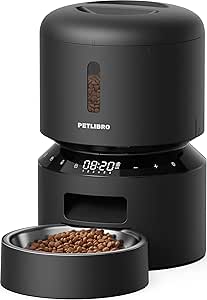 | Best for Straightforward Scheduled Feeding | Capacity: 3 liters | Meal schedule: Up to 6 meals per day | Portion setting: 1–50 portions per meal; 2.5 teaspoons per portion | VIEW ON AMAZON | See Our Full Breakdown |
| Frienhund Automatic Pet Feeder with 2K Camera, 7L Storage, and Dual-Band Wi-Fi |  | Best for Camera Monitoring and Large Capacity | Food capacity: 7 liters (29 cups) | Feeding schedule: Up to 15 meals per day, up to 20 portions per meal | Camera: 3-megapixel camera with infrared night vision | VIEW ON AMAZON | See Our Full Breakdown |
| PETLIBRO Automatic Cat Feeder with 1080p Camera |  | Best for Balanced Smart Feeding | Capacity: 5 liters | Camera: 1080p HD with night vision | Connectivity: 2.4 GHz and 5 GHz Wi-Fi | VIEW ON AMAZON | See Our Full Breakdown |
| oneisall Automatic Cat Feeder for Two Cats |  | Best for Feeding Two Cats Separately | Capacity: 5 L (20 cups; listed as 11 pounds) | Feeding schedule: Up to 6 meals per day | Portion size: Approximately 10 g (1/12 cup) per portion | VIEW ON AMAZON | See Our Full Breakdown |
| PETLIBRO RFID Automatic Cat Feeder with Wi-Fi and Diet Tracking |  | Best for Individual Food Access in Multi-Cat Homes | Capacity: 3 liters | Access control: Included RFID collar tag; not microchip activated | Connectivity: Dual-band Wi-Fi (2.4 GHz and 5 GHz) and Bluetooth | VIEW ON AMAZON | See Our Full Breakdown |
| automatic cat feeder | Warranty | Dimensions | Capacity | Power |
|---|---|---|---|---|
| SureFeed Microchip Pet Feeder | Three years | — | — | — |
| Voluas 4L Automatic Pet Feeder | 1 year | 7.4 × 7.4 × 11.25 inches | 4 liters | 5V USB adapter or 3 D-cell batteries (not included) |
| PETLIBRO 5L Wi-Fi Automatic Pe | 24 months | — | 5 liters | — |
| Oneisall Automatic Cat Feeder | 2 years | 16.72 × 7.1 × 13.4 inches | 5 L / 20 cups | — |
| Yuposl Automatic Cat Feeder | — | — | 3L (12 cups) | 3 D-size alkaline batteries (not included) or wall power |
| PETLIBRO Automatic Pet Feeder | 24 months | — | — | — |
| oneisall Automatic Cat Feeder | 2 years | 16.73 × 7.09 × 13.4 inches | — | — |
| oneisall Automatic Cat Feeder | 2 years | 22.6 × 6.46 × 13 inches | — | — |
| IMIPAW Automatic Cat Feeder wi | — | 7 × 12 × 7 inches | — | 5V DC adapter or 3 D-cell batteries (not included) |
| ANDOLL HOME 4L Automatic Cat F | 1 year | 12 × 7 × 13 inches | — | 5V DC adapter or 3 AA batteries (not included) |
| PETLIBRO Automatic Cat Feeder | 24 months | 7.9 × 7.7 × 7.6 inches | 3 liters | USB-C with backup from 3 D-cell batteries |
| Frienhund Automatic Pet Feeder | One year | — | — | 5V DC adapter with backup from 3 D-cell batteries |
| PETLIBRO Automatic Cat Feeder | 24 months | 13.78 × 12.99 × 7.48 inches | 5 liters | — |
| oneisall Automatic Cat Feeder | 2 years | 16.73 × 7.09 × 13.4 inches | 5 L (20 cups; listed as 11 pounds) | DC power with backup from 4 AA batteries (not included) |
| PETLIBRO RFID Automatic Cat Fe | — | 10.43 × 9.45 × 17.13 inches | 3 liters | Corded electric with battery backup |
More Details on Our Top Picks
SureFeed Microchip Pet Feeder
I’d choose the SureFeed Microchip Pet Feeder when the problem is not meal timing but keeping one pet away from another’s food. Its lid opens for a registered microchip or the included RFID collar tag, giving it a different job from the Voluas 4L Automatic Pet Feeder, which schedules portions but does not identify who is eating. The seal also helps wet food stay fresher, making this one of the few picks here that accommodates both wet and dry meals. A staged training mode can help a cautious cat get used to the lid. The tradeoff is capacity: at 13.5 fl oz, it is a selective-access feeder, not a bulk hopper. Multi-pet households may need one unit per cat, and extra collar tags may require a separate purchase.
Pros:- Opens for a registered microchip or the included RFID collar tag, helping limit food stealing.
- Sealed lid helps keep wet or dry food fresher between meals.
- Supports up to 32 stored pet IDs.
- Includes a staged training mode for pets that need time to get comfortable.
Cons:- The 13.5 fl oz capacity is small compared with the 4L Voluas and 5L PETLIBRO feeders.
- A separate feeder may be needed for each pet that requires individual access.
- Additional RFID collar tags may need to be purchased separately.
Best for: Households where one cat steals another cat’s food, or where a pet needs controlled access to wet or dry meals.
Not ideal for: Owners seeking a large-capacity feeder that automatically dispenses several scheduled meals for multiple pets from one unit.
- Food capacity:13.5 fl oz
- Food compatibility:Wet and dry food
- Microchip compatibility:9-digit Avid Secure, 10-digit FDXA, and 15-digit FDXB
- Stored pet IDs:Up to 32
- RFID collar tags included:1
- Included accessories:Single bowl, split bowl, mat, RFID collar tag, and user manual
- Model:MPF001
- Warranty:Three years
Our verdict“Choose this feeder for pet-specific food access and freshness, but pick a scheduled hopper if you need larger portions stored in advance.”
Voluas 4L Automatic Pet Feeder with Programmable Portions and Voice Recorder
The Voluas 4L Automatic Pet Feeder is a practical choice for owners who want a regular dry-food schedule without app setup. Its LCD controls cover one to four meals per day, while USB power or three D-cell batteries offer placement flexibility and a backup option. That makes it simpler than the PETLIBRO 5L Wi-Fi Automatic Pet Feeder, which adds app scheduling, feeding records, and alerts but depends on connected controls. Voluas also includes a short voice recording to cue a pet at mealtime. The tradeoff is a less detailed schedule: it tops out at four meals, and each portion is approximately 6–7 g, so owners should check whether that increment suits their cat’s feeding plan. It handles dry food only, and the batteries are not included.
Pros:- Schedules one to four meals per day with adjustable portions.
- Can run from the included USB adapter or three D-cell batteries.
- Voice recorder offers a familiar mealtime cue.
- Removable parts make routine cleaning easier.
Cons:- Designed for dry food only.
- Three D-cell backup batteries are not included.
- Offers fewer daily meals and fewer connected features than the PETLIBRO 5L Wi-Fi feeder.
Best for: Cat owners who want basic scheduled dry-food portions, easy-to-read onboard controls, and optional battery operation without using a phone app.
Not ideal for: Owners who need wet-food feeding, frequent small meals beyond four per day, or app-based scheduling and status alerts.
- Capacity:4 liters
- Meal schedule:1–4 meals per day
- Portion size:Approximately 6–7 g per portion
- Power:5V USB adapter or 3 D-cell batteries (not included)
- Voice recording:Up to 10 seconds
- Dimensions:7.4 × 7.4 × 11.25 inches
- Weight:3.7 pounds
- Warranty:1 year
Our verdict“Pick Voluas for uncomplicated scheduled dry-food feeding, and choose the PETLIBRO instead if app records and alerts matter more.”
PETLIBRO 5L Wi-Fi Automatic Pet Feeder with Freshness Preservation, Black
For buyers who want to manage meals remotely, the PETLIBRO 5L Wi-Fi Automatic Pet Feeder brings scheduling, feeding records, and status alerts into one app-connected setup. It supports up to 10 meals a day and adjustable portions, giving it more scheduling range than the four-meal Voluas. Low-food and jam alerts can help flag a problem before a pet misses a meal, while the sealing design and desiccant support kibble freshness. A stainless steel bowl adds a useful food-contact surface, though the base itself should not be washed. This model is a stronger fit for connected routines than the Yuposl 3L feeder, which works without Wi-Fi and offers simpler onboard controls. The PETLIBRO’s tradeoffs are its corded power, dry-kibble-only compatibility, and recurring desiccant replacement.
Pros:- App scheduling supports up to 10 meals per day and feeding records.
- Alerts can report low food, jams, and other status issues.
- Sealing design and desiccant help preserve dry kibble freshness.
- Stainless steel bowl and short voice recordings add practical mealtime features.
Cons:- Works with dry kibble only, within the stated 2–15 mm size range.
- The feeder base should not be washed.
- Desiccant bag requires replacement every two weeks, and the unit uses corded power.
Best for: Owners who want app-managed dry-food schedules, feeding records, and alerts for low food or dispensing issues.
Not ideal for: Buyers who need wet-food support, battery-powered placement, or a feeder whose main unit can be washed.
- Capacity:5 liters
- Connectivity:2.4 GHz and 5 GHz Wi-Fi, Bluetooth
- Meals per day:Up to 10
- Portions per meal:1–48 portions
- Portion size:1/12 cup
- Food compatibility:Dry kibble, 2–15 mm in diameter
- Power source:Corded electric
- Warranty:24 months
Our verdict“Choose this PETLIBRO for app control and feeding alerts; choose the non-Wi-Fi Yuposl if you prefer simpler controls and battery power.”
Oneisall Automatic Cat Feeder for 2 Cats – Timed Cat Food Dispenser
The Oneisall Automatic Cat Feeder for 2 Cats is the clearest fit here for two cats that can share a dispenser but need separate places to eat. Its dual stainless-steel bowls sit 16 inches apart, reducing crowding compared with a single-bowl feeder such as the Voluas. The 5L hopper and schedule of up to six meals per day suit owners who want fewer refills and straightforward dial programming, without relying on Wi-Fi. A 10-second recording can provide a familiar cue, and the bowls are dishwasher-safe. The compromise is limited control: unlike the app-connected PETLIBRO, this model does not offer phone scheduling or alerts. It also dispenses dry kibble only, and its 16.72-inch length needs more floor space than a compact single-bowl unit. Backup AA batteries are not included.
Pros:- Two stainless-steel bowls are spaced 16 inches apart for side-by-side feeding.
- 5L capacity reduces how often owners need to refill the hopper.
- Simple dial controls schedule up to six meals per day.
- Dishwasher-safe bowls and a voice recorder support easier daily routines.
Cons:- No Wi-Fi or smartphone app control, unlike the PETLIBRO 5L Wi-Fi feeder.
- Compatible only with dry kibble smaller than 0.5 inch.
- Long dual-bowl layout takes more floor space, and backup AA batteries are not included.
Best for: Homes with two cats that eat dry kibble at the same scheduled times and need separate, spaced feeding bowls.
Not ideal for: Owners who need individualized meal access, app control, wet-food compatibility, or a compact footprint.
- Capacity:5 L / 20 cups
- Meals per day:Up to 6
- Portion size:Approximately 10 g (1/12 cup) per meal
- Bowl layout:Two stainless-steel bowls, spaced 16 inches apart
- Voice recorder:10-second recording
- Power source:USB DC power; backup with 4 AA batteries (not included)
- Dimensions:16.72 × 7.1 × 13.4 inches
- Warranty:2 years
Our verdict“Choose Oneisall when two cats can eat the same scheduled dry meals from separated bowls, but look elsewhere for app control or individual access.”
Yuposl Automatic Cat Feeder, 3L, with Stainless Steel Bowl
The Yuposl Automatic Cat Feeder suits owners who want scheduled dry-food portions without connecting a feeder to an app. Its onboard LCD and buttons set one to six meals per day, and the 3L hopper offers a middle ground between the smaller SureFeed portion-access unit and the larger PETLIBRO 5L hopper. Battery or wall power gives it more placement flexibility than the corded-only PETLIBRO, though the three D-size batteries are not included. A stainless steel bowl and removable, washable components make cleanup more manageable; the main unit itself is not washable. Its sealed lid and desiccant help protect kibble, but this is still a dry-food dispenser, not a solution for wet meals or food stealing between pets. Buyers also need to match kibble to the supported 2–15 mm size range.
Pros:- Schedules one to six meals per day without Wi-Fi or a smartphone.
- 3L capacity and wall or battery power allow flexible placement.
- Stainless steel bowl and removable washable components simplify cleanup.
- Sealed design and desiccant help keep dry food fresh.
Cons:- Three D-size alkaline batteries are not included.
- Supports dry food only, with kibble sized 2–15 mm.
- Its 3L capacity is smaller than the 5L Oneisall and PETLIBRO feeders.
Best for: Owners seeking a mid-capacity dry-food feeder with onboard scheduling, washable removable parts, and the option to place it away from an outlet.
Not ideal for: Households needing app alerts, wet-food support, or a large hopper for extended periods between refills.
- Capacity:3L (12 cups)
- Meal schedule:1–6 meals per day
- Food type:Dry food
- Compatible food size:2–15 mm
- Power:3 D-size alkaline batteries (not included) or wall power
- Bowl:Stainless steel
- Cleaning:All components except the main unit are removable and washable
- Model:YPF03-PW00
Our verdict“Pick Yuposl for flexible, app-free scheduled feeding with easier-cleaning parts, but choose a 5L model if fewer refills are the priority.”
PETLIBRO Automatic Pet Feeder with 1080p Camera and Night Vision
I’d choose this PETLIBRO when seeing and speaking to my cat matters as much as keeping meals on schedule. Its 1080p camera, infrared night vision, and two-way audio add a level of remote check-in that the IMIPAW programmable feeder does not offer, while the app supports up to 10 meals daily and on-demand feeding. Motion and sound alerts plus feeding history can help me notice activity around meals, not just whether food was dispensed. The tradeoff is that video storage takes extra setup: a microSD card is not included, and cloud storage requires a paid subscription. It also holds dry food only, so I’d skip it if I need wet-food dispensing or prefer a simpler, screen-free feeder.
Pros:- Schedules up to 10 meals per day with adjustable portions and remote feeding
- 1080p camera, wide viewing angle, and infrared night vision support check-ins in varied lighting
- Two-way audio and a recordable voice message add ways to interact around mealtimes
- Motion, sound, blockage, and low-food alerts provide more information than a basic timer feeder
Cons:- MicroSD card for local video storage is sold separately
- Cloud video storage requires a paid subscription
- Camera and app features add complexity compared with simpler feeders such as the IMIPAW
Best for: Cat owners who are away during the day and want scheduled feeding plus live video, alerts, and two-way interaction.
Not ideal for: Buyers who want video recording without purchasing a memory card or subscription, or who need a feeder for wet food.
- Food capacity:5 L
- Connectivity:2.4 GHz and 5 GHz Wi-Fi
- Meal schedule:Up to 10 meals per day
- Portions:1–50 portions per meal
- Camera:1080p HD, 145° wide-angle lens, infrared night vision
- Audio:Two-way audio; recordable voice message up to 10 seconds
- Video storage:MicroSD card up to 256 GB (not included) or paid cloud subscription
- Food type:Dry food
- Warranty:24 months
Our verdict“Choose this PETLIBRO if remote video and interaction are priorities; choose the IMIPAW if you only need straightforward scheduled dry-food portions.”
oneisall Automatic Cat Feeder for Two Cats, 5L, Wi-Fi App Control
This oneisall is the most directly suited to households feeding two cats from one scheduled setup: it sends equal portions to two stainless steel bowls and provides app-based scheduling, manual feeding, and logs. That shared dispensing arrangement makes it a more purposeful two-cat pick than the single-bowl IMIPAW, while the PETLIBRO camera feeder offers richer monitoring rather than a two-bowl design. A recorded voice message can signal mealtime, and the 5-liter hopper reduces how often I need to refill it. Its limits are practical: kibble must be smaller than 0.5 inch, and the main unit is not water-washable. Equal portions also suit cats with similar needs better than pets requiring separate diets or different serving sizes.
Pros:- Dispenses equal portions to two included stainless steel bowls
- App supports scheduled and manual feeding plus feeding-log access
- 5-liter capacity cuts down on frequent refills
- Includes a 10-second voice message feature and anti-chew cord
Cons:- Main unit is not water-washable
- Kibble must be smaller than 0.5 inch
- Equal dispensing cannot tailor portions separately for each cat
Best for: Households with two cats who eat the same dry food in equal portions and want app scheduling for both bowls.
Not ideal for: Owners of cats on separate diets or unequal portions, or anyone feeding kibble 0.5 inch or larger.
- Food capacity:5 liters (20 cups)
- Connectivity:2.4 GHz and 5 GHz Wi-Fi
- App compatibility:iOS and Android
- Portion size:Approximately 10 g (1/12 cup) per portion
- Maximum kibble size:Less than 0.5 inch
- Voice recording:10 seconds
- Dimensions:16.73 × 7.09 × 13.4 inches
- Power source:Corded electric
- Warranty:2 years
Our verdict“Pick this oneisall for two cats sharing the same food and serving size; choose a camera-equipped PETLIBRO if remote visual monitoring matters more than dual bowls.”
oneisall Automatic Cat Feeder and Water Dispenser, 8.5 L
I’d shortlist this oneisall for a home where combining routine dry-food feeding and a water station saves space and setup. The 5 L food compartment and 3.5 L gravity-fed water reservoir keep the two supplies separate, and its USB-C or battery power options give it more backup flexibility than the corded oneisall two-cat app feeder. Its scheduled meals are adjustable, with removable parts and stainless steel bowls that simplify cleaning. The main compromise is that food and water follow different routines: meals can be timed, but water is dispensed by gravity, not on a schedule. It also lacks the app controls and remote feeding available on the two-cat Wi-Fi model, so it suits buyers who value a combined station over connected monitoring.
Pros:- Combines a 5 L food hopper with a separate 3.5 L water reservoir
- USB-C and optional battery power provide two ways to run the feeder
- Scheduled portions support one to six meals per day
- Stainless steel bowls and removable parts make routine cleaning easier
Cons:- Water dispensing is gravity-fed rather than scheduled
- Four AA backup batteries are not included
- Does not offer the app-based remote feeding available on the oneisall two-cat Wi-Fi feeder
Best for: Cat owners who want a single station for scheduled dry food and readily available gravity-fed water, with removable parts for cleaning.
Not ideal for: Buyers who need app control, scheduled water dispensing, or a separate water fountain rather than a gravity reservoir.
- Food capacity:5 L
- Water capacity:3.5 L
- Feeding schedule:1–6 meals per day
- Portions per meal:1–16 portions, 5–10 g each
- Power source:USB-C or 4 AA batteries (not included)
- Material:Plastic and stainless steel
- Dimensions:22.6 × 6.46 × 13 inches
- Item weight:3 kg
- Warranty:2 years
Our verdict“Choose this model if an integrated food-and-water station matters more than app access or scheduled water service.”
IMIPAW Automatic Cat Feeder with Programmable Meals, Desiccant Bag, and Dual Power
The IMIPAW is a straightforward choice for owners who want portioned dry food without an app or camera. It schedules up to six meals and 20 portions per day, with a 3-liter hopper that is smaller than the 5-liter PETLIBRO camera feeder and the two-cat oneisall, but may suit a single cat or a compact feeding area. Its adapter-and-battery power setup can keep feeding going through an outage, though the three D-cell batteries are not included. A removable tray and included desiccant bag address two everyday chores: cleaning the serving area and helping keep kibble dry. Compared with those connected alternatives, it gives up remote changes and monitoring; I’d choose it for uncomplicated routines, not for checking or adjusting meals from away.
Pros:- Schedules up to six meals and 20 portions per day
- Runs from a 5V adapter or three D-cell batteries during power interruptions
- Removable tray makes food-area cleanup easier
- Includes a desiccant bag to help keep dry food fresh
Cons:- Three D-cell backup batteries are not included
- Dispenses dry food only
- Lacks the app controls and camera monitoring of the PETLIBRO Wi-Fi camera feeder
Best for: Owners of cats or small pets who want programmable dry-food meals, a compact setup, and backup power without app features.
Not ideal for: People who need remote feeding, camera monitoring, wet-food service, or a larger hopper for multiple cats.
- Food capacity:3 liters (12 cups)
- Portion size:7–9 g per serving
- Feeding schedule:Up to 6 meals and 20 portions per day
- Power:5V DC adapter or 3 D-cell batteries (not included)
- Dimensions:7 × 12 × 7 inches
- Weight:1.2 kg
- Material:ABS
- Suitable for:Cats and small pets
Our verdict“Choose the IMIPAW for basic scheduled dry-food portions and backup power, but opt for a Wi-Fi model if you need remote control.”
ANDOLL HOME 4L Automatic Cat Feeder with Voice Recorder
The ANDOLL HOME stands out for pairing a 10-second voice recording with up to eight scheduled meals, giving cats a familiar mealtime cue without requiring app control. Its swinging dispensing mechanism is designed to help food move through the outlet, a useful point for owners concerned about blockages. Compared with the IMIPAW, it offers two more scheduled meals and a larger 4-liter capacity; the IMIPAW, however, has a smaller footprint and a simpler schedule to manage. The ANDOLL also has adapter power, AA battery backup, and power-off memory. Those features come with tradeoffs: backup batteries are not included, care is hand-wash only, and its one-year warranty is shorter than the two-year coverage listed for the IMIPAW and oneisall models.
Pros:- Schedules up to eight meals each day
- Voice recording plays three times at feeding time
- Swinging dispensing mechanism is designed to help prevent blockages
- Sealed, desiccant-equipped container plus battery backup and power-off memory
Cons:- Three AA backup batteries are not included
- Hand-wash-only care is less convenient than removable dishwasher-safe parts
- One-year warranty is shorter than the two-year coverage listed for the IMIPAW and oneisall feeders
Best for: Owners who want a dry-food feeder with frequent meal scheduling, a familiar recorded voice cue, and battery backup.
Not ideal for: Buyers who want dishwasher-friendly parts, app-based remote feeding, or a longer warranty period.
- Food capacity:4 liters
- Scheduled meals:Up to 8 daily
- Voice recording:10 seconds; plays 3 times at feeding time
- Power:5V DC adapter or 3 AA batteries (not included)
- Dimensions:12 × 7 × 13 inches
- Material:Stainless steel
- Bowl tilt:8 degrees
- Food type:Dry food
- Warranty:1 year
Our verdict“Choose the ANDOLL HOME if a recorded voice cue and up to eight daily meals matter more than app control or easy dishwasher cleanup.”
PETLIBRO Automatic Cat Feeder with Portion Control, Voice Meal Call, and Battery Backup
This PETLIBRO is a good fit for owners who want dependable meal scheduling without adding a camera or app-based monitoring. It dispenses up to six meals a day, with portions adjustable from 1 to 50 units, and a recorded call can help make scheduled meals more familiar to a cat. Its 3-liter sealed container and desiccant bag are useful for keeping dry kibble fresher between refills. Compared with the camera-equipped PETLIBRO PLAF203, this model gives up remote viewing and feeding history, but has a simpler feature set for buyers who only need timed dispensing. Battery backup and an infrared stop feature add practical safeguards. The tradeoffs are its dry-kibble-only compatibility and a base that cannot be washed, so it suits routine feeding better than wet food or easy full-unit cleaning.
Pros:- Schedules up to six meals daily with adjustable portions
- Sealed storage and desiccant help protect kibble freshness
- Battery backup supports feeding during power interruptions
- Infrared detection helps stop dispensing when food is obstructed
Cons:- Only accepts dry kibble 2–15 mm in diameter
- The feeder base should not be washed
Best for: Cat owners who want portion-controlled scheduled meals and outage backup without paying for camera or app features.
Not ideal for: Owners who need remote video monitoring, wet-food dispensing, or a feeder base that can be rinsed clean.
- Capacity:3 liters
- Meal schedule:Up to 6 meals per day
- Portion setting:1–50 portions per meal; 2.5 teaspoons per portion
- Power:USB-C with backup from 3 D-cell batteries
- Approximate battery life:30–50 days
- Voice message:Recordable message up to 10 seconds
- Food compatibility:Dry kibble 2–15 mm in diameter
- Dimensions:7.9 × 7.7 × 7.6 inches
- Warranty:24 months
Our verdict“Choose this PETLIBRO for reliable scheduled dry-food portions and backup power, but pick the PLAF203 if remote camera access matters more.”
Frienhund Automatic Pet Feeder with 2K Camera, 7L Storage, and Dual-Band Wi-Fi
For buyers who want to check in on a cat as well as automate meals, the Frienhund combines a 3-megapixel camera with night vision, motion alerts, two-way audio, and app-based scheduling. Its 7-liter hopper holds more food than the 5-liter PETLIBRO PLAF203, which can mean fewer refills in a busy household or when an owner is away. Scheduling up to 15 meals per day also offers finer timing than the PETLIBRO’s 10-meal limit. Removable food components and a dishwasher-safe stainless steel bowl make routine cleanup more practical than on feeders whose bases must stay dry. The added camera and storage options bring extra setup: local recording requires a TF card, which is not listed as included, and video cloud storage may require a separate service. This is a substantial option for connected monitoring, not the simplest pick for basic timed meals.
Pros:- Large 7-liter capacity reduces refill frequency
- Camera offers night vision, motion alerts, and two-way audio
- Supports up to 15 scheduled meals daily
- Removable tank and dishwasher-safe stainless steel bowl simplify cleaning
Cons:- A TF card for local video storage is not stated as included
- Camera and app functions add setup and connectivity requirements
- Cloud video storage may involve a separate service
Best for: Owners who want app scheduling, video check-ins, and a large hopper for a multi-day feeding routine.
Not ideal for: Buyers seeking a simple feeder without app setup, or anyone who wants local video recording without sourcing a separate TF card.
- Food capacity:7 liters (29 cups)
- Feeding schedule:Up to 15 meals per day, up to 20 portions per meal
- Camera:3-megapixel camera with infrared night vision
- Wi-Fi:2.4 GHz and 5 GHz
- Audio:Two-way audio
- Video storage:TF card up to 128GB and cloud storage
- Power:5V DC adapter with backup from 3 D-cell batteries
- Cleaning:Removable BPA-free food tank and dishwasher-safe stainless steel bowl
- Warranty:One year
Our verdict“Pick the Frienhund if camera access and a larger hopper matter more than keeping your feeder setup simple.”
PETLIBRO Automatic Cat Feeder with 1080p Camera
The PETLIBRO PLAF203 balances everyday meal automation with useful remote oversight. Its app supports schedules of up to 10 meals per day, portion control, and feeding history, while a 1080p camera with night vision lets owners check whether a meal was delivered and eaten. Two-way audio and a personalized recorded meal call add interaction, rather than leaving the camera as a passive monitor. Compared with the Frienhund 7L feeder, this PETLIBRO has less storage and a lower meal limit, but its feature set is more focused on monitoring scheduled cat meals than maximizing hopper size. The sealed 5-liter tank and desiccant compartment support kibble freshness, and the anti-blockage design helps food flow. Its main compromises are dependence on Wi-Fi and the app for smart functions, plus a motorized base that cannot be immersed for cleaning.
Pros:- 1080p camera includes night vision and supports live viewing and recording
- App combines meal scheduling, portion control, and feeding history
- Two-way audio and recorded meal calls support remote interaction
- Sealed tank and anti-blockage design help preserve food and maintain dispensing
Cons:- Smart features depend on Wi-Fi and the PETLIBRO app
- The base containing the motor must not be immersed in water
- Its 5-liter capacity is smaller than the Frienhund 7-liter feeder
Best for: Cat owners who want camera check-ins, feeding history, and flexible app scheduling in one feeder.
Not ideal for: Households that need a high-capacity hopper, more than 10 daily meals, or offline access to smart features.
- Capacity:5 liters
- Camera:1080p HD with night vision
- Connectivity:2.4 GHz and 5 GHz Wi-Fi
- Feeding schedule:Up to 10 meals per day
- Audio:Two-way audio and recorded meal calls up to 10 seconds
- Dimensions:13.78 × 12.99 × 7.48 inches
- Materials:Plastic, silicone, and stainless steel
- Intended for:Cats and small dogs
- Warranty:24 months
Our verdict“Choose the PLAF203 for a well-rounded camera-equipped feeding routine, but opt for the Frienhund if you need more storage or more daily meals.”
oneisall Automatic Cat Feeder for Two Cats
The oneisall PFD-002 is designed around a problem many single-outlet feeders do not solve: giving two cats their meals at separate bowls. Its bowls sit 16 inches apart, which can reduce crowding and competition, while scheduled portions and a 5-liter hopper cover routine dry-food feeding. That makes it a more direct fit for two cats sharing a space than the PETLIBRO feeder with voice call, which dispenses from a single feeding station. The tradeoff is less individual control: both cats are served by the same unit, with no camera, app, or separate diet access. A voice recorder can call cats to meals, and the stainless steel bowls are dishwasher-safe. The main unit, however, is not water-washable, and backup power requires four AA batteries sold separately. Kibble also needs to be smaller than 0.5 inch.
Pros:- Two bowls spaced 16 inches apart can reduce competition at mealtimes
- Schedules up to six meals daily with portion control
- 5-liter capacity supports fewer refills than smaller hoppers
- Dishwasher-safe stainless steel bowls and a 10-second voice recorder
Cons:- Backup requires four AA batteries, which are not included
- The main unit is not water-washable
- Accepts only dry kibble smaller than 0.5 inch
Best for: Households with two cats eating the same dry food who want separated bowls and scheduled portions.
Not ideal for: Owners whose cats need different diets or individually restricted access, or who want app monitoring and camera features.
- Capacity:5 L (20 cups; listed as 11 pounds)
- Feeding schedule:Up to 6 meals per day
- Portion size:Approximately 10 g (1/12 cup) per portion
- Maximum kibble size:Less than 0.5 inch
- Voice recorder:10 seconds
- Bowl spacing:16 inches
- Power:DC power with backup from 4 AA batteries (not included)
- Dimensions:16.73 × 7.09 × 13.4 inches
- Warranty:2 years
Our verdict“Choose the oneisall if two cats can share one schedule and benefit from separate bowls; skip it if they need individualized food access.”
PETLIBRO RFID Automatic Cat Feeder with Wi-Fi and Diet Tracking
When cats share a home but not a diet, the PETLIBRO RFID feeder solves a different problem from ordinary timed dispensers: its included RFID collar tag grants access to the designated cat. That can help limit food stealing and make portions easier to track for individual feeding routines. The app adds meal scheduling and eating-habit tracking, while battery backup helps keep the routine going through a power outage. Compared with the oneisall feeder for two cats, which sends food to two bowls on one shared schedule, this PETLIBRO focuses on controlled access for one tagged cat rather than serving both pets at once. The tradeoffs are meaningful: the tag is required and the system is not microchip activated, so a cat must wear the supplied collar tag. Its 3-liter capacity is also smaller than the oneisall’s 5-liter hopper, and the feeder base and RFID reader should not be washed with water.
Pros:- RFID access helps keep other cats away from a designated cat’s food
- App supports meal scheduling and eating-habit tracking
- Can help households manage different diets or feeding portions
- Battery backup supports feeding during power interruptions
Cons:- Requires the provided RFID collar tag and does not read microchips
- The 3-liter capacity is smaller than the oneisall two-cat feeder’s 5-liter hopper
- Feeder base and RFID reader should not be washed with water
Best for: Multi-cat households where one cat needs a distinct food or portion routine and will tolerate wearing the included RFID collar tag.
Not ideal for: Owners who need microchip recognition, dislike collar tags, or want one feeder to serve two cats at once.
- Capacity:3 liters
- Access control:Included RFID collar tag; not microchip activated
- Connectivity:Dual-band Wi-Fi (2.4 GHz and 5 GHz) and Bluetooth
- Power:Corded electric with battery backup
- Dimensions:10.43 × 9.45 × 17.13 inches
- Weight:7.7 pounds
- Materials:ABS, PC, silica gel, stainless steel, and TPE
- Included components:Feeder, RFID collar tag sensor, RFID reader, stainless steel bowl with lid, and 2 bowl shields
Our verdict“Choose this PETLIBRO for tag-controlled access and diet tracking, but choose the oneisall if both cats can share a feeding schedule and need separate bowls.”

How We Picked
I compared these 15 automatic cat feeders by how well their features address real feeding needs: dependable scheduling, portion control, food access for the intended pet, and usefulness of app or camera functions. I also weighed capacity against household size, power backup options, food freshness features, and the practical work involved in cleaning bowls, containers, and connected components. A feature counted most when it solved a clear problem rather than simply adding complexity.
The ranking gives priority to everyday feeding usefulness and versatility, then distinguishes specialist picks from general-purpose models. That puts the PETLIBRO 5L Wi-Fi feeder ahead as a balanced choice, while the SureFeed ranks for selective access rather than broad scheduling features. Camera models place higher for buyers who need remote mealtime visibility; simpler programmable feeders remain appealing when ease of setup and routine portions matter more than an app. Product names and listed features are used to compare fit, not to imply hands-on testing or performance guarantees.
Factors to Consider When Choosing Automatic Cat Feeders
Before choosing among these automatic cat feeders, start with the feeding problem you want to solve. A timer cannot stop another cat from stealing a meal, and a camera does not replace portion planning. These broader checks can help prevent a feature-rich feeder from being the wrong fit for your home.
Match the Feeder to the Feeding Problem
Write down the main reason you want an automatic feeder: missed meals, portion consistency, early-morning requests, or one cat eating another’s food. Timed dispensing helps with routine, but it does not identify which pet is at the bowl. Selective-access models address food stealing more directly, though they may be less suited to feeding several cats from one shared station. Avoid choosing by feature count before deciding which problem needs solving. If more than one issue matters, rank them so you can tell which compromise is acceptable.
Plan Portions Around Your Cat’s Actual Diet
Meal programs and portion settings are useful only if their serving units match your cat’s food and feeding plan. Kibble size and shape can affect how consistently food moves through a dispenser, so check the manufacturer’s compatibility guidance rather than assuming every dry food behaves alike. Small scheduled meals may help divide a daily ration, but the feeder still needs to be set to the total amount your veterinarian or feeding plan recommends. A common mistake is to count each scheduled release as a full meal without tracking the day’s total. For wet food or special diets, verify that the specific model is designed to handle that food type.
Choose Capacity for Your Routine, Not Just Fewer Refills
A larger hopper can reduce refill frequency, but it also means food may sit in the container longer between top-ups. Estimate how much your cat eats each day and how often you are comfortable checking the feeder. Capacity should fit your household: one cat with modest portions has different needs from two cats sharing a feeding area. Bigger storage does not automatically solve access disputes or guarantee food freshness. Consider whether the feeder’s footprint and placement work in the same spot where your cat already eats.
Decide Whether App and Camera Features Earn Their Complexity
Wi-Fi control can make schedule changes easier when you are away, while a camera can show whether a cat approached the bowl. Those functions are most useful when remote visibility changes a real decision, such as checking whether a meal was dispensed or monitoring a pet’s routine. They also bring app setup, network dependence, and more components to maintain. A camera view cannot confirm how much food a cat actually ate if another pet can reach the bowl. If your schedule rarely changes and you do not need video, a basic programmable model may be simpler to manage.
Treat Backup Power as Part of the Feeding Plan
Power and connectivity are separate dependencies: a Wi-Fi feeder can lose app access when the network is down, while a power interruption can affect dispensing unless the design includes backup power. Dual-power options are worth a closer look if missed meals would be a serious concern or if outages are common where you live. Check what the backup source supports and whether it needs to be purchased separately. Do not assume battery backup preserves every smart function; it may only keep basic feeding operation available. Keep a manual feeding plan for travel or extended disruptions.
Account for Cleaning and Multi-Cat Behavior
Food bowls, removable trays, and storage areas need regular cleaning, so review which parts come apart and how easily they can be reached. Two-cat designs are not automatically fair: cats may eat at different speeds, avoid eating side by side, or compete for the same outlet. Observe how your cats behave at shared bowls before buying a combined feeding station. If one pet needs a restricted diet, a shared timer is a weaker solution than a feeder that controls access. Separate stations can take more space, but they may make mealtimes calmer and make each cat’s intake easier to track.
Frequently Asked Questions
Can an automatic feeder stop one cat from eating another cat’s food?
A standard timed feeder dispenses meals on a schedule, but it usually does not prevent another cat from reaching the bowl. For food stealing or prescription diets, look for a design that restricts access to a particular pet, such as the SureFeed Microchip Pet Feeder or PETLIBRO RFID model. Check whether each cat needs a separate feeder and whether the access method fits your pets. A shared feeding area can still create crowding even when access is controlled. If diet separation is medically important, ask your veterinarian how closely intake needs to be monitored.
Is a camera feeder worth choosing over a feeder with app scheduling alone?
A camera is useful when seeing a meal helps you confirm that your cat came to the feeder or lets you check on feeding behavior while away. It does not prove how much food was eaten, especially in a multi-cat home, and it adds another feature to set up and maintain. App scheduling without video may be enough if your main need is changing meal times or portions remotely. Among this lineup, Frienhund offers a 2K camera and 7L storage, while PETLIBRO has 1080p camera options. Choose video for monitoring needs, not simply because it sounds more advanced.
Should I choose a two-cat feeder or buy two separate feeders?
A shared two-cat feeder can save space and make coordinated meal schedules easier, but it may not suit cats that guard food or eat at different speeds. Separate feeders give you more control over placement and can make it easier to track each pet’s portions. Food access matters more than the shared label: a combined dispenser is not the same as individual diet control. Compare the bowl arrangement with how your cats already eat, and think about whether either cat needs a special diet. If you cannot supervise meals, separate or access-controlled stations may be the safer fit.
Will an automatic feeder work if my Wi-Fi or power goes out?
Wi-Fi and power failures affect different functions, so check the model’s backup details rather than assuming an app-connected feeder will keep operating normally. A dual-power design such as the listed IMIPAW model is aimed at maintaining feeding capability through a power interruption, while Wi-Fi features may still be unavailable when the network is down. Confirm what backup power actually supports and whether batteries are included or need separate purchase. Keep the feeder’s schedule and instructions available offline. For a long outage or travel, arrange a person who can check the cat and food supply.
How do I know whether a feeder’s capacity is right for my cat?
Estimate your cat’s daily food amount, then compare it with the feeder’s usable storage and your preferred refill schedule. A large hopper can reduce how often you top it up, but it may be unnecessary for a single cat and will not solve portion or access problems. Check food compatibility as well, since kibble shape and size can affect dispensing. For more than one cat, calculate their combined daily needs rather than judging capacity by one pet’s serving. Choose a size that fits your routine while leaving room to inspect and clean the feeder regularly.
Conclusion
For most households seeking a balance of scheduled feeding and remote control, my best overall pick is the PETLIBRO 5L Wi-Fi Automatic Pet Feeder. The best value in practical simplicity is the Voluas 4L feeder, which covers programmable portions and a voice recording without making camera monitoring the focus; it suits buyers who want a straightforward routine, though it lacks the connected oversight of Wi-Fi models. For a best premium-style feature set, I’d look at the Frienhund 2K Camera Feeder with 7L storage, while recognizing that camera and network features add setup needs. The best choice for beginners is a basic programmable option such as IMIPAW, particularly for buyers who want set meal times and dual-power support without prioritizing video. For specific needs, choose SureFeed for pet-specific food access, oneisall’s two-cat models for shared feeding setups, and the oneisall food-and-water unit when a combined station better fits your space. Match the feeder to the problem you need solved first; the most capable feature list is not automatically the best fit for your cats.