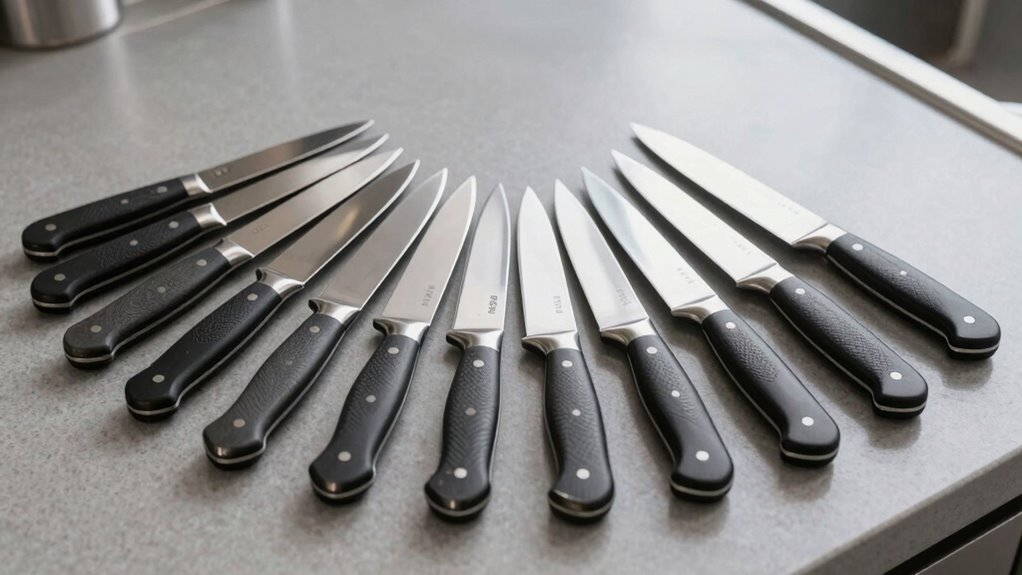
Choosing among AUS-10 kitchen knives means weighing edge geometry, blade shape, handle material, and how much care you want to give the knife. My leading picks serve different priorities: the Yoshihiro 9.5-inch Gyuto offers a long, thin Japanese-style blade; the Regalia Gyuto pairs AUS-10 with a moisture-resistant G10 handle and a stated sharpening service; and the KitchenAid Damascus Chef Knife brings a familiar 8-inch format with a broad blade. The tradeoff is straightforward: thinner, harder edges can suit precise slicing but need more careful handling, while unusual shapes such as the Dalstrong Tanto trade some everyday versatility for a distinctive point. I’ve ranked these five by how clearly their design supports a useful kitchen role, while accounting for stated care limits and missing information.

Get the latest gadgets delivered free with Prime
- Fast, free delivery on millions of items
- Prime Video, Amazon Music and more included
- Member-only deals all year
Complete the kit



Key Takeaways
- Best long-blade pick: Yoshihiro’s 240 mm gyuto gives buyers more reach for larger ingredients, but it calls for careful hand washing and water-stone sharpening.
- Most familiar format: KitchenAid’s 8-inch chef knife has a broad blade and an 18-degree edge, making it the straightforward choice for general chopping and dicing.
- Handle for damp kitchens: Regalia’s G10 handle is described as resistant to heat, cold, and moisture; the listed free sharpening service may also appeal to owners who do not sharpen at home.
- Fine-edge specialist: Kanngou’s stated 10–12-degree edge favors precise work, while its description limits intended use to boneless foods and omits care directions.
- Shape over all-purpose reach: Dalstrong’s Tanto-style point and 16-ounce weight distinguish it from the gyutos, but buyers seeking one conventional knife for every prep task may prefer another pick.
| Yoshihiro AUS10 Ice-Hardened Gyuto Chef Knife, 9.5 in (240 mm), Rosewood Handle |  | Best Overall for a Long, Precise Gyuto | Blade material: AUS-10 stainless steel | Blade length: 9.5 in (240 mm) | Edge: Double edged | VIEW ON AMAZON | See Our Full Breakdown |
| KitchenAid 8-Inch Forged Damascus Steel Chef Knife |  | Best Familiar All-Purpose Format | Blade material: AUS-10 Japanese Damascus steel | Blade construction: 67 layers | Blade length: 8 inches | VIEW ON AMAZON | See Our Full Breakdown |
| Kanngou 8.27-Inch Japanese Gyuto Chef Knife with AUS-10 Damascus Steel and Ebony Handle |  | Best for a Fine, Acute Edge | Blade material: 67-layer Damascus steel with AUS-10 core | Blade length: 8.27-inch gyuto | Hardness: HRC 60–62 | VIEW ON AMAZON | See Our Full Breakdown |
| Regalia 8-Inch Japanese AUS-10 Damascus Gyuto Chef Knife with G10 Handle |  | Best for Low-Maintenance Handle Materials and Sharpening Support | Blade length: 8 inches | Blade core: Japanese AUS-10 steel | Cladding: 66 layers of high-carbon stainless Damascus steel | VIEW ON AMAZON | See Our Full Breakdown |
| Dalstrong Shogun Series 8-Inch Tanto Chef Knife |  | Best for Cooks Who Specifically Want a Tanto Point | Series: Shogun | Blade length: 8 inches | Blade material: Japanese AUS-10V steel | VIEW ON AMAZON | See Our Full Breakdown |
| aus 10 kitchen knife | Blade length | Blade material | Handle material | Hardness |
|---|---|---|---|---|
| Yoshihiro AUS10 Ice-Hardened G | 9.5 in (240 mm) | AUS-10 stainless steel | — | 61 HRC |
| KitchenAid 8-Inch Forged Damas | 8 inches | AUS-10 Japanese Damascus steel | Blonde pakkawood | — |
| Kanngou 8.27-Inch Japanese Gyu | 8.27-inch gyuto | 67-layer Damascus steel with AUS-10 core | Ebony wood | HRC 60–62 |
| Regalia 8-Inch Japanese AUS-10 | 8 inches | — | G10 fiberglass | 62+ HRC |
| Dalstrong Shogun Series 8-Inch | 8 inches | Japanese AUS-10V steel | Black G-10 | — |
More Details on Our Top Picks
Yoshihiro AUS10 Ice-Hardened Gyuto Chef Knife, 9.5 in (240 mm), Rosewood Handle
The Yoshihiro is my strongest all-around pick for cooks who specifically want a Japanese-style gyuto rather than a shorter, conventional chef knife. Its 240 mm blade gives more working length for slicing larger vegetables, fish, and boneless meat, while the thin, double-edged profile is described as suited to precise cutting. Compared with the 8-inch KitchenAid, it offers more reach but asks for more room on the board and a steadier, more careful cutting style.
The ice-hardened AUS-10 steel is listed at 61 HRC, and the octagonal rosewood handle gives this model a different feel from the G10-handled Regalia and Dalstrong. A magnetic oak saya is included, which is useful for protecting the blade during drawer or counter storage. The product description also sets firm boundaries: this is not a knife for bones, frozen foods, or nutshells, and the maker recommends hand washing, prompt drying, and water-whetstone sharpening.
That care routine is the main reason I would not rank it as a carefree household beater. It is better suited to someone willing to keep a hard, thin edge away from rough jobs. Compared with Kanngou’s similarly Japanese-style blade, Yoshihiro supplies clearer care guidance and a longer 9.5-inch size; Kanngou, in turn, specifies a more acute edge angle. My overall choice goes to Yoshihiro because its role, build, and included protective cover make a coherent package for regular careful prep.
Pros:- Long 240 mm blade offers reach for larger ingredients and slicing tasks.
- Thin, double-edged AUS-10 blade is designed for precise, versatile prep.
- Octagonal rosewood handle provides a distinct grip profile.
- Magnetic oak saya is included for blade protection.
Cons:- Requires hand washing and prompt drying.
- Not suitable for bones, frozen foods, or nutshells.
- Water-whetstone sharpening is recommended, which may be unfamiliar to some owners.
Best for: Cooks who want a long Japanese gyuto for precise slicing of vegetables, fish, and boneless meat, and are comfortable with attentive care.
Not ideal for: Anyone who needs a knife for bones, frozen ingredients, rough utility work, or dishwasher cleaning.
- Blade material:AUS-10 stainless steel
- Blade length:9.5 in (240 mm)
- Edge:Double edged
- Hardness:61 HRC
- Handle:Octagonal rosewood
- Saya cover:Magnetic oak wood
- Made in:Japan
Our verdict“I rank Yoshihiro first for buyers who want a long, carefully maintained gyuto with a useful protective saya and clear everyday prep strengths.”
KitchenAid 8-Inch Forged Damascus Steel Chef Knife
KitchenAid takes the most familiar route in this group: an 8-inch chef-knife format with a wide blade for chopping, dicing, and mincing. That makes it an easier fit for cooks who do not want the extra reach of Yoshihiro’s 9.5-inch gyuto or the specialized point of Dalstrong’s Tanto model. The listed 8-ounce weight also makes it the lightest knife here with a stated weight, though the other listings do not provide enough weight data for a full comparison.
Its blade is described as 67-layer AUS-10 Japanese Damascus steel with an 18-degree edge. The broad profile can help when moving chopped ingredients from board to pan, and the blonde pakkawood handle is secured with triple-pin rivets. Against Kanngou and Regalia, KitchenAid gives a less acute stated edge angle than their 10–12-degree and 8–12-degree-per-side specifications, respectively. That makes the specifications easier to read as a general-use design, though edge-angle figures alone do not establish how a knife will perform or hold up.
The key limitation is care: hand washing is recommended. Buyers seeking a highly acute edge or longer Japanese blade may prefer Kanngou or Yoshihiro, while those who value moisture-resistant handle material may favor Regalia’s G10. KitchenAid earns its place because its conventional shape, broad blade, and listed weight make it the simplest option to understand for everyday board work.
Pros:- Familiar 8-inch chef-knife shape suits common prep tasks.
- Wide blade supports chopping and moving ingredients from the board.
- 67-layer AUS-10 Japanese Damascus construction is specified.
- Pakkawood handle uses triple-pin rivets and the knife has a listed 8-ounce weight.
Cons:- Hand washing is recommended.
- The listing provides fewer details about hardness and long-term sharpening than some rivals.
- Its conventional length offers less reach than the Yoshihiro gyuto.
Best for: Home cooks who want a conventional 8-inch chef knife for routine slicing, chopping, dicing, and mincing.
Not ideal for: Buyers seeking a very long gyuto, an especially acute stated edge, or a knife with explicitly rugged care guidance.
- Blade material:AUS-10 Japanese Damascus steel
- Blade construction:67 layers
- Blade length:8 inches
- Edge angle:18 degrees
- Handle material:Blonde pakkawood
- Handle fastening:Triple-pin rivets
- Weight:8 ounces
Our verdict“I recommend KitchenAid to buyers who value a familiar, broad 8-inch chef-knife layout over a longer or more specialized blade.”
Kanngou 8.27-Inch Japanese Gyuto Chef Knife with AUS-10 Damascus Steel and Ebony Handle
Kanngou’s defining specification is its stated 10–12-degree hand-sharpened edge, paired with an AUS-10 core and 67-layer Damascus construction. That makes it the most clearly fine-edge-oriented choice in this group, compared with KitchenAid’s listed 18-degree edge and Yoshihiro’s emphasis on a thin, ice-hardened blade without a supplied angle. The 8.27-inch gyuto format is also a middle ground: longer than KitchenAid’s 8-inch blade, but well short of Yoshihiro’s 9.5 inches.
The full-tang ebony handle and stated 8.8-ounce weight give buyers more construction and handling detail than some entries here. Its HRC 60–62 range is also specified. A gift box and scabbard case are included, but presentation is secondary to the main tradeoff: the description frames this knife for boneless foods. I would not infer that its fine edge is suitable for hard or abrasive tasks, and the provided information gives no care instructions.
Compared with Regalia, Kanngou has a slightly less acute stated angle range and an ebony handle rather than G10, while Regalia lists a sharpening service and lifetime guarantee. Compared with Yoshihiro, Kanngou offers a shorter blade and a more specific edge-angle figure, but Yoshihiro provides clearer washing and sharpening guidance. I place Kanngou below those more fully defined options because buyers need to supply more care judgment themselves.
Pros:- AUS-10 core with 67-layer Damascus construction is specified.
- Hand-sharpened 10–12-degree edge is aimed at precise cutting.
- Full-tang ebony handle and 8.8-ounce weight are listed.
- Scabbard case is included for storage.
Cons:- Product description limits stated use to boneless foods.
- No care instructions are provided.
- The acute edge calls for careful use rather than rough kitchen tasks.
Best for: Cooks who prioritize a finely sharpened gyuto for slicing and dicing boneless ingredients and can handle an acute edge carefully.
Not ideal for: People who cut bones or frozen foods, want explicit care directions, or prefer a more forgiving general-purpose edge.
- Blade material:67-layer Damascus steel with AUS-10 core
- Blade length:8.27-inch gyuto
- Hardness:HRC 60–62
- Edge angle:10–12 degrees
- Construction:Forged, full tang
- Handle material:Ebony wood
- Weight:8.8 ounces
- Included components:Gift box and scabbard case
Our verdict“Kanngou suits careful cooks who want a specifically acute gyuto edge, but its use limits and missing care guidance keep it behind the clearer all-around picks.”
Regalia 8-Inch Japanese AUS-10 Damascus Gyuto Chef Knife with G10 Handle
Regalia is the clearest fit for buyers who want a Japanese-style gyuto but would rather avoid a wood handle. Its G10 fiberglass handle is described as resistant to heat, cold, and moisture, giving it a practical contrast with the rosewood Yoshihiro and ebony Kanngou. The 8-inch blade keeps the knife in a familiar working range, while its full-tang forged construction supplies a useful build detail absent from some competing descriptions.
The blade has a Japanese AUS-10 core, 66 layers of Damascus cladding, and a stated hardness of 62+ HRC. Its edge angle is listed as 8–12 degrees per side, which describes a narrow geometry; buyers should still treat the figure as a specification, not a guarantee of cutting results. Regalia also lists a lifetime guarantee and free sharpening for life. That service may be meaningful to cooks who do not want to maintain an acute edge themselves, especially when compared with Yoshihiro’s recommendation to sharpen using water whetstones.
Regalia ranks below the leading choices because the supplied description gives no weight or care instructions, and the performance claims are not independently verified here. The sharpening offer is a differentiator, but a buyer should check its current terms and availability before relying on it. Compared with KitchenAid, Regalia is more specialized in edge geometry and support; KitchenAid is the more conventional, clearly weighted option. I see Regalia as a strong match for handle preference and sharpening access, not an automatic upgrade for every kitchen.
Pros:- Japanese AUS-10 core with 66 layers of Damascus cladding.
- Full-tang forged construction is specified.
- G10 handle is described as resistant to heat, cold, and moisture.
- Lifetime guarantee and free sharpening for life are listed.
Cons:- No weight or care instructions are provided.
- Performance claims are not independently verified in the supplied description.
- Very acute stated edge geometry may require careful maintenance.
Best for: Cooks who prefer a G10 handle and value a listed sharpening service alongside an AUS-10 gyuto.
Not ideal for: Buyers who need published weight and care details, or who prefer a standard edge and a familiar chef-knife profile.
- Blade length:8 inches
- Blade core:Japanese AUS-10 steel
- Cladding:66 layers of high-carbon stainless Damascus steel
- Construction:Forged, full tang
- Hardness:62+ HRC
- Edge angle:8–12 degrees per side
- Handle material:G10 fiberglass
- Support:Lifetime guarantee and free sharpening for life
Our verdict“Regalia is my handle-and-maintenance pick for buyers who value G10 and the stated sharpening service more than detailed weight and care specifications.”
Dalstrong Shogun Series 8-Inch Tanto Chef Knife
Dalstrong is the outlier in this lineup. Although it is sold as a chef knife, the Tanto-style point makes its blade shape less conventional than the gyuto profiles from Yoshihiro, Kanngou, and Regalia, or the broad KitchenAid chef knife. That shape is the reason to choose it, not a universal advantage: buyers drawn to a distinctive point and a firm, deliberate feel may appreciate the design, while cooks who want one knife to rock-chop and handle varied prep may find a conventional chef knife more adaptable.
The forged 8-inch blade uses Japanese AUS-10V steel, with a hand-finished edge and a black G10 handle. A sheath is included, which adds a storage option not listed for KitchenAid or Regalia. At 16 ounces, it has the heaviest stated weight in this comparison: twice KitchenAid’s listed 8 ounces and heavier than Kanngou’s 8.8 ounces. That is a substantial difference on paper, so buyers who favor a lighter knife should look first at KitchenAid or Yoshihiro, whose weight is not supplied.
The listing does not provide a hardness figure or care instructions, so the steel description should not be treated as a substitute for those details. Against the other four, Dalstrong ranks fifth because its unusual silhouette narrows its audience and the available information leaves practical questions unanswered. It may suit a buyer specifically seeking a Tanto-inspired kitchen blade, but I would not choose it as the default recommendation for everyday all-purpose prep.
Pros:- Forged 8-inch blade uses Japanese AUS-10V steel.
- Hand-finished edge is specified.
- Black G10 handle is designed for control and comfort.
- Sheath is included.
Cons:- Tanto-style point may be less versatile for common kitchen cuts.
- Listed 16-ounce weight is much heavier than KitchenAid’s stated 8 ounces.
- No hardness or care details are provided.
Best for: Cooks who specifically want a Tanto-style chef knife, prefer a substantial listed weight, and value an included sheath.
Not ideal for: Buyers seeking a conventional all-purpose gyuto or chef knife, a lightweight feel, or detailed hardness and care specifications.
- Series:Shogun
- Blade length:8 inches
- Blade material:Japanese AUS-10V steel
- Construction:Forged
- Blade edge:Plain, hand-finished
- Handle material:Black G-10
- Weight:16 ounces
- Included:Sheath
Our verdict“I would choose Dalstrong only when the Tanto shape is a specific preference; most cooks seeking a flexible everyday knife have a better fit elsewhere in this group.”

How We Picked
I compared the five knives through the practical question behind this roundup: which AUS-10 option best suits a particular cook, rather than which one has the longest feature list? I gave weight to blade shape and length, since a long gyuto, an 8-inch chef knife, and a Tanto point guide different cutting motions. I also looked at stated edge angles and hardness where supplied, treating those figures as product specifications rather than proof of real-world performance.
Construction and handling were next. A full-tang build, handle material, weight, and included sheath can affect how a knife feels to use and store, but the supplied descriptions do not give comparable details for every model. I did not fill in those gaps with assumptions. For example, the KitchenAid listing provides a weight, while Yoshihiro does not; Regalia lists a warranty and sharpening service, but no weight or care directions.
Finally, I considered care demands and stated use limits. A hard, acute edge may suit fine slicing but is not a cue to cut bones or frozen food; the Yoshihiro explicitly rules out those tasks. I ranked options higher when their role is clear and their stated benefits fit a distinct buyer. The order is editorial, not a claim that one knife will suit every kitchen.
| aus 10 kitchen knife | Handle material | Construction |
|---|---|---|
| Yoshihiro AUS10 Ice-Hardened G | — | — |
| KitchenAid 8-Inch Forged Damas | Blonde pakkawood | — |
| Kanngou 8.27-Inch Japanese Gyu | Ebony wood | Forged, full tang |
| Regalia 8-Inch Japanese AUS-10 | G10 fiberglass | Forged, full tang |
| Dalstrong Shogun Series 8-Inch | Black G-10 | Forged |
Factors to Consider When Choosing Aus 10 Kitchen Knives
I would choose an AUS-10 knife by matching its geometry and care demands to the jobs it will handle most often. The steel label matters, but blade length, edge shape, handle, and available maintenance guidance separate these five more clearly.Start with blade shape and length
A longer blade can make broad slicing strokes more comfortable, but it needs more board space and control. Yoshihiro’s 9.5-inch gyuto is the longest option here. KitchenAid, Kanngou, Regalia, and Dalstrong cluster around an 8-inch format, but they do not cut alike: KitchenAid has a broad, familiar chef-knife profile, while the other three are described as gyutos or a Tanto-style chef knife. If this is your only kitchen knife, the familiar KitchenAid shape or a conventional gyuto is a safer starting point than the Tanto point.
Read edge angles as clues, not promises
The supplied edge figures range from KitchenAid’s 18 degrees to Kanngou’s 10–12 degrees and Regalia’s 8–12 degrees per side. Those numbers suggest different sharpening geometries, but they do not independently prove sharpness, durability, or how long an edge will last. A narrower angle can suit precise cutting, yet it is not a reason to use a knife on bones or frozen food. Yoshihiro’s product details explicitly prohibit those jobs; Kanngou’s description is limited to boneless foods.
Choose a handle and weight you can live with
Handle material shapes the ownership experience as much as the blade’s appearance. The lineup includes rosewood, ebony, pakkawood, and G10. Regalia and Dalstrong use G10, while the wood-handled options call for attention to moisture and care instructions. The listed weights also vary: KitchenAid is 8 ounces, Kanngou is 8.8 ounces, and Dalstrong is 16 ounces. Yoshihiro and Regalia do not list a weight, so I would not assume they fall between those figures.
Factor care and sharpening into the choice
These listings do not support a claim that any knife is maintenance-free. Yoshihiro calls for hand washing, prompt drying, and water-whetstone sharpening; KitchenAid recommends hand washing. Kanngou and Regalia do not provide care directions in the supplied descriptions. Regalia lists free sharpening for life, while Yoshihiro specifies a sharpening method. I would check the current terms of any service and choose a knife whose care routine matches the tools and time I actually have.
Treat extras as useful, not decisive
Protective storage can matter, particularly for thin edges. Yoshihiro includes a magnetic oak saya, Kanngou includes a scabbard case, and Dalstrong includes a sheath. These features help distinguish the packages, but they do not replace safe storage or careful handling. Damascus layers are also a construction detail, not a standalone measure of cutting ability. I would make the final choice based on intended tasks, handling preferences, and care information first, then use included accessories as a tie-breaker.
Frequently Asked Questions
What does AUS-10 mean in a kitchen knife?
AUS-10 is the named stainless steel used in several blades in this comparison, sometimes as the core beneath Damascus cladding. The product descriptions associate it with sharpness and edge retention, but the steel name alone does not tell me the full cutting experience. Blade geometry, heat treatment, sharpening, and use all matter, so I compare those details alongside the steel specification.
Which knife in this group is best for an everyday home cook?
For a conventional all-purpose shape, I would start with the KitchenAid 8-inch chef knife because its broad blade is described for slicing, chopping, dicing, and mincing. A cook who prefers Japanese gyuto geometry and careful maintenance may favor the Yoshihiro instead. The right choice depends on whether familiar handling or a longer, thinner blade better fits the usual prep routine.
Are these AUS-10 knives suitable for bones or frozen food?
I would not assume so. Yoshihiro explicitly says not to use its knife on bones or frozen foods, and Kanngou describes its intended use as boneless foods. The other listings do not supply permission for those tasks, so I would use a cleaver or another tool designed for hard materials rather than risk damaging a fine kitchen edge.
Which knife has the most acute stated edge?
Regalia lists an 8–12-degree angle per side, while Kanngou lists a 10–12-degree edge and KitchenAid specifies 18 degrees. The figures are not presented in identical formats, so I would avoid treating them as a direct performance ranking. They are useful clues about the intended geometry, but careful handling and suitable sharpening still matter.
Do Damascus layers make a knife cut better?
Not on their own. KitchenAid and Kanngou list 67-layer Damascus construction, and Regalia specifies 66 layers of cladding over an AUS-10 core. Those details describe construction and appearance; cutting depends on the blade’s geometry, edge condition, and build as a whole. I would not select a knife solely because it has the highest layer count.
Conclusion
For the buyer who wants one Japanese-style knife for careful daily prep, I recommend the Yoshihiro 9.5-inch Gyuto: it combines a long, thin blade with an included saya, provided you can follow its hand-wash and sharpening guidance. If you want a familiar shape for mixed kitchen jobs, the KitchenAid 8-inch chef knife is the easier starting point. Choose Regalia if G10 and a listed sharpening service matter most; choose Kanngou if your priority is an acute edge for boneless ingredients and you are comfortable filling in missing care guidance. I would reserve the Dalstrong Tanto for cooks who specifically want its unusual point and heavier feel. Match the knife to your actual cutting habits, not just the steel name or Damascus finish.
Fall Picks
fall essentials
As an affiliate, we earn on qualifying purchases.