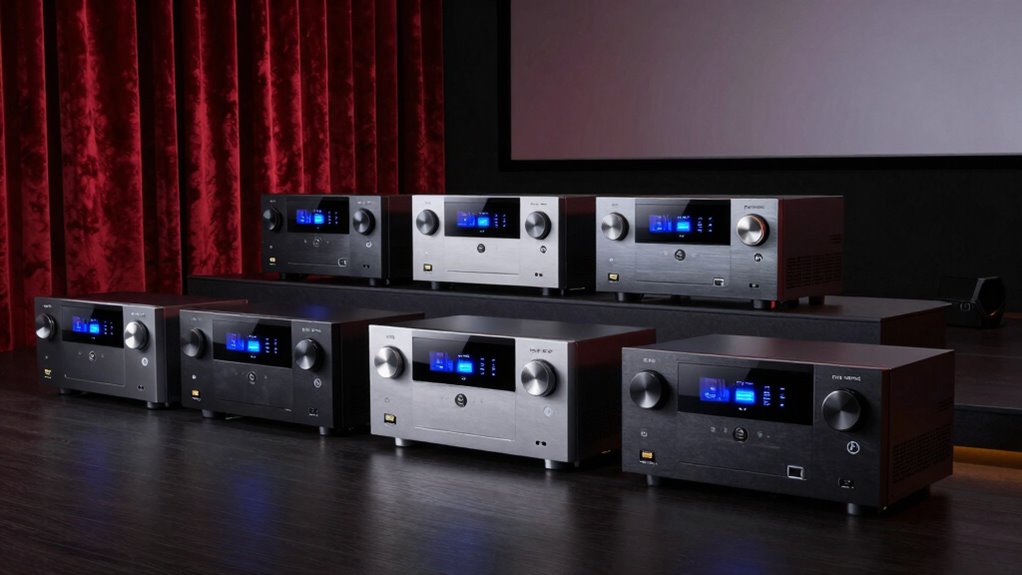

Searching for a 9.2-channel AV receiver with HDMI 2.1? I’ve narrowed this comparison to three models built for immersive surround sound and high-frame-rate video, but they take different routes to a good home theater. The Sony STR-AZ3000ES is my all-around pick for its broad streaming support, two HDMI outputs, and Zones 2 and 3. The Onkyo TX-NR7100 stands out if built-in Dirac Live room correction and gaming features matter most. A second STR-AZ3000ES listing adds detailed ES-series and custom-installation positioning, though its core model specifications overlap substantially with the first Sony.

Get the latest gadgets delivered free with Prime
- Fast, free delivery on millions of items
- Prime Video, Amazon Music and more included
- Member-only deals all year
The main tradeoff is not simply which receiver has the most features. I’d weigh room correction, HDMI layout, multiroom needs, and setup complexity against one another. All three offer 9.2-channel processing and HDMI 2.1 features, but the Onkyo brings Dirac Live while the Sonys put more emphasis on streaming, integration, and multi-zone playback. These are not 11-channel receivers, so buyers planning a larger speaker layout should check their channel requirements before choosing.
Complete the kit



Key Takeaways
- Sony STR-AZ3000ES (B0DG2ZJ48W): My best overall fit for a broad home theater setup, with 9.2 channels, six HDMI inputs, two outputs, Zones 2 and 3, and several built-in streaming options.
- Sony STR-AZ3000ES Premium ES (B0C5S37CVW): A close alternative for custom-integration buyers seeking IP control compatibility and Sony’s ES-series positioning; the supplied specifications largely overlap with the other Sony listing.
- Onkyo TX-NR7100: My room-correction pick, thanks to built-in Dirac Live, THX certification, VRR, ALLM, and 4K/120Hz pass-through.
- HDMI 2.1 does not mean identical port layouts: Compare input and output counts, eARC, and supported video features against the devices you plan to connect.
- 9.2-channel processing is not a guarantee of every speaker configuration: Check the receiver’s supported speaker layouts and expansion needs before building a system.
| Sony STR-AZ3000ES 9.2-Channel 8K Home Theater AV Receiver |  | Best Overall | Channels: 9.2 | Power: 120W per channel; stated at 8 ohms | HDMI inputs / outputs: 6 / 2 | VIEW ON AMAZON | See Our Full Breakdown |
| Sony STR-AZ3000ES Premium ES 9.2 Channel 8K A/V Receiver | | Best for Custom Integration | Channels: 9.2 | Output power: 120W per channel; stated at 8 ohms, 1kHz, 2ch | HDMI inputs / outputs: 6 / 2 | VIEW ON AMAZON | See Our Full Breakdown |
| Onkyo TX-NR7100 9.2-Channel THX-Certified AV Receiver |  | Best for Room Correction and Gaming | Channels: 9.2 | Certification: THX Certified | Room correction: Dirac Live | VIEW ON AMAZON | See Our Full Breakdown |
| channel av receiver with hdmi 21 | Channels | HDMI inputs / outputs | HDMI video support | Surround formats |
|---|---|---|---|---|
| Sony STR-AZ3000ES 9.2-Channel | 9.2 | 6 / 2 | HDMI 2.1; 8K and 4K/120Hz | Dolby Atmos and DTS:X |
| Sony STR-AZ3000ES Premium ES 9 | 9.2 | 6 / 2 | HDMI 2.1; 8K and 4K/120Hz | — |
| Onkyo TX-NR7100 9.2-Channel TH | 9.2 | — | — | Dolby Atmos and DTS:X |
More Details on Our Top Picks
Sony STR-AZ3000ES 9.2-Channel 8K Home Theater AV Receiver
This Sony is my best overall choice for a buyer assembling a flexible, feature-rich theater rather than a system centered on just one use. Its 9.2-channel format and 120W-per-channel rating suit a substantial surround setup, while HDMI 2.1 support for 8K and 4K/120Hz connects it to current gaming hardware and compatible displays. Six HDMI inputs and two outputs offer useful connection flexibility, though buyers should still confirm which specific inputs deliver the video features their devices need.
Its biggest distinction from the Onkyo is breadth beyond the main theater. The Sony lists Zones 2 and 3, Works with Sonos, Chromecast, AirPlay, and Google Assistant, making it a better fit when music or video needs to reach more than one room. The Onkyo counters with built-in Dirac Live, which may matter more when room acoustics are the main challenge. This Sony lists Atmos and DTS:X decoding, but its feature set may take more setup time than a simpler receiver, and the large chassis needs a suitably spacious, well-ventilated cabinet.
The second Sony listing is also an STR-AZ3000ES with closely matching headline specifications. I favor this listing for its clearly stated Zones 2 and 3 and wireless-speaker compatibility details, not because the supplied information proves a hardware advantage over the other Sony. Choose it for versatile connections and multiroom options; skip it if you want guided simplicity or built-in Dirac Live correction.
Pros:- 9.2-channel processing and a stated 120W per channel support a substantial home theater.
- HDMI 2.1 supports 8K and 4K/120Hz video with six inputs and two outputs.
- Zones 2 and 3, Sonos support, AirPlay, Chromecast, and Bluetooth broaden listening options.
- Dolby Atmos and DTS:X decoding support immersive surround formats.
Cons:- Its extensive features and setup options can challenge first-time users.
- The large receiver needs ample cabinet space and airflow.
- It does not list built-in Dirac Live room correction like the Onkyo.
Best for: Home theater owners who want a 9.2-channel receiver with HDMI 2.1, several built-in streaming choices, two HDMI outputs, and multi-zone flexibility.
Not ideal for: First-time AV receiver buyers who want a very simple setup, or buyers who need Dirac Live room correction built in.
- Channels:9.2
- Power:120W per channel; stated at 8 ohms
- HDMI inputs / outputs:6 / 2
- HDMI video support:HDMI 2.1; 8K and 4K/120Hz
- Surround formats:Dolby Atmos and DTS:X
- HDR formats:Dolby Vision, HDR10, HLG, IMAX Enhanced
- Wireless and streaming:Bluetooth, Wi-Fi, Chromecast built-in, AirPlay, Spotify Connect
- Zones and integration:Zones 2 and 3; Works with Sonos
Our verdict“I’d choose this Sony for an adaptable 9.2-channel theater with strong multiroom and streaming support, provided its size and setup complexity suit the room.”
Sony STR-AZ3000ES Premium ES 9.2 Channel 8K A/V Receiver
This second STR-AZ3000ES listing makes most sense for a buyer who values the product’s ES-series and custom-integration positioning. Its supplied description calls out flexible setup options and IP control compatibility, which can be useful when a theater is managed as part of a broader installed system. It retains the same core format that defines this roundup: 9.2 channels, HDMI 2.1, 8K and 4K/120Hz video support, and Dolby Atmos and DTS:X decoding.
Compared with the first Sony listing, the main distinction in the supplied details is emphasis, not a clear change in core performance. This version explicitly mentions 360 Spatial Sound Mapping and IP control compatibility, while the other Sony description gives more detail on Zones 2 and 3 and Sony wireless speaker compatibility. The listings share the STR-AZ3000ES model name and closely aligned HDMI and power specifications, so I would not assume they are meaningfully different receivers without confirming the exact listing and included configuration.
Against the Onkyo, this Sony is the more natural option for someone whose setup depends on Sony’s integration ecosystem and listed streaming platforms. The Onkyo remains the clearer choice for built-in Dirac Live room correction and named gaming functions such as VRR and ALLM. This Sony is also a substantial 32.8-pound unit with a complex feature set; it may be more receiver than a casual listener needs, and the supplied information does not clarify future software-update support.
Pros:- 9.2-channel processing with Dolby Atmos, DTS:X, and 360 Spatial Sound Mapping.
- HDMI 2.1 supports 8K and 4K/120Hz video; the listing specifies six inputs and two outputs.
- IP control compatibility and custom-installation positioning suit integrated systems.
- Wi-Fi, Bluetooth, Chromecast, Spotify Connect, AirPlay, Google Assistant, and Sonos support.
Cons:- Its core specifications closely overlap with the other Sony listing, leaving little documented separation.
- At 32.8 pounds, it calls for sturdy shelving or rack support.
- The described feature set may be demanding for casual users, and update support is not specified.
Best for: Custom-installation buyers who want a Sony ES-series 9.2-channel receiver with HDMI 2.1, IP control compatibility, and broad streaming support.
Not ideal for: Buyers seeking a clearly distinct upgrade over the other STR-AZ3000ES listing, built-in Dirac Live, or a lightweight receiver.
- Channels:9.2
- Output power:120W per channel; stated at 8 ohms, 1kHz, 2ch
- HDMI inputs / outputs:6 / 2
- HDMI video support:HDMI 2.1; 8K and 4K/120Hz
- Audio formats:Dolby Atmos, DTS:X, 360 Reality Audio
- HDR formats:Dolby Vision, HDR10, HLG, IMAX Enhanced
- Wireless:Wi-Fi, Bluetooth, Chromecast built-in, AirPlay, Spotify Connect
- Integration and weight:IP control compatibility; Works with Sonos; 32.8 pounds
Our verdict“I’d choose this listing when its custom-control positioning fits an installed system, but I’d compare the two Sony listings carefully because their stated core specifications overlap.”
Onkyo TX-NR7100 9.2-Channel THX-Certified AV Receiver
The Onkyo earns its place by addressing two specific priorities more directly than either Sony: room correction and gaming-oriented video features. Built-in Dirac Live can help tailor playback to the room, a practical advantage where speaker placement or acoustics are less than ideal. It is not a magic fix for poor placement, and PC or Mac calibration requires a USB microphone that is not included, but the correction system gives this model a distinctive role in the lineup.
Its HDMI 2.1 feature list names 4K/120Hz pass-through, VRR, ALLM, and QFT, plus 8K transfer and eARC. That makes the Onkyo a strong fit for a theater that doubles as a current-generation gaming setup. It lists three HDMI outputs, compared with two on each Sony listing, but the provided details do not specify six HDMI inputs, so buyers should verify the input count and port-by-port capabilities before planning a full set of devices.
Compared with the Sony STR-AZ3000ES, the Onkyo gives up some of the Sony’s clearly described built-in streaming range, Zones 2 and 3, and direct Works with Sonos support. Its Sonos connection needs a separate Sonos Port, while DTS Play-Fi offers another multiroom route. THX certification and Dirac Live make it the more targeted pick for buyers who want to tune a room and connect a gaming console; it is less compelling for someone prioritizing an uncomplicated setup or Sony’s stated multi-zone ecosystem.
Pros:- Built-in Dirac Live room correction gives it a clear advantage for room-tuning flexibility.
- HDMI features include 4K/120Hz pass-through, VRR, ALLM, QFT, 8K transfer, and eARC.
- THX certification and Dolby Atmos and DTS:X support suit immersive home theater use.
- DTS Play-Fi, Wi-Fi, Bluetooth, and listed streaming services support flexible listening.
Cons:- A USB microphone for PC or Mac Dirac Live calibration is not included.
- Sonos integration requires a separate Sonos Port.
- The supplied specifications do not state its HDMI input count, so connection planning needs verification.
Best for: Gamers and home theater owners who want built-in Dirac Live, named HDMI gaming features, and a 9.2-channel immersive audio setup.
Not ideal for: Buyers who want direct Sonos integration without an extra Port, Sony’s listed Zones 2 and 3, or a simple plug-and-play setup.
- Channels:9.2
- Certification:THX Certified
- Room correction:Dirac Live
- HDMI standard and video:HDMI 2.1; 8K and 4K transfer up to 40Gbps
- HDMI outputs:3
- Gaming features:4K/120Hz HDR pass-through, VRR, ALLM, QFT
- Surround formats:Dolby Atmos and DTS:X
- Network and multiroom:Wi-Fi, Bluetooth, DTS Play-Fi; Sonos requires Sonos Port
Our verdict“I’d pick the Onkyo over either Sony when Dirac Live and gaming features lead the decision, while accepting extra calibration and Sonos setup requirements.”

How We Picked
I ranked these receivers around the actual needs implied by a 9.2-channel AV receiver with HDMI 2.1 search: immersive audio, modern video connectivity, and enough flexibility to fit a serious home theater. I compared the supplied specifications for channel count, HDMI capabilities, room correction, streaming, multiroom options, and setup demands. A feature only helps if it suits the system around it, so I also weighed each model’s drawbacks rather than treating a long feature list as a win on its own.
My top position goes to the first Sony listing because its described HDMI layout, Zones 2 and 3, Sonos support, wireless playback, and voice-control options make it the most adaptable choice across viewing and listening setups. The Onkyo ranks next for buyers who value Dirac Live and gaming-oriented HDMI features more than direct Sonos integration or the Sony’s listed multi-zone arrangement. The second Sony earns a separate place for its custom-installation emphasis and ES-series description, but I treat it as a close alternative rather than a distinct technical class: both Sony listings identify the STR-AZ3000ES and share the key 9.2-channel and HDMI details. I haven’t assumed differences that the supplied product information does not establish.
I did not rank these by price or customer feedback. I also avoid treating HDMI 2.1 as a blanket promise that every input supports every feature at once; buyers should verify the exact port capabilities for their source devices and display. The rankings reflect the information provided here, not hands-on testing.
Factors to Consider When Choosing 92 Channel Av Receiver With Hdmi 21
To choose among these receivers, I’d start with the system you are building, not the longest feature list. The core promise—9.2-channel audio with HDMI 2.1—is shared, but the room, connected devices, and multiroom plans determine which differences matter.
Check what 9.2 channels mean for your speaker plan
A 9.2-channel receiver gives you a platform for an immersive home theater, but the label alone does not spell out every available speaker layout or how channels are assigned. Before buying, write down your planned front, surround, and height speakers, along with whether you expect to add powered subwoofers or another room. Then check the model’s supported configurations against that plan. The Sonys list Zones 2 and 3, which speaks to multiroom playback; that is not the same thing as additional theater channels. If your target layout exceeds nine amplified channels, do not assume any receiver in this group will power it without extra equipment.
Match HDMI 2.1 to your sources and display
HDMI 2.1, 4K/120Hz, and 8K support are useful only when the source, receiver input, and television or projector all support the format you want. Count your devices—game consoles, streaming boxes, disc players, and other sources—and compare that total with available inputs. The Sony listings specify six inputs and two outputs. The Onkyo description specifies three outputs and several gaming features, but not its input count in the supplied details. Check the exact connections and video support for the ports you plan to use, especially if your setup relies on VRR, ALLM, or 4K/120Hz.
Decide whether room correction is a priority
The clearest technical separator here is built-in Dirac Live on the Onkyo. Room correction can tune playback to the listening space and may be valuable when speaker placement, room shape, or furnishings affect the sound. Calibration still takes care: a microphone is not included for PC or Mac Dirac Live calibration, and correction cannot make every room or speaker arrangement behave identically. The Sony listings describe advanced calibration or spatial-sound features, but the supplied details do not identify Dirac Live. Choose by the correction system you specifically want, not by assuming every receiver’s calibration tools are equivalent.
Choose your multiroom and streaming path
If you expect music in other rooms, compare the connections you already use. The Sony listings name AirPlay, Chromecast built-in, Bluetooth, and Sonos support; the first Sony also specifies Zones 2 and 3. The Onkyo offers DTS Play-Fi and can integrate with Sonos through a Sonos Port, which adds an equipment requirement. Streaming platform support and multi-zone speaker playback solve related but different needs. Make sure the receiver supports both your preferred music service and the way you intend to distribute sound around the home.
Plan for setup, control, and physical space
These are substantial receivers with features that take planning. Both Sony listings describe a broad set of streaming and control options, and the second calls out IP control compatibility for custom installations. The feature depth may be welcome in a configured theater but can create a steeper learning curve for someone replacing a basic sound system. Check cabinet width, depth, height, ventilation, and shelf strength before selecting a unit; the second Sony is listed at 32.8 pounds. Allow room for cable bends and airflow rather than sizing a shelf to the receiver’s chassis alone.
Use the tradeoffs to break the tie
I’d choose the first Sony for general flexibility and multiroom options, the second Sony when its ES-series and IP-control positioning suit a custom installation, and the Onkyo when built-in Dirac Live and gaming features are the deciding factors. The Sony listings share a model name and many core specifications, so verify the exact listing details rather than paying attention to wording alone. For every option, confirm speaker-layout support, HDMI port capabilities, and compatibility with your existing devices before settling on a receiver.
Frequently Asked Questions
What does 9.2-channel mean on an AV receiver?
9.2-channel describes a receiver designed to process a nine-channel speaker configuration along with two subwoofer outputs or subwoofer feeds, though exact speaker layouts and output behavior vary by model. It does not mean the receiver powers eleven main speakers, and it does not automatically mean you can run every possible height-speaker arrangement. Check the manufacturer’s supported layouts against your intended speaker setup before buying.
Which receiver in this comparison is best for 4K/120Hz gaming?
The Onkyo TX-NR7100 has the most explicit gaming-feature list here: 4K/120Hz pass-through, VRR, ALLM, and QFT. Both Sony listings also specify HDMI 2.1 support for 4K/120Hz. If gaming is central to your setup, confirm which exact inputs support the functions your console or PC needs, and check that your display supports the same formats.
Is the Onkyo TX-NR7100 a better choice than the Sony STR-AZ3000ES?
It depends on your priority. I’d favor the Onkyo when Dirac Live room correction and named HDMI gaming features are high on the list. I’d favor the Sony when Zones 2 and 3, its stated built-in streaming options, and Works with Sonos matter more. The Onkyo needs a Sonos Port for Sonos integration, while its calibration microphone is not included for PC or Mac calibration.
Are the two Sony STR-AZ3000ES listings different receivers?
Both listings identify the Sony STR-AZ3000ES and share key details such as 9.2 channels, HDMI 2.1, 8K and 4K/120Hz support, six HDMI inputs, and two outputs. Their descriptions emphasize different details, including Zones 2 and 3 in one listing and IP control compatibility in the other. The supplied information does not establish a core hardware distinction, so I’d verify the exact listing, included configuration, and seller details before deciding between them.
Do these receivers support Dolby Atmos and DTS:X?
All three product descriptions list Dolby Atmos and DTS:X support. To hear these formats as intended, you’ll need compatible source content and a supported speaker layout; the receiver’s channel count alone does not establish which precise layout is right for your room. Match the receiver’s setup options to your speaker plan and check the format settings on each connected source.
Conclusion
For the broadest mix of 9.2-channel theater, streaming, HDMI connections, and multiroom flexibility, I’d start with the first Sony STR-AZ3000ES. Choose the second Sony listing if IP control and its ES-series custom-installation positioning fit your system, while checking its overlap with the first Sony before treating it as a distinct option. If room correction and console-friendly HDMI features carry more weight than built-in Sonos support or the Sony multi-zone details, the Onkyo TX-NR7100 is the focused alternative. Whichever receiver you select, confirm the speaker layout, input-by-input HDMI capabilities, and available cabinet space against your setup.