

The Sony Xperia 1 VII takes the top spot among the best Sony smartphones thanks to its flagship camera system, 512GB of storage, and long update commitment, while the Xperia 1 VI offers nearly the same premium experience at a lower price now that it’s a generation older. Budget-minded buyers get a strong option in the Xperia 10 VII, which brings 5G and solid battery life without the flagship cost. The main tradeoff in Sony’s lineup is familiar: exceptional displays, camera control, and headphone jacks on one hand, versus higher prices, slower charging, and software that lags behind rivals on the other. There’s also the question of buying international versions versus U.S. warranty models — a real decision that affects support and network bands. Read on for the full breakdown of where each model wins and where it falls short.

Get the latest gadgets delivered free with Prime
- Fast, free delivery on millions of items
- Prime Video, Amazon Music and more included
- Member-only deals all year
Complete the kit



Key Takeaways
- The Xperia 1 VII ranks first because it’s the only model in this lineup with top-tier processing, camera hardware, and multi-year software support — everything else trades away at least one of those.
- The Xperia 1 VI is the smart premium value play: its camera and display still outclass the entire Xperia 10 line, and its price drop since the 1 VII launched makes the savings substantial.
- The two Xperia 10 VII variants are essentially the same phone in different colors and warranty configurations — choose based on storage, color, and seller region, not performance.
- The Xperia XA2 cannot compete on specs in 2026, but its U.S. warranty and rock-bottom price give it a narrow niche as a backup or minimalist phone.
- Every Sony phone here keeps a headphone jack and microSD expansion, which is now nearly unique among flagship brands and a genuine reason to choose Sony over Samsung or Google.



| Sony smartphone | Storage | Display | RAM | Model |
|---|---|---|---|---|
| Sony Xperia 10 VII 5G Dual-SIM | 128GB | 6.1-inch OLED, 120Hz, HDR | 8GB | XQ-FE72 |
| Sony Xperia 10 VII 5G 128GB Du | 128GB | 6.1-inch OLED, 120Hz, HDR | 8GB | XQ-FE72 |
| Sony Xperia 5 IV 128GB Factory | 128GB | 6.1-inch FHD 120Hz HDR | 128GB | — |
| Sony Xperia XA2 Factory Unlock | 32GB | 1080p Full HD Gorilla Glass | — | — |
| Sony Xperia 1 VI XQ-EC72 5G Du | 512GB | 6.5-inch 4K OLED | 12GB | Xperia 1 VI XQ-EC72 |
| Sony Xperia 1 VII XQ-FS72 512G | 512GB | 6.5-inch LTPO OLED, 120Hz, HDR | 12GB | XQ-FS72 |
More Details on Our Top Picks
Sony Xperia 10 VII 5G Dual-SIM Smartphone, 128GB/8GB, White (International Version)
The Sony Xperia 10 VII stands out for offering a compelling mix of modern features at a competitive price. Its 6.1-inch 120Hz OLED display provides smooth visuals with vibrant HDR, making it ideal for media consumption. The 50MP main camera with optical image stabilization rivals more expensive models like the Xperia 5 IV, yet it remains lightweight and easy to carry. While lacking compatibility with CDMA carriers like Verizon and Sprint, its dual-SIM support and water resistance make it a versatile choice for international travelers or those who need flexibility. Compared to the Xperia 5 IV, it sacrifices some camera versatility and screen size but gains affordability and better portability. The tradeoffs involve limited US carrier compatibility and no US warranty, which might concern frequent travelers or US-based users. Overall, this model makes the most sense for users seeking a well-rounded 5G phone with excellent display quality and durability without the premium price tag.
Pros:- Smooth 120Hz OLED display with HDR for vibrant visuals
- Versatile 50MP main camera with OIS for sharp photos
- IP65/IP68 water and dust resistance for durability
- Dual-SIM 5G support offers flexibility for travel
Cons:- Limited compatibility with US CDMA carriers like Verizon and Sprint
- International model lacks US warranty and carrier support
Best for: International travelers and budget-conscious users who want water resistance and a solid camera in a compact package
Not ideal for: US-based users on Verizon or Sprint networks who need CDMA compatibility or a US warranty
- Model:XQ-FE72
- Storage:128GB
- RAM:8GB
- Network:GSM / HSPA / LTE / 5G
- Display:6.1-inch OLED, 120Hz, HDR
- Processor:Qualcomm Snapdragon 6 Gen 3
Our verdict“This phone suits international and budget-minded users who prioritize display quality and durability over carrier compatibility.”
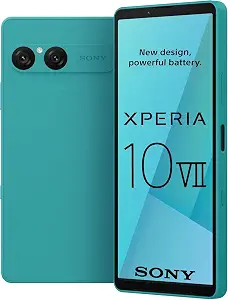
Sony Xperia 10 VII 5G 128GB Dual-SIM Unlocked Smartphone (Turquoise Green)
The Sony Xperia 10 VII 5G Turquoise Green builds on the core strengths of the Xperia 10 VII series, emphasizing lightweight design and strong 5G connectivity. Its 120Hz OLED display offers a crisp, smooth experience similar to the Xperia 5 IV but with a more portable form factor. The inclusion of a 50MP main camera with optical image stabilization ensures good photo quality without the complexity of multiple lenses. Its IP65/IP68 water resistance adds durability for outdoor use. Compared to the Xperia 5 IV, it trades the triple-lens versatility for simplicity and affordability but still delivers excellent core features. The main tradeoff remains its lack of US warranty and compatibility issues with CDMA networks like Verizon, making it ideal for international use. Overall, this model makes sense for users seeking broad 5G support, a lightweight form factor, and a reliable camera in an unlocked package.
Pros:- 120Hz OLED display with HDR for smooth visuals
- 50MP main camera with OIS for steady shots
- IP65/IP68 water and dust resistance for durability
- Lightweight design with broad 5G band support
Cons:- No US warranty; international only
- Carrier band support must be verified before purchase
Best for: Travelers and users seeking a lightweight, fully unlocked 5G phone with durable build and broad carrier support
Not ideal for: US users on Verizon or Sprint who need CDMA compatibility or carrier-specific features
- Model:XQ-FE72
- Storage:128GB
- RAM:8GB
- Network:GSM / HSPA / LTE / 5G
- Display:6.1-inch OLED, 120Hz, HDR
- Processor:Qualcomm Snapdragon 6 Gen 3
Our verdict“Ideal for those seeking a lightweight, durable 5G phone with excellent display and camera at an affordable price for international use.”
Sony Xperia 5 IV 128GB Factory Unlocked Smartphone, Black
The Sony Xperia 5 IV is tailored for users who demand more from their camera system and display. Its 6.1-inch FHD 120Hz HDR display offers a cinematic experience, especially for media enthusiasts. The standout feature is its three-lens camera system supporting 4K HDR slow-motion recording at 120 fps, combined with real-time Eye AF and object tracking—ideal for photography buffs or videographers. The built-in live streaming capability further supports content creators on the go. Compared with the Xperia 10 VII, it sacrifices size and battery life for a more advanced camera and display experience. The compact size might feel limiting for some, and the 128GB storage, while sufficient for many, could be restrictive for heavy users. This model makes the most sense for multimedia professionals or serious mobile videographers needing high-end video features.
Pros:- Versatile three-lens camera system with 4K HDR slow-motion
- Bright, smooth 120Hz HDR display for media consumption
- Supports 4K HDR recording on all rear lenses
- Built-in live streaming for real-time content sharing
Cons:- Limited to 128GB storage, which may fill quickly
- Compact size could feel cramped for some users
Best for: Content creators, mobile videographers, and users prioritizing camera versatility and display quality
Not ideal for: Users seeking a larger device or with limited storage needs who prefer a budget option
- Storage:128GB
- RAM:128GB
- Display:6.1-inch FHD 120Hz HDR
- Cameras:Three-lens system supporting 4K HDR 120 fps
- Video Recording:4K HDR on all rear lenses
- Features:Real-time Eye AF, object tracking, live streaming
Our verdict“Best suited for serious mobile content creators who need a compact device with professional-grade camera features.”
Sony Xperia XA2 Factory Unlocked Phone – 5.2″ Screen – 32GB – Silver (U.S. Warranty)
The Sony Xperia XA2 offers a straightforward experience in a compact, affordable package. Its 5.2-inch Full HD display with Gorilla Glass provides solid daily usability, and the 23 MP camera supports 4K video and slow-motion, appealing to casual photographers. The device’s Snapdragon 630 processor is adequate for basic apps and media but may struggle with intensive multitasking or high-end gaming. Its 32GB storage is limited, though expandable via microSD, and being Verizon certified makes it a strong choice for U.S. users wanting quick setup. Compared to the Xperia 10 VII, it’s smaller and less versatile for international use but excels in US carrier compatibility. The tradeoff involves lower processing power and limited storage, which might not meet the needs of power users. It’s best for those who want a reliable, affordable device for everyday tasks with U.S. carrier support.
Pros:- Factory unlocked and compatible with major US carriers
- High-quality 23 MP camera with 4K video and slow-motion
- Durable Gorilla Glass display
- Compact, easy-to-hold design
Cons:- Limited to 32GB storage, which can be restrictive
- Mid-range Snapdragon 630 processor may feel underpowered for demanding tasks
Best for: Budget-conscious US users desiring a compact phone with good camera capabilities on major carriers
Not ideal for: Power users or those needing extensive storage and high-end performance
- Screen Size:5.2 inches
- Display:1080p Full HD Gorilla Glass
- Storage:32GB
- Rear Camera:23 MP, 4K video, slow-motion
- Processor:Qualcomm Snapdragon 630
- Battery:3,300 mAh
Our verdict“A solid choice for U.S. users seeking an affordable, compact smartphone with decent camera performance and carrier compatibility.”
Sony Xperia 1 VI XQ-EC72 5G Dual-SIM Smartphone, 512GB/12GB, Platinum Silver
The Sony Xperia 1 VI caters to users who need maximum storage and top-tier performance. Its 512GB of internal storage and 12GB RAM provide ample space and power for demanding apps, large media libraries, and high-end multitasking. The 6.5-inch 4K OLED display delivers stunning visuals, perfect for professional content creation or media consumption. While it supports only GSM networks and isn’t compatible with Verizon or Sprint, its factory-unlocked status and dual-SIM support make it ideal for international use. Compared to the Xperia 10 series, it sacrifices size and portability for sheer performance and storage capacity. The main tradeoffs involve network limitations and a higher price point, but for power users, it offers unmatched specs. This device makes the most sense for global professionals or serious multimedia consumers who prioritize storage and processing power over network compatibility.
Pros:- Massive 512GB internal storage for all media and apps
- 12GB RAM for seamless multitasking and demanding tasks
- 6.5-inch 4K OLED display for stunning visuals
- Factory unlocked with dual-SIM for international flexibility
Cons:- Limited to GSM networks; incompatible with Verizon and Sprint
- High price may be prohibitive for casual users
Best for: Global users, content creators, and power users needing extensive storage and premium specs
Not ideal for: US-based users on CDMA networks or those preferring a smaller, more portable device
- Model:Xperia 1 VI XQ-EC72
- Storage:512GB
- RAM:12GB
- Network:5G GSM only
- Display:6.5-inch 4K OLED
- Cameras:Multiple rear lenses supporting high-end video
Our verdict“Best for global professionals and multimedia enthusiasts who need maximum storage and top-tier performance in a premium design.”
Sony Xperia 1 VII XQ-FS72 512GB Dual-SIM 5G Smartphone, Orchid Purple
The Sony Xperia 1 VII stands out for its combination of a stunning 6.5-inch 120Hz LTPO OLED display and a powerful Snapdragon 8 Elite processor, making it ideal for multimedia enthusiasts who want vibrant visuals and smooth performance. Its Zeiss triple-camera system with continuous optical zoom offers notable versatility, especially compared to the Xperia 5 IV, which has a smaller display and fewer camera features. However, the international model’s lack of a US warranty and potential carrier compatibility issues could pose hurdles for some buyers. Its IP65/IP68 ratings ensure durability for outdoor use, but the absence of Verizon or Sprint support limits its appeal for CDMA network users. This pick makes the most sense for those seeking a top-tier, future-proof flagship with excellent imaging and a large, vibrant screen.
Pros:- Vivid 6.5-inch 120Hz LTPO OLED display with HDR support
- Powerful Snapdragon 8 Elite processor with 12GB RAM for smooth multitasking
- Versatile Zeiss triple-camera system with 3.5x-7.1x optical zoom
- Robust water and dust resistance (IP65/IP68)
Cons:- International model lacks a US warranty, increasing potential risk
- Carrier band support must be verified, which could complicate US carrier compatibility
- Not compatible with CDMA carriers like Verizon and Sprint
Best for: Tech-savvy multimedia lovers who prioritize a large, high-quality display and advanced camera features.
Not ideal for: Users who need guaranteed US warranty and carrier support, especially on CDMA networks like Verizon or Sprint.
- Model:XQ-FS72
- Storage:512GB
- RAM:12GB
- Operating System:Android 15
- Display:6.5-inch LTPO OLED, 120Hz, HDR
- Rear Cameras:48MP wide, 12MP telephoto, 48MP ultrawide
- Video:Up to 4K at 120 fps
- Network:Sub-6 5G, 2G/3G/4G LTE
- Water Resistance:IP65/IP68
Our verdict“This flagship suits buyers who want the best Sony has to offer in display, camera, and processing power, and are comfortable with international purchase nuances.”

How We Picked
I ranked these phones on five factors that matter most to Sony buyers: performance headroom, camera capability, display quality, software support timeline, and price-to-value ratio. Because Sony spans everything from a 2018-era budget phone to current flagships, I weighted longevity heavily — a phone that stops receiving security updates in a year is a worse buy than its spec sheet suggests, no matter how cheap it is. I also factored in practical purchasing realities: international dual-SIM versions often cost less but lack U.S. warranty coverage, so where a listing sits on that spectrum affected placement.
The ranking logic follows a simple ladder. The Xperia 1 VII wins on every criterion except price. The Xperia 1 VI sits right behind it because it delivers most of that experience for meaningfully less money. The two Xperia 10 VII variants fill the midrange role, separated only by configuration details. The Xperia XA2 lands last not because it’s poorly built, but because its age undermines performance, app support, and security — the tradeoffs only make sense at a very low price.
| Sony smartphone | Model | Processor |
|---|---|---|
| Sony Xperia 10 VII 5G Dual-SIM | XQ-FE72 | Qualcomm Snapdragon 6 Gen 3 |
| Sony Xperia 10 VII 5G 128GB Du | XQ-FE72 | Qualcomm Snapdragon 6 Gen 3 |
| Sony Xperia 5 IV 128GB Factory | — | — |
| Sony Xperia XA2 Factory Unlock | — | Qualcomm Snapdragon 630 |
| Sony Xperia 1 VI XQ-EC72 5G Du | Xperia 1 VI XQ-EC72 | — |
| Sony Xperia 1 VII XQ-FS72 512G | XQ-FS72 | — |
Factors to Consider When Choosing Best Sony Smartphones
Choosing between Sony’s smartphones comes down to matching the lineup’s quirks to what you actually need. These are the factors that separate a satisfying purchase from a regrettable one.Software Support and Phone Age
Sony supports its flagships for around three years of OS updates and midrange models for less, and the clock starts at launch — not when you buy it. The Xperia 1 VI, for example, is already a year into its support window even though it’s still sold new. The Xperia XA2 is the cautionary tale here: it launched in 2018 and no longer receives security patches, which matters for banking apps and anything involving personal data. If you keep phones for four-plus years, buying the newest generation you can afford costs less over time than replacing an unsupported phone early. A common mistake is chasing a discount on an older flagship without checking how much of its update runway remains.
International Versions Versus U.S. Warranty Models
Most Sony phones sold online are international dual-SIM variants, and that’s neither good nor bad — it’s a tradeoff. International versions are usually cheaper and include dual-SIM, but Sony’s U.S. support won’t cover hardware defects, and you’ll rely on the seller’s return policy instead. Before buying, verify the listed LTE and 5G bands against your carrier’s requirements; a phone that misses key bands will have weak or missing coverage regardless of how good it is otherwise. U.S. warranty models like the XA2 trade the dual-SIM flexibility for official support. If you’re the type who wants manufacturer recourse for a defective unit, that warranty is worth real money; if you’re comfortable with seller-level protection, the international discount is often the better deal.
The Sony Camera Philosophy
Sony’s cameras, especially on the Xperia 1 line, are built around manual control and photographic flexibility rather than automatic point-and-shoot results. The Photography Pro app borrows interface ideas from Sony’s Alpha cameras, which rewards users who want to adjust ISO, shutter speed, and focus themselves. If you mostly shoot casual photos of friends and pets, a Samsung or Google phone will often produce better results with zero effort. This is the single biggest source of disappointed Sony buyers: expecting effortless computational photography and getting a photographer’s tool instead. Match the phone to how you actually shoot, not to the spec sheet’s megapixel count.
Charging Speed and Battery Realities
Sony has never chased extreme fast-charging numbers, and that hasn’t changed with the 1 VII. What Sony does instead is aggressive battery longevity through charging management — features like charge limits and heat-reducing overnight routines that keep the battery healthy across years of use. The practical consequence: you’ll charge slower than a flagship from most rivals, but the battery is likelier to still hold strong capacity in year three. If you regularly run your phone to zero and need a 20-minute top-up, this will frustrate you. If you charge overnight and keep phones long-term, Sony’s approach works in your favor.
Storage, microSD, and the Headphone Jack
Sony is one of the last manufacturers keeping both the 3.5mm headphone jack and microSD expansion across its entire lineup, and that should influence which storage tier you buy. A 128GB Xperia 10 VII with a cheap microSD card can hold years of photos and offline music, which means paying extra for higher internal storage is less necessary than with, say, a Pixel. The 512GB flagships are for people who install large games or shoot lots of 4K video. Don’t overpay for internal storage you can cheaply add — but also don’t buy the 32GB XA2 expecting a memory card to fix its aging processor.
Where Sony Fits Against the Competition
The honest question is whether a Sony phone is the right choice at all for your needs. Sony wins on display quality without notches or punch-holes, physical shutter-button camera control, audio features, and unique design. It tends to lose on price-per-performance, charging speed, availability of U.S. carrier deals, and software polish. Sony phones rarely appear in carrier promotions, so you’ll almost always pay full retail upfront. If those strengths align with how you use a phone — media, photography, wired audio — the premium is defensible. If you want the best value-per-dollar flagship regardless of brand, this lineup will frustrate you.
Frequently Asked Questions
Is the Xperia 1 VII worth the extra money over the Xperia 1 VI?
It depends mostly on how long you plan to keep the phone. The 1 VII gains a newer processor, improved camera processing, and an extra year of software support, which matters if you’re a multi-year owner. If you upgrade every two years or so, the 1 VI delivers perhaps 90% of the same experience — same 512GB-class storage options, same design language, same display approach — at a meaningfully lower price after the newer model’s launch. Photographers who shoot a lot in low light will get more from the 1 VII’s updates. Casual users will struggle to notice the difference in daily use, making the 1 VI the smarter buy for most people.
What’s the difference between the two Xperia 10 VII models listed?
Functionally, almost nothing — they’re the same phone with the same 128GB storage, 8GB RAM, and 5G support. The differences come down to color (White versus Turquoise Green) and the seller configuration, with one listed as an international version. That means warranty handling and included accessories may differ even though the hardware is identical. Choose based on which color you prefer and which seller offers the better return policy and price. Don’t pay a premium expecting one to perform better than the other, because it won’t.
Are international dual-SIM Sony phones safe to buy in the U.S.?
Generally yes, with two caveats worth checking before purchase. First, confirm the specific model number supports your carrier’s LTE and 5G bands — Sony makes regional variants, and a mismatch means weak signal or missing features like VoWiFi. Second, understand that Sony’s U.S. warranty won’t apply, so your protection is the seller’s return window and any third-party warranty you add. In exchange, you typically get a lower price and dual-SIM capability that U.S. models often lack. Many buyers make this trade happily; just go in knowing manufacturer support isn’t part of the deal.
Can the Xperia XA2 still work as a daily phone in 2026?
Only for a narrow set of users. It handles calls, messaging, email, and light browsing fine, and its U.S. warranty status and very low price make it tempting. The problems are software: it no longer receives security updates, some modern apps have dropped support for its Android version, and newer versions of banking or streaming apps may refuse to install. That makes it risky as a primary phone for anyone who uses sensitive apps. It makes far more sense as a backup device, a first phone for a child, or a dedicated media or travel phone where those limitations don’t matter.
Do Sony phones work well for gaming?
The flagships do, though Sony takes a different approach than gaming-focused rivals. The Xperia 1 VII and 1 VI have processors capable of running demanding titles at high settings, and Sony’s game-enhancement software includes thermal management that sustains performance over long sessions instead of throttling aggressively. The 21:9-style tall displays also suit landscape gaming with on-screen controls. Where Sony lags is in high refresh-rate implementation compared to gaming phones — the experience is smooth but not the absolute fastest available. The Xperia 10 VII handles casual and mid-tier games well but will need settings reduced for the most demanding titles.
Conclusion
Mapping these picks to buyer types closes the decision cleanly. For best overall, the Sony Xperia 1 VII is the clear leader — newest hardware, strongest cameras, and the longest support runway in the lineup. For best premium value, the Xperia 1 VI delivers nearly the same flagship experience for less, and it’s the pick I’d steer most buyers toward. For best value overall, either Xperia 10 VII variant brings 5G, a headphone jack, and microSD support at a midrange price — choose the color and seller that suits you. For beginners or minimalists who just need basic communication at the lowest cost, the Xperia XA2 works only as a backup or secondary device given its expired software support. And for specific needs — photography enthusiasts who want manual camera control, or audiophiles who want a headphone jack in a flagship — the Xperia 1 VII is the phone built for exactly that. If none of these profiles fits, the honest answer is that Sony’s strengths are narrow but genuine: buy one when those strengths match how you use your phone.
Fall Picks
fall essentials
As an affiliate, we earn on qualifying purchases.