
Sam Altman’s whirlwind tour aims to secure OpenAI’s AI future by forging global manufacturing partnerships in Taiwan, South Korea, and Japan, focusing on boosting AI chip production. He’s also engaging with Middle Eastern funds to finance massive data centers, ensuring a reliable supply chain and scalable infrastructure. Collaborating with industry giants, Altman is building the foundation for AI’s rapid growth. Keep exploring to uncover how these strategies could shape AI’s next frontier.
Key Takeaways
- Sam Altman visited East Asia to strengthen manufacturing partnerships with TSMC, Samsung, and Foxconn, boosting AI chip production capacity.
- He engaged Middle Eastern investors, including Mubadala and MGX, to fund large-scale data centers supporting AI infrastructure.
- Collaborations with Oracle, NVIDIA, and SoftBank aim to secure supply chains and expand global AI hardware capacity.
- Altman’s strategic focus is on developing factories capable of producing a gigawatt of AI infrastructure weekly.
- The tour aims to ensure reliable hardware supply, diversified funding, and infrastructure growth to support AI advancements through 2030.
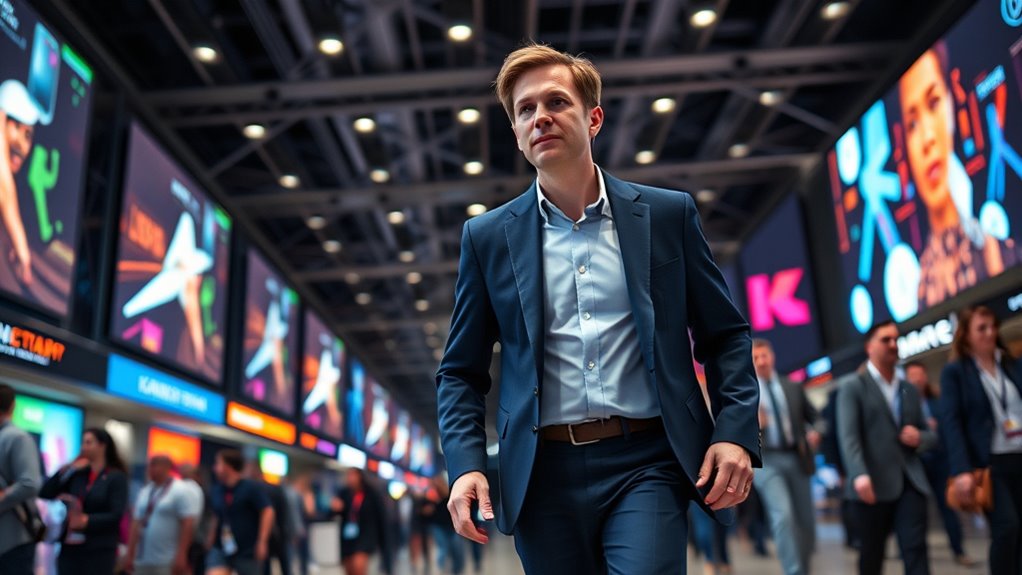
Sam Altman is on a strategic tour to secure critical computational support for OpenAI’s ambitious expansion plans. As you follow his journey across East Asia and the Middle East, it becomes clear that his goal is to lock in essential manufacturing and funding partnerships to sustain the rapid growth of AI infrastructure. In East Asia, Altman visits Taiwan, South Korea, and Japan, meeting with industry giants like TSMC, Samsung, Foxconn, SK Hynix, and Hitachi. These companies hold the key to increasing AI chip production, which is vital for meeting OpenAI’s enormous computational demands. Your understanding of this effort reveals a calculated push to secure prioritized manufacturing capacity, ensuring OpenAI can produce the necessary chips at scale and on time. The emphasis is on developing factories capable of generating a gigawatt of AI infrastructure weekly, a feat that requires massive investment and strategic cooperation.
Simultaneously, Altman’s focus extends to the Middle East, where he engages with investors such as Abu Dhabi’s Mubadala and MGX funds. These organizations are targeted for funding data center projects, which are critical to supporting OpenAI’s expanding AI network. You see this as a move to diversify funding sources and tap into regions eager to lead in next-generation AI technology. The planned construction of data centers, each costing around $50 billion, underscores the scale of this undertaking. These centers will serve as the backbone for OpenAI’s supercomputing networks, enabling the development of more advanced AI models.
Altman’s ambitions are supported by strategic partnerships with industry leaders like Oracle, NVIDIA, and SoftBank. These collaborations help fund and build the infrastructure needed to keep pace with the global demand for AI computing power. By fostering close ties with chip manufacturers and hardware suppliers, OpenAI aims to mitigate supply chain disruptions, especially amid worldwide shortages. Your insight shows that securing a reliable supply chain of memory chips from companies like SK Hynix and increasing memory supply from Samsung and Foxconn are vital steps to ensure continuous growth. This supply chain expansion is crucial for meeting the growing demand for high-bandwidth memory needed for AI workloads. Altman’s projections highlight that AI will surpass human intelligence by 2030, prompting massive investments in data centers and computational resources. The plan is to expand capacity so AI can support scientific discovery, economic innovation, and creative breakthroughs. His messaging underscores the importance of aligning AI development with human values, aiming to prevent hostile outcomes. This strategic tour, therefore, isn’t just about securing hardware and funds; it’s about positioning OpenAI to lead a new era of AI capabilities, transforming industries and unlocking unprecedented possibilities.
Frequently Asked Questions
What Specific Companies Did Altman Visit During His Tour?
You see, Altman visited companies like TSMC, Samsung Electronics, SK Hynix, and Foxconn to secure AI chip supply and expand manufacturing capacity. He also met with Oracle, Databricks, and SoftBank to develop data centers and AI capabilities. Additionally, he engaged with investors in the UAE, East Asia, and the Middle East to fund infrastructure projects. These visits aim to strengthen OpenAI’s global hardware and investment foundation for AI growth.
How Much Funding Was Ultimately Secured From These Partnerships?
You’ve secured a total of $40 billion in funding from these partnerships. This substantial investment came from various sources, including a recent funding round that valued OpenAI at $300 billion, and commitments like Oracle’s $300 billion spend over five years. Additionally, investments from SoftBank, T. Rowe Price, and venture capitalists like Sequoia Capital and Andreessen Horowitz have markedly boosted OpenAI’s financial resources for expanding its AI infrastructure.
Were There Any Unexpected Challenges During Altman’s Negotiations?
Think of negotiations as steering a stormy sea—you never know what unexpected waves will hit. During Altman’s negotiations, he faced surprising challenges like internal conflicts, legal battles over AI copyright issues, and secrecy around partnership details. These hurdles threatened to sink the deal, forcing him to adapt quickly. Despite the turbulence, he stayed focused, steering through the chaos to secure what OpenAI needed for its future.
How Will the New Computational Support Impact Openai’s Future Projects?
The new computational support will *considerably* boost your future projects by enabling faster, more accurate AI models with broader capabilities. You’ll be able to develop complex solutions in coding, health, and visual perception, and deploy them more efficiently. With reduced costs and increased scalability, your projects can grow more ambitious, integrating multi-modal systems and real-time solutions. This infrastructure will also foster innovation, allowing you to stay ahead in AI advancements and meet evolving market demands.
What Are the Long-Term Goals of Altman’s Strategic Tour?
Your understanding is that Altman’s long-term goals with his strategic tour are to secure critical computational resources, ensuring OpenAI stays at the forefront of AI development. He’s aiming to shift investments toward future AI applications, fostering innovation beyond current models. By doing so, he wants to maintain leadership, accelerate technological progress, and shape a future where AI benefits all humanity, ultimately guiding the world through the AI-driven economy and societal transformation.
Conclusion
As you follow Sam Altman’s whirlwind tour, you see he’s not just seeking support—he’s illustrating how essential computational power is for AI’s future. Imagine a pyramid where innovation depends on a strong foundation of resources. Without it, progress stalls. His efforts highlight that, to keep pushing boundaries, OpenAI needs robust backing. This visual reminds you that securing computational support isn’t just about numbers; it’s about fueling the next leap in AI evolution.