
TL;DR

Get the latest gadgets delivered free — and shop member deals
- Fast, free delivery on millions of items
- Access to Prime Big Deal Days deals on October 6–7
- Prime Video, Amazon Music and more included
VR headsets use a combination of sensors and algorithms to detect user movements and actions. This article explains the confirmed methods and what remains uncertain about current tracking technologies.
VR headsets such as Oculus Quest primarily detect user movements through a combination of built-in sensors, including accelerometers, gyroscopes, and external cameras, according to discussions on Reddit. This technology allows for real-time tracking of head and hand movements, which is critical for immersive virtual experiences. The details of these mechanisms are now better understood by the public, although some aspects remain under development.
VR headsets utilize multiple sensors to monitor user movements. Accelerometers measure linear acceleration, while gyroscopes track rotational motion, together providing precise data on head orientation and movement. External cameras or sensors, often called ‘inside-out tracking,’ use visual data to map the environment and track the position of controllers and the headset itself. According to Reddit users, this combination enables accurate, low-latency tracking necessary for immersive VR experiences.
Recent discussions suggest that the Oculus Quest and similar devices rely heavily on inside-out tracking with multiple cameras integrated into the headset. These cameras capture the environment and the position of controllers, translating visual data into movement information using complex algorithms. While the core technology is confirmed, some finer details about the algorithms and sensor calibration are not publicly disclosed and are believed to be proprietary.
How VR Headsets Detect Your Movements And Actions
A VR headset does not rely on one sensor. It continuously combines inertial measurements, camera observations and predictive algorithms to estimate where your head and hands are—and where they are moving next.
Three positional and three rotational axes
Inertial, visual and controller data
Updates occur continuously during use
Hardware and algorithms keep improving
Three inputs build one motion picture
Each sensing method solves a different part of the tracking problem. Inertial sensors respond quickly, while cameras provide environmental reference points that help correct accumulated position errors.
Accelerometers
Measure changes in linear acceleration. Their rapid readings help the system detect translation, sudden movement and changes in speed.
Gyroscopes
Measure angular velocity. They reveal when the headset or controller turns, tilts or rotates around its axes.
Inside-out cameras
Observe environmental features, controllers and—in supported systems—hands, helping calculate position within the physical room.
Raw signals become virtual movement
Tracking algorithms align measurements collected at different speeds, estimate the user’s current pose and smooth small errors before the virtual scene is rendered.
Sensors collect motion and visual data
Measurements align on a shared timeline
Algorithms combine complementary signals
Head and hand poses are calculated
The virtual scene responds to the user
Why combine sensors? Inertial sensors are fast but can drift over time. Cameras provide stable environmental references but may lose visibility. Sensor fusion uses the strengths of both.
Inside-out versus external tracking
Modern standalone devices commonly use inside-out tracking. Earlier and specialist systems may use external stations for a fixed, highly controlled tracking volume.
| System | Sensor location | Setup | Portability | Common limitation | Status |
|---|---|---|---|---|---|
| Inside-out | Built into the headset | Maps the room during use | High | Camera occlusion and difficult lighting | Widely used |
| External | Placed around the play area | Requires fixed sensor positions | Lower | More hardware and setup effort | Established |
| Hybrid | Headset plus added references | Combines multiple tracking sources | Variable | Greater system complexity | Developing |
Tracking quality shapes immersion
When virtual movement closely matches physical movement, interaction feels natural. Delays, jumps or lost controllers weaken presence and can contribute to discomfort.
Known, inferred and undisclosed
The broad architecture of VR movement detection is well understood. The exact implementation details used by individual manufacturers are not always public.
Core sensors
Accelerometers, gyroscopes and cameras are established components of contemporary headset and controller tracking systems.
Hand tracking
Some headsets use cameras and learned visual models to estimate hands and gestures without dedicated controllers.
Proprietary logic
Fine-grained sensor fusion, calibration, prediction and error-correction methods may remain confidential.
Physical action
The user turns, reaches or walks.
Sensor evidence
Motion and images are sampled.
Pose estimate
Signals become position and rotation.
Virtual response
The viewpoint or avatar updates.
Perceived presence
The virtual world feels responsive.
More awareness, less friction
Future systems may add richer depth sensing, more cameras and stronger predictive models. The goal is robust tracking across more rooms, movements and visibility conditions.
Development horizon
Expected improvements include better environmental understanding, lower latency, more reliable hand tracking and hybrid systems that combine additional sensing methods.
How are hand movements tracked?
Cameras may observe controllers or estimate hands directly, while inertial sensors provide additional motion data.
Can tracking issues be eliminated?
New sensors and algorithms can reduce failures, but visibility, latency and environmental constraints remain engineering challenges.
What do the algorithms actually do?
They combine measurements, estimate pose, correct errors and predict motion so the displayed scene remains smooth and responsive.
How Tracking Technologies Impact VR Experience
The way VR headsets detect movements directly affects the quality of immersion and user experience. Accurate tracking reduces motion sickness, enhances realism, and allows for more natural interactions. Understanding these mechanisms helps consumers and developers improve VR hardware and software, potentially leading to more advanced and accessible virtual environments.
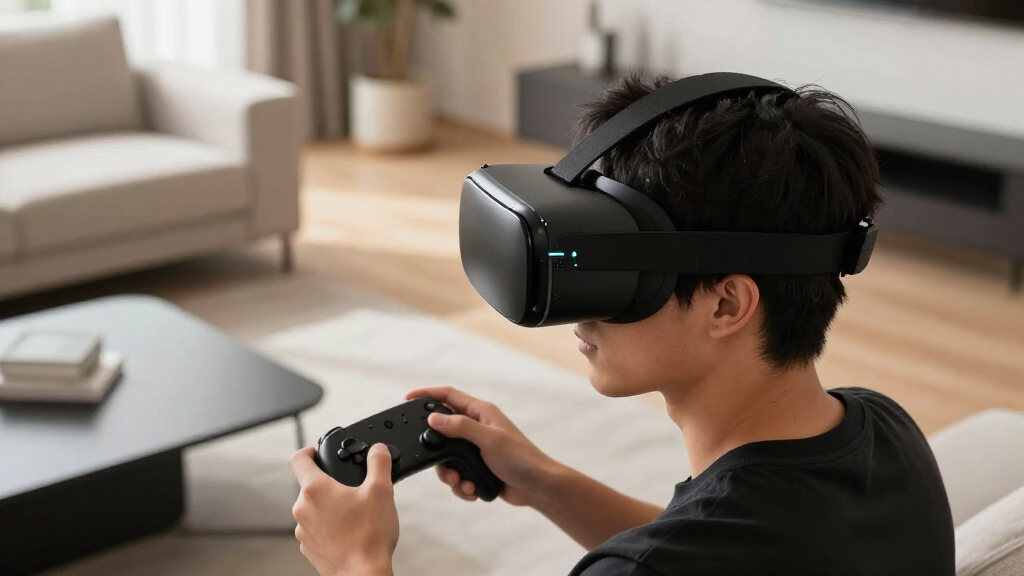
VR headset with inside-out tracking
As an affiliate, we earn on qualifying purchases.
As an affiliate, we earn on qualifying purchases.
Evolution and Components of VR Movement Detection
VR tracking technology has evolved from basic external sensors to sophisticated inside-out systems. Early devices relied on external base stations, but modern headsets like Oculus Quest use built-in cameras and sensors for self-contained tracking. These advancements have made VR more portable and user-friendly. The core components include accelerometers, gyroscopes, and visual sensors, with ongoing improvements in algorithm efficiency and sensor calibration.
“The headset uses accelerometers and gyroscopes to track head orientation, combined with inside-out cameras for environment mapping.”
— an anonymous researcher on Reddit
Unconfirmed Aspects of VR Movement Detection
While the basic components are known, specific details about the proprietary algorithms used for sensor fusion and calibration remain undisclosed. It is also unclear how future hardware updates might improve tracking accuracy or reduce latency beyond current capabilities. Additionally, some claims about the extent of environmental mapping and obstacle detection are still unverified.
Future Developments in VR Tracking Technologies
Upcoming VR headsets are expected to incorporate more advanced sensors, such as lidar or additional cameras, to improve environmental awareness and tracking precision. Software updates may enhance algorithm efficiency, reducing latency and increasing accuracy. Developers and manufacturers are also exploring hybrid systems that combine multiple sensor types for more robust tracking in complex environments.
Key Questions
How do VR headsets track hand movements?
Most VR headsets track hand movements using external or built-in sensors, including cameras that detect controllers and hand gestures, along with accelerometers and gyroscopes for precise motion data.
Are there limitations to current VR tracking systems?
Yes, current systems can experience latency issues, occlusion problems where sensors lose sight of controllers, and environmental limitations that affect tracking accuracy.
Will future VR headsets eliminate tracking issues?
Advancements in sensor technology and algorithms aim to reduce these issues, but complete elimination depends on ongoing research and hardware innovation.
How does inside-out tracking differ from external sensors?
Inside-out tracking uses cameras and sensors built into the headset to map the environment and track movement, whereas external sensors are placed outside the play area to monitor user position.
What role do algorithms play in movement detection?
Algorithms process sensor data to interpret user movements, fuse information from multiple sensors, and correct errors, enabling smooth and accurate tracking.
Source: r/OculusQuest
Halloween Picks
halloween
As an affiliate, we earn on qualifying purchases.