
TL;DR
An innovative controller has enabled a 60Hz refresh rate for E-ink displays, making them viable as computer monitors. This breakthrough challenges long-held beliefs about E-ink’s limitations and could expand its applications.
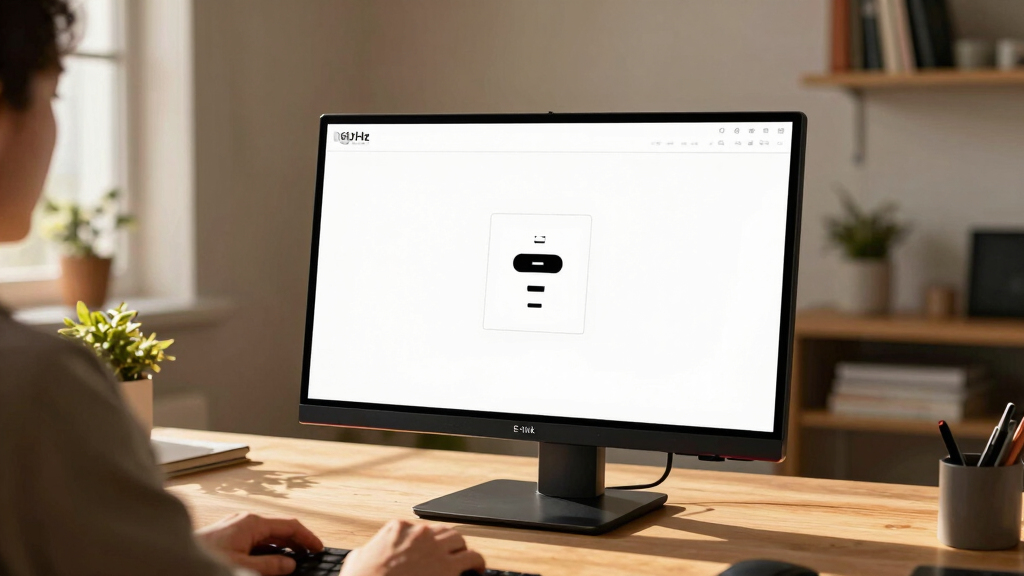
A researcher has developed a custom controller that enables a 60Hz refresh rate on a high-resolution E-ink display, making it suitable for use as a computer monitor. This breakthrough challenges the longstanding perception that E-ink screens are inherently too slow for dynamic applications, potentially expanding their use cases in computing and portable displays.
The development was led by an anonymous researcher who created a custom controller to overcome the traditional limitations of E-ink displays. Historically, E-ink screens have been used primarily in e-readers, with slow refresh rates and high latency due to design choices driven by low power needs and limited processing capabilities. The new controller, however, demonstrates that these limitations are not inherent to the technology itself.
Initial tests with the custom controller showed promising results, achieving a 60Hz refresh rate at high resolution. This performance level is comparable to many standard computer monitors, opening the door for E-ink displays to be used in more interactive and responsive applications. The project has culminated in the release of a fully open-source, user-repairable 13.3-inch portable E-ink monitor called Modos Flow, available through Crowd Supply. Both monochrome and color versions are offered.
Despite the technical success, the development process involved significant optimization and feature work to balance appearance and responsiveness across different display modes. The project also faced delays and challenges related to vendor issues and market timing, which slowed its progress from proof of concept to finished product.
Implications for E-Ink’s Future in Computing
This development could significantly broaden the applications of E-ink technology beyond static reading devices. By achieving a 60Hz refresh rate, E-ink displays can now support more interactive uses, such as portable monitors, e-notebooks, and low-power secondary screens. This challenges the perception that E-ink is only suitable for simple, low-refresh-rate applications, potentially leading to new markets and innovative device designs.
Furthermore, the open-source nature of the project encourages community involvement and further development, which could accelerate the adoption of high-performance E-ink displays in mainstream electronics. The ability to repair and customize these displays also aligns with trends toward sustainability and user empowerment in hardware design.

Bigme B13 Portable Display Screen 13.3 Inch Color E-Ink Computer Screen for Laptop Screen Extender, Plug& Play, Color Display Extender with Touchscreen FHD 3200×2400 Display
- Size and Resolution: 13.3-inch FHD 3200×2400 color E-Ink display
- Eye-Friendly Display: Reduces eye strain with color E-Ink technology
- Wide Device Compatibility: Compatible with PC, Mac, iOS, Android devices
As an affiliate, we earn on qualifying purchases.
As an affiliate, we earn on qualifying purchases.
E-Ink’s Longstanding Limitations and Recent Breakthroughs
E-ink displays have traditionally been limited to low refresh rates, typically around 1Hz, due to their controller design and the constraints of early low-power applications like e-readers. These limitations were primarily driven by the need to minimize power consumption and simplify interface options, which resulted in high latency and slow updates. Over the years, some efforts have been made to improve refresh speeds, but achieving 60Hz has remained elusive until now.
The recent breakthrough stems from a custom controller designed to optimize refresh cycles and interface handling. This approach was first demonstrated in a proof-of-concept phase, with subsequent refinement leading to the current high-refresh-rate display. The project has garnered attention within the maker and tech communities, highlighting the potential for E-ink to serve in more dynamic roles.
“The controller proves that E-ink’s slow refresh isn’t an inherent limitation, but rather a challenge that can be overcome with the right hardware and software design.”
— an anonymous researcher
Remaining Challenges and Market Adoption Questions
While the technical achievement is confirmed, it is still unclear how widely this technology will be adopted in commercial products. Questions remain about long-term reliability, manufacturing scalability, and whether vendors will embrace the new controller design. Additionally, the performance in different lighting conditions and the overall user experience with color versus monochrome displays are still being evaluated.
Future Development and Commercialization Plans
The next steps involve further testing and refinement of the high-refresh-rate E-ink displays, including durability assessments and user interface optimization. The open-source project aims to encourage community contributions, which could lead to broader adoption. Commercial partners may also explore integrating this technology into portable monitors, e-readers, and other low-power devices. The developer plans to release updated versions and gather user feedback over the coming months.
Key Questions
Can this new controller be used with existing E-ink displays?
It is currently designed for specific high-resolution E-ink panels and requires custom hardware integration. Compatibility with existing displays is limited but may improve as the project develops.
Will this technology be available commercially soon?
The project is in the early stages of development, with open-source hardware available now. Commercial products based on this technology could emerge within the next year, depending on industry interest and manufacturing scaling.
Does this mean E-ink displays can now support video or fast-moving content?
Achieving 60Hz refresh rate makes basic video playback and dynamic content feasible, but actual performance may vary based on the display’s resolution, color capabilities, and software optimization.
What are the advantages of a high-refresh-rate E-ink display?
Higher refresh rates reduce latency and improve responsiveness, enabling more interactive applications like portable monitors, e-notebooks, and low-power secondary screens.
Source: Hackaday