3D printing revolutionizes manufacturing by enabling you to prototype quickly, test complex designs, and customize products with precision. It streamlines production, reduces waste, and cuts costs by consolidating parts and localizing manufacturing. This technology accelerates innovation, shortens development cycles, and fosters sustainable practices. Whether for prototyping or full-scale production, 3D printing gives you a competitive edge through faster, more flexible, and eco-friendly manufacturing solutions. Keep exploring to discover how it can transform your projects.
Key Takeaways
- Accelerates product development cycles through rapid prototyping and iterative design testing.
- Enables on-demand, localized manufacturing, reducing supply chain costs and lead times.
- Allows for highly customized, complex parts that were previously difficult or costly to produce.
- Promotes sustainability by reducing material waste and supporting eco-friendly manufacturing practices.
- Provides a competitive edge with innovative designs, faster market delivery, and flexible production capabilities.
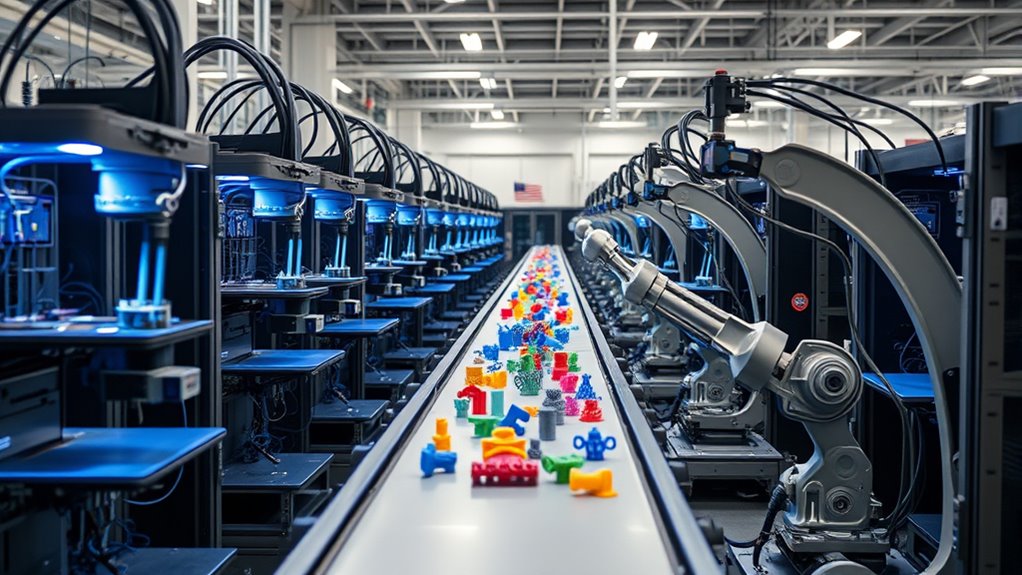
3D printing has revolutionized manufacturing by enabling you to create prototypes quickly, cut down lead times, and reduce costs. This technology has become a game-changer in how products move from concept to market. With rapid prototyping, you can test and refine designs faster than traditional methods, allowing for more innovative product development.
3D printing’s capabilities in additive manufacturing mean you can produce parts with complex geometries that were previously impossible or too costly with conventional manufacturing techniques. This flexibility improves overall product design, leading to better performance and functionality. Additionally, the layer-by-layer process allows for highly precise and customizable parts tailored to specific needs.
By integrating 3D printing into your manufacturing processes, you can consolidate multiple components into a single, streamlined part, reducing assembly time and potential points of failure. This not only speeds up production but also simplifies supply chains, making on-demand and localized production achievable. The design freedom offered by this technology enables innovative solutions that were previously unattainable.
Instead of relying on extensive inventories or long-distance shipping, you can produce parts closer to where they’re needed, cutting down on transportation costs and lead times. This shift toward just-in-time manufacturing increases your ability to respond swiftly to market demands or design changes.
Moreover, additive manufacturing supports sustainable practices by reducing waste during production. Unlike subtractive methods that carve away material, 3D printing uses only the material necessary for the final part, making it inherently more eco-friendly. You can also utilize environmentally friendly materials, such as biodegradable plastics, further decreasing your manufacturing footprint.
As the technology advances, its application extends beyond prototypes to full-scale production, impacting sectors like aerospace, automotive, and healthcare where high precision and customization are essential. Understanding these advantages can help your business leverage 3D printing more effectively.
In product development, 3D printing accelerates iteration cycles, allowing you to quickly produce and evaluate multiple design options. This rapid feedback loop enhances innovation and reduces time-to-market.
Additionally, the ability to produce complex geometries enables the creation of lightweight yet strong components, optimizing product performance without adding unnecessary weight or complexity. The flexibility of 3D printing allows for innovative design solutions that were previously unfeasible.
Furthermore, understanding the sustainability benefits of 3D printing can help your business adopt more environmentally responsible manufacturing practices, aligning with global efforts to reduce industrial waste and carbon footprint. This not only enhances your company’s eco-conscious image but also can lead to cost savings over time.
As a result, you gain a competitive edge by bringing innovative, high-quality products to market faster and more sustainably.

SUNLU PLA 3D Printer Filament, Black, 1KG
- Material Type: PLA for 3D printing
- Neat Winding: Self-developed winding for easy use
- Filament Diameter: 1.75mm precision
As an affiliate, we earn on qualifying purchases.
As an affiliate, we earn on qualifying purchases.
Frequently Asked Questions
How Does 3D Printing Affect the Manufacturing Industry?
You see, 3D printing transforms manufacturing by making it quicker and more flexible. It lets you prototype rapidly, cut costs, and design complex parts easily.
You can produce on-demand locally, reducing shipping and supply chain issues. This technology enables small and medium runs, accelerates product development, and supports innovation.
Industries like aerospace, automotive, and healthcare now leverage 3D printing to improve performance, customize products, and meet sustainability goals effectively.
What Impact That 3D Printing Is Having on Traditional Manufacturing?
You see that 3D printing is transforming traditional manufacturing by reducing reliance on costly tooling and speeding up product development. It allows you to produce complex parts in-house, cut shipping costs, and respond quickly to market changes.
This technology challenges mass production norms, lowers costs for small runs, and pushes manufacturers like you to adopt more flexible, hybrid strategies to stay competitive in a rapidly evolving industry.
What Was the Impact of 3D Printing?
You see that 3D printing has revolutionized manufacturing by enabling faster prototyping, cutting costs, and allowing for complex, customized designs. It has improved supply chain resilience with localized, on-demand production.
Industry sectors like aerospace, automotive, and healthcare benefit from lighter, stronger parts. Overall, it shifted manufacturing from mass production to a flexible, demand-driven process, empowering you to innovate and meet specific consumer needs more efficiently.
How Does Adoption of 3D Printing Affect Manufacturing?
You might be surprised to learn that additive manufacturing revenues are expected to grow from $1.4 billion in 2019 to over $5.8 billion by 2025.
When you adopt 3D printing, you reduce tooling costs and lead times, transforming production from months to hours. It enables on-demand, localized manufacturing, minimizes supply chain risks, and fosters innovative designs with complex geometries.
Ultimately, this boosts efficiency, lowers costs, and expands your production capabilities.
Conclusion
As you step into the future, 3D printing acts like a magic wand, transforming manufacturing from a rigid machine to a flexible artist’s palette. It’s like having a personal workshop at your fingertips, shaping ideas into reality faster than ever before. With this technology, you’ll find innovation blossoming like a garden in spring, where every layer you build is a new chapter in your creative story. Embrace it, and watch your possibilities unfold endlessly.