To improve your bass without new gear, start by experimenting with your subwoofer’s placement. Avoid placing it directly against walls or corners initially, and listen for the fullest, most balanced sound. Try shifting or angling it slightly to reduce room interference and standing waves. Adjust phase and crossover settings for smoother blending with your main speakers. Keep in mind, small changes can make a big difference, and for more tips, you’ll discover even better placement strategies below.

Get the latest gadgets delivered free with Prime
- Fast, free delivery on millions of items
- Prime Video, Amazon Music and more included
- Member-only deals all year
Key Takeaways
- Experiment with different room locations, avoiding walls and corners initially, to find a balanced, full bass response.
- Fine-tune subwoofer placement by small shifts and angling to minimize room reflections and standing waves.
- Adjust phase and crossover settings for seamless integration with your main speakers and clearer sound.
- Use your ears to identify the spot with the fullest, most even bass, and refine placement accordingly.
- Incorporate soundproofing pads or foam under the sub to reduce external vibrations and focus bass performance.
As an affiliate, we earn on qualifying purchases.
Why Your Bass Sounds Off and How Placement Can Help

If your bass sounds hollow, boomy, or uneven, the problem often lies in subwoofer placement. Poor placement can cause issues like lack of subwoofer isolation, where vibrations bleed into other components, muddying sound clarity. It can also throw off your bass response calibration, making it harder to achieve balanced, accurate low-end sound. Moving your subwoofer to a better spot helps minimize unwanted vibrations and reduces interference from nearby objects or walls. Proper placement ensures the subwoofer can produce tight, controlled bass, rather than fluctuating or overly resonant sound. Additionally, sound isolation is crucial for preventing vibrations from affecting other parts of your home theater setup. Paying attention to where you position your subwoofer is essential for achieving regional flavor and optimal sound quality, and you can considerably improve sound without additional equipment, simply by optimizing placement for better isolation and more accurate bass response. To further enhance your listening experience, considering room acoustics can also make a significant difference in how your bass performs. Being mindful of the environmental factors in your space can help you fine-tune your setup for even better results.
Finding the Best Spot for Your Subwoofer
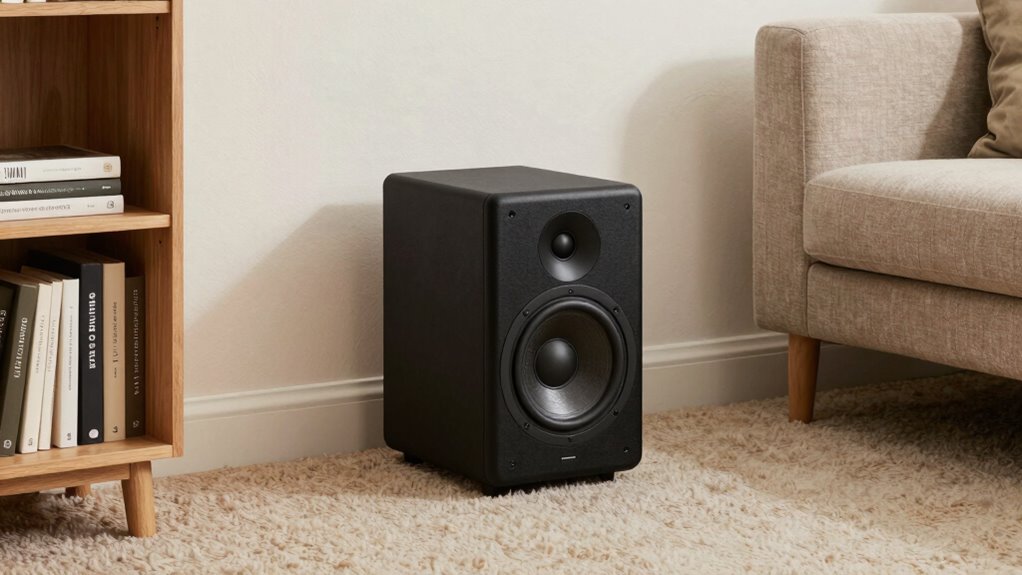
Finding the best spot for your subwoofer is essential to achieving clear, balanced bass. To do this, start by experimenting with different positions in your room, focusing on areas where the bass sounds full and smooth. Proper subwoofer calibration helps guarantee that your sub integrates seamlessly with your main speakers, avoiding muddy or boomy sound. Avoid placing the sub too close to walls or corners initially, as this can cause exaggerated bass. Instead, find a spot where the bass feels even and natural, then adjust for speaker integration, ensuring your sub blends smoothly with your existing speakers. Remember, small shifts in placement can make a significant difference, so take your time testing until you find the optimal location. Additionally, understanding room acoustics can help you optimize placement for the best sound quality. Being aware of standing waves and how they affect sound distribution can further improve your subwoofer’s performance. Moreover, using acoustic treatments can help mitigate undesirable sound reflections, enhancing overall bass clarity. Paying attention to sound reflection patterns in your room can also assist in refining your subwoofer placement for the most accurate bass response. Recognizing how room dimensions influence sound can help you make more informed placement decisions.
How to Fine-Tune Your Subwoofer Placement for Best Sound

Once you’ve found a good spot for your subwoofer, the next step is fine-tuning its placement for ideal sound. You’ll want to adjust the phase and crossover settings to guarantee the bass blends smoothly with your main speakers. Small tweaks here can make a big difference in achieving clear, powerful low-end performance. Additionally, understanding digital content formats can help you optimize your audio setup for various media types, ensuring the best possible sound experience. Proper equipment safety and maintenance practices can also preserve your gear’s performance and prevent damage over time. Being aware of soundproofing techniques can further improve your listening environment by reducing unwanted echoes and external noise. Incorporating acoustic treatment can also enhance bass response by minimizing room resonances that interfere with subwoofer output. Regularly checking and calibrating your setup ensures sustained optimal sound quality and prevents potential equipment damage.
Optimal Subwoofer Location
Ever wondered how to find the perfect spot for your subwoofer? The key is ideal placement combined with proper subwoofer calibration. Start by experimenting with different locations—near walls or corners often boost bass, but too close can cause muddiness. Use your ears to identify where the bass sounds fullest and most balanced. To minimize vibrations that could disturb others or cause unwanted noise, apply soundproofing techniques like isolating pads or foam mats under the subwoofer. These steps help focus the bass directly into your listening area. Remember, small adjustments can make a big difference. Once you find a spot that delivers clear, punchy bass, fine-tune your subwoofer’s settings to match the room’s acoustics. Proper placement and calibration create the best sound experience without any additional equipment. Additionally, consider eco-friendly disposal tips for your old or unused gear to maintain an environmentally responsible setup. Incorporating soundproofing techniques can further enhance your listening environment by reducing unwanted vibrations. Being aware of DIY tools and safety tips can help you make these adjustments safely and effectively. Understanding battery capacity and how it impacts your system can also help in optimizing your overall setup and performance. Moreover, understanding how room acoustics influence sound can guide you in selecting the best placement for optimal bass response.
Adjusting Phase and Crossover
After finding the ideal spot for your subwoofer, the next step is to fine-tune its settings to achieve seamless integration with your main speakers. Start with phase adjustment to ensure the subwoofer’s sound aligns with your speakers, eliminating any hollow or disconnecting bass. Switch the phase control back and forth, listening for the point where bass sounds fullest and most balanced. Then, focus on crossover tuning, setting the crossover frequency so the subwoofer blends smoothly with your main speakers without gaps or overlap. Use your receiver’s test tones or your ears to find the sweet spot where bass feels natural and cohesive. Proper phase adjustment and crossover tuning are key to getting the most out of your subwoofer’s placement without any extra purchases. Regularly checking your subwoofer placement and settings ensures optimal sound quality over time. Additionally, understanding speaker integration principles can help you make more precise adjustments for a richer listening experience. Incorporating phase alignment techniques can further enhance the seamlessness of your sound.
Fixing Common Subwoofer Placement Issues
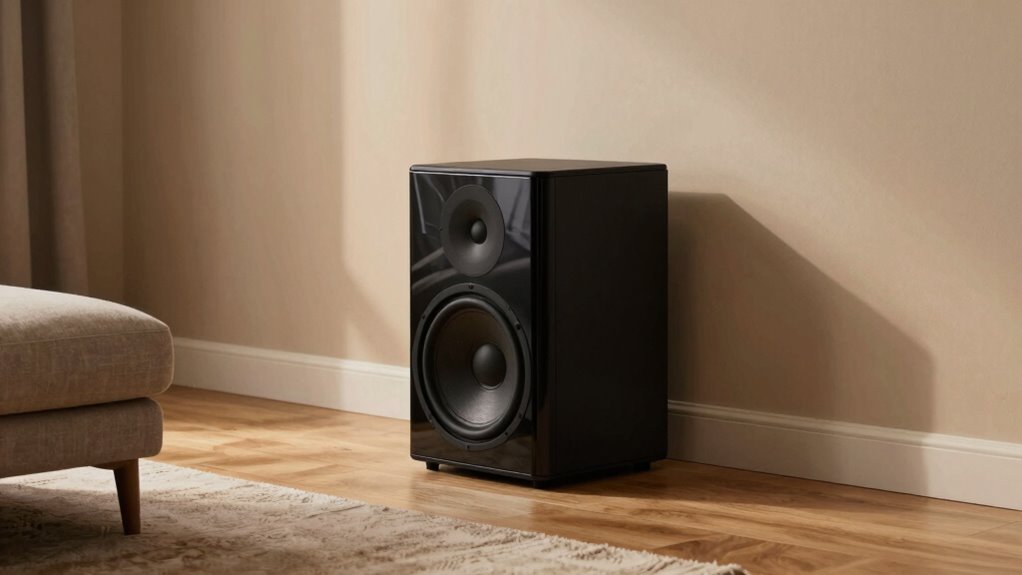
You might notice your subwoofer sounds off or lacks depth, indicating placement errors. To fix this, you need to identify where issues like wall proximity or furniture blocking sound are occurring. Adjusting for room interference helps guarantee your subwoofer delivers clear, balanced bass. Additionally, considering the safety of furniture placement can prevent accidental damage and improve sound quality. Being aware of room acoustics can further enhance your setup by minimizing sound reflections and dead spots. Proper subwoofer positioning is essential to optimize sound performance and avoid common listening issues. Paying attention to luxury lifestyle products in your setup can also elevate your overall audio experience by integrating premium accessories or furniture designed to complement high-end audio equipment. Recognizing early warning signs of suboptimal placement can help you make timely adjustments for the best sound.
Identifying Placement Errors
Incorrect subwoofer placement often leads to uneven bass response and muddiness in your sound, making it vital to identify common placement errors. Common mistakes include poor speaker orientation, which can disrupt sound dispersion, and furniture obstruction that dampens or distorts bass. You might also place the subwoofer too close to walls or corners, creating boomy or muddy sound. To fix these issues, check if the subwoofer’s speaker orientation is aimed for ideal sound spread and ensure no furniture blocks its movement. Additionally, avoid positioning the sub too close to walls or corners, which can cause unwanted resonances. By recognizing these errors, you can adjust the placement without buying new equipment, achieving clearer, more balanced bass throughout your space.
Adjusting for Room Interference
Room interference can markedly impact your subwoofer’s sound quality, causing uneven bass response or boomy resonances. To improve the room acoustic, start by identifying areas where sound reflections are strongest. Moving your subwoofer slightly or angling it differently can reduce these reflections, smoothing out bass response. Use your ears to detect where bass sounds muddy or exaggerated, and experiment with repositioning until the sound feels balanced. Sometimes, placing the subwoofer closer to a wall or corner amplifies bass due to boundary reinforcement, but this can also cause boomy effects. Adjusting placement to minimize problematic reflections and avoid placing the sub near reflective surfaces helps create a cleaner, more consistent bass experience. Small changes can considerably enhance your listening environment.
Making the Most of Walls and Room Layouts

Maximizing the placement of your subwoofer involves understanding how walls and room layouts influence sound. Walls can cause wall reflections that boost or muddy bass, so experimenting with positioning can improve clarity. Room layout also matters—furniture interference can block or absorb bass frequencies, reducing performance. To optimize your subwoofer placement, consider these tips:
- Use wall reflections to your advantage by placing the sub near a wall or corner for added bass fullness.
- Avoid furniture interference by moving the sub away from large or bulky pieces that can absorb or disrupt sound waves.
- Experiment with different distances from walls and furniture to find the spot that delivers smooth, even bass without boomy or muddled sound.
Tips to Keep Your Subwoofer Sound Perfect Over Time
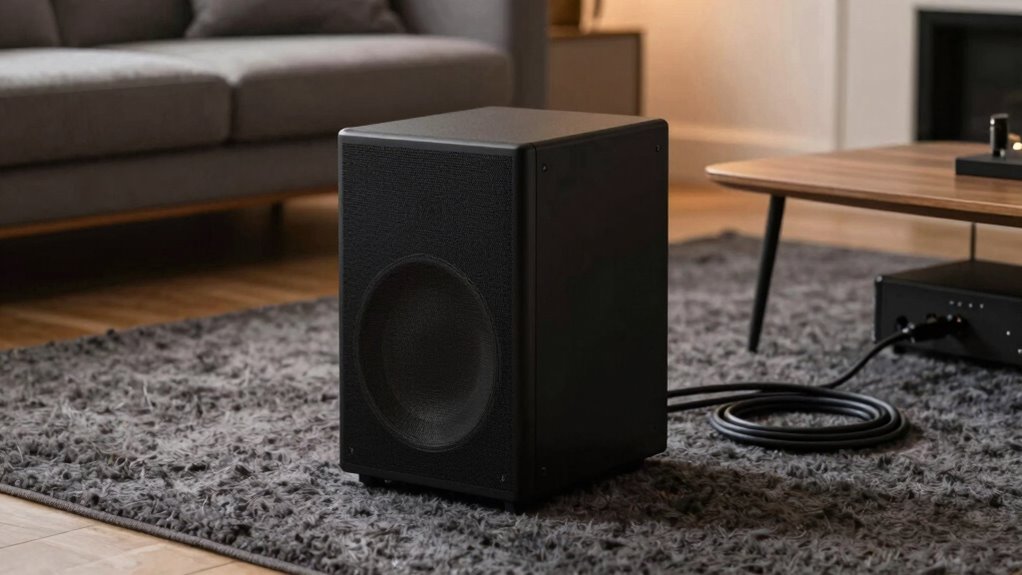
To keep your subwoofer sounding its best over time, regular maintenance and mindful care are essential. Start by guaranteeing proper subwoofer insulation around the cabinet to prevent unwanted vibrations and improve sound quality. Check connections periodically to avoid loose wires that can cause distortion. For wireless subwoofer placement, keep the device away from interference sources like Wi-Fi routers or Bluetooth devices, which can affect sound clarity. Maintain a stable position to prevent shifts that could alter sound output. Cleaning dust and debris from the subwoofer regularly also helps preserve performance. If you notice a drop in sound quality, consider repositioning the subwoofer or adjusting settings rather than buying new equipment. Proper care ensures your subwoofer continues delivering rich, deep bass for years to come.
Frequently Asked Questions
How Does Room Shape Affect Subwoofer Placement?
Room shape substantially affects subwoofer placement because it influences room modes, which cause bass peaks and nulls. Irregularly shaped rooms help distribute sound more evenly, reducing problematic resonances. You can improve bass response by using acoustic treatment, like bass traps, to minimize reflections and absorb excess energy. Experiment with different positions, especially near corners or walls, to find the spot where room modes are minimized and bass sounds clearer.
Can Furniture Placement Improve Bass Response?
Ever wonder if furniture placement can boost your bass? Absolutely! Strategically positioning your furniture, like using decorative shelving or acoustic panels, can help reflect and diffuse sound waves, enhancing bass response. Placing your sofa or shelves near the subwoofer minimizes sound obstacles and improves clarity. So, rearranging your furniture isn’t just aesthetic—it’s a simple, effective way to get richer, fuller bass without buying new gear.
What Tools Can Help Measure Optimal Subwoofer Positioning?
You can use measurement tools like a sound level meter or room calibration microphone to find the best subwoofer placement. These tools help you measure bass response at different spots, guiding your placement techniques to optimize sound. By testing various positions and analyzing the measurements, you’ll identify where the bass sounds fullest and smoothest, ensuring you get the best possible performance without any extra purchases.
How Often Should I Reposition My Subwoofer for Best Sound?
You should reposition your subwoofer whenever you notice changes in sound quality or after significant room modifications. Regular subwoofer calibration helps maintain ideal bass, so check your setup every few months. Incorporate soundproofing techniques to minimize bass loss and improve clarity. Use your ears and a measurement tool to identify the best spot, then fine-tune placement as needed, ensuring consistent, rich sound without constantly rearranging your setup.
Are There Specific Materials That Enhance Subwoofer Performance?
Material matters when it comes to boosting bass. You’ll find that dense, soft materials like carpets, curtains, and foam panels absorb unwanted sound waves, improving clarity. Conversely, reflective surfaces like bare walls or glass can cause sound distortion. Using acoustic treatments strategically enhances subwoofer performance, minimizing unwanted echoes and maximizing bass response. So, choose your materials wisely to create a balanced, booming sound environment without spending a dime.
Conclusion
Did you know that simply adjusting your subwoofer’s placement can dramatically improve your bass without spending a dime? It’s a proven fact that room layout and positioning impact sound quality more than many realize. By experimenting with different spots and considering walls and furniture, you can uncover richer, deeper bass. So, before buying anything new, try these simple tweaks—you might just discover that great sound is closer than you think!
Fall Picks
fall essentials
As an affiliate, we earn on qualifying purchases.