
TL;DR

Get the latest gadgets delivered free — and shop member deals
- Fast, free delivery on millions of items
- Access to Prime Big Deal Days deals on October 6–7
- Prime Video, Amazon Music and more included
IdeaClyst acts as a digital war room that combines AI-driven analysis with a founder’s workspace. It speeds up idea validation, surfaces hidden risks, and keeps all your insights private on your local machine, making smarter decisions faster.
Imagine standing inside a command center for your next big idea. Bright screens, charts, notes, and a team of skeptical advisors ready to poke holes. That’s the essence of a war room—except now, it’s digital, private, and powered by AI-driven analysis. If you’ve ever wrestled with uncertainty, you’ll want to see how IdeaClyst turns chaos into clarity.
This isn’t just about brainstorming; it’s about making the hardest decisions with confidence. In this article, you’ll learn how a digital war room like IdeaClyst helps you visualize progress, centralize insights, and test ideas faster than ever before. It’s a game-changer for founders tired of hoping they picked the right idea—because now, you’ll know.
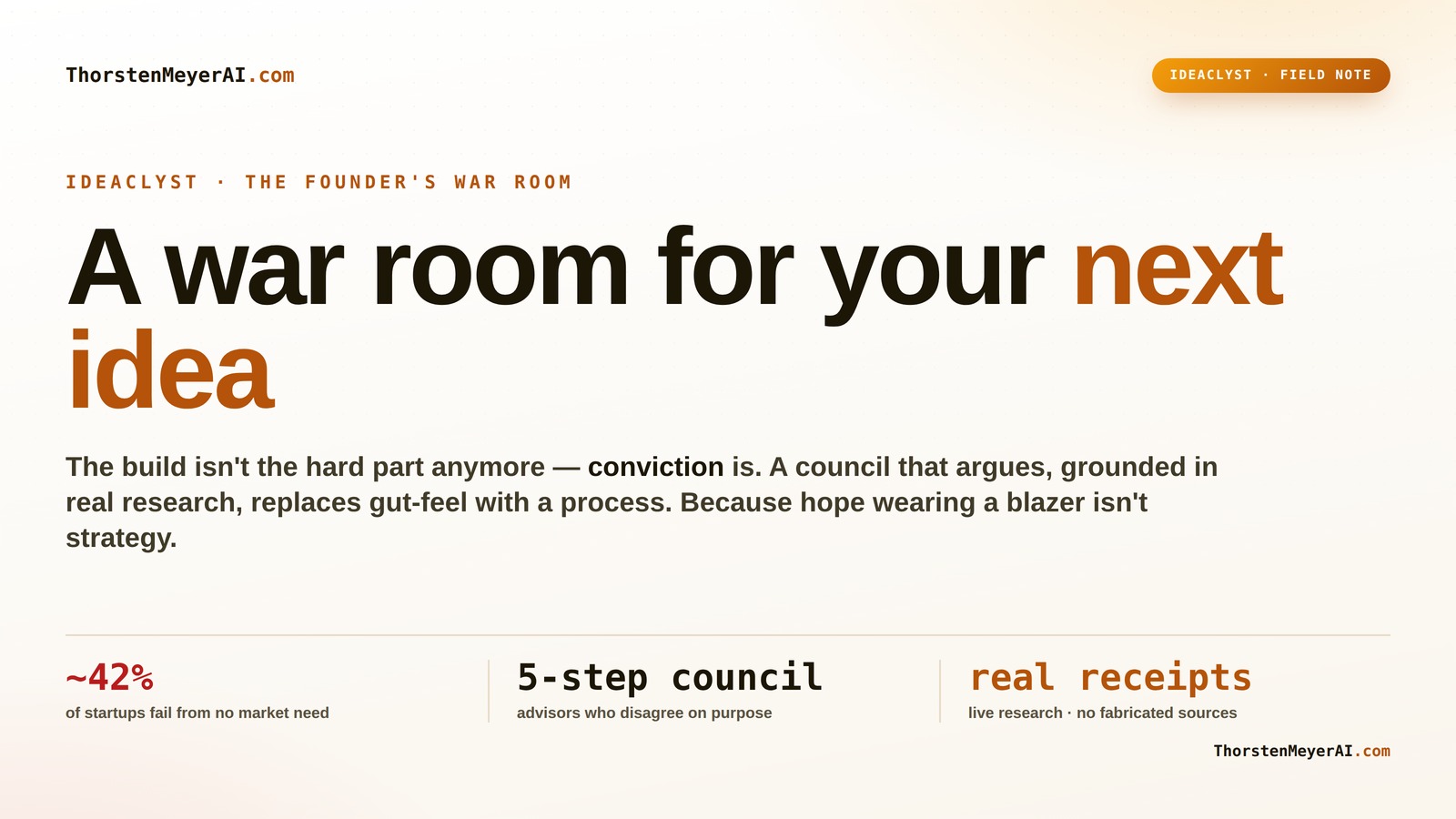
A war room for your next idea
The build isn’t the hard part anymore — conviction is. Knowing which idea deserves the next six months, and being able to defend it. Most founders answer with gut feel and optimistic math. That’s hope wearing a blazer. IdeaClyst replaces it with a process.
The most expensive decision is what to build
The single most valuable thing a tool can do is talk you out of the wrong six months. The numbers make the case better than any pitch.
Three tools in one — on your own machine
Strip away the framing and IdeaClyst is three things at once, all running locally with nothing leaving your laptop.
An AI council
Pressure-tests an idea you bring it — advisors who argue on purpose.
A discovery engine
Finds ideas you didn’t know to look for by hunting real demand signals.
A founder’s workspace
Carries winners from “interesting” all the way to “ready to build.”
Advisors who disagree on purpose
Not one confident, agreeable answer — a structured five-step deliberation where models play different roles and turn on their own work. The disagreement is the feature.
The five-step deliberation
A council that leads with the bad news surfaces the objections you’d otherwise find the expensive way, on month five.
Product strategy
Who’s it for, what’s the wedge, why now, what’s the business model.
Technical architecture
What would it actually take to build — and where’s the risk.
Critique pass
The council turns on its own work. Where’s the hand-waving? What kills this?
Second, independent critique
A different voice, a different angle — so blind spots don’t survive.
Final synthesis
Everything into one coherent founder packet: strategy, architecture, validation, plan.
When IdeaClyst cites a source, it actually fetched it
The hard departure from “ask an AI what it thinks of my startup.” It runs in a strict, real-data-only mode — if it can’t gather genuine evidence, it says so plainly rather than inventing a plausible paragraph.
Confidence with receipts
No fabricated statistics, no imaginary competitors, no made-up citations. The packet survives a skeptical co-founder or a sharp investor because the reasoning has receipts.
Market research first
Scouts the landscape before the council reasons about anything.
Competitor read
Real positioning, pricing signals, feature claims — differentiation vs. reality.
Validation with links
Not “talk to customers” — concrete signals & sources you can click.
From the blank page to build-ready
Evaluation is half the problem; the blank page is the other half. And a plan is worthless if it dies in a tab you never reopen.
Bring a space, not an idea
“AI for accountants,” “tools for indie game studios” — plus your goal and real capacity. It hunts demand signals across HN, Reddit, Product Hunt, GitHub, pricing pages.
- An honest market read — leads with the bad news when a space is hard
- An opportunity map — high pain, thin competition
- Ranked candidates — wedge, who pays, effort, risk, confidence
- each with KILL CRITERIA — when to walk away
A home and a forward path
Every promising idea gets carried forward, with every artifact in plain files on your disk.
- Validation tooling — sprint board, interview list, evidence browser
- Founder profile — a personal-fit lens; same discovery, different advice
- Build workspaces — funnel, personas, landing draft, version history
- “Build this idea” → a PRD + task queue, ready for a coding agent
Key Takeaways
- A digital war room like IdeaClyst centralizes all your idea validation efforts, making complex decisions easier.
- Grounding your analysis in live web research reduces false confidence and aligns your plans with real-world data.
- The AI council stage exposes risks and biases early, saving months and thousands of dollars.
- Using a local-first, privacy-focused tool keeps your ideas secure and accessible, even offline.
- Building a simple, flexible digital war room in five steps can dramatically improve your decision quality.
AI-powered idea validation software
As an affiliate, we earn on qualifying purchases.
As an affiliate, we earn on qualifying purchases.
What a Digital War Room Actually Does for Your Ideas
A digital war room is a dedicated space—online or offline—where your team visualizes, tracks, and tests ideas in real time. You can learn more about latest technology trends that can be integrated into your war room setup. Picture a sleek dashboard on your laptop, filled with charts, notes, and AI suggestions, all in one place. It’s like a control tower, guiding you through the fog of uncertainty.
For example, a SaaS founder might use the war room to map out potential customer segments, competitors, and technical risks side-by-side. Seeing everything at once helps catch gaps or overconfidence before sinking months into a losing proposition. Discover how innovative tools can enhance your decision-making process.
Beyond just centralizing information, a digital war room encourages a mindset of continuous iteration. It allows teams to adapt their strategies based on fresh data and insights, rather than relying on static plans or gut feelings. This ongoing process reduces the risk of making decisions based on outdated assumptions, which is crucial in fast-changing markets. Check out drone and UAV innovations that can provide new perspectives for your projects. It also fosters transparency—everyone involved can see the current state of the project, promoting accountability and aligned understanding.
Why Visibility Turns Good Ideas Into Great Decisions
Visibility is the secret sauce. When your entire team or yourself can see every piece of the puzzle, decision fatigue drops. You notice patterns, risks, and opportunities emerging in plain sight. This comprehensive view reduces the cognitive load—less mental juggling means better, faster choices.
Take, for instance, a startup testing a new feature. Instead of relying on assumptions or scattered data, they load user feedback, technical estimates, and market data into the war room. With everything visible, they can quickly identify whether the feature addresses real customer needs or just sounds good on paper. This prevents costly missteps and helps prioritize efforts where they matter most.
Research shows that teams with high transparency make 30% faster decisions and are 25% more likely to pivot when needed. The reason? Clear visibility minimizes miscommunication, aligns expectations, and empowers faster course corrections. It also fosters a culture of data-driven decision-making, where intuition is supported by evidence rather than guesswork. The tradeoff is that maintaining high transparency requires discipline—consistent updates and honest assessments—but the payoff is a more agile, confident team.
Physical vs. Digital War Rooms: Which Is Right for You?
Physical war rooms are walls covered in sticky notes, whiteboards, and charts. They work well for teams in the same room, fostering face-to-face energy. But they’re limited by space, accessibility, and the need for physical presence. They also tend to be static, making it hard to update or share insights remotely, which can slow down decision cycles.
Digital war rooms, like with IdeaClyst, break free from these limits. They let remote teams collaborate effortlessly, keep an organized record, and quickly update data. Everything is searchable and versioned—no sticky notes lost or overwritten. This flexibility means ideas can evolve in real-time, and stakeholders across different locations can stay aligned without the logistical headache of physical meetings.
For example, a distributed startup might use IdeaClyst to simulate a war room on their laptops, sharing real-time updates with investors and partners across time zones. This setup reduces delays, fosters a culture of continuous feedback, and allows for rapid iteration. The tradeoff is that digital tools require discipline to keep data organized, but the benefits of accessibility, scalability, and real-time collaboration outweigh this challenge.
How to Build Your Own Digital War Room in 4 Steps
- Define your core questions—What are the key uncertainties about your idea? Clarifying these helps focus your research and testing efforts, ensuring you’re not just gathering data but addressing the right risks and assumptions.
- Gather data—Use live web research, customer feedback, and technical estimates. The quality and relevance of your data directly impact the insights you gain. Prioritize sources that are current and authoritative to avoid basing decisions on outdated or biased information.
- Organize into sections—Strategy, risks, validation tests, critiques—like an outline for your project. This structure helps you see gaps, redundancies, and areas needing deeper investigation, making your decision process more rigorous.
- Use tools like IdeaClyst to connect everything—AI council, research, and plan—making it easy to update and review. This integrated approach ensures your insights are always current and your assumptions are challenged regularly, reducing the risk of oversight or bias.
For example, a solo founder might spend a Sunday setting up a simple Markdown file with sections for each step. As they research, they update the file, watching their idea mature in real time. This process fosters continuous refinement and keeps decision-making agile.
It’s not about perfection. It’s about creating a living document that guides your decisions, helps you adapt quickly, and keeps everyone aligned—even if that team is just one person. For more insights, visit technology reviews and tips.
What Makes IdeaClyst Different from Other Idea Tools?
Unlike generic brainstorming apps, IdeaClyst is built for rigorous validation and deep analysis. It combines AI with live web research—so your insights are grounded in current, real-world data. This ensures your validation isn’t just based on assumptions or static templates but reflects actual market conditions, user behaviors, and competitive landscapes. This depth means you’re more likely to identify real risks and opportunities early, rather than chasing false positives or superficial trends.
It also emphasizes privacy: everything stays on your local machine, not in the cloud. That’s a significant advantage for founders concerned about sensitive ideas leaking or data privacy. This local-first approach means you retain full control over your data, reducing security risks associated with cloud storage or third-party servers.
Furthermore, IdeaClyst’s council stage forces models to challenge your assumptions actively, encouraging critical thinking rather than passive note-taking. This debate-like process surfaces hidden biases and blind spots, making your plan tougher, smarter, and less likely to blow up later. The combination of deep validation, privacy, and active critique sets IdeaClyst apart from more superficial, less rigorous tools.
How Grounding Your Idea in Live Web Research Saves You Time and Money
Research is the backbone of good validation. IdeaClyst’s live web research feature pulls in the latest data—market trends, competitors, customer needs—directly into your analysis. This approach reduces months of surveys, focus groups, and guesswork, enabling you to base decisions on current, relevant information. The real-time aspect means you’re not relying on outdated reports but continuously updating your understanding as markets evolve.
For example, instead of relying on a dated market report, you get real-time insights from current web data, social media chatter, and news. This immediacy accelerates your decision cycle from months to hours, giving you a competitive edge and reducing the risk of investing in ideas that no longer fit the market landscape.
According to recent startup data, founders using live research cut validation time by over 50%, saving thousands of dollars and preventing costly pivots or failed launches. This integration of current data not only speeds up your process but also improves accuracy, helping you avoid costly mistakes and focus resources on ideas with genuine market fit.
Frequently Asked Questions
Is IdeaClyst a physical war room or a software tool?
IdeaClyst is a digital, local-first software tool designed to act as a virtual war room. It runs entirely on your machine, storing all data locally, with no need for cloud accounts or subscriptions.How does IdeaClyst help me validate my ideas faster?
By grounding analysis in live web research and simulating debate among AI council models, it streamlines research and highlights risks early—reducing validation time from months to hours.Can a solo founder use IdeaClyst effectively?
Absolutely. It’s designed for individual entrepreneurs who want a structured, private space to develop and validate ideas without relying on external tools or services.What makes IdeaClyst different from other validation tools?
Its emphasis on live, real-world research, structured council debates, and local data storage set it apart. It combines AI insights with current market data, all while keeping your ideas private.How do I keep my war room updated over time?
Regularly incorporate new research, update your validation tests, and refine your architecture and strategy sections. The flexible Markdown format makes continuous updates simple and straightforward.Conclusion
In a world where uncertainty rules, your best weapon is clarity. IdeaClyst transforms the chaos of new ideas into a structured, evidence-backed process—your own digital war room. The next big breakthrough doesn’t have to be a shot in the dark; it can be a confident step forward, grounded in real research and sharp analysis.
So, set up your war room today. Keep your ideas close, your data closer, and let your decisions speak for themselves. After all, in the race of innovation, clarity wins.
Fall Picks
fall essentials
As an affiliate, we earn on qualifying purchases.