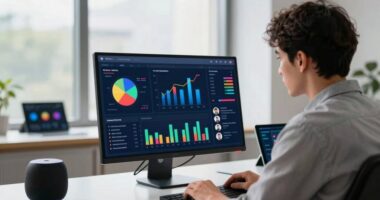
Digital twins are virtual models that replicate your physical assets, helping you optimize operations and predict issues before they happen. By using real-time data and advanced simulations, you can monitor performance, reduce downtime, and extend asset lifespan. These digital copies enable you to make smarter decisions, run what-if scenarios, and improve efficiency. Continuing to explore this technology reveals how it can transform your asset management and boost operational success.

Get the latest gadgets delivered free — and shop member deals
- Fast, free delivery on millions of items
- Access to Prime Big Deal Days deals on October 6–7
- Prime Video, Amazon Music and more included
Key Takeaways
- Digital twins are virtual replicas of physical assets used for real-time performance monitoring and operational optimization.
- They enable predictive maintenance by analyzing sensor data to forecast and prevent potential failures.
- High simulation accuracy requires quality data, advanced algorithms, and ongoing calibration to mirror real-world conditions.
- Digital twins support scenario testing and data-driven decisions to enhance asset efficiency, safety, and cost management.
- As technology advances, digital twins become essential tools for maximizing asset performance and ensuring operational excellence.

Have you ever wondered how companies can monitor and optimize their physical assets in real time? That’s where digital twins come into play. A digital twin is a virtual replica of a physical asset—like a machine, building, or even an entire factory—that mirrors its real-world counterpart. These models enable you to see how your assets perform, identify issues before they become serious, and optimize operations without interrupting daily activities. By harnessing digital twins, you gain a powerful tool for predictive maintenance, reducing downtime and extending asset life.
Digital twins are virtual models that optimize asset performance and enable predictive maintenance in real time.
One of the key advantages of digital twins is their ability to facilitate predictive maintenance. Instead of waiting for a machine to break down, you can analyze real-time data fed from sensors embedded in the physical asset. This data feeds into the digital twin, giving you a detailed, up-to-date picture of its condition. With this information, you can predict potential failures before they happen, scheduling maintenance only when necessary. This approach minimizes unnecessary repairs and prevents unexpected outages, saving you money and productivity. Furthermore, the success of predictive maintenance hinges on simulation accuracy. The more precise your digital twin models are, the better they reflect real-world conditions. High simulation accuracy means you can trust the model’s predictions and insights, making your maintenance decisions more reliable. Achieving this accuracy involves integrating high-quality data, sophisticated algorithms, and continuous calibration of the digital twin to mirror real-world changes. As a result, your predictive maintenance strategies become more effective and efficient.
Implementing digital twins also helps streamline your decision-making process. Instead of relying solely on historical data or reactive responses, you can run simulations to see how different scenarios might impact your assets. For example, you can test how a change in operational parameters affects performance or lifespan. This proactive approach allows you to optimize asset usage, reduce costs, and enhance safety. Additionally, digital twins support ongoing monitoring, providing insights into wear and tear, energy consumption, and operational efficiency in real time. This continuous feedback loop ensures you stay ahead of potential problems and can make data-driven choices quickly. Moreover, understanding the importance of data quality in digital twin models ensures that the simulations and predictions are accurate and trustworthy, emphasizing the need for reliable sensors and data collection methods.
In essence, digital twins give you a virtual window into your physical assets, transforming how you maintain and operate them. By focusing on predictive maintenance and guaranteeing simulation accuracy, you’re better equipped to prevent failures, cut costs, and maximize asset performance. As technology advances, digital twins will become even more integral to industrial and commercial success, offering smarter, more responsive asset management. Embracing this innovation puts you at the forefront of operational excellence, helping you adapt swiftly to changing conditions and demands.
digital twin software for asset management
As an affiliate, we earn on qualifying purchases.
As an affiliate, we earn on qualifying purchases.
Frequently Asked Questions
How Do Digital Twins Handle Real-Time Data Integration?
You handle real-time data integration in digital twins by guaranteeing sensor synchronization, which keeps data consistent across devices. You also minimize data latency by using fast communication networks and efficient processing algorithms. This way, the digital twin receives up-to-the-minute information, allowing you to analyze and respond quickly to changes in the real-world environment. Proper integration ensures your virtual model reflects reality accurately and in real time.
What Industries Benefit Most From Digital Twin Technology?
You benefit most from digital twin technology in manufacturing and healthcare diagnostics. In manufacturing, digital twins boost efficiency by simulating processes and predicting maintenance needs, reducing downtime. In healthcare, they enhance diagnostics by creating detailed virtual models of patients, enabling personalized treatment plans. These industries leverage digital twins to optimize operations, improve outcomes, and reduce costs, making them prime sectors for this innovative technology.
How Secure Are Digital Twin Systems From Cyber Threats?
Digital twin systems can be quite secure when you implement strong cybersecurity measures and data encryption. You should regularly update security protocols, use multi-factor authentication, and monitor for threats to protect sensitive data. While no system is completely invulnerable, these practices considerably reduce your risk of cyber attacks. Staying vigilant and investing in robust security helps ensure your digital twin remains safe and reliable for real-world applications.
What Are the Costs Associated With Implementing Digital Twins?
The costs of implementing digital twins involve a detailed cost analysis, considering software, hardware, and ongoing maintenance. You’ll face implementation challenges like integrating data systems and ensuring cybersecurity. While initial investments can be significant, the long-term benefits—improved efficiency and predictive maintenance—often justify the expense. Planning carefully and understanding these costs upfront helps you manage budgets effectively, ensuring a smoother shift to digital twin technology.
How Do Digital Twins Evolve With Changing Physical Assets?
Ever wonder how your digital twin stays in sync with changing physical assets? It evolves through continuous sensor calibration, updating data to reflect real-time conditions. Data visualization tools help you see these changes clearly, enabling quick adjustments. By constantly refining the virtual model, your digital twin adapts seamlessly, ensuring accurate simulations and optimizations, even as your physical asset transforms. This ongoing process keeps your digital twin reliable and effective.
Conclusion
You now stand at the edge of a new era, where digital twins mirror your world in endless detail. Imagine watching a virtual model breathe life into your operations, guiding you through unseen currents and hidden efficiencies. As data flows like a steady stream, your decisions become sharper, faster, more precise. Embrace this digital symphony, where technology and reality dance in harmony, revealing endless possibilities and transforming your world into a seamless, optimized landscape.
Fall Picks
fall essentials
As an affiliate, we earn on qualifying purchases.