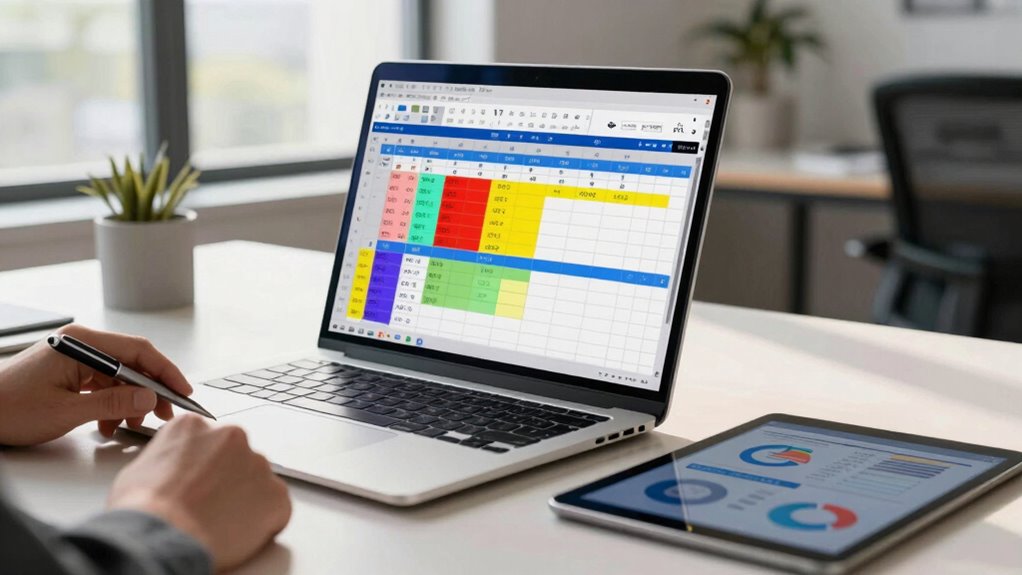

A well-designed automation ROI spreadsheet helps you identify projects that waste resources and don’t deliver real value. It tracks manual oversight, workflow impacts, and efficiency improvements to guarantee automation projects truly benefit your business. By comparing expected gains with actual outcomes, you can stop dead-end initiatives before they drain resources. Using this tool regularly keeps your automation efforts aligned with your goals. Keep exploring further to see how this spreadsheet can become your decision-making secret weapon.
Key Takeaways
- The spreadsheet evaluates automation projects based on measurable business benefits like time savings, error reduction, and cost efficiency.
- It tracks manual oversight to identify when automation increases complexity or requires ongoing manual intervention.
- The tool identifies process bottlenecks and assesses whether automation effectively streamlines workflows and reduces delays.
- It serves as a decision-making guide to prioritize high-ROI projects and eliminate those unlikely to deliver value.
- The spreadsheet ensures strategic resource allocation by aligning automation efforts with overall business performance goals.

Automation ROI, or Return on Investment, measures how effectively your automation efforts translate into tangible business gains. It’s not just about cutting costs or speeding up tasks—it’s about guaranteeing that your automation projects genuinely add value. When you delve into automation, it’s tempting to assume that more automation automatically equals better results. But without proper evaluation, you risk investing time and resources into projects that don’t deliver. That’s where a well-designed spreadsheet becomes your best tool—a simple yet powerful way to identify and stop bad projects before they drain your resources.
Automation ROI measures value, ensuring your projects deliver real business gains and prevent resource-wasting failures.
You need to examine how much manual oversight is involved in your current processes. If a task requires constant human intervention, automation might not be as straightforward as it seems. Automating complex processes that demand ongoing manual oversight often leads to more problems than solutions. It creates process bottlenecks rather than alleviating them, because the automation isn’t truly reducing workload but shifting it. Your spreadsheet should track the level of manual oversight each project needs and compare it against expected gains. If the automation increases oversight or complicates workflows, that project may not be worth pursuing.
Process bottlenecks are another critical factor to evaluate. When automation fails to address core inefficiencies or, worse, introduces new delays, it’s a sign you’re heading down the wrong path. Your spreadsheet should help you quantify how automation impacts process flow, highlighting areas where bottlenecks persist or worsen. If a project doesn’t improve cycle times or reduces accuracy, it’s a clear sign that the investment isn’t paying off. You can then prioritize projects that streamline workflows and eliminate delays, guaranteeing your automation efforts deliver real efficiency gains. Additionally, understanding the cost-benefit analysis of each project can help clarify whether the automation justifies the investment.
This spreadsheet isn’t just a tally sheet—it’s a decision-making tool. It forces you to ask hard questions: Does this automation reduce manual oversight? Does it eliminate process bottlenecks or just relocate them? Will it generate measurable business value, such as faster turnaround times, fewer errors, or lower costs? By systematically analyzing these factors, you can prevent bad projects from consuming your budget and time. Recognizing the importance of process analysis helps ensure your automation investments are truly effective and aligned with your overall goals. Furthermore, incorporating ROI metrics into your evaluation provides a quantitative basis for decision-making, helping you prioritize high-impact projects.
In essence, your spreadsheet acts like a guardrail, keeping your automation initiatives on track. It helps you identify projects that have the potential to deliver high ROI and weed out those likely to fail or cause more problems. As a result, you’re not just throwing resources into automation for its own sake—you’re making strategic, data-backed decisions that improve your overall business performance. This approach guarantees your automation investments truly pay off, making your ROI a reliable measure of success rather than just a number on paper.
automation ROI spreadsheet template
As an affiliate, we earn on qualifying purchases.
As an affiliate, we earn on qualifying purchases.
Frequently Asked Questions
How Long Does It Take to See ROI From Automation?
You can typically see ROI from automation within a few months to a year, depending on your investment evaluation and the complexity of the automation metrics you track. By monitoring key automation metrics, you identify cost savings and efficiency gains early. Regularly reviewing these metrics helps you adjust strategies quickly, ensuring you maximize your return and justify continued investment in automation.
What Industries Benefit Most From Automation ROI Analysis?
Think of industry benchmarks as your lighthouse and ROI visualization as your map. You benefit most from automation ROI analysis in industries like manufacturing, finance, and healthcare, where processes are complex and data-driven. These sectors quickly see how automation boosts efficiency and cuts costs. By comparing your results against benchmarks, you gain clarity, ensuring your automation investments are strategic and profitable, guiding your ship safely toward growth.
Can Small Businesses Effectively Measure Automation ROI?
Yes, small businesses can effectively measure automation ROI. By tracking improvements in cost efficiency and employee productivity, you gain clear insights into automation’s impact. Use simple spreadsheets or tools to compare pre- and post-automation metrics, focusing on savings and efficiency gains. This helps you determine if automation investments are worthwhile, enabling smarter decisions that boost your bottom line and streamline operations.
What Are Common Pitfalls in Calculating ROI for Automation?
Many miss the mark in measuring automation ROI because of common challenges like calculation confusion and measurement inaccuracies. You might overlook hidden costs or overestimate benefits, leading to skewed success stories. To avoid these pitfalls, focus on precise data collection and clear benchmarks. Address automation challenges head-on by establishing consistent metrics, ensuring your calculations capture true value, and preventing poor project decisions based on flawed or fuzzy figures.
How Does Automation ROI Impact Overall Business Strategy?
Automation ROI influences your overall business strategy by guiding innovation metrics and emphasizing cost optimization. When you accurately measure ROI, you can prioritize automation projects that deliver the most value, fostering smarter investments. This focus encourages continuous improvement, streamlines operations, and aligns automation initiatives with strategic goals. As a result, your business becomes more competitive, agile, and efficient, ultimately supporting long-term growth and sustainable success.
Conclusion
Imagine a world where every project you undertake is a calculated step toward success, not a costly gamble. By leveraging automation ROI insights, you can stop bad projects before they drain your resources. Isn’t it time you looked at your spreadsheet and asked, “Is this worth the risk?” With clear data guiding your decisions, you’ll steer your team toward smarter, more profitable outcomes. Don’t let uncertainty steer your ship—let automation be your compass.