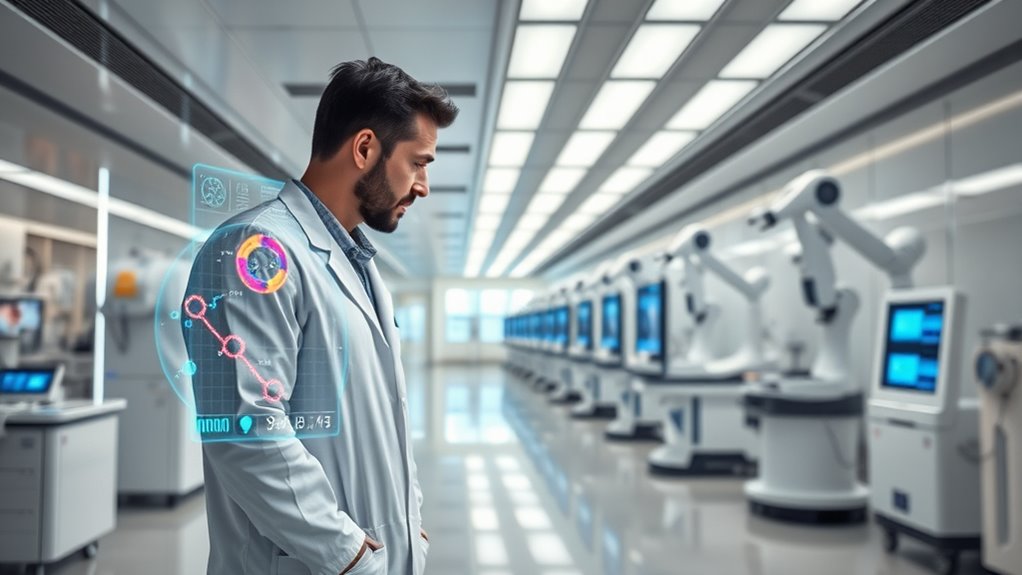

AI is transforming healthcare by enabling personalized medicine and improving diagnostics. It analyzes your genetic information and other health data to identify mutations, disease markers, and risk factors. This allows for more accurate, tailored treatments that can better suit your needs and reduce side effects. AI also predicts disease progression and outcomes, helping you catch health issues early. Keep exploring how AI continues to shape the future of personalized care and diagnostics.
Key Takeaways
- AI enables detailed genomic analysis for personalized diagnosis and targeted therapies.
- It predicts disease risks and treatment outcomes through advanced modeling.
- Integration of genetic, health records, and wearable data improves diagnostic accuracy.
- AI continuously learns from new data, refining personalized healthcare strategies.
- It enhances early detection and reduces healthcare costs via proactive intervention.

Have you ever wondered how artificial intelligence is transforming healthcare? One of the most exciting advancements is in personalized medicine and diagnostics, where AI tools are revolutionizing the way we understand and treat diseases. At the heart of this progress is genomic analysis, which allows you to examine an individual’s genetic makeup with incredible detail. By analyzing vast amounts of genetic data, AI algorithms can identify mutations, gene variations, and other markers that influence disease risk and treatment response. This means you can receive diagnoses and therapies tailored specifically to your genetic profile, increasing effectiveness and reducing adverse effects.
AI-driven genomic analysis enables personalized diagnoses and treatments tailored to your unique genetic makeup.
Predictive modeling plays a pivotal role in this landscape, helping healthcare providers forecast disease progression and treatment outcomes with greater accuracy. When AI leverages your genomic data through predictive modeling, it can anticipate potential health issues before they fully develop. For example, AI systems might analyze your genetic predispositions alongside lifestyle factors to predict your likelihood of developing conditions like cancer, diabetes, or heart disease. This proactive approach enables early interventions, potentially saving lives and improving quality of life.
With AI-driven genomic analysis, you’re no longer limited to broad, one-size-fits-all treatment plans. Instead, your healthcare becomes highly individualized, based on precise genetic information. This personalization extends beyond genetics; AI integrates data from electronic health records, imaging, and wearable devices to create comprehensive health profiles. These profiles allow for more accurate diagnoses, ensuring you receive the right treatment at the right time. For instance, if your genetic analysis indicates a higher risk for a certain type of cancer, your doctor can recommend targeted screening or preventive measures tailored specifically for you.
The power of predictive modeling also enhances diagnostic accuracy. When AI systems process your genetic data alongside clinical information, they can detect subtle patterns that might escape human observation. This enables earlier diagnosis of complex diseases, often before symptoms appear. Early detection improves treatment success rates and can considerably reduce healthcare costs. Additionally, AI continuously learns from new data, refining its predictions and ensuring that your personalized care evolves as more information becomes available. Incorporating AI-driven data analytics further enhances this process, allowing for more precise and dynamic healthcare strategies.
Frequently Asked Questions
How Does AI Ensure Patient Data Privacy and Security?
You can trust AI to protect patient data by implementing strong data encryption, which scrambles sensitive information to prevent unauthorized access. Access controls are also essential; they restrict data access only to authorized personnel. These security measures work together to guarantee your patient’s privacy remains intact, reducing risks of breaches and maintaining confidentiality throughout healthcare processes. This way, AI actively safeguards your data while supporting effective, personalized treatment.
What Are the Ethical Concerns With Ai-Driven Diagnoses?
Imagine an AI system diagnosing a patient, but bias mitigation isn’t considered, leading to misdiagnoses for certain groups. Ethical concerns include ensuring informed consent, so patients understand how AI makes decisions affecting their health. Bias can skew results, risking inequality. You must address these issues to maintain trust, fairness, and transparency in AI-driven diagnoses, protecting patient rights and promoting ethical healthcare practices.
How Accessible Are AI Healthcare Tools Globally?
You might find that AI healthcare tools are less accessible globally due to technology disparities and uneven global adoption. While some countries integrate advanced AI solutions into their healthcare systems, others face infrastructure challenges, limited internet access, and funding shortages. This creates a gap, making it harder for many populations to benefit from AI-driven diagnostics and personalized medicine, highlighting the need for international efforts to bridge these disparities and promote equitable healthcare technology access.
What Training Is Needed for Healthcare Professionals?
Like a modern-day Merlin, you need to master new skills to harness AI’s power. You’ll require specialized medical training to understand AI tools and develop AI literacy, ensuring you interpret data accurately. This includes learning about algorithms, data analysis, and ethical considerations. By staying updated through workshops and courses, you can confidently integrate AI into your practice, ultimately improving patient outcomes and advancing healthcare.
How Does AI Handle Rare or Complex Diseases?
AI handles rare and complex diseases through advanced algorithms that excel in rare disease detection and complex case analysis. You benefit from AI’s ability to analyze vast datasets, identify subtle patterns, and suggest potential diagnoses. This technology accelerates diagnosis, improves accuracy, and helps you develop personalized treatment plans. By continuously learning from new data, AI enhances your capacity to manage challenging cases effectively, ultimately leading to better patient outcomes.
Conclusion
Just as a master navigator guides a ship through uncharted waters, AI steers healthcare toward personalized medicine and precise diagnostics. With each innovation, you become part of a transformative journey, where data becomes your compass and algorithms your trusted crew. Embrace this voyage, knowing that, like a lighthouse shining through the fog, AI illuminates the path to better health outcomes. The future of medicine is ours to shape—boldly and confidently.