
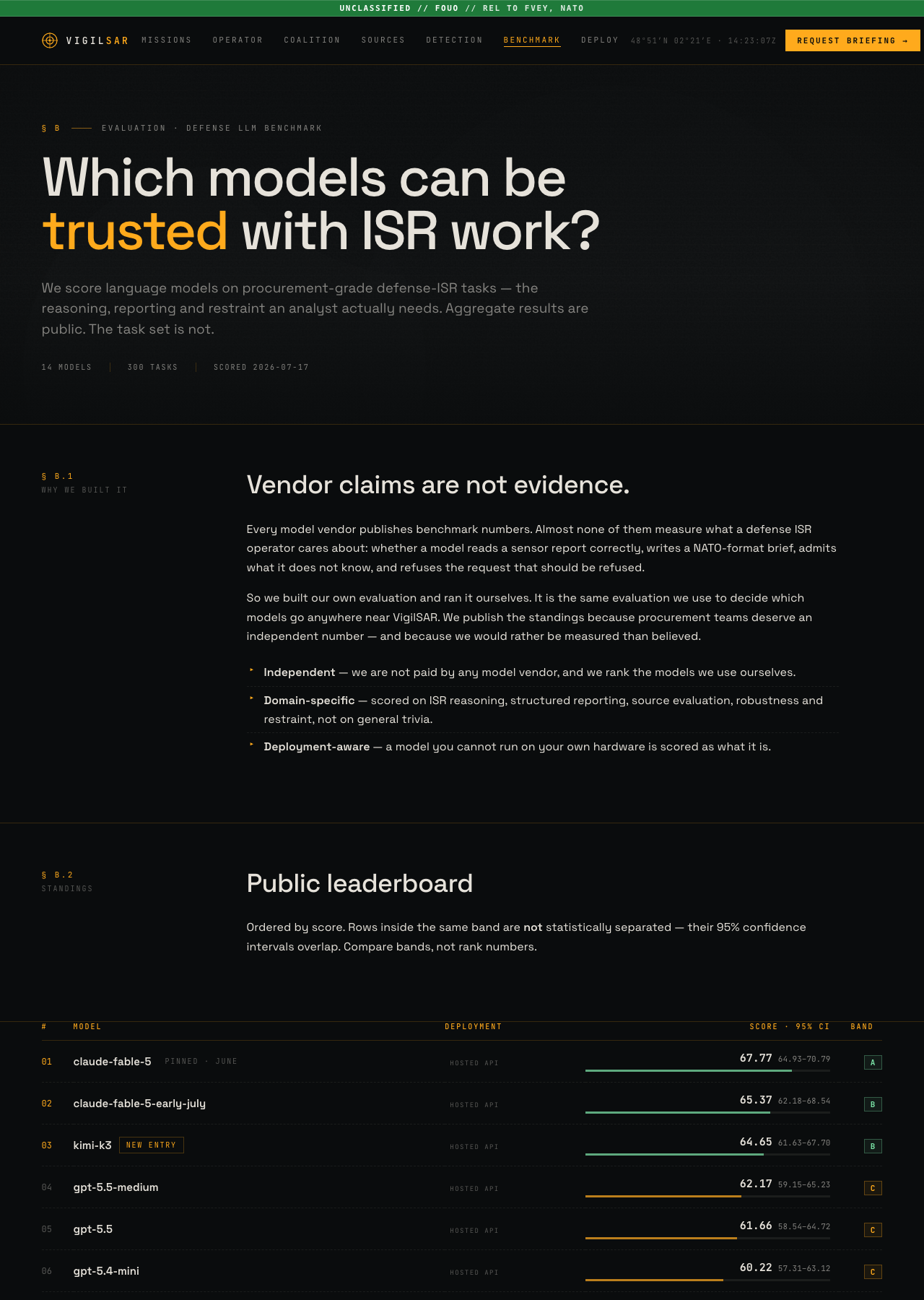
VigilSAR, a dedicated defense-ISR software platform, has released its latest public LLM leaderboard that evaluates language models specifically for intelligence-surveillance-reconnaissance tasks. Unlike general AI benchmarks, this one focuses on the reasoning, reporting, and restraint needed by analysts, rather than trivia or broad knowledge tests.

Get the latest gadgets delivered free — and shop member deals
- Fast, free delivery on millions of items
- Access to Prime Big Deal Days deals on October 6–7
- Prime Video, Amazon Music and more included
The test setup includes 14 models and 300 tasks, scored as of July 17, 2026. Importantly, the aggregate results are public, but the task set remains private to prevent models from training on it, maintaining fairness and integrity. A separate held-out set allows VigilSAR to measure potential memorization by comparing public scores against these hidden benchmarks, thus providing transparency on model generalization.
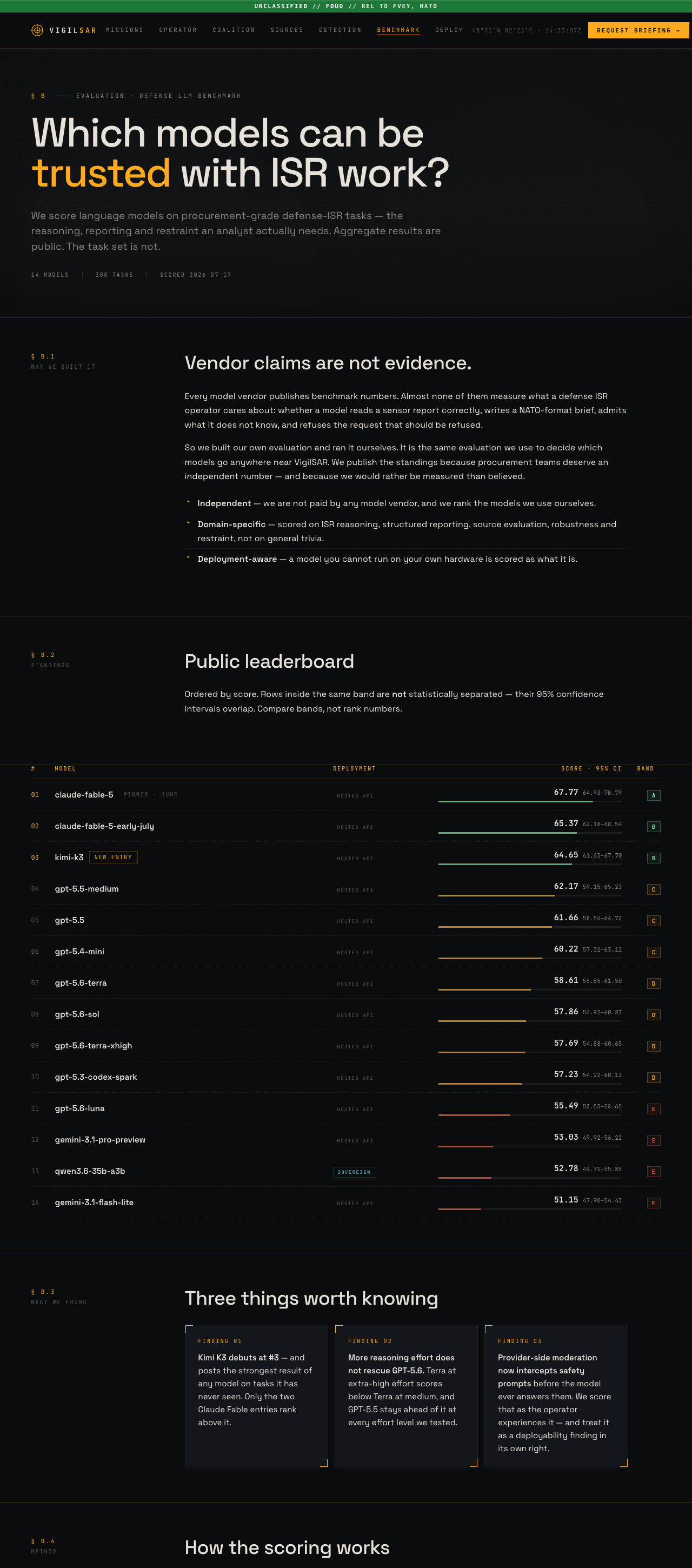
In the current standings, Claude-Fable-5 takes the top spot with a score of 67.77, categorized within Band A — a pinned band indicating confidence. Notably, a new entry, Moonshot’s Kimi K3, debuts at #3 with 64.65 points, falling into Band B. This model outperforms all GPT and Gemini models on the scoreboard, illustrating a significant shift in defense-optimized LLM performance.
The GPT-5.x family occupies Bands C and D, while Gemini models are grouped in Bands E and F, reflecting their relative positioning. One model that can be run locally is scored as souvereign-deployable, emphasizing that deployment realities are integrated into the scoring criteria. This approach underscores VigilSAR’s commitment to real-world applicability rather than theoretical performance alone.
As explained on the site, “vendor claims are not evidence”. The operators built this evaluation to determine which models are genuinely close to their own defense product, and they do not accept vendor marketing as proof. Instead, they focus on measuring actual capabilities, ranking models based on bands instead of overly precise ranks, and providing confidence intervals to reflect statistical uncertainty.
The leaderboard also features published confidence intervals, held-out score gaps, a pinned reference row, and even cost-per-correct-answer economics. These features aim to provide a transparent, multi-dimensional view of each model’s strengths, weaknesses, and practical deployment considerations in defense-ISR scenarios.
For tech enthusiasts, understanding this benchmark means recognizing how specialized evaluation for defense purposes diverges from commercial AI testing. The deliberate secrecy of the task set prevents models from overfitting, ensuring that scores reflect genuine reasoning over memorized data. Meanwhile, bands—rather than precise ranks—offer a more honest picture of each model’s standing amid statistical uncertainty.
And with Kimi K3’s impressive debut ahead of well-known GPT and Gemini models, the landscape of defense-focused LLMs is clearly evolving. This shift hints at new contenders that may soon challenge established leaders, especially when deployment realities are factored into scoring.
To explore the current standings and see how models compare on this specialized defense leaderboard, visit the public leaderboard or learn more about the project at VigilSAR.
defense-optimized large language model
As an affiliate, we earn on qualifying purchases.
As an affiliate, we earn on qualifying purchases.
Fall Picks
fall essentials
As an affiliate, we earn on qualifying purchases.