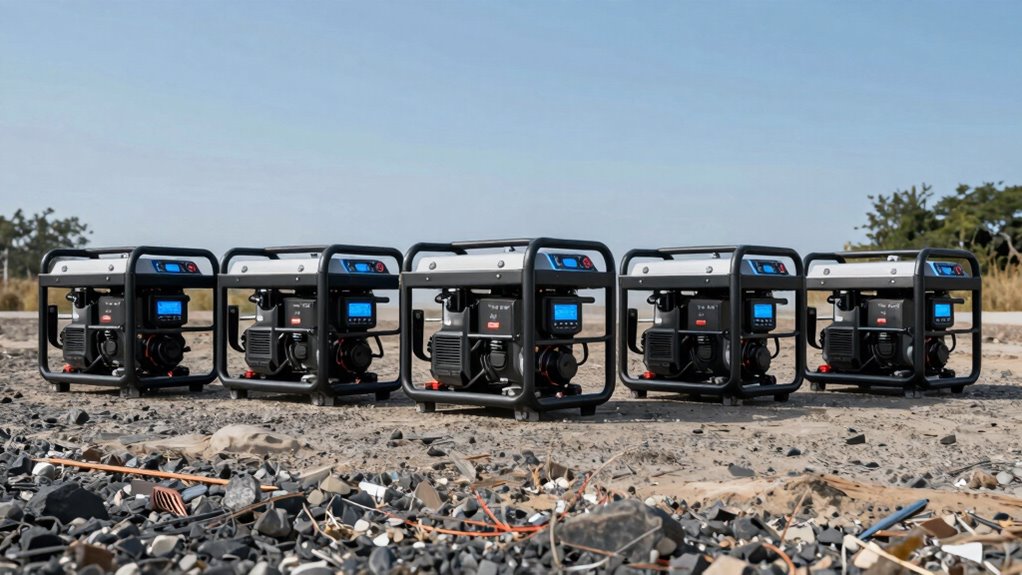

For a dual-fuel inverter generator around 9,000 watts, I rank the Champion 11,000-Watt Dual-Fuel first for its extra output headroom, while the Champion 9000-Watt is a closer match for buyers who want a right-sized home backup unit. The DuroMax XP9500iH stands out for remote starting, and the Westinghouse adds natural-gas compatibility if a third fuel option matters more than a strict dual-fuel match. The main tradeoffs are peak versus running watts, fuel flexibility, noise, portability, and the controls you want during an outage. Ratings and fuel use vary by model and operating conditions, so compare continuous output—not just the largest number in the name—with the loads you plan to run. Read on for my full breakdown of where each generator fits and which compromises are worth making.

Get the latest gadgets delivered free with Prime
- Fast, free delivery on millions of items
- Prime Video, Amazon Music and more included
- Member-only deals all year
Complete the kit


Key Takeaways
- More rated wattage can mean more usable headroom: the Champion 11,000-Watt leads this lineup for buyers with larger simultaneous loads, but it may be more generator than a basic backup setup needs.
- The Champion 9000-Watt is the closest match to the search: its listed output and inverter design make it a direct contender without leaning on an oversized headline figure.
- Fuel flexibility is not identical across the group: the Westinghouse is tri-fuel, including natural gas, while the other listed models are dual-fuel options.
- Remote start is a practical differentiator: the DuroMax and GENMAX list remote starting, which can be useful when the generator is positioned outdoors away from the house.
- Output figures need careful comparison: peak watts are not the same as sustained running watts, and fuel choice can affect available output; verify the exact rating for the load and fuel you expect to use.
| Champion 11,000-Watt Dual-Fuel Portable Inverter Generator with Electric Start |  | Best Overall for 9,000-Watt Running Output | Starting watts: 11,000 watts | Running watts, gasoline: 9,000 watts | Running watts, propane: 8,100 watts | VIEW ON AMAZON | See Our Full Breakdown |
| Champion Power Equipment 9000-Watt Electric Start Home Backup Portable Open Frame Inverter Generator with Quiet Technology and CO Shield |  | Best Gasoline-Only Home Backup Pick | Starting watts: 9,000 watts | Running watts: 7,250 watts | Fuel type: Gasoline | VIEW ON AMAZON | See Our Full Breakdown |
| Westinghouse 8200 Peak Watt Tri-Fuel Portable Inverter Generator, Remote Electric Start, Transfer Switch Ready, Gas, Propane, Natural Gas, Low THD, Safe for Electronics, Parallel Capable, CO Sensor |  | Best for Three-Fuel Flexibility | Peak watts, gasoline: 8,200 watts | Running watts, gasoline: 6,600 watts | Running watts, propane: 5,940 watts | VIEW ON AMAZON | See Our Full Breakdown |
| AIVOLT 8000W Dual-Fuel Inverter Generator |  | Best for Easier Handling in the Mid-Output Class | Surge power: 8,000 watts | Running power: 6,100 watts | Fuel types: Gasoline and propane | VIEW ON AMAZON | See Our Full Breakdown |
| DuroMax XP9500iH 9,500-Watt Dual Fuel Portable Digital Inverter Generator |  | Best for Remote Starting and Expandability | Starting watts: 9,500 watts | Running watts: 7,600 watts | Fuel description: Product description states gasoline and propane; supplied specs list gasoline | VIEW ON AMAZON | See Our Full Breakdown |
| GENMAX GM9000iEDC Portable Dual-Fuel Inverter Generator |  | Best for Expandable Backup Power | Peak output: 9,000 watts | Fuel types: Gasoline and propane | Engine: 458 cc, 4-stroke OHV | VIEW ON AMAZON | See Our Full Breakdown |
| dual fuel inverter generator 9000w | Engine | Fuel types | Noise level | Starting watts |
|---|---|---|---|---|
| Champion 11,000-Watt Dual-Fuel | 459cc single-cylinder OHV, 4-stroke | Gasoline and propane | 64 dBA at 23 feet | 11,000 watts |
| Champion Power Equipment 9000- | 420cc 4-stroke | — | 72 dBA | 9,000 watts |
| Westinghouse 8200 Peak Watt Tr | 298cc 4-stroke OHV | Gasoline, propane, and natural gas | — | — |
| AIVOLT 8000W Dual-Fuel Inverte | 322cc 4-stroke OHV | Gasoline and propane | 62 dBA at 23 feet | — |
| DuroMax XP9500iH 9,500-Watt Du | 459cc 4-stroke | — | — | 9,500 watts |
| GENMAX GM9000iEDC Portable Dua | 458 cc, 4-stroke OHV | Gasoline and propane | As low as 62 dBA at 25% load and 23 feet | — |
More Details on Our Top Picks
Champion 11,000-Watt Dual-Fuel Portable Inverter Generator with Electric Start
For buyers who mean 9,000 running watts when they search for a 9000W inverter generator, this Champion is the closest match in the group: it delivers that figure on gasoline and keeps clean power under 3% THD for sensitive electronics. Unlike the gasoline-only Champion 9000-Watt Open Frame, it can also run on propane, though output falls to 8,100 running watts on that fuel. Its electric start, CO Shield, and covered outlets suit home backup, while a listed 15-hour gasoline runtime at 25% load reduces refueling interruptions during lighter use. The tradeoff is size and heft: this is a high-output machine with a 459cc engine, not the easy-to-lift choice. Its propane runtime is also shorter, up to eight hours at 25% load with a 20-pound tank.
Pros:- Provides 9,000 running watts on gasoline and 8,100 on propane
- Less than 3% THD is suitable for sensitive electronics
- Electric start, Cold Start Technology, and CO Shield add convenience and safety features
- Listed gasoline runtime reaches 15 hours at 25% load
Cons:- High-output build may be cumbersome to move and store
- Propane runtime is listed at up to eight hours at 25% load with a 20-pound tank
- Must be operated outdoors, away from occupied buildings
Best for: Homeowners who need close to 9,000 watts of gasoline running capacity, want propane as a backup fuel, and plan to connect multiple household loads.
Not ideal for: Campers or solo users who prioritize easy loading and lighter-duty power; its heavy-duty output comes with a bulky format, and propane output is lower than gasoline output.
- Starting watts:11,000 watts
- Running watts, gasoline:9,000 watts
- Running watts, propane:8,100 watts
- Fuel types:Gasoline and propane
- Engine:459cc single-cylinder OHV, 4-stroke
- Gasoline runtime:Up to 15 hours at 25% load
- Noise level:64 dBA at 23 feet
- Power quality:Less than 3% THD
- Warranty:3-year limited warranty with lifetime technical support
Our verdict“Choose this Champion if matching 9,000 running watts on gasoline matters more than keeping the generator compact or light.”
Champion Power Equipment 9000-Watt Electric Start Home Backup Portable Open Frame Inverter Generator with Quiet Technology and CO Shield
This Champion makes the list for buyers who want inverter power and home-backup outlets but do not need dual-fuel flexibility. Its 7,250 running watts sit well below the 9,000-running-watt Champion dual-fuel model, so it is better suited to a smaller load plan than to buyers who need the roundup target as continuous output. It does, however, pair less than 3% THD with a 120/240V locking outlet and a 14-50R outlet, giving household and RV users useful connection options. Electric start, Cold Start Technology, CO Shield, and an Intelligauge make operation more approachable than a bare-bones unit. The compromises are clear: it runs on gasoline only, and its listed 72 dBA noise level is higher than the 64 dBA figure for the larger dual-fuel Champion.
Pros:- Less than 3% THD supports use with sensitive electronics
- Electric start and Cold Start Technology simplify starting
- Includes both 120/240V locking and 14-50R outlets
- Intelligauge displays voltage, frequency, and operating hours
Cons:- Gasoline-only operation offers less fuel flexibility than the other Champion in this roundup
- 7,250 running watts falls short of the 9,000W continuous-output target
- Listed noise level is 72 dBA
Best for: Homeowners and RV users who want an electric-start inverter with 120/240V connections and can work within 7,250 running watts on gasoline.
Not ideal for: Buyers who need 9,000 running watts or propane operation; the Champion dual-fuel 11,000-watt model offers both, while this one is gasoline-only and lower-output.
- Starting watts:9,000 watts
- Running watts:7,250 watts
- Fuel type:Gasoline
- Engine:420cc 4-stroke
- Fuel tank capacity:4.3 gallons
- Runtime:Up to 10.5 hours at 25% load
- Noise level:72 dBA
- Power quality:Less than 3% THD
- Outlets:120V 20A duplex, 120/240V 30A locking, 120/240V 30.2A 14-50R, 12V automotive-style, and dual-port USB adapter
Our verdict“Pick this model for gasoline-powered home backup with inverter features, but choose the larger Champion if you need dual fuel or closer to 9,000 running watts.”
Westinghouse 8200 Peak Watt Tri-Fuel Portable Inverter Generator, Remote Electric Start, Transfer Switch Ready, Gas, Propane, Natural Gas, Low THD, Safe for Electronics, Parallel Capable, CO Sensor
The Westinghouse stands apart by accepting gasoline, propane, and natural gas, a practical advantage for households with a natural-gas connection or limited fuel storage. That flexibility comes with lower output than the 9,000-running-watt Champion: the Westinghouse provides 6,600 watts on gasoline, 5,940 on propane, and 5,280 on natural gas. I would treat it as a flexible backup option, not a true 9,000W-running-watt substitute. Its 50A outlet, remote electric start, and under-3% THD make it useful for transfer-switch-ready home loads and electronics, while a 17-hour runtime at 25% load on a 3.9-gallon gasoline tank suits lighter demand. Compared with the AIVOLT 8000W, it adds natural-gas compatibility and a 50A outlet, but its running output remains lower than the headline 8,000W surge figure might suggest.
Pros:- Three fuel options include natural gas, unlike the dual-fuel models in this group
- 50A 120/240V outlet supports compatible home-backup connections
- Remote electric start and folding-handle wheel kit support easier operation and positioning
- Less than 3% THD and copper windings are specified for clean power
Cons:- Gasoline running output is 6,600 watts, well below the 9,000-watt Champion
- Running capacity drops to 5,280 watts on natural gas
- Only three outlets are listed, limiting direct connection options
Best for: Homeowners with access to natural gas who value fuel choice, remote starting, and a 50A home-backup connection more than high continuous wattage.
Not ideal for: Buyers who need around 9,000 running watts or expect full output on propane or natural gas; each alternate fuel reduces the available running capacity.
- Peak watts, gasoline:8,200 watts
- Running watts, gasoline:6,600 watts
- Running watts, propane:5,940 watts
- Running watts, natural gas:5,280 watts
- Fuel types:Gasoline, propane, and natural gas
- Engine:298cc 4-stroke OHV
- Gasoline runtime:Up to 17 hours at 25% load
- Power quality:Less than 3% THD
- Home-backup outlet:120/240V 14-50R 50A
Our verdict“Choose the Westinghouse when natural-gas access and a 50A backup connection matter more than reaching 9,000 running watts.”
AIVOLT 8000W Dual-Fuel Inverter Generator
The AIVOLT is a dual-fuel inverter for buyers who want a more manageable output class than the 9,000-running-watt Champion. Its 8,000W surge and 6,100W running output can cover a selected set of household essentials, but the running figure is not a match for a 9000W continuous-power requirement. The gasoline-or-propane choice gives it more fuel flexibility than the gasoline-only Champion 9000-Watt Open Frame, and the listed 62 dBA noise level is lower than that model’s 72 dBA. Wheels and a telescopic handle help with positioning, although 129 pounds still makes lifting a two-person task for many buyers. Its runtime claim of over 10 hours applies at 25% load, so heavier backup use will mean more frequent refueling than that headline suggests.
Pros:- Runs on gasoline or propane
- 62 dBA listed noise level is lower than the gasoline-only Champion 9000-Watt Open Frame’s 72 dBA
- Wheels and telescopic handle assist with ground-level movement
- CO auto-shutdown and low-oil shutdown provide added safety
Cons:- 6,100 running watts is well short of 9,000 watts
- At 129 pounds, it is heavy to lift without help
- The over-10-hour runtime is specified at only 25% load
Best for: RV owners and homeowners who need dual-fuel operation, moderate backup capacity, and wheels for moving the unit across a driveway or campsite.
Not ideal for: Buyers who require 9,000 running watts, frequently lift a generator alone, or expect the 10-hour runtime at substantial loads.
- Surge power:8,000 watts
- Running power:6,100 watts
- Fuel types:Gasoline and propane
- Engine:322cc 4-stroke OHV
- Runtime:Over 10 hours at 25% load
- Noise level:62 dBA at 23 feet
- Tank capacity:3.6 gallons
- Weight:129 pounds
- Voltage:120V/240V
Our verdict“Choose the AIVOLT for dual-fuel flexibility and wheeled mobility if 6,100 running watts covers your planned loads.”
DuroMax XP9500iH 9,500-Watt Dual Fuel Portable Digital Inverter Generator
The DuroMax is a strong middle ground for buyers who want more output than the AIVOLT without stepping up to the Champion’s 9,000 gasoline running watts. It delivers 7,600 running watts and 9,500 peak watts, with gasoline or propane operation, remote electric start, and an ATS-ready outlet. Its parallel capability gives buyers a path to expand capacity by linking a second compatible unit, though the kit is sold separately and the space and cost of a second generator are real planning factors. Compared with the Champion 11,000-watt model, the DuroMax offers remote starting and expansion but lists fewer outlets and lower running output. The supplied data also identifies gasoline as its fuel type despite the product description’s dual-fuel claim, so buyers should verify propane output and runtime before relying on that fuel for a backup plan.
Pros:- 7,600 running watts exceed the AIVOLT’s 6,100 watts
- Remote electric start makes starting possible from a distance
- ATS-ready outlet supports connection to a compatible automatic transfer switch
- Parallel capable for expansion with a second XP9500iH and a separate kit
Cons:- Running output remains below 9,000 watts
- Only two total power outlets are listed in the supplied product data
- The supplied specs list gasoline only, leaving propane output and runtime unconfirmed
Best for: Homeowners or RV users who value remote starting, ATS compatibility, and the option to add a second compatible inverter later.
Not ideal for: Buyers who need a clearly documented 9,000 running watts, many direct outlet choices, or confirmed propane performance without checking the manufacturer’s full specifications.
- Starting watts:9,500 watts
- Running watts:7,600 watts
- Fuel description:Product description states gasoline and propane; supplied specs list gasoline
- Engine:459cc 4-stroke
- Tank capacity:7 liters
- Runtime:19 hours listed
- Voltage:240 volts
- Parallel capability:Yes; parallel kit sold separately
- Safety features:CO alert and low-oil shutoff
Our verdict“Pick the DuroMax for remote starting and future parallel expansion, but verify its propane specifications and outlet needs before buying for home backup.”
GENMAX GM9000iEDC Portable Dual-Fuel Inverter Generator
The GENMAX GM9000iEDC pairs 9,000 peak watts with 7,600 rated watts on a single unit, giving it a clear home-backup role without relying on a larger starting-watt figure alone. Its standout distinction is parallel capability: connect a second compatible unit with the separately sold kit to reach the stated 15,200 running watts. That gives buyers a way to expand later, while the Westinghouse 8200 offers three fuel choices, including natural gas, rather than this model’s gas-or-propane setup.
Remote and electric start, a digital data center, and a carbon-monoxide shutoff add practical convenience during outages. The listed noise figure is 62 dBA at 25% load from 23 feet, but that is a partial-load measurement, not a guarantee at heavier demand. At 281.1 pounds, it is also a substantial machine despite its wheels and handle. I’d choose it for expandable backup capacity, not for easy solo lifting or the simplest out-of-box parallel setup.
Pros:- Provides 7,600 rated watts on one unit for substantial home backup loads.
- Runs on gasoline or propane, giving owners a second fuel option during supply disruptions.
- Parallel capability allows expansion with a second compatible unit and a separately sold kit.
- Remote and electric start, a digital data center, and CO shutoff support easier operation and monitoring.
Cons:- At 281.1 pounds, it is heavy to load or move without help, despite its wheels and handle.
- The parallel kit is sold separately, adding a required extra purchase for expansion.
- It does not offer the Westinghouse 8200’s natural-gas fuel option.
Best for: Homeowners who want a dual-fuel inverter generator now and may add a second compatible GENMAX unit for greater backup capacity later.
Not ideal for: Buyers who need a lightweight generator, natural-gas operation, or parallel capability without purchasing a separate kit.
- Peak output:9,000 watts
- Fuel types:Gasoline and propane
- Engine:458 cc, 4-stroke OHV
- Fuel tank capacity:6.9 gallons
- Noise level:As low as 62 dBA at 25% load and 23 feet
- Weight:281.1 pounds
- Parallel output:Up to 15,200 running watts with two compatible units; kit sold separately
- Compliance:EPA and CARB compliant
Our verdict“Choose the GENMAX if you want 7,600 rated watts with dual-fuel flexibility and a path to higher output, and can manage its weight and separate parallel kit.”

How We Picked
I ranked these generators around the needs behind a roughly 9,000-watt dual-fuel search: enough continuous power for substantial backup loads, the option to run on gasoline or propane, and inverter output suited to sensitive electronics. I gave weight to the stated output class, fuel options, starting controls, transfer-switch or parallel capability where listed, and features such as CO monitoring. I treated model names and peak-watt claims as starting points, not proof of equivalent running performance.
The order favors fit and useful headroom over the biggest headline number alone. The Champion 11,000-Watt ranks first for buyers who may need extra capacity; the 9000-Watt Champion follows as a more direct match. Other picks earn their place through different priorities—third-fuel flexibility, remote start, or a stated 8,000-watt class—while tradeoffs in exact output, fuel choice, and feature set keep them from ranking higher for every buyer. Before purchase, I would confirm the current manufacturer specifications for running watts on each fuel, dimensions, sound data, and included accessories.
| dual fuel inverter generator 9000w | Fuel types |
|---|---|
| Champion 11,000-Watt Dual-Fuel | Gasoline and propane |
| Champion Power Equipment 9000- | — |
| Westinghouse 8200 Peak Watt Tr | Gasoline, propane, and natural gas |
| AIVOLT 8000W Dual-Fuel Inverte | Gasoline and propane |
| DuroMax XP9500iH 9,500-Watt Du | — |
| GENMAX GM9000iEDC Portable Dua | Gasoline and propane |
Factors to Consider When Choosing Dual Fuel Inverter Generator 9000w
Choosing among generators in this power class is less about finding the largest number and more about matching continuous capacity, fuel access, and operating setup to your home or RV. These checks can prevent overspending on unused capacity—or buying a unit that cannot support the loads you expect.
Match Running Watts to the Loads You Will Use Together
Write down the appliances you expect to run at the same time, then check both their running draw and startup surge. Refrigerators, sump pumps, and air conditioners may briefly demand more power when their motors start, so adding only their steady-state watts can leave too little headroom. A generator’s peak-watt figure describes short-duration capacity; it does not tell you how much load it can sustain. Compare the manufacturer’s running-watt figures, including any difference between gasoline and propane operation. If you want to run central air or several large appliances, ask an electrician to help estimate starting loads rather than guessing from appliance labels alone. Buying far more capacity can add bulk and fuel use, while buying too little can force you to manage loads manually.
Choose Fuel Options Around Your Actual Supply
Dual fuel provides a choice between gasoline and propane, but those fuels bring different storage and runtime tradeoffs. Gasoline is widely available, yet it needs suitable storage and can degrade; propane stores well when handled in approved cylinders or tanks, though output may be lower on propane for some models. The Westinghouse listing adds natural gas, which can be valuable where a compatible supply and safe installation are available, but that makes it tri-fuel rather than a direct dual-fuel equivalent. Check the specified wattage and runtime for each fuel instead of assuming the advertised maximum applies to both. Also confirm connector types, hose requirements, and whether the setup complies with local rules. A fuel option only helps if you can connect and replenish it safely during the conditions you expect.
Plan the Electrical Connection Before an Outage
A large portable generator is not automatically ready to power a home’s circuits. Decide whether you will use compatible individual outlets for selected appliances or connect through a properly installed transfer switch or interlock system. Never connect a generator to household wiring through a standard wall outlet, since that can create dangerous backfeed. Check the generator’s outlet types, circuit ratings, and neutral configuration against the equipment or transfer setup you plan to use. Transfer-switch-ready claims are useful, but they do not replace an electrician’s confirmation of compatibility. Buyers who only need RV or appliance power should compare the available receptacles just as closely as the headline wattage.
Treat Noise, Placement, and CO Safety as Setup Requirements
“Inverter” does not mean silent, and open-frame designs can still produce substantial noise under heavy load. Compare published sound measurements only when the distance and load conditions are similar; otherwise, the figures may not describe the same situation. Plan to operate the generator outdoors, far from doors, windows, and vents, following the manual’s clearance instructions. CO sensors and shutdown features add a safety layer, but they do not make indoor, garage, or enclosed-space operation safe. Think through cable length and placement before buying, since putting the generator farther from occupied areas may call for properly rated extension equipment. Local noise rules and neighbors’ proximity can matter as much as the listed sound claim.
Account for Weight, Starting, and Routine Maintenance
Generators in this output range are substantial machines, so check the listed weight, wheel arrangement, and lift points before deciding where it will live. Electric or remote start can reduce effort, but a battery still needs care and may not eliminate the need for recoil starting on every model. Confirm whether a battery, remote, propane hose, and wheel kit come with the unit or require separate purchase. Read the maintenance schedule for oil changes, air-filter service, and fuel-system care, especially if the generator will sit unused between emergencies. A portable label does not mean one person can move every unit across rough ground. If storage access is difficult, prioritize a manageable setup over features you may rarely use.
Check the Value of Parallel Capability and Warranty Support
Parallel capability can let compatible generators operate together, but it is not a shortcut to capacity unless the models, cables, and operating rules support the arrangement. Compare the cost and storage burden of a second unit with buying one larger generator; two units can offer redundancy and easier handling, while one unit may simplify operation. Confirm which models can actually be paired and whether a parallel kit is included. Before choosing based on convenience, review warranty coverage, service access, and the availability of replacement parts in your area. A generator used for emergency backup needs support that remains accessible after the initial purchase. These details can make a modest spec difference more important over years of ownership.
Frequently Asked Questions
Is an 11,000-watt generator a better choice than a 9,000-watt model for home backup?
Not automatically: the useful comparison is each model’s running watts on your chosen fuel, plus its ability to handle motor startup surges. The Champion 11,000-Watt offers more stated headroom, which can help when several large loads may run together, while the Champion 9000-Watt is a closer match if your calculated demand stays within its limits. Extra capacity can be wasted if your transfer setup or household load never uses it. Make a load list and include the appliances that may start at the same time. If you are unsure about air-conditioning or pump startup, get a qualified electrician to check the load plan.
Can I connect one of these generators directly to my home’s electrical panel?
Do not connect a portable generator directly through a household wall outlet or an improvised cable. Home backup generally requires a compatible transfer switch or approved interlock installed to local code by a qualified electrician. A “transfer switch ready” feature indicates potential compatibility, not that the generator is already connected safely or that every panel configuration will work. Ask the electrician to verify outlet type, generator capacity, neutral requirements, and the circuits you intend to power. Until a proper connection is installed, use only the generator’s approved outlets and follow its manual.
Does propane provide the same power and runtime as gasoline?
Not necessarily. Many dual-fuel generators produce different output on propane and gasoline, so check the model’s specifications for both fuels before sizing it for essential loads. Runtime also depends on tank size, load, and operating conditions, which makes a single runtime claim difficult to apply to every setup. Propane can be convenient for storage, while gasoline may be easier to source in some areas; neither is universally better. Keep enough of the fuel you intend to rely on, and follow the manufacturer’s connection and storage directions. If your planned loads are near the generator’s limit, use the lower applicable fuel rating when making your decision.
Is a CO sensor enough to make generator operation safe near the house?
No. A carbon-monoxide sensor or shutdown system is an added safeguard, not permission to run a generator indoors, in a garage, or close to doors and windows. Operate it outdoors at the distance and clearance specified in the manual, with exhaust directed away from occupied spaces. CO can enter a home through openings that are not directly beside the generator. Use working carbon-monoxide alarms inside the home as a separate layer of protection. Follow local guidance and the generator maker’s safety instructions even when the model includes CO monitoring.
When does the Westinghouse tri-fuel option make more sense than a dual-fuel generator?
The Westinghouse is worth comparing when access to natural gas matters alongside gasoline and propane, such as a property with a suitable gas connection and a backup plan built around that supply. Natural gas can reduce reliance on stored gasoline or propane, but using it requires compatible equipment, correct installation, and a safe connection. Its listed peak output is 8,200 watts, so buyers should check running output carefully against the loads they need to support. If you only need gasoline and propane, one of the dual-fuel models may be a closer fit to the search and simpler to compare. Choose tri-fuel for a real supply advantage, not just because it offers an extra fuel label.
Conclusion
For most buyers seeking a capable unit in this class, I would start with the Champion 11,000-Watt Dual-Fuel as my best overall pick when extra load headroom matters. The Champion 9000-Watt is my best value-style fit for shoppers who want a more direct match to the target output class, though I would verify its current fuel-specific running ratings and included equipment before buying. For a premium-feeling feature set centered on remote start and a 9,500-watt label, I would shortlist the DuroMax XP9500iH; for beginners, I would favor the Champion 9000-Watt’s straightforward role and familiar dual-fuel setup. Choose the Westinghouse for a genuine natural-gas need, the GENMAX if its remote-start and parallel features suit your setup, or the AIVOLT if its verified output and fit meet your load plan. My final check would be running watts on the fuel you expect to use, safe electrical connection, and whether the generator is manageable where you plan to store and operate it.