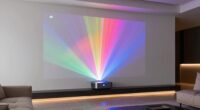
The best overall ultra short throw 4K projector in this roundup is the Hisense PX3-PRO, a strong choice for buyers who want 4K resolution and triple-laser color in a living-room setup. For a more premium feature set, the AWOL VISION Aetherion Max stands out, while the Hisense PL2 offers a simpler alternative for buyers focused on core projection performance. The main tradeoffs are brightness in rooms with ambient light, color and contrast priorities, built-in smart features, and how much setup flexibility you need. Not every projector listed is native 4K: the Optoma Photon Go is 1080p, so it suits a different use case. Continue reading for the full breakdown and help matching each model to your room and priorities.

Get the latest gadgets delivered free with Prime
- Fast, free delivery on millions of items
- Prime Video, Amazon Music and more included
- Member-only deals all year
Complete the kit



Key Takeaways
- The Hisense PX3-PRO leads as the all-around choice because its 4K triple-laser approach suits buyers seeking vivid color and a home-theater-focused UST setup.
- Premium features separate the AWOL Aetherion Max and Aetherion Pro from more straightforward options, but buyers should prioritize those extras only if they fit their viewing habits and system plans.
- The Hisense PL2 and WEMAX Nova Pro represent more accessible paths to UST viewing, with smart-platform and setup details worth weighing against the more feature-rich models.
- The Optoma Photon Go is the outlier: its 1080p resolution means it is not a direct match for shoppers who require 4K, even though its compact, triple-laser design may suit portability-focused setups.
- Screen and room conditions matter as much as projector specs; brightness, ambient light, placement, and screen compatibility can change which model is the better fit.
| Epson Lifestudio Grand Plus Ultra Short Throw Laser Projector |  | Best Overall for Brightness and Built-In Entertainment | Native resolution: 3840 x 2160 | Image size: 60–150 inches | Brightness: 4,000 lumens color and white | VIEW ON AMAZON | See Our Full Breakdown |
| AWOL VISION Aetherion Max 4K Ultra Short Throw Laser Projector |  | Best for High-Refresh-Rate Gaming | Native resolution: 3840 × 2160 | Throw ratio: 0.2:1 | Brightness: 3,300 ISO lumens in description; 3,000 lm in specifications | VIEW ON AMAZON | See Our Full Breakdown |
| WEMAX Nova Pro 4K Ultra Short Throw Laser Projector with Google TV |  | Best for Built-In Streaming on a Simpler Setup | Resolution: 3840 × 2160 | Display technology: DLP | Light source: ALPD laser | VIEW ON AMAZON | See Our Full Breakdown |
| Hisense PX3-PRO 4K Triple-Laser Ultra Short Throw Projector |  | Best for Dolby Vision and Premium Home Cinema | Native resolution: 3840 × 2160 | Image size: 80–150 inches | Brightness: 3,000 lumens | VIEW ON AMAZON | See Our Full Breakdown |
| Optoma Photon Go ML1080UST 1080p Ultra Short Throw Triple Laser Projector |  | Best Portable Option, Not a 4K Display | Resolution: 1920 x 1080; accepts 4K input | Light source: Triple RGB laser | Brightness: 650 ANSI lumens | VIEW ON AMAZON | See Our Full Breakdown |
| JMGO O2S Ultra 4K Ultra Short Throw Triple Laser Projector |  | Best for Built-In Streaming and Audio | Native resolution: 3840 x 2160 | Brightness: 3,600 ISO lumens | Light source: RGB triple laser | VIEW ON AMAZON | See Our Full Breakdown |
| AWOL VISION LTV-3000 Pro 4K 3D Ultra Short Throw Triple Laser Projector |  | Best for Home-Theater Integration | Native resolution: 3840 x 2160 | Brightness: 2,000 lm; maximum white brightness 3,000 ANSI lumens | Throw ratio: 0.25:1 | VIEW ON AMAZON | See Our Full Breakdown |
| Hisense PL2 Ultra Short Throw 4K Laser Projector |  | Best for Straightforward, Compact Setups | Native resolution: 3840 x 2160 | Brightness: 2,700 ANSI lumens | Contrast ratio: 3,000:1 | VIEW ON AMAZON | See Our Full Breakdown |
| AWOL Aetherion Pro 4K Ultra Short Throw Laser Projector |  | Best for Large Screens and Gaming | Native resolution: 3840 x 2160 | Brightness: 2,600 ISO lumens in description; 3,000 lumens in specifications | Maximum image size: 200 inches | VIEW ON AMAZON | See Our Full Breakdown |
| ultra short throw 4k projector | Brightness | Image size | Native resolution | Connectivity |
|---|---|---|---|---|
| Epson Lifestudio Grand Plus Ul | 4,000 lumens color and white | 60–150 inches | 3840 x 2160 | HDMI, USB, Wi-Fi |
| AWOL VISION Aetherion Max 4K U | 3,300 ISO lumens in description; 3,000 lm in specifications | 80-inch minimum; maximum listed as 150 inches in specifications and up to 200 inches in description | 3840 × 2160 | 3× HDMI 2.1a, DisplayPort 1.4a |
| WEMAX Nova Pro 4K Ultra Short | 2,100 ISO lumens | 80–150 inches | — | HDMI 2.1, USB, 3.5mm audio, optical, LAN, Wi-Fi 6, Bluetooth |
| Hisense PX3-PRO 4K Triple-Lase | 3,000 lumens | 80–150 inches | 3840 × 2160 | Bluetooth 5, Ethernet, HDMI, USB 3.0, Wi-Fi |
| Optoma Photon Go ML1080UST 108 | 650 ANSI lumens | 60–100 inches | — | HDMI, RCA, Wi-Fi, Bluetooth |
| JMGO O2S Ultra 4K Ultra Short | 3,600 ISO lumens | 80–150 inches | 3840 x 2160 | — |
| AWOL VISION LTV-3000 Pro 4K 3D | 2,000 lm; maximum white brightness 3,000 ANSI lumens | 80–150 inches | 3840 x 2160 | — |
| Hisense PL2 Ultra Short Throw | 2,700 ANSI lumens | 80–150 inches | 3840 x 2160 | Bluetooth, Ethernet, HDMI, USB, and Wi-Fi |
| AWOL Aetherion Pro 4K Ultra Sh | 2,600 ISO lumens in description; 3,000 lumens in specifications | — | 3840 x 2160 | — |
More Details on Our Top Picks
Epson Lifestudio Grand Plus Ultra Short Throw Laser Projector
The Epson Lifestudio Grand Plus is my strongest all-round pick for buyers who want a bright 4K HDR image and fewer separate living-room components. Its 4,000 lumens of both color and white brightness give it a brightness advantage over the WEMAX Nova Pro’s 2,100 ISO lumens, which may help when the room is not fully dark. Google TV and the 2.1-channel Bose system also make this more self-contained than options that rely on an external streamer or speakers. Three HDMI ports with gaming features add flexibility for consoles and other sources. The tradeoff is placement: it still needs a nearby, suitable screen or wall, and its minimum 60-inch image may be too large for compact setups. Buyers seeking a 200-inch image or advanced 240 Hz gaming features should compare it with the AWOL VISION Aetherion Max.
Pros:- 4K HDR projection supports image sizes up to 150 inches.
- 4,000 lumens of color and white brightness provide more room-light tolerance than the WEMAX Nova Pro.
- Google TV and built-in 2.1-channel audio with Bose technology reduce the need for separate entertainment gear.
- Three HDMI ports accommodate multiple connected sources.
Cons:- The 60-inch minimum image size limits use in smaller rooms.
- A close projection surface is still required, so placement depends on the room layout.
- Its listed gaming features are less specific than the Aetherion Max’s 240 Hz, VRR, and ALLM support.
Best for: Living-room buyers who want a bright 4K HDR ultra short throw with streaming, multiple HDMI connections, and built-in audio.
Not ideal for: People who need a smaller-than-60-inch image or prioritize high-refresh-rate gaming features such as 240 Hz and VRR.
- Native resolution:3840 x 2160
- Image size:60–150 inches
- Brightness:4,000 lumens color and white
- Light source:Laser
- Light source life:20,000 hours
- Throw distance:1.1–1.7 feet
- Smart TV:Google TV
- Audio:Built-in 2.1-channel system with Bose technology
- Connectivity:HDMI, USB, Wi-Fi
Our verdict“Choose the Epson if you want a bright, self-contained 4K UST for everyday living-room viewing and do not need the Aetherion Max’s advanced gaming specifications.”
AWOL VISION Aetherion Max 4K Ultra Short Throw Laser Projector
The AWOL VISION Aetherion Max is the clearest choice here for buyers who want a UST projector to serve as a gaming display as well as a movie screen. Its 240 Hz support, VRR, ALLM, and 1 ms-class input latency are a more explicit gaming package than the Epson Lifestudio Grand Plus, whose listing mentions gaming features without the same detail. Three HDMI 2.1a ports and DisplayPort 1.4a also give PC and console players useful connection options. Triple-laser projection, 4K resolution, and Dolby Vision support round out its home-cinema appeal. There are specification discrepancies buyers should factor into planning: the image limit is listed as 150 inches in one place and up to 200 inches in another, while brightness is given as both 3,300 ISO and 3,000 lumens. Its 80-inch minimum and suggested ALR screen also make it less flexible in bright rooms.
Pros:- 240 Hz support, VRR, ALLM, and 1 ms-class input latency target responsive gaming.
- Three HDMI 2.1a ports plus DisplayPort 1.4a support a broad mix of gaming sources.
- Triple-laser 4K projection supports Dolby Vision, HDR10+, HDR10, and HLG.
- The 0.2:1 throw ratio suits close-to-wall living-room placement.
Cons:- The listed maximum image size conflicts: specifications say 150 inches, while the description says up to 200 inches.
- Brightness is reported as both 3,300 ISO lumens and 3,000 lumens, complicating comparisons.
- An ALR screen is suggested for clearer viewing in direct overhead light.
Best for: Console and PC gamers building a living-room UST setup who want 4K, high refresh rates, VRR, and modern HDMI connections.
Not ideal for: Buyers who need unambiguous maximum image-size specifications, a small image below 80 inches, or a setup that performs well in direct overhead light without a suitable screen.
- Native resolution:3840 × 2160
- Throw ratio:0.2:1
- Brightness:3,300 ISO lumens in description; 3,000 lm in specifications
- Image size:80-inch minimum; maximum listed as 150 inches in specifications and up to 200 inches in description
- Contrast ratio:Up to 6,000:1 native; 60,000:1 viewing in description
- Gaming features:1 ms-class input latency at 240 Hz, VRR, ALLM
- Connectivity:3× HDMI 2.1a, DisplayPort 1.4a
- Light source life:25,000 hours
- Warranty:2 years
Our verdict“Pick the Aetherion Max if gaming responsiveness and connection options matter more to you than straightforward placement specifications.”
WEMAX Nova Pro 4K Ultra Short Throw Laser Projector with Google TV
The WEMAX Nova Pro suits buyers who want a 4K UST that can handle streaming and everyday entertainment without requiring a separate media player. Google TV, Netflix, Google Assistant, and Google Cast are built in, while the dual 15W speakers add Dolby Audio and DTS-HD playback. Its 0.23:1 throw ratio can create an image up to 150 inches from a short distance, giving it a compact placement advantage over a standard-throw projector. Compared with the brighter Epson Lifestudio Grand Plus, however, the Nova Pro’s 2,100 ISO lumens make a darkened room more important. It also starts at 80 inches, so it is not the better fit for buyers who want a smaller picture. HDR10, HLG, MEMC, and 3D support broaden its format options, but its central appeal is convenience rather than peak brightness.
Pros:- Google TV, Netflix, Google Assistant, and Google Cast are included.
- The 0.23:1 throw ratio supports close placement and images up to 150 inches.
- Dual 15W speakers provide built-in Dolby Audio and DTS-HD sound.
- Supports HDR10, HLG, MEMC, and 3D.
Cons:- Its 2,100 ISO lumens are lower than the Epson Lifestudio Grand Plus’s listed brightness, making room light a bigger concern.
- The 80-inch minimum image size may be too large for some rooms.
- Direct sunlight can affect image quality.
Best for: Viewers who want a 4K UST with Google TV and Netflix built in, plus integrated speakers for a straightforward home setup.
Not ideal for: People who watch with substantial daylight or need an image smaller than 80 inches; the Epson Lifestudio Grand Plus offers higher listed brightness and a lower minimum size.
- Resolution:3840 × 2160
- Display technology:DLP
- Light source:ALPD laser
- Brightness:2,100 ISO lumens
- Throw ratio:0.23:1
- Image size:80–150 inches
- Audio:Dual 15W speakers with Dolby Audio and DTS-HD
- Connectivity:HDMI 2.1, USB, 3.5mm audio, optical, LAN, Wi-Fi 6, Bluetooth
- Built-in features:Google TV, Netflix, Google Assistant, Google Cast, HDR10, HLG, MEMC, 3D
Our verdict“Choose the Nova Pro for an integrated streaming-and-audio setup in a room where you can control the light.”
Hisense PX3-PRO 4K Triple-Laser Ultra Short Throw Projector
The Hisense PX3-PRO is the cinema-focused option for buyers who want triple-laser color and broad movie-format support in a close-to-wall 4K setup. It combines Dolby Vision, Dolby Atmos, and IMAX Enhanced with Google TV and Harman Kardon speakers, so its feature set reaches beyond image resolution alone. Compared with the WEMAX Nova Pro, it adds a triple-laser light source and more prominently targets premium HDR and cinema formats, while the Nova Pro is a more direct fit for buyers who prioritize built-in Google TV convenience and detailed app support. The Hisense supports image sizes from 80 to 150 inches and lists 3,000 lumens. Its placement data needs careful checking: the supplied minimum and maximum throw-distance labels appear reversed or unclear. A suitable wall or screen is also necessary to make a large image work well.
Pros:- Triple-laser 4K projection supports a wide color gamut and AI upscaling.
- Dolby Vision, Dolby Atmos, and IMAX Enhanced suit a movie-focused setup.
- Harman Kardon speakers and Google TV provide built-in audio and streaming features.
- Supports image sizes up to 150 inches from a close-to-wall position.
Cons:- The listed throw-distance endpoints are unclear, making placement planning harder than with the Aetherion Max’s stated 0.2:1 ratio.
- The 80-inch minimum image size limits smaller-room flexibility.
- A suitable wall or screen is needed for a large projected image.
Best for: Home-cinema viewers who want triple-laser 4K projection, Dolby Vision, IMAX Enhanced, and integrated branded speakers.
Not ideal for: Buyers who need precise, easy-to-interpret placement measurements or a smaller-than-80-inch image; confirm throw requirements and screen fit before choosing.
- Native resolution:3840 × 2160
- Image size:80–150 inches
- Brightness:3,000 lumens
- Contrast ratio:3,000:1
- Light source:Triple laser
- Light source life:25,000 hours
- Throw distance:Listed as 0.12–0.46 meters; minimum and maximum labels are unclear
- Audio:Harman Kardon speakers; Dolby Atmos support
- Connectivity:Bluetooth 5, Ethernet, HDMI, USB 3.0, Wi-Fi
Our verdict“Choose the PX3-PRO for its cinema-format support and triple-laser design, but verify placement measurements against your room before buying.”
Optoma Photon Go ML1080UST 1080p Ultra Short Throw Triple Laser Projector
The Optoma Photon Go ML1080UST is the portability pick, but it is not a native 4K projector: its resolution is 1920 x 1080, despite accepting 4K input. That distinction puts it behind the Epson Lifestudio Grand Plus and the other 4K models for buyers focused on fine image detail. What it offers instead is a compact, 6.9-pound design, an integrated battery rated for up to 1.5 hours, and a 60–100-inch image from a short distance. Google TV includes certified Netflix and Disney+ access, while autofocus and auto keystone correction can simplify setup away from a fixed media room. Its 650 ANSI lumens are also far below the Epson’s 4,000-lumen rating, so this is better suited to darker, flexible viewing than a bright main-room replacement. The battery’s limited runtime makes it a short-session convenience, not a full evening solution.
Pros:- Compact 6.9-pound design and integrated battery support more flexible placement than the larger fixed-room models.
- Google TV includes certified Netflix and Disney+ access.
- Autofocus and auto keystone correction simplify setup.
- Triple RGB laser light source supports HDR10 and 4K input.
Cons:- Native resolution is 1920 x 1080, not 4K.
- 650 ANSI lumens are much lower than the Epson Lifestudio Grand Plus’s 4,000-lumen rating.
- The battery is rated for only up to 1.5 hours of use.
Best for: Buyers who value a portable, battery-powered short-throw projector for occasional viewing and can accept Full HD instead of native 4K.
Not ideal for: Anyone shopping specifically for native 4K detail, a bright living-room image, or battery-powered viewing sessions longer than about 1.5 hours.
- Resolution:1920 x 1080; accepts 4K input
- Light source:Triple RGB laser
- Brightness:650 ANSI lumens
- Throw distance:0.34–0.81 feet
- Image size:60–100 inches
- Battery life:Up to 1.5 hours
- Connectivity:HDMI, RCA, Wi-Fi, Bluetooth
- Weight:6.9 pounds
- Dimensions:9.92 x 2.56 x 6.18 inches
Our verdict“Choose the Photon Go for portable Full HD viewing with built-in streaming, not if native 4K resolution is your main requirement.”
JMGO O2S Ultra 4K Ultra Short Throw Triple Laser Projector
The JMGO O2S Ultra is a strong fit for buyers who want a short-throw 4K setup with fewer separate entertainment components. Its 0.16:1 throw ratio allows an 80-to-150-inch image from close to the wall, while RGB triple laser, 3,600 ISO lumens, and Dolby Vision target vivid, detailed viewing. Built-in Google TV with native Netflix and 20W Dynaudio speakers make it more self-contained than the AWOL VISION LTV-3000 Pro, whose standout audio feature is a dialogue-focused center channel. The JMGO also supports Dolby Atmos, DTS:X, and Blu-ray 3D. Its 150-inch ceiling is less ambitious than the AWOL Aetherion Pro’s 200 inches, and the supplied details do not specify warranty coverage. Choose it for an integrated living-room system, not a buyer seeking the largest possible image.
Pros:- 0.16:1 throw ratio supports a large image from very close to the wall
- RGB triple laser, 3,600 ISO lumens, and Dolby Vision support
- Google TV includes native Netflix access
- 20W Dynaudio speakers and support for Dolby Atmos, DTS:X, and Blu-ray 3D
Cons:- Maximum image size is 150 inches, below the AWOL Aetherion Pro’s stated 200-inch limit
- Warranty details are not provided in the supplied product information
Best for: Viewers who want a close-placement 4K projector with built-in Netflix, Google TV, and capable integrated speakers.
Not ideal for: Buyers planning a screen larger than 150 inches or those who need clearly stated warranty terms before purchasing.
- Native resolution:3840 x 2160
- Brightness:3,600 ISO lumens
- Light source:RGB triple laser
- Throw ratio:0.16:1
- Contrast ratio:4,000:1 native
- Image size:80–150 inches
- Audio:20W Dynaudio integrated speakers
- Smart platform:Google TV with native Netflix
Our verdict“Choose the JMGO O2S Ultra if built-in streaming and sound matter as much as close-placement 4K projection.”
AWOL VISION LTV-3000 Pro 4K 3D Ultra Short Throw Triple Laser Projector
The AWOL VISION LTV-3000 Pro suits a planned home-theater installation more than a casual, move-it-around setup. Its built-in center channel speaker is designed to keep dialogue anchored to the image, and Control4 compatibility plus PJ Link IP control can help it fit into a broader automation system. It supports 4K UHD, Dolby Vision, HDR10+, and 3D across an 80-to-150-inch image range. Compared with the JMGO O2S Ultra, its stated brightness is lower and its 0.25:1 throw ratio calls for different cabinet measurements; unlike that JMGO, the supplied details do not list built-in Google TV or native Netflix. AWOL recommends an ALR screen for brighter rooms, so this pick makes most sense in a controlled-light theater where installation and dialogue clarity take priority.
Pros:- 4K UHD triple-laser image with Dolby Vision, HDR10+, and 3D support
- Center channel speaker is designed to improve dialogue placement and clarity
- Control4 integration and PJ Link IP control support system-based installations
- Supports screen sizes from 80 to 150 inches
Cons:- AWOL recommends an ALR screen for brighter rooms
- The fixed 0.25:1 throw ratio requires careful cabinet and screen placement
- Supplied details list HDMI connectivity but do not specify built-in streaming apps
Best for: Home-theater owners with a darkened room, a fixed cabinet position, and Control4 or other IP-based system integration.
Not ideal for: Buyers who need an easy-to-move projector, built-in streaming apps, or strong performance in a bright room without an ALR screen.
- Native resolution:3840 x 2160
- Brightness:2,000 lm; maximum white brightness 3,000 ANSI lumens
- Throw ratio:0.25:1
- Contrast ratio:2,500:1
- Image size:80–150 inches
- Supported formats:Dolby Vision, HDR10+, and 3D
- Connectivity and control:HDMI; PJ Link IP control; Control4 integration
- Light-source life:25,000 hours
Our verdict“Pick the LTV-3000 Pro for a dark-room theater installation where dialogue handling and automation matter more than built-in streaming.”
Hisense PL2 Ultra Short Throw 4K Laser Projector
The Hisense PL2 is a sensible choice for buyers who want a stationary 4K laser projector without the JMGO O2S Ultra’s emphasis on integrated speakers and smart TV features. It covers the familiar 80-to-150-inch screen range, adds Dolby Vision and AI upscaling, and uses a laser light source rated for 25,000 hours. Its 2,700 ANSI lumens place it below the JMGO’s stated 3,600 ISO lumens, so buyers comparing those figures should not assume the PL2 is the stronger pick for a bright room. Bluetooth, Ethernet, HDMI, USB, and Wi-Fi offer flexible connections, though the product data does not identify a smart platform. The design is stationary and needs a tabletop position, and inconsistent recommended screen-size information in the supplied description makes placement details worth checking before arranging the room.
Pros:- 4K UHD resolution with AI upscaling and Dolby Vision support
- Ultra-short-throw design fits compact viewing areas
- Bluetooth, Ethernet, HDMI, USB, and Wi-Fi connectivity
- Laser light source rated for 25,000 hours
Cons:- Stationary tabletop design is not suited to buyers who want a portable setup
- Stated brightness is lower than the JMGO O2S Ultra’s 3,600 ISO lumens
- Supplied product information gives inconsistent recommended screen-size details
Best for: Buyers setting up a fixed tabletop UST system who want 4K, Dolby Vision, and multiple wired and wireless connection options.
Not ideal for: People who need a portable projector, confirmed built-in streaming apps, or the higher stated brightness of the JMGO O2S Ultra.
- Native resolution:3840 x 2160
- Brightness:2,700 ANSI lumens
- Contrast ratio:3,000:1
- Image size:80–150 inches
- Throw distance:0.22–1.5 feet
- HDR support:Dolby Vision and HDR
- Connectivity:Bluetooth, Ethernet, HDMI, USB, and Wi-Fi
- Light-source life:25,000 hours
Our verdict“Choose the Hisense PL2 for a fixed, compact 4K setup with broad connectivity, but check screen-placement guidance before committing.”
AWOL Aetherion Pro 4K Ultra Short Throw Laser Projector
The AWOL Aetherion Pro is the most screen-size-ambitious pick in this group, with support for images up to 200 inches compared with the 150-inch limits of the JMGO O2S Ultra and Hisense PL2. Its claimed native contrast of up to 6,000:1 and 110% Rec.2020 color target buyers seeking rich picture performance, while Dolby Vision and several other HDR formats broaden content support. Gaming features—1ms latency, VRR, and ALLM—give it a clear role for console players, and Anti-RBE technology may appeal to viewers sensitive to rainbow effects. There is a data caveat: brightness is listed as both 2,600 ISO lumens and 3,000 lumens. Its larger image potential also asks more of room layout and screen placement than the smaller-screen alternatives.
Pros:- Supports images up to 200 inches, larger than the 150-inch limits of the JMGO O2S Ultra and Hisense PL2
- 1ms latency, VRR, and ALLM support gaming use
- Dolby Vision, HDR10+, HDR10, and HLG support
- 110% Rec.2020 color gamut, Anti-RBE technology, and a stated two-year warranty
Cons:- Brightness is inconsistent across the supplied information: 2,600 ISO lumens in the description and 3,000 lumens in specifications
- Large-screen projection requires suitable room dimensions and careful screen placement
- Its maximum image size may exceed what many compact living rooms can accommodate
Best for: Console gamers and dedicated theater owners who want a large UST screen, broad HDR support, and VRR-focused gaming features.
Not ideal for: Buyers with limited wall or screen space, or anyone who needs a single, consistent brightness figure before choosing a projector.
- Native resolution:3840 x 2160
- Brightness:2,600 ISO lumens in description; 3,000 lumens in specifications
- Maximum image size:200 inches
- Native contrast ratio:Up to 6,000:1
- Color gamut:110% Rec.2020
- Gaming features:1ms latency, VRR, and ALLM
- Supported HDR formats:Dolby Vision, HDR10+, HDR10, and HLG
- Warranty:2 years
Our verdict“Choose the Aetherion Pro if you have room for a screen up to 200 inches and want gaming features, while treating its brightness figure as unresolved.”

How We Picked
I ranked these models by how well they match the needs behind an ultra short throw 4K projector search: sharp large-screen viewing, practical living-room placement, useful image performance, and features that make sense beyond a spec sheet. I gave more weight to genuine 4K models than to the 1080p Optoma Photon Go, while still including it for buyers whose priority is a compact UST design rather than 4K detail. Triple-laser systems, smart-TV features, 3D support, and gaming or home-cinema positioning helped distinguish models with different strengths.
The order also reflects ease of choosing and likely buyer fit, not a claim that one specification wins in every room. I considered the tradeoffs buyers should verify before purchase: brightness needs, screen pairing, installation tolerance, connectivity, and whether the built-in platform or specialist features will actually be used. Models with broader appeal rank ahead of more niche or premium-oriented picks; the latter can be the better buy when their specific strengths match a reader’s setup.
| ultra short throw 4k projector | Light source |
|---|---|
| Epson Lifestudio Grand Plus Ul | Laser |
| AWOL VISION Aetherion Max 4K U | — |
| WEMAX Nova Pro 4K Ultra Short | ALPD laser |
| Hisense PX3-PRO 4K Triple-Lase | Triple laser |
| Optoma Photon Go ML1080UST 108 | Triple RGB laser |
| JMGO O2S Ultra 4K Ultra Short | RGB triple laser |
| AWOL VISION LTV-3000 Pro 4K 3D | — |
| Hisense PL2 Ultra Short Throw | — |
| AWOL Aetherion Pro 4K Ultra Sh | — |
Factors to Consider When Choosing Ultra Short Throw 4k Projector
Before choosing a model, I would match the projector to the room and viewing habits rather than treating 4K or laser branding as a complete answer. These factors help avoid paying for features that will go unused—or choosing a projector that cannot perform well in its intended space.
1. Check Whether 4K Is a Firm Requirement
Resolution affects how much fine detail remains visible on a large image, particularly when viewers sit close or watch text-heavy content. This roundup includes one clear exception: the Optoma Photon Go is a 1080p model, so it should not be shortlisted as a like-for-like 4K choice. Think about your usual content and seating distance before deciding how much resolution matters; streamed films, sports, and casual viewing do not all reveal detail in the same way. Also check how a manufacturer describes its 4K imaging, since resolution terminology can refer to different display methods. If 4K is non-negotiable, keep the comparison focused on the 4K models and treat the Optoma as a separate portability option.
2. Match Brightness to Your Room and Screen
A projector that looks satisfying in a dark dedicated room may feel less punchy in a bright living room. Ambient light washes out perceived contrast, so closing curtains or scheduling movie viewing after dark can matter more than a small specification difference. A compatible ambient-light-rejecting screen may help in shared spaces, but it adds cost and must be selected for UST projection geometry. Avoid assuming that a larger image is always better: increasing image size spreads the available light across a wider area. Decide how much daylight you need to tolerate, then choose a screen size and setup around that reality.
3. Plan Placement Before Buying
Ultra short throw placement saves the long ceiling mount, but it does not remove installation work. The projector needs a stable, level surface close to the wall, and small shifts can move the image enough to require readjustment. Check the throw ratio and recommended image dimensions against the furniture depth and wall space you actually have. A screen that is not flat or aligned can reveal distortions that are harder to correct than ordinary TV placement issues. Measure the intended setup before ordering, and avoid relying on digital keystone correction as a substitute for careful positioning.
4. Choose Smart Features Around Your Existing System
Built-in streaming can simplify a setup, but it may be less useful if you already rely on a streaming box, game console, or receiver. Check the apps you use, the available HDMI connections, and whether audio must pass through another device. Smart-platform support can change over time, so buyers who plan to keep a projector for years may prefer to treat an external streamer as replaceable. Likewise, built-in speakers can reduce setup friction for casual viewing but rarely replace a dedicated sound system for a cinema-focused room. Prioritize the connections and platform that fit your current equipment rather than choosing by feature count alone.
5. Pay for Specialist Features Only When You Will Use Them
Triple-laser color, 3D playback, and advanced home-cinema positioning can distinguish premium models, but those features have different value for different households. A buyer who watches 3D content should give the AWOL VISION LTV-3000 Pro’s stated 3D support more weight than a buyer who streams films and sports. If you already own a strong audio system, built-in sound features may be less persuasive than image and connectivity choices. Compare the complete system you need, including screen and sound, rather than focusing on the projector alone. Spending more makes sense when a specific capability solves a real limitation in your setup.
6. Look Beyond the Projector for Total Setup Fit
UST projectors are often bought as TV replacements, yet the screen, furniture, room lighting, and cable routing all shape the finished result. A fixed screen can improve alignment and everyday convenience, while a bare wall may introduce texture or color that affects the image. Check whether your cabinet has enough depth, whether the screen can be placed at the right height, and where power and HDMI cables will run. Consider fan noise and access for cleaning when deciding where the unit will sit. A model that fits the room cleanly can be a better everyday choice than one with more headline features but a compromised installation.
Frequently Asked Questions
Is the Optoma Photon Go a good alternative if I want a 4K UST projector?
Not if 4K resolution is a firm requirement: the Photon Go is a 1080p model, so its role in this roundup is for buyers prioritizing a compact triple-laser UST option. It may still suit a secondary room or a setup where portability matters more than fine image detail. Compare it with the 4K models only after deciding whether that resolution compromise is acceptable. If you watch close to a very large screen or regularly view detailed 4K content, keep your shortlist to the 4K projectors.
Do I need an ambient-light-rejecting screen for a UST projector?
You do not always need one, especially in a room where you can control daylight and use a plain, flat projection surface. In a bright shared living room, an appropriate UST-compatible ambient-light-rejecting screen can help preserve perceived contrast. Screen design and installation matter: a screen made for a different projector type may not handle UST light angles well. Treat the screen as part of the system budget and verify compatibility before choosing a projector. If possible, plan the screen and projector together rather than buying them as unrelated components.
Will an ultra short throw projector work on my existing TV cabinet?
It may, but cabinet depth and height can make alignment difficult even though the projector sits close to the wall. UST images respond noticeably to small changes in position, so a narrow or uneven surface can turn setup into repeated adjustment. Measure the wall-to-cabinet distance, projector footprint, and desired screen size before committing. Check the model’s throw guidance and leave room for ventilation and cable connections. A low, stable surface designed around the screen height is often easier to live with than a cabinet chosen only for appearance.
Should I choose the Hisense PX3-PRO or spend more on an AWOL Aetherion model?
The PX3-PRO is the more straightforward all-around recommendation in this comparison, while the Aetherion models make more sense when their premium positioning and feature set match a specific home-cinema plan. Start by listing the capabilities you will use, such as particular connectivity, image features, or system integration needs, then check the exact model specifications. Do not assume that a higher-tier name automatically means a better fit for your room. If those extra capabilities do not solve a real limitation, the broader appeal of the PX3-PRO may matter more than a premium feature list.
Can a UST projector replace a television for everyday viewing?
It can work well as a large-screen centerpiece, but the experience depends on room light, screen setup, and how often you watch during the day. A television is usually simpler in bright rooms and needs less installation planning; a UST projector offers a much larger image when paired with a suitable surface. Consider whether you want instant casual viewing or mainly use the room for planned films and sports. Smart apps and speakers can make projector use simpler, but an external streamer or sound system may still suit your setup better. Decide based on daily habits, not screen size alone.
Conclusion
For the best overall, I would start with the Hisense PX3-PRO because it offers a well-rounded 4K triple-laser direction for home viewing. The best value-minded choice is the Hisense PL2 or WEMAX Nova Pro, depending on which model’s platform and setup details fit your needs; compare their current specifications before choosing. For a best premium option, consider the AWOL VISION Aetherion Max, while the Epson Lifestudio Grand Plus is another strong candidate for buyers drawn to its distinct lifestyle-focused positioning. Beginners should shortlist the WEMAX Nova Pro if its Google TV integration matches their streaming habits and they want a familiar all-in-one starting point. For specific needs, the AWOL VISION LTV-3000 Pro stands out for 3D support, while the Optoma Photon Go is only for shoppers willing to trade 4K for a 1080p compact option. Match your final pick to your room, screen, and real feature needs—not the biggest spec list.